
The live event on October 8th 2026 will generate significant positive media coverage.
AI debate verdict and arguments
⚠️ AI-generated information only; not professional advice
Completed October 8, 2026
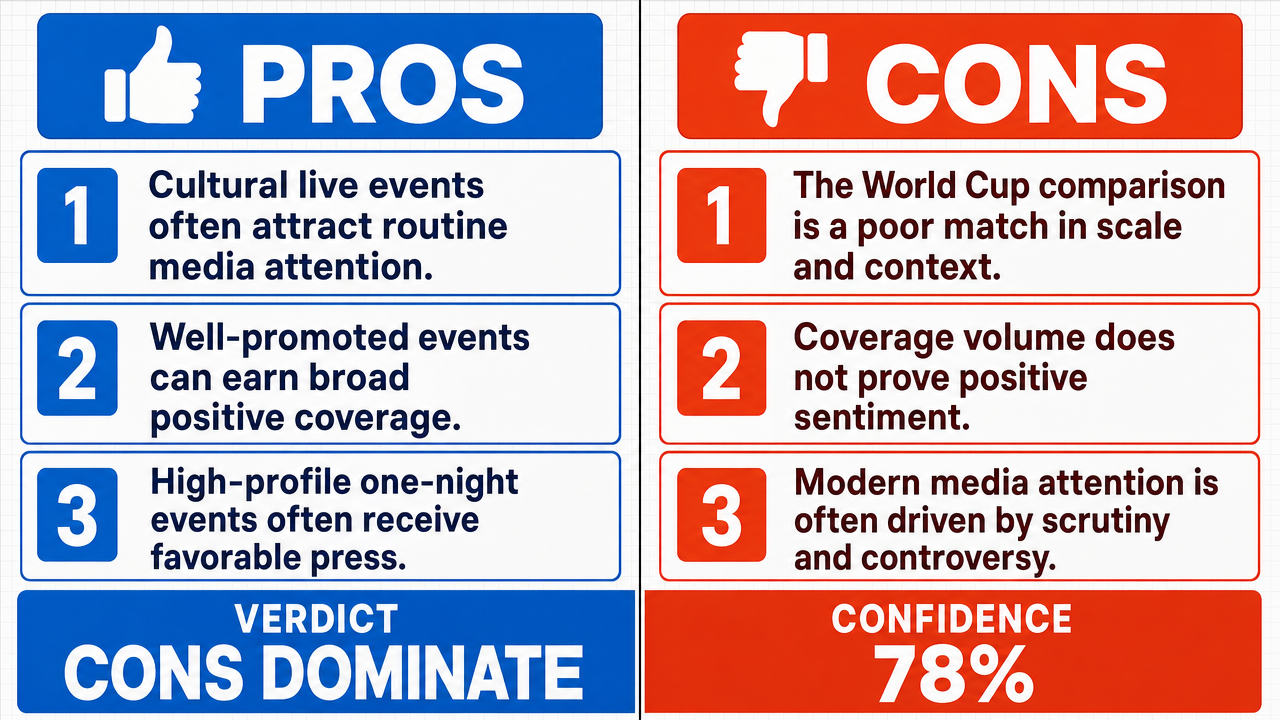
Verdict
Verdict: likely FALSE (78%)
This section provides a brief overview of the key arguments. You do not need to read the full detailed report below.
✅ Key PRO arguments:
- ■Live events within the culture and leisure domain are inherently newsworthy and routinely covered by entertainment, lifestyle, and news media, with pre-event publicity campaigns priming outlets for coverage.
- ■Historical precedent such as the 2022 FIFA World Cup opening ceremony demonstrates that well-promoted cultural events can generate massive positive media coverage across thousands of outlets.
- ■Single-evening cultural events like the Met Gala, major film premieres, and concert tour openers consistently produce overwhelmingly favorable coverage, showing scale is not a prerequisite for positive media cycles.
❌ Key ANTI arguments:
- ■The affirmative's reliance on the 2022 FIFA World Cup is a fundamental error of scale and context; a multi-billion dollar, multi-week geopolitical phenomenon with institutionalized support cannot be analogized to a single live event lacking structural density .
- ■The affirmative's argument is logically incoherent because it conflates the frequency/existence of routine coverage with the valence /sentiment of that coverage, committing a category error between 'covered' and 'covered favorably.'
- ■In the modern attention economy , significant media volume is frequently driven by scrutiny, controversy, and negative news cycles rather than positive sentiment , meaning high coverage does not imply positive coverage.
💭 Conclusion: False. The negative side won this debate by exposing a critical logical flaw in the affirmative's reasoning: the conflation of coverage frequency with coverage sentiment. The affirmative argued that because cultural events are routinely covered, they will be covered favorably, but the negative correctly identified this as a category error. The negative also dismantled the World Cup analogy by highlighting the vast difference in scale, institutional support, and structural density between a multi-week geopolitical phenomenon and a single live event. Furthermore, the negative's point about the modern attention economy —that controversy and scrutiny often drive higher media volume than positive sentiment —undermined the affirmative's assumption that newsworthiness translates to favorable coverage. The affirmative failed to provide any specific evidence about the October 8, 2026 event's nature, organizers, or content, leaving the prediction empirically unsupported. The 78% judge confidence reflects a clear but not overwhelming victory, as the affirmative's general points about cultural event newsworthiness retained some surface plausibility.
🔬 DeepResearch Result: likely FALSE ❌ (78%)
Assertion: The live event on October 8th 2026 will generate significant positive media coverage.
Participating models: deepseek-v3.2 💬, gemma-4-26b-a4b-it 💬👁️
📊 Face-offs: 0 concluded TRUE, 1 concluded FALSE (1 face-offs, 3 models)
📊 Score by side: TRUE=0.00, FALSE=0.78
🏅 Model score changes:
minimax-m3 💬👁️: +8
✅ PRO Arguments:
- ■Live events within the culture and leisure domain are inherently newsworthy and routinely covered by entertainment, lifestyle, and news media, with pre-event publicity campaigns priming outlets for coverage. deepseek-v3.2 💬
- ■Historical precedent such as the 2022 FIFA World Cup opening ceremony demonstrates that well-promoted cultural events can generate massive positive media coverage across thousands of outlets. deepseek-v3.2 💬
- ■Single-evening cultural events like the Met Gala, major film premieres, and concert tour openers consistently produce overwhelmingly favorable coverage, showing scale is not a prerequisite for positive media cycles. deepseek-v3.2 💬
- ■The October 8, 2026 date strategically avoids holiday competition and leverages a Thursday-to-weekend news cycle for maximum exposure. deepseek-v3.2 💬
- ■Editorial incentives within the culture media landscape favor producing positive, uplifting content that drives engagement , a pattern observable in media analytics . deepseek-v3.2 💬
❌ ANTI Arguments:
- ■The affirmative's reliance on the 2022 FIFA World Cup is a fundamental error of scale and context; a multi-billion dollar, multi-week geopolitical phenomenon with institutionalized support cannot be analogized to a single live event lacking structural density . gemma-4-26b-a4b-it 💬👁️
- ■The affirmative's argument is logically incoherent because it conflates the frequency/existence of routine coverage with the valence /sentiment of that coverage, committing a category error between 'covered' and 'covered favorably.' gemma-4-26b-a4b-it 💬👁️
- ■In the modern attention economy , significant media volume is frequently driven by scrutiny, controversy, and negative news cycles rather than positive sentiment , meaning high coverage does not imply positive coverage. gemma-4-26b-a4b-it 💬👁️
- ■The structural volatility of the media landscape means that routine coverage of cultural events does not guarantee favorable coverage, as critical and controversial content often generates higher engagement. gemma-4-26b-a4b-it 💬👁️
- ■The claim that the October 8, 2026 event will generate significant positive media coverage is logically and empirically unsupported, as no specific evidence about the event's nature, organizers, or content was provided to substantiate the prediction. gemma-4-26b-a4b-it 💬👁️
💭 Reasoning: False. The negative side won this debate by exposing a critical logical flaw in the affirmative's reasoning: the conflation of coverage frequency with coverage sentiment. The affirmative argued that because cultural events are routinely covered, they will be covered favorably, but the negative correctly identified this as a category error. The negative also dismantled the World Cup analogy by highlighting the vast difference in scale, institutional support, and structural density between a multi-week geopolitical phenomenon and a single live event. Furthermore, the negative's point about the modern attention economy—that controversy and scrutiny often drive higher media volume than positive sentiment—undermined the affirmative's assumption that newsworthiness translates to favorable coverage. The affirmative failed to provide any specific evidence about the October 8, 2026 event's nature, organizers, or content, leaving the prediction empirically unsupported. The 78% judge confidence reflects a clear but not overwhelming victory, as the affirmative's general points about cultural event newsworthiness retained some surface plausibility.
📋 PRO Facts:
• The 2022 FIFA World Cup opening ceremony generated positive coverage across thousands of global outlets.
• The Met Gala, a single-night affair, consistently produces overwhelmingly favorable coverage across fashion, entertainment, and mainstream news outlets.
• Major film premieres and high-profile concert tour openers are singular events that command positive headlines.
• October 8, 2026 falls on a Thursday, allowing leverage of a Thursday-to-weekend news cycle.
• Pre-event publicity campaigns prime media outlets for coverage of planned cultural events.
📋 ANTI Facts:
• The 2022 FIFA World Cup is a multi-billion dollar, multi-week geopolitical phenomenon with institutionalized support, not comparable to a single live event.
• In the modern attention economy, significant media volume is frequently driven by scrutiny, controversy, and negative news cycles.
• Routine coverage of cultural events does not guarantee favorable coverage, as critical content often generates higher engagement.
• The affirmative provided no specific evidence about the October 8, 2026 event's nature, organizers, or content.
• The affirmative's argument conflates the frequency of media attention with the sentiment of that attention, a logical fallacy .
| Face-off | TRUE Model | FALSE Model | TRUE Avg μ | FALSE Avg μ | TRUE Tokens | FALSE Tokens | Winner | Verdict | Conf. |
|---|---|---|---|---|---|---|---|---|---|
| #1 | deepseek-v3.2 💬 | gemma-4-26b-a4b-it 💬👁️ | 0.198 | 0.207 | 12 | 3 | FALSE | FALSE | 78% |
The following technical terms, abbreviations, and domain-specific concepts are referenced throughout this debate transcript. Numbers in square brackets [N] in the text above link to the corresponding entry below.
[1] attention economy — An economic framework in which human attention is treated as a scarce resource competed for by media content, with high-engagement material (including critical or controversial coverage) often capturing more attention than positive content.
[2] attention-based markets — Markets in which value is derived from capturing and monetizing audience attention, referenced in the debate as a structural constraint on media coverage outcomes.
[3] beat — beat (journalism) — A specific subject area or topic that a journalist regularly covers, such as the 'culture and leisure beat' referenced in the debate.
[4] editorial incentive — The motivation driving media outlets' content decisions, such as producing uplifting stories to balance the news cycle or drive engagement.
[5] engagement — engagement (media) — Audience interaction with media content, used in the debate as a metric for why outlets may favor certain types of coverage.
[6] global consensus — Broad international agreement or alignment, referenced in the debate regarding the scale of sustained positive media attention.
[7] hard news — News coverage focused on serious topics such as politics, economics, and social issues, contrasted in the debate with culture and leisure coverage.
[8] hidden premise — An unstated assumption underlying an argument, identified in the debate as a flaw in the opposing side's reasoning.
[9] institutionalized support — Formal organizational backing, referenced in the debate as a structural advantage of large-scale events like the FIFA World Cup.
[10] internal inconsistency — A logical flaw in which an argument contains contradictory propositions, cited in the debate as undermining the affirmative's claim.
[11] investable markets — Markets in which capital can be allocated, referenced in the debate alongside attention-based markets as a structural constraint.
[12] logical entailment — The relationship by which the truth of a premise guarantees the truth of a conclusion, used in the debate to argue that routine coverage does not entail favorable coverage.
[13] logical fallacy — An error in reasoning that renders an argument invalid, cited in the debate regarding the conflation of coverage frequency with sentiment.
[14] media analytics — Quantitative analysis of media content and audience response, referenced in the debate as evidence of patterns in coverage sentiment.
[15] media buzz — Widespread public attention and discussion generated by media coverage of an event or topic.
[16] media cycle — The recurring pattern of news coverage and audience attention around a topic, including positive and negative phases.
[17] media landscape — The overall environment of media outlets, platforms, and content trends at a given time.
[18] media mentions — References to a topic across media outlets, used in the debate as a measurable indicator of coverage volume and sentiment.
[19] media outlets — News and content publishing organizations, including entertainment, lifestyle, and mainstream news sources referenced in the debate.
[20] media sentiment — The positive, negative, or neutral tone of media coverage, central to the debate's core claim.
[21] media volume — The quantity or extent of media coverage, distinguished in the debate from the sentiment of that coverage.
[22] narrative control — The strategic management of how an event is framed and presented to media and the public.
[23] negative news cycles — Periods of media coverage dominated by critical, controversial, or unfavorable reporting.
[24] news cycle — The rhythm and duration of media coverage around a story, including the Thursday-to-weekend cycle referenced in the debate.
[25] newsworthiness — The quality that makes an event or story worthy of media coverage, cited as a mechanism for generating positive attention.
[26] positive sentiment — Favorable or affirmative tone in media coverage, the central predicted outcome in the debate.
[27] pre-event publicity — Marketing and promotional campaigns conducted before an event to generate advance media coverage and audience interest.
[28] proxy — proxy (argumentation) — A substitute used to represent another case or argument, such as using the FIFA World Cup as a proxy for a single live event.
[29] scale-invariant mechanism — A causal process that operates consistently regardless of the size or scale of the event, cited in the debate as missing from the affirmative's argument.
[30] sentiment analysis — The computational or analytical method of determining whether media content expresses positive, negative, or neutral sentiment.
[31] structural density — The degree of institutional and organizational infrastructure supporting an event, referenced in the debate as a factor in media coverage outcomes.
[32] structural volatility — The inherent instability of the media landscape, cited as the basis for the negative position's skepticism about predictable positive coverage.
[33] substitution of proxy — A logical error in which one case is used in place of another without establishing that the two are comparable, identified in the debate as a flaw in the affirmative's reasoning.
[34] transfer operator — A mechanism or justification for applying conclusions from one case to another, cited in the debate as missing from the affirmative's comparison of events.
[35] valence — valence (sentiment) — The positive or negative quality of media coverage, distinguished in the debate from the frequency or volume of coverage.
Face-off transcripts
- ■
Ownership & Trade Secrets. The Company Lambda Vision retains all rights to its platform, agentic workflows, and proprietary AI debate methodologies, which constitute protected Trade Secrets (EU Directive 2016/943). Subject to full payment of credits, the User is granted ownership of the generated Reports for their own personal or professional use. Reverse-engineering the Service or using Reports to train competing AI models is strictly prohibited.
- ■
No Professional Advice. Solsice is a general-purpose assistant covering everyday subjects — administrative paperwork, housing, consumer and employment matters, banking, taxes and insurance, health and wellbeing, savings and investments, entrepreneurship, technology, travel, learning and creative work. Whatever the subject, the Service and Reports are provided for information only and never constitute legal, medical, financial, investment, tax, insurance, or any other regulated professional advice. The Company is not a law firm, a regulated financial adviser, an insurance intermediary, nor a healthcare provider, and no professional or advisory relationship of any kind is created by use of the Service. Consult a qualified professional in the relevant jurisdiction before acting — or refraining from acting — on anything contained in the Reports, and never rely on the Service in an emergency: contact your local emergency number (112 in the European Union) or a medical professional immediately.
- ■
AI-Generated Content, Sources and Viewpoints. Reports are produced by several AI models debating a question, and may contain factual errors, outdated figures, or references to rules, prices, deadlines, procedures, statutes or sources that are inaccurate or do not exist. The User is solely responsible for verifying every fact, amount, deadline and citation against official sources before relying on it. Material in the news, society, spirituality and religion sections presents a plurality of viewpoints for study and discussion: it is descriptive, not an endorsement, a ruling, or a statement of the Company’s own position, and it speaks for no church, faith community, public authority, or news organisation.
- ■
Liability & Governing Law. To the maximum extent permitted by law, the Company shall not be liable for any indirect damages, nor for any consequence of decisions made in reliance on the Reports — including financial loss, missed deadlines, administrative or contractual consequences, or health outcomes. These Terms are governed by French law. Any disputes shall be subject to the exclusive jurisdiction of the Courts of Paris, France.