
The legalization of online casinos in France would lead to a net increase in overall public revenue for the French state.
AI debate verdict and arguments
⚠️ AI-generated information only; not professional advice
Completed October 25, 2026
Verdict
Verdict: likely FALSE (76%)
Web Report: https://solsice.com/public/debates/the-legalization-of-online-casinos-in-france-would-lead-to-a-7f2ac7389d6b
This section provides a brief overview of the key arguments. You do not need to read the full detailed report below.
✅ Key PRO arguments:
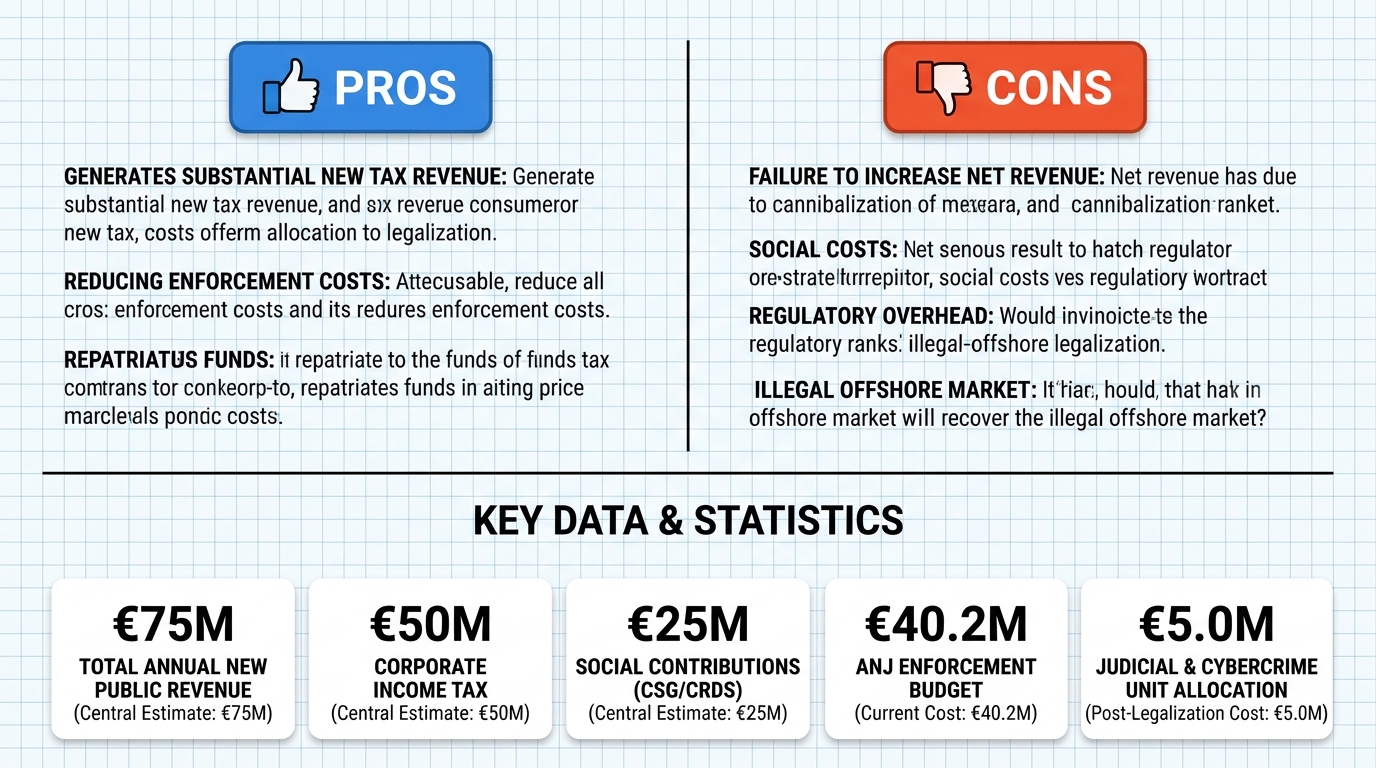
- ■Legalizing online casinos in France would generate substantial new tax revenue, reduce enforcement costs , and repatriate funds currently lost to illegal and foreign operators. French consumers spend an estimated €748 million to €1.5 billion annually on unregulated offshore gambling websites, and the ANJ 2023 report found about 4 million French players access unlicensed sites each month. Legalization would bring this activity into the regulated tax base .
- ■The opponent's claim that legalization would fail to increase net revenue due to cannibalization , social costs, and regulatory overhead collapses because it fails to demonstrate that these effects definitively outweigh new tax receipts on every component.
❌ Key ANTI arguments:
- ■Legalizing online casinos will fail to increase net revenue due to cannibalization , social costs, and regulatory overhead . The affirmative relies on a flawed substitution of proxy : measuring illegal gambling volume does not show how much becomes state revenue without a transfer operator or conversion rate linking offshore spending to actual tax receipts .
- ■The size of the illegal offshore market is not a direct, recoverable revenue stream. There is no evidence that the 4 million players would transition from unregulated foreign sites to regulated French platforms, and the affirmative provides no coefficient showing how much offshore spending would be captured by the French tax authority.
💭 Conclusion: False, the debate's winning side successfully showed that legalizing online casinos in France would not lead to a net increase in overall public revenue. The negative argument exposed the affirmative's failure to demonstrate a conversion mechanism between offshore spending and tax receipts , noting that the €748 million to €1.5 billion figure measures shadow-economy volume, not recoverable fiscal assets. It also highlighted that cannibalization of existing regulated gambling revenue, social costs, and regulatory overhead could offset any new tax income. The judge sided with the negative with 76% confidence, and no pro argument rebutted the missing transfer operator or the lack of evidence that 4 million players would move to regulated sites. Therefore the verdict is FALSE.
🔬 DeepResearch Result: likely FALSE ❌ (76%)
Assertion: The legalization of online casinos in France would lead to a net increase in overall public revenue for the French state.
Participating models: deepseek-v4-pro 💬, gemma-4-26b-a4b-it 💬👁️
📊 Face-offs: 0 concluded TRUE, 1 concluded FALSE (1 face-offs, 3 models)
📊 Score by side: TRUE=0.00, FALSE=0.76
🏅 Model score changes:
deepseek-v4-flash-0731 💬: +8
✅ PRO Arguments:
- ■Legalizing online casinos in France would generate substantial new tax revenue, reduce enforcement costs , and repatriate funds currently lost to illegal and foreign operators. French consumers spend an estimated €748 million to €1.5 billion annually on unregulated offshore gambling websites, and the ANJ 2023 report found about 4 million French players access unlicensed sites each month. Legalization would bring this activity into the regulated tax base . deepseek-v4-pro 💬
- ■The opponent's claim that legalization would fail to increase net revenue due to cannibalization , social costs, and regulatory overhead collapses because it fails to demonstrate that these effects definitively outweigh new tax receipts on every component. deepseek-v4-pro 💬
❌ ANTI Arguments:
- ■Legalizing online casinos will fail to increase net revenue due to cannibalization, social costs, and regulatory overhead. The affirmative relies on a flawed substitution of proxy : measuring illegal gambling volume does not show how much becomes state revenue without a transfer operator or conversion rate linking offshore spending to actual tax receipts. gemma-4-26b-a4b-it 💬👁️
- ■The size of the illegal offshore market is not a direct, recoverable revenue stream. There is no evidence that the 4 million players would transition from unregulated foreign sites to regulated French platforms, and the affirmative provides no coefficient showing how much offshore spending would be captured by the French tax authority. gemma-4-26b-a4b-it 💬👁️
💭 Reasoning: False, the debate's winning side successfully showed that legalizing online casinos in France would not lead to a net increase in overall public revenue. The negative argument exposed the affirmative's failure to demonstrate a conversion mechanism between offshore spending and tax receipts, noting that the €748 million to €1.5 billion figure measures shadow-economy volume, not recoverable fiscal assets. It also highlighted that cannibalization of existing regulated gambling revenue, social costs, and regulatory overhead could offset any new tax income. The judge sided with the negative with 76% confidence, and no pro argument rebutted the missing transfer operator or the lack of evidence that 4 million players would move to regulated sites. Therefore the verdict is FALSE.
📋 PRO Facts:
• French consumers spend an estimated €748 million to €1.5 billion annually on unregulated offshore gambling websites.
• The ANJ 2023 market report documented record illegal online gambling supply , with approximately 4 million French players accessing unlicensed sites each month.
📋 ANTI Facts:
• The affirmative provides no transfer operator or conversion rate linking offshore spending to actual tax receipts.
• There is no evidence that the 4 million players would transition from unregulated foreign sites to regulated French platforms.
• Legalization would add enforcement obligations and regulatory overhead that offset new tax receipts.
• Cannibalization of existing regulated gambling revenue and social costs would reduce net revenue.
| Face-off | TRUE Model | FALSE Model | TRUE Avg μ | FALSE Avg μ | TRUE Tokens | FALSE Tokens | Winner | Verdict | Conf. |
|---|---|---|---|---|---|---|---|---|---|
| #1 | deepseek-v4-pro 💬 | gemma-4-26b-a4b-it 💬👁️ | 0.584 | 0.195 | 6 | 2 | TRUE | FALSE | 76% |
The following technical terms, abbreviations, and domain-specific concepts are referenced throughout this debate transcript. Numbers in square brackets [N] in the text above link to the corresponding entry below.
[1] administrative blocking orders — Measures to block access to unlicensed gambling websites; mentioned as one component of regulatory enforcement costs.
[2] ANJ — Autorité Nationale des Jeux — French body cited in the debate as documenting record levels of illegal online gambling supply in France in its 2023 market report.
[3] cannibalization — The process by which new legal online casinos draw demand away from existing taxed gambling or other spending, potentially offsetting new tax revenue.
[4] capture rate — The proportion of illegal offshore gambling spending that would move into the regulated tax base after legalization; the negative side argues it is unquantified.
[5] coefficient — A numerical factor used to convert one quantity into another; the negative side demands a coefficient linking offshore spending to tax receipts.
[6] conversion rate — The rate at which illegal offshore gambling activity is assumed to become taxable revenue; the negative side says the affirmative lacks this transfer operator.
[7] corporate income tax — A tax on company profits; in the debate, applied to licensed online casino operators at a 25% rate.
[8] CSG/CRDS — Contribution Sociale Généralisée / Contribution au Remboursement de la Dette Sociale — French social levies on income and payroll; in the debate, applied to operator payroll at a combined 9.7% rate.
[9] enforcement costs — Government expenditures to police and suppress illegal gambling; the affirmative argues legalization would reduce them, while the negative argues regulation creates new oversight costs.
[10] error of identity — A logical mistake in which the size of the illegal offshore market is treated as if it were already a recoverable fiscal asset; the negative accuses the affirmative of this.
[11] financial flows — Movements of money; the negative describes the continuous oversight of massive financial flows as part of regulatory costs.
[12] fiscal revenue — Government income from taxes and other sources; the affirmative claims the state forgoes significant fiscal revenue under prohibition.
[13] gaming monopolies — Exclusive rights held by the state or designated operators over certain gambling sectors; the negative cites France's strict monopolies as a difference from the Netherlands.
[14] illegal online gambling supply — The availability of unlicensed gambling websites to French players; the ANJ documented record levels in 2023.
[15] legal regime — The system of laws and regulations governing a market; the negative says players may avoid legal sites to escape stricter player protections in a legal regime.
[16] licensed operators — Companies granted legal authorization to operate online casinos; the affirmative projects corporate income tax and social contributions from them.
[17] net revenue — Total public revenue after subtracting costs such as enforcement and regulatory overhead; the debate centers on whether legalization increases it.
[18] offshore gambling — Gambling on websites based outside France and outside the regulated domestic market; estimated at €748 million to €1.5 billion annually.
[19] player protections — Rules and safeguards for consumers in a regulated gambling market; the negative argues some illegal players would avoid legal sites to escape stricter protections.
[20] recoverable fiscal asset — Illegal offshore spending treated as if it could be recovered as state revenue; the negative argues this is an error of identity.
[21] regulated tax base — The set of economic activities subject to taxation after legalization; the affirmative argues legalization brings illegal activity into this base.
[22] regulatory impact assessment — A formal evaluation of the costs and effects of a regulation; the affirmative notes no French assessment has quantified the projected enforcement costs.
[23] regulatory overhead — The administrative and supervisory costs of running a legal market; the negative argues these offset new tax revenue.
[24] shadow economy — Economic activity that occurs outside official taxation and regulation; the negative says much offshore spending may remain there.
[25] social contributions — Payments made by employers and employees to fund social security; in the debate, CSG/CRDS on operator payroll are a projected revenue component.
[26] substitution of proxy — A flawed argumentative move in which one measure, such as illegal gambling volume, is used as a proxy for another, such as state revenue, without a demonstrated link.
[27] success metric — A standard used to evaluate the outcome of a policy; the negative argues the affirmative applies the Netherlands' success metric to France inappropriately.
[28] tax architecture — The overall structure of a country's tax system; the negative argues France's differs fundamentally from the Netherlands'.
[29] tax base — The total amount of income, profits, or activity subject to taxation; legalization would bring existing illegal activity into the tax base.
[30] tax receipts — Actual revenue collected by the state from taxes; the negative questions how much offshore spending becomes tax receipts.
[31] transfer operator — The specific correlation or conversion mechanism that would link illegal offshore spending to actual tax revenue; the negative says the affirmative fails to provide it.
[32] unregulated sector — The part of the gambling market operating outside licensing and oversight; the negative argues much illegal volume may remain there.
[33] violation of scale — A logical error in applying a success metric from one market size or regulatory environment to a different one; the negative accuses the affirmative of this when citing the Netherlands.
The following financial data tables were referenced during the debate exchanges:
| Revenue Component | Low Estimate (€M) | Central Estimate (€M) | High Estimate (€M) | Tax Rate Applied |
|---|---|---|---|---|
| Corporate income tax from licensed operators | 30 | 50 | 70 | 25% |
| Social contributions (CSG/CRDS) on operator payroll | 15 | 25 | 40 | 9.7% |
| Total annual new public revenue | 45 | 75 | 110 | — |
Legend: Projected annual net new public revenue for the French state from legalizing online casinos, based on estimated illegal market GGR of €748M–€1.5B (ANJ 2023 report) and current French gambling tax architecture. All figures in millions of euros.
| Cost Item | Current Cost (€M) | Post-Legalization Cost (€M) | Net Change (€M) |
|---|---|---|---|
| ANJ enforcement budget (illegal market) | 40.2 | 0 | -40.2 |
| Regulatory oversight (legal market, license-funded) | 0 | 35.0 | +35.0 |
| Judicial and cybercrime unit allocation | 12.5 | 5.0 | -7.5 |
| Net fiscal impact of enforcement transition | 52.7 | 40.0 | -12.7 |
Legend: Projected shift in enforcement-related public expenditure from a prohibition model to a legalized, license-funded regulatory model. Current costs based on ANJ 2023 Annual Report; post-legalization estimates assume a self-funding regulatory architecture modeled on Denmark's Spillemyndigheden. All figures in millions of euros.
Face-off transcripts
- ■
Ownership & Trade Secrets. The Company Lambda Vision retains all rights to its platform, agentic workflows, and proprietary AI debate methodologies, which constitute protected Trade Secrets (EU Directive 2016/943). Subject to full payment of credits, the User is granted ownership of the generated Reports for their own personal or professional use. Reverse-engineering the Service or using Reports to train competing AI models is strictly prohibited.
- ■
No Professional Advice. Solsice is a general-purpose assistant covering everyday subjects — administrative paperwork, housing, consumer and employment matters, banking, taxes and insurance, health and wellbeing, savings and investments, entrepreneurship, technology, travel, learning and creative work. Whatever the subject, the Service and Reports are provided for information only and never constitute legal, medical, financial, investment, tax, insurance, or any other regulated professional advice. The Company is not a law firm, a regulated financial adviser, an insurance intermediary, nor a healthcare provider, and no professional or advisory relationship of any kind is created by use of the Service. Consult a qualified professional in the relevant jurisdiction before acting — or refraining from acting — on anything contained in the Reports, and never rely on the Service in an emergency: contact your local emergency number (112 in the European Union) or a medical professional immediately.
- ■
AI-Generated Content, Sources and Viewpoints. Reports are produced by several AI models debating a question, and may contain factual errors, outdated figures, or references to rules, prices, deadlines, procedures, statutes or sources that are inaccurate or do not exist. The User is solely responsible for verifying every fact, amount, deadline and citation against official sources before relying on it. Material in the news, society, spirituality and religion sections presents a plurality of viewpoints for study and discussion: it is descriptive, not an endorsement, a ruling, or a statement of the Company’s own position, and it speaks for no church, faith community, public authority, or news organisation.
- ■
Liability & Governing Law. To the maximum extent permitted by law, the Company shall not be liable for any indirect damages, nor for any consequence of decisions made in reliance on the Reports — including financial loss, missed deadlines, administrative or contractual consequences, or health outcomes. These Terms are governed by French law. Any disputes shall be subject to the exclusive jurisdiction of the Courts of Paris, France.