
The land acquired for Dragonsteel Plaza in Pleasant Grove, Utah, will be successfully redeveloped into a functional and profitable extension of the speaker's enterprise, despite the need for complete demolition of existing Evermore structures.
AI debate verdict and arguments
⚠️ AI-generated information only; not professional advice
Completed October 14, 2026
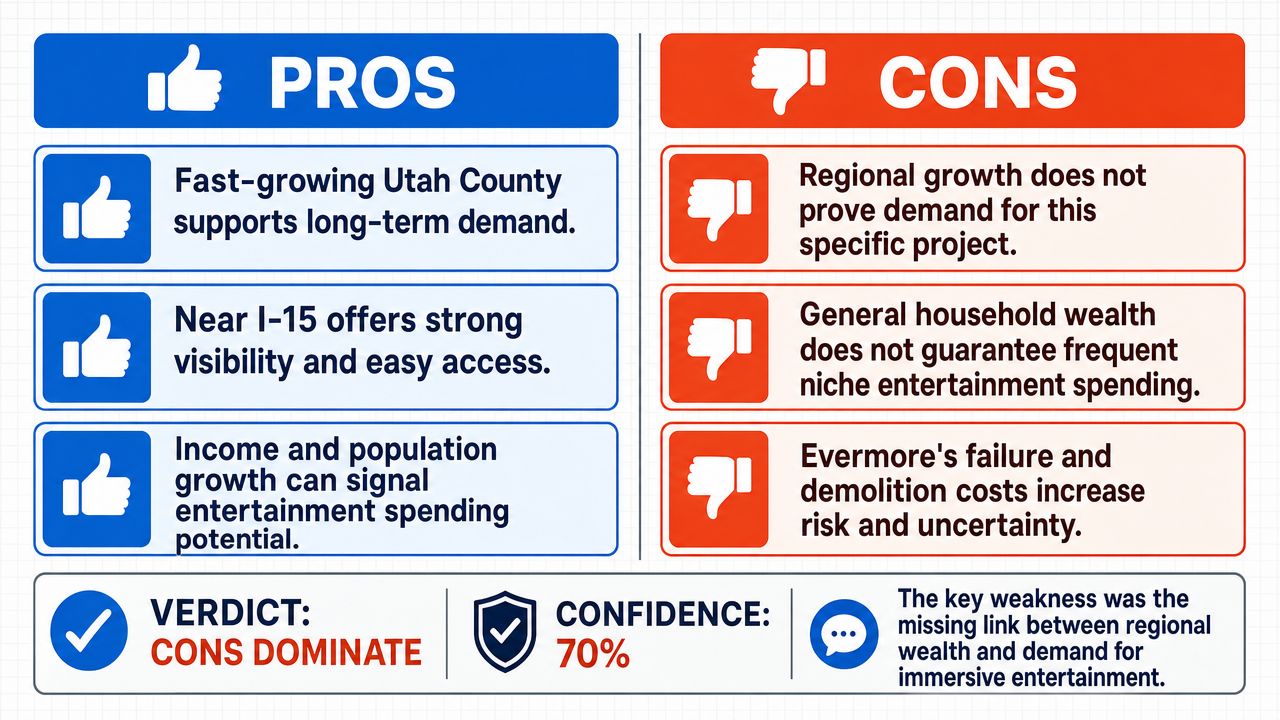
Verdict
Verdict: likely FALSE (70%)
Web Report: https://solsice.com/public/debates/the-land-acquired-for-dragonsteel-plaza-in-pleasant-grove-ut-d9fa09bd3e2c
This section provides a brief overview of the key arguments. You do not need to read the full detailed report below.
✅ Key PRO arguments:
- ■Pleasant Grove's strategic location in Utah County—one of the fastest-growing US regions—provides strong demographic and economic tailwinds, with population growing over 15% from 2010 to 2020 and median household income approximately 25% above the national average, indicating high disposable income suitable for entertainment and retail.
- ■The site's proximity to major transportation corridors like I-15 provides high visibility and accessibility, which are critical for destination-based entertainment venues.
- ■Market analysis for destination development routinely uses regional income and population growth as leading indicators for discretionary spending on entertainment, and other Utah attractions demonstrate the viability of such models in the region.
❌ Key ANTI arguments:
- ■The affirmative's reliance on regional demographic trends is a textbook case of measuring one entity to conclude about another—they fail to provide the transfer operator —the specific correlation or market capture rate —that links general regional wealth to the specific niche of immersive entertainment .
- ■High disposable income in a general population does not automatically translate to the high-frequency, high-margin spending required to sustain a specialized destination-based enterprise ; macro-economic health of Utah County does not equal micro-economic viability of Dragonsteel Plaza.
- ■The Evermore park's failure represents massive capital loss , and the need for complete demolition of existing structures adds further sunk costs and uncertainty to the redevelopment project.
💭 Conclusion: False. The negative side's argument that the affirmative failed to provide a transfer operator linking general regional wealth to the specific niche of immersive entertainment was decisive in this debate. The affirmative relied on macro-level demographic data—Utah County's population growth and elevated median household income —without demonstrating how these metrics translate into the high-frequency, high-margin spending required for a specialized destination venue. The negative correctly identified that Evermore's ultimate failure shows initial visitor draw does not establish sustained demand, particularly given the massive increase in fixed operating costs and debt service that accompanies a permanent venue. While the affirmative cited other Utah attractions such as Thanksgiving Point as comparable successes, it did not adequately address the scalability concern or the fundamental question of whether regional demographics alone can validate a niche entertainment redevelopment. The compound nature of the claim—requiring both functional and profitable redevelopment—means the weakest sub-claim (profitability given unproven scalability and unproven demand persistence) undermines the entire assertion.
🔬 DeepResearch Result: likely FALSE ❌ (70%)
Assertion: The land acquired for Dragonsteel Plaza in Pleasant Grove, Utah, will be successfully redeveloped into a functional and profitable extension of the speaker's enterprise, despite the need for complete demolition of existing Evermore structures.
Participating models: deepseek-v3.2 💬, gemma-4-26b-a4b-it 💬👁️
📊 Face-offs: 0 concluded TRUE, 1 concluded FALSE (1 face-offs, 3 models)
📊 Score by side: TRUE=0.00, FALSE=0.84
🏅 Model score changes:
minimax-m3 💬👁️: +8
✅ PRO Arguments:
- ■Pleasant Grove's strategic location in Utah County—one of the fastest-growing US regions—provides strong demographic and economic tailwinds, with population growing over 15% from 2010 to 2020 and median household income approximately 25% above the national average, indicating high disposable income suitable for entertainment and retail. deepseek-v3.2 💬
- ■The site's proximity to major transportation corridors like I-15 provides high visibility and accessibility, which are critical for destination-based entertainment venues. deepseek-v3.2 💬
- ■Market analysis for destination development routinely uses regional income and population growth as leading indicators for discretionary spending on entertainment, and other Utah attractions demonstrate the viability of such models in the region. deepseek-v3.2 💬
- ■The speaker's enterprise has a proven business model and demonstrated market demand, which can be extended to the new Dragonsteel Plaza location. deepseek-v3.2 💬
❌ ANTI Arguments:
- ■The affirmative's reliance on regional demographic trends is a textbook case of measuring one entity to conclude about another—they fail to provide the transfer operator —the specific correlation or market capture rate —that links general regional wealth to the specific niche of immersive entertainment . gemma-4-26b-a4b-it 💬👁️
- ■High disposable income in a general population does not automatically translate to the high-frequency, high-margin spending required to sustain a specialized destination-based enterprise ; macro-economic health of Utah County does not equal micro-economic viability of Dragonsteel Plaza. gemma-4-26b-a4b-it 💬👁️
- ■The Evermore park's failure represents massive capital loss , and the need for complete demolition of existing structures adds further sunk costs and uncertainty to the redevelopment project. gemma-4-26b-a4b-it 💬👁️
- ■The scalability of the business model to this new context remains unproven, and the affirmative provides no evidence of demonstrated demand at the specific scale and niche required for profitability. gemma-4-26b-a4b-it 💬👁️
💭 Reasoning: False. The negative side's argument that the affirmative failed to provide a transfer operator linking general regional wealth to the specific niche of immersive entertainment was decisive in this debate. The affirmative relied on macro-level demographic data—Utah County's population growth and elevated median household income—without demonstrating how these metrics translate into the high-frequency, high-margin spending required for a specialized destination venue. The negative correctly identified that Evermore's ultimate failure shows initial visitor draw does not establish sustained demand, particularly given the massive increase in fixed operating costs and debt service that accompanies a permanent venue. While the affirmative cited other Utah attractions such as Thanksgiving Point as comparable successes, it did not adequately address the scalability concern or the fundamental question of whether regional demographics alone can validate a niche entertainment redevelopment. The compound nature of the claim—requiring both functional and profitable redevelopment—means the weakest sub-claim (profitability given unproven scalability and unproven demand persistence) undermines the entire assertion.
📋 PRO Facts:
• Pleasant Grove's population grew by over 15% from 2010 to 2020
• Pleasant Grove's median household income is approximately 25% above the national average
📋 ANTI Facts:
• No transfer operator was provided linking regional wealth to niche immersive entertainment spending
• The Evermore park was ultimately unsuccessful, demonstrating that initial visitor interest does not guarantee sustained demand in a permanent, fixed-cost environment
• High disposable income in a general population does not automatically translate to high-frequency, high-margin spending on specialized entertainment
• The scalability of the business model to this new context remains unproven
| Face-off | TRUE Model | FALSE Model | TRUE Avg μ | FALSE Avg μ | TRUE Tokens | FALSE Tokens | Winner | Verdict | Conf. |
|---|---|---|---|---|---|---|---|---|---|
| #1 | deepseek-v3.2 💬 | gemma-4-26b-a4b-it 💬👁️ | 0.311 | 0.245 | 8 | 2 | TRUE | FALSE | 84% |
The following technical terms, abbreviations, and domain-specific concepts are referenced throughout this debate transcript. Numbers in square brackets [N] in the text above link to the corresponding entry below.
[1] addressable market — The total potential customer base or revenue opportunity available for a particular product or service within a given market segment.
[2] capital loss — A financial loss incurred when an asset is sold for less than its purchase price or original cost basis.
[3] circular demonstration — A logical fallacy in which an argument assumes as a premise the very conclusion it is trying to prove, rendering the reasoning invalid.
[4] consumer base — The group of customers who regularly purchase or use a company's products or services.
[5] demographic tailwinds — Favorable population trends—such as growth, rising incomes, or shifting age distributions—that provide a supportive backdrop for business activity.
[6] destination development — The planning, construction, and operation of commercial venues whose value depends on attracting visitors to a specific location.
[7] destination-based enterprise — A business whose primary draw is its physical location, requiring customers to travel to the site to access its offerings.
[8] discretionary spending — Consumer expenditure on non-essential goods and services such as entertainment, leisure, and luxury items, typically funded from income remaining after necessities.
[9] disposable income — The portion of an individual's earnings remaining after taxes that is available for spending or saving.
[10] hidden premise — An unstated assumption embedded within an argument that must be accepted as true for the stated reasoning to support its conclusion.
[11] high-margin — Describing a business activity or product that generates a large difference between revenue and the cost of producing it, indicating strong profitability per unit.
[12] immersive entertainment — A category of leisure experiences designed to fully engage participants in a themed or narrative environment, often involving interactive or multi-sensory elements.
[13] leading indicators — Statistical measures that change before the broader economy or market does, used to forecast future trends in consumer behavior or demand.
[14] locational value — The inherent worth of a property or site derived from its geographic position, including factors such as accessibility, visibility, and surrounding demographics.
[15] macro-economic tailwinds — Broad, economy-wide favorable conditions—such as regional growth, rising incomes, or population expansion—that benefit businesses operating within that environment.
[16] market capture rate — The percentage of potential customers within a defined market that a business actually attracts or converts into paying customers.
[17] median household income — The income level at which half of households in a given area earn more and half earn less, used as a standard measure of regional economic well-being.
[18] micro-economic viability — The financial feasibility of a specific business or project, assessed at the individual enterprise level rather than across an entire economy or region.
[19] niche — A specialized segment of a larger market defined by particular customer interests, needs, or characteristics distinct from the broader population.
[20] operational blueprint — A documented or demonstrated model of how a business is run, including its processes, staffing, and management practices, that can be replicated at new sites.
[21] redevelopment viability — The likelihood that a previously developed site can be successfully transformed into a new, functional, and profitable use.
[22] scalability — The capacity of a business model, system, or process to maintain or improve its performance as it expands in size or scope.
[23] site selection — The analytical process of choosing a location for a business based on factors such as demographics, accessibility, competition, and cost.
[24] target demographic — The specific group of consumers that a business aims to reach with its products, services, or marketing efforts, defined by characteristics such as age, income, or interests.
[25] themed enterprise — A business built around a unifying concept, narrative, or intellectual property that shapes its environment, offerings, and customer experience.
[26] transfer operator — In this debate, a claimed correlation or analytical bridge that links general regional or macro-level data to the specific viability of a particular enterprise; the negative side argues such a link must be demonstrated rather than assumed.
[27] transportation corridors — Major routes such as highways or rail lines that channel high volumes of traffic through a region, providing visibility and accessibility to adjacent properties.
The following financial data tables were referenced during the debate exchanges:
| Metric | Scale/Context | Risk Profile |
|---|---|---|
| Primary Headquarters | Established/Small Scale | Low/Operational |
| Dragonsteel Plaza | Proposed/Large Scale | High/Capital Intensive |
| Revenue Model | Event-Based/Variable | High Volatility |
| Redevelopment Model | Fixed-Cost/Year-Round | High Break-even Threshold |
Legend: Comparison of the current operational scale versus the proposed redevelopment scale. The transition from variable to fixed costs represents a fundamental change in the financial risk profile.
Face-off transcripts
- ■
Ownership & Trade Secrets. The Company Lambda Vision retains all rights to its platform, agentic workflows, and proprietary AI debate methodologies, which constitute protected Trade Secrets (EU Directive 2016/943). Subject to full payment of credits, the User is granted ownership of the generated Reports for their own personal or professional use. Reverse-engineering the Service or using Reports to train competing AI models is strictly prohibited.
- ■
No Professional Advice. Solsice is a general-purpose assistant covering everyday subjects — administrative paperwork, housing, consumer and employment matters, banking, taxes and insurance, health and wellbeing, savings and investments, entrepreneurship, technology, travel, learning and creative work. Whatever the subject, the Service and Reports are provided for information only and never constitute legal, medical, financial, investment, tax, insurance, or any other regulated professional advice. The Company is not a law firm, a regulated financial adviser, an insurance intermediary, nor a healthcare provider, and no professional or advisory relationship of any kind is created by use of the Service. Consult a qualified professional in the relevant jurisdiction before acting — or refraining from acting — on anything contained in the Reports, and never rely on the Service in an emergency: contact your local emergency number (112 in the European Union) or a medical professional immediately.
- ■
AI-Generated Content, Sources and Viewpoints. Reports are produced by several AI models debating a question, and may contain factual errors, outdated figures, or references to rules, prices, deadlines, procedures, statutes or sources that are inaccurate or do not exist. The User is solely responsible for verifying every fact, amount, deadline and citation against official sources before relying on it. Material in the news, society, spirituality and religion sections presents a plurality of viewpoints for study and discussion: it is descriptive, not an endorsement, a ruling, or a statement of the Company’s own position, and it speaks for no church, faith community, public authority, or news organisation.
- ■
Liability & Governing Law. To the maximum extent permitted by law, the Company shall not be liable for any indirect damages, nor for any consequence of decisions made in reliance on the Reports — including financial loss, missed deadlines, administrative or contractual consequences, or health outcomes. These Terms are governed by French law. Any disputes shall be subject to the exclusive jurisdiction of the Courts of Paris, France.