
The lack of open societal and medical discourse about menopause significantly contributes to prolonged physical and emotional suffering for women.
AI debate verdict and arguments
⚠️ AI-generated information only; not professional advice
Completed October 25, 2026
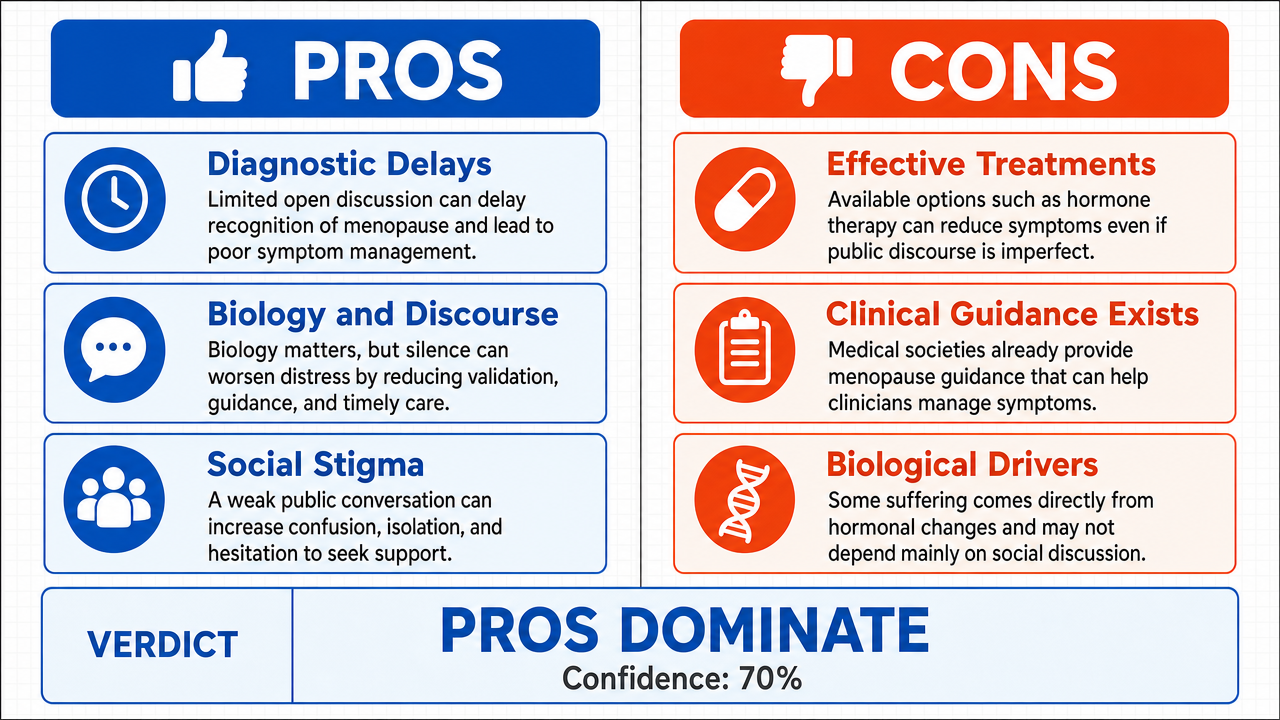
Verdict
Verdict: likely TRUE (70%)
Web Report: https://solsice.com/public/debates/the-lack-of-open-societal-and-medical-discourse-about-menopa-ed249d2d0601
This section provides a brief overview of the key arguments. You do not need to read the full detailed report below.
✅ Key PRO arguments:
- ■The absence of standardized medical discourse leads to significant diagnostic delays and mismanagement of menopausal symptoms. When menopause is treated as a peripheral 'natural' inevitability rather than a clinical transition requiring active management, healthcare providers fail to recognize or validate the severity of symptoms such as vasomotor instability , sleep disturbances , and genitourinary syndrome of menopause (GSM), causing women to endure debilitating physical symptoms for years without appropriate intervention such as HRT.
- ■The opposition's claim that suffering is purely a product of neuroendocrine changes and independent of discourse relies on a false dichotomy between biology and social context. While the neuroendocrine transition is the biological driver, the 'prolonged' nature of suffering is a direct consequence of the discourse vacuum: without medical discourse validating vasomotor symptoms or cognitive shifts as part of a predictable hormonal transition , women are more likely to misattribute these changes to unrelated psychiatric conditions, delaying proper care.
❌ Key ANTI arguments:
- ■The availability of effective medical interventions like Hormone Replacement Therapy (HRT) directly contradicts the assertion that lack of discourse leads to prolonged suffering. Clinical trials demonstrate that HRT significantly reduces vasomotor symptoms and improves quality of life , proving that when discourse and treatment are present, suffering is mitigated rather than prolonged, and the efficacy of these treatments is well-documented in major medical literature.
- ■Standardized clinical discourse already exists and mitigates suffering. The North American Menopause Society (NAMS) publishes comprehensive clinical guidelines that define diagnostic criteria and management strategies for menopausal symptoms, refuting the premise that discourse is absent and undermining the mechanism of 'delays due to silence.'
💭 Conclusion: True. The affirmative side presented a stronger causal argument linking the discourse vacuum to prolonged suffering, emphasizing that the absence of open medical and societal dialogue leads to diagnostic delays , symptom mismanagement, and the misattribution of menopausal changes to unrelated psychiatric conditions. The negative side's counter that HRT and NAMS guidelines demonstrate sufficient discourse was less persuasive because the existence of clinical guidelines does not equate to widespread open discourse reaching women or general practitioners in practice. The affirmative's framing of discourse as shaping the interpretation and management of biological signals effectively dismantled the false dichotomy between biology and social context. However, confidence is moderated to 70% because the debate focused predominantly on the physical suffering component, with the emotional suffering sub-claim receiving comparatively less direct evidentiary support.
🔬 DeepResearch Result: likely TRUE ✅ (70%)
Assertion: The lack of open societal and medical discourse about menopause significantly contributes to prolonged physical and emotional suffering for women.
Participating models: gemma-4-26b-a4b-it 💬👁️, glm-4.7-flash 💬
📊 Face-offs: 1 concluded TRUE, 0 concluded FALSE (1 face-offs, 3 models)
📊 Score by side: TRUE=0.70, FALSE=0.00
🏅 Model score changes:
minimax-m3 💬👁️: +7
✅ PRO Arguments:
- ■The absence of standardized medical discourse leads to significant diagnostic delays and mismanagement of menopausal symptoms. When menopause is treated as a peripheral 'natural' inevitability rather than a clinical transition requiring active management, healthcare providers fail to recognize or validate the severity of symptoms such as vasomotor instability , sleep disturbances , and genitourinary syndrome of menopause (GSM), causing women to endure debilitating physical symptoms for years without appropriate intervention such as HRT. gemma-4-26b-a4b-it 💬👁️
- ■The opposition's claim that suffering is purely a product of neuroendocrine changes and independent of discourse relies on a false dichotomy between biology and social context. While the neuroendocrine transition is the biological driver, the 'prolonged' nature of suffering is a direct consequence of the discourse vacuum: without medical discourse validating vasomotor symptoms or cognitive shifts as part of a predictable hormonal transition , women are more likely to misattribute these changes to unrelated psychiatric conditions, delaying proper care. gemma-4-26b-a4b-it 💬👁️
❌ ANTI Arguments:
- ■The availability of effective medical interventions like Hormone Replacement Therapy (HRT) directly contradicts the assertion that lack of discourse leads to prolonged suffering. Clinical trials demonstrate that HRT significantly reduces vasomotor symptoms and improves quality of life , proving that when discourse and treatment are present, suffering is mitigated rather than prolonged, and the efficacy of these treatments is well-documented in major medical literature. glm-4.7-flash 💬
- ■Standardized clinical discourse already exists and mitigates suffering. The North American Menopause Society (NAMS) publishes comprehensive clinical guidelines that define diagnostic criteria and management strategies for menopausal symptoms, refuting the premise that discourse is absent and undermining the mechanism of 'delays due to silence.' glm-4.7-flash 💬
💭 Reasoning: True. The affirmative side presented a stronger causal argument linking the discourse vacuum to prolonged suffering, emphasizing that the absence of open medical and societal dialogue leads to diagnostic delays, symptom mismanagement, and the misattribution of menopausal changes to unrelated psychiatric conditions. The negative side's counter that HRT and NAMS guidelines demonstrate sufficient discourse was less persuasive because the existence of clinical guidelines does not equate to widespread open discourse reaching women or general practitioners in practice. The affirmative's framing of discourse as shaping the interpretation and management of biological signals effectively dismantled the false dichotomy between biology and social context. However, confidence is moderated to 70% because the debate focused predominantly on the physical suffering component, with the emotional suffering sub-claim receiving comparatively less direct evidentiary support.
📋 PRO Facts:
• Menopause involves clinical symptoms including vasomotor instability, sleep disturbances, and genitourinary syndrome of menopause (GSM) that require active clinical management.
• Without validating medical discourse, women are more likely to misattribute menopausal symptoms to unrelated psychiatric conditions, delaying appropriate care.
📋 ANTI Facts:
• Hormone Replacement Therapy (HRT) has been demonstrated in clinical trials to significantly reduce vasomotor symptoms and improve quality of life.
• The North American Menopause Society (NAMS) publishes comprehensive clinical guidelines defining diagnostic criteria and management strategies for menopausal symptoms.
| Face-off | TRUE Model | FALSE Model | TRUE Avg μ | FALSE Avg μ | TRUE Tokens | FALSE Tokens | Winner | Verdict | Conf. |
|---|---|---|---|---|---|---|---|---|---|
| #1 | gemma-4-26b-a4b-it 💬👁️ | glm-4.7-flash 💬 | 0.264 | 0.320 | 4 | 4 | FALSE | TRUE | 70% |
The following technical terms, abbreviations, and domain-specific concepts are referenced throughout this debate transcript. Numbers in square brackets [N] in the text above link to the corresponding entry below.
[1] clinical discourse — Professional, standardized communication and discussion within the medical community regarding diagnosis, treatment, and management of health conditions. In the debate, the affirmative argues its absence causes diagnostic delays, while the negative argues it already exists via published guidelines.
[2] clinical guidelines — Systematically developed statements published by professional medical bodies to assist practitioners in making decisions about appropriate healthcare for specific conditions. Cited in the debate as evidence that standardized menopausal discourse already exists.
[3] clinical trials — Research studies conducted on human participants to evaluate the safety and efficacy of medical interventions. Referenced in the debate as the source of evidence supporting the effectiveness of hormone replacement therapy.
[4] cognitive shifts — Changes in mental processing, memory, or attention. Mentioned in the debate as a menopausal symptom that, without validating medical discourse, may be misattributed to unrelated psychiatric conditions or aging.
[5] diagnostic criteria — Standardized clinical benchmarks used to identify and confirm a specific medical condition. Referenced in the debate as part of the comprehensive guidelines published by NAMS.
[6] diagnostic delays — Extended periods between symptom onset and accurate medical diagnosis. The affirmative argues these result from the absence of standardized medical discourse about menopause.
[7] evidence-based management strategies — Treatment approaches grounded in scientifically validated research rather than anecdote or tradition. The affirmative argues that the absence of discourse prevents their widespread adoption for menopausal symptoms.
[8] false dichotomy — A logical fallacy that presents two options as mutually exclusive when in fact they are not. The affirmative uses this term to argue against separating biological and social/contextual factors in menopausal suffering.
[9] genitourinary syndrome of menopause — GSM — A cluster of symptoms affecting the genital and urinary tracts associated with hormonal changes during menopause. Cited in the debate as one of the symptom categories often unrecognized by healthcare providers.
[10] hormonal transition — The biological shift in hormone levels that characterizes menopause. The affirmative acknowledges it as the physiological driver of symptoms while arguing discourse shapes how those symptoms are interpreted and managed.
[11] hormone replacement therapy — HRT — Medical treatment that supplements hormones (typically estrogen, sometimes combined with progesterone) to alleviate symptoms caused by hormonal decline. Referenced in the debate as a primary intervention for vasomotor symptoms.
[12] hypothalamus — A brain region that regulates autonomic functions and hormone release. The negative cites neuroendocrine changes in this structure as the biological driver of vasomotor and sleep symptoms.
[13] internalized shame — Self-directed negative feelings absorbed from societal stigma. The affirmative argues menopause stigma leads women to experience this, intensifying emotional suffering.
[14] menopause — The clinical transition marked by the cessation of menstruation and associated hormonal changes. The debate centers on whether silence around this transition prolongs physical and emotional suffering.
[15] neuroendocrine — Relating to the interaction between the nervous system and hormonal signaling. The negative argues neuroendocrine changes in the hypothalamus biologically drive menopausal symptoms independent of discourse.
[16] normalization — The sociological process by which a previously stigmatized topic becomes accepted as a routine part of public discussion. The negative argues menopause is undergoing this process in media and corporate policy.
[17] North American Menopause Society — NAMS — A professional organization cited in the debate as publishing comprehensive clinical guidelines that define diagnostic criteria and management strategies for menopausal symptoms.
[18] physiological — Relating to the normal functioning of an organism's body and its systems. Used in the debate to distinguish biological symptom drivers from sociocultural factors.
[19] quality of life — A clinical outcome measure reflecting a patient's overall physical, mental, and social well-being. The negative cites clinical trials showing HRT improves this metric for menopausal women.
[20] sleep disturbances — Disruptions to normal sleep patterns, including insomnia or fragmented sleep. Listed in the debate as a menopausal symptom driven by neuroendocrine changes.
[21] stigma — A mark of social disgrace or disapproval attached to a particular condition or status. The affirmative argues menopause stigma creates a psychological burden that intensifies emotional suffering.
[22] vasomotor instability — Dysregulation of the body's temperature-control mechanisms, manifesting as hot flashes and night sweats. Cited in the debate as a primary menopausal symptom often unrecognized by clinicians.
[23] vasomotor symptoms — Symptoms resulting from impaired autonomic regulation of blood vessel dilation and constriction, primarily hot flashes and night sweats. Referenced in the debate as the target outcome for HRT efficacy.
Face-off transcripts
- ■
Ownership & Trade Secrets. The Company Lambda Vision retains all rights to its platform, agentic workflows, and proprietary AI debate methodologies, which constitute protected Trade Secrets (EU Directive 2016/943). Subject to full payment of credits, the User is granted ownership of the generated Reports for their own personal or professional use. Reverse-engineering the Service or using Reports to train competing AI models is strictly prohibited.
- ■
No Professional Advice. Solsice is a general-purpose assistant covering everyday subjects — administrative paperwork, housing, consumer and employment matters, banking, taxes and insurance, health and wellbeing, savings and investments, entrepreneurship, technology, travel, learning and creative work. Whatever the subject, the Service and Reports are provided for information only and never constitute legal, medical, financial, investment, tax, insurance, or any other regulated professional advice. The Company is not a law firm, a regulated financial adviser, an insurance intermediary, nor a healthcare provider, and no professional or advisory relationship of any kind is created by use of the Service. Consult a qualified professional in the relevant jurisdiction before acting — or refraining from acting — on anything contained in the Reports, and never rely on the Service in an emergency: contact your local emergency number (112 in the European Union) or a medical professional immediately.
- ■
AI-Generated Content, Sources and Viewpoints. Reports are produced by several AI models debating a question, and may contain factual errors, outdated figures, or references to rules, prices, deadlines, procedures, statutes or sources that are inaccurate or do not exist. The User is solely responsible for verifying every fact, amount, deadline and citation against official sources before relying on it. Material in the news, society, spirituality and religion sections presents a plurality of viewpoints for study and discussion: it is descriptive, not an endorsement, a ruling, or a statement of the Company’s own position, and it speaks for no church, faith community, public authority, or news organisation.
- ■
Liability & Governing Law. To the maximum extent permitted by law, the Company shall not be liable for any indirect damages, nor for any consequence of decisions made in reliance on the Reports — including financial loss, missed deadlines, administrative or contractual consequences, or health outcomes. These Terms are governed by French law. Any disputes shall be subject to the exclusive jurisdiction of the Courts of Paris, France.