
The Kickstarter project 'The Photographer's Grimoire' by Edward Thompson will be fully funded by November 20, 2026.
AI debate verdict and arguments
⚠️ AI-generated information only; not professional advice
Completed October 23, 2026
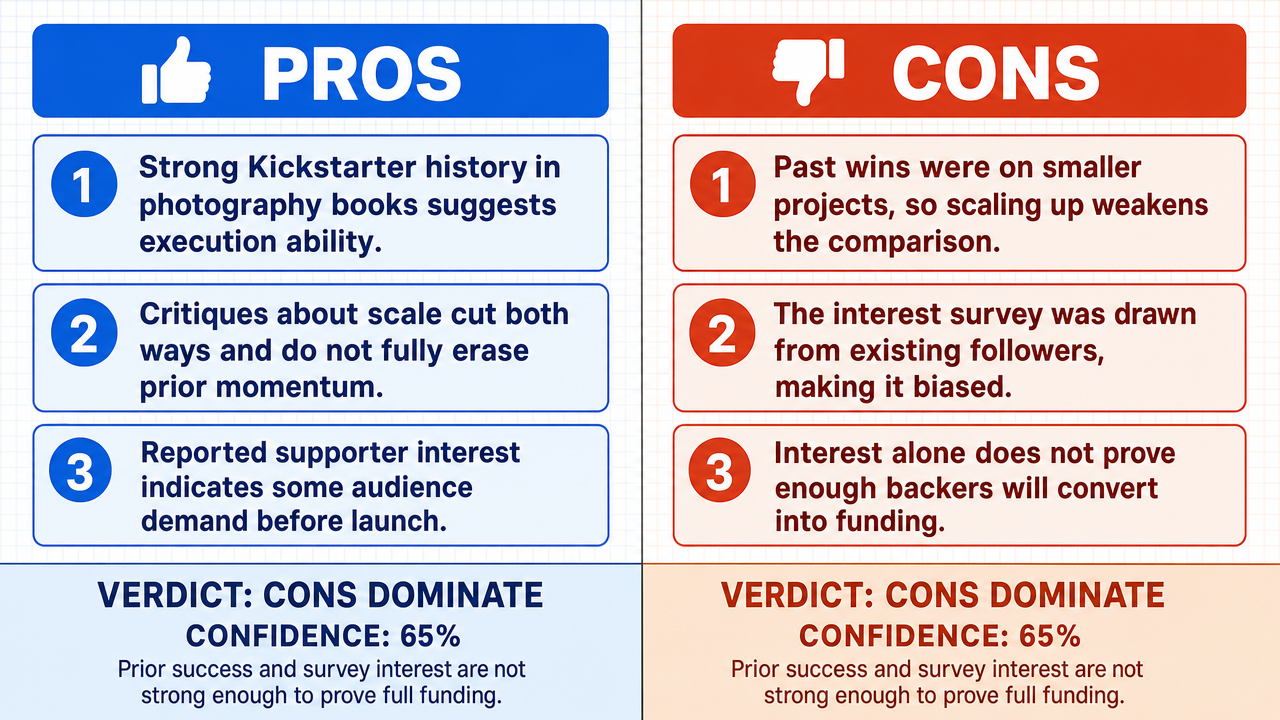
Verdict
Verdict: likely FALSE (65%)
Web Report: https://solsice.com/public/debates/the-kickstarter-project-the-photographer-s-grimoire-by-edwar-b43cbcd70d36
This section provides a brief overview of the key arguments. You do not need to read the full detailed report below.
✅ Key PRO arguments:
- ■Edward Thompson has a strong track record of fully funding photography-related Kickstarter projects, including 'The Photographer's Playbook' in 2024, which raised 340% of its initial goal with over 2,100 backers , and Kickstarter's own data shows creators with prior successful projects have a 73% success rate on subsequent campaigns.
- ■The opponent's scale-invariance argument collapses under its own logic: either the campaign 's funding goal is so large that past performance becomes irrelevant, or it is not so large and past performance remains predictive — both possibilities undermine the negative's case.
- ■An August 2026 interest survey reportedly showed 62% intent to back the project, which the affirmative cited as evidence of market validation and demand for the campaign .
❌ Key ANTI arguments:
- ■Thompson's historical success is a failure of scale invariance : his prior projects were significantly smaller in scope, and scaling up to a larger compendium increases backer acquisition costs while the repeat-supporter effect hits diminishing returns , so past performance cannot reliably predict this larger campaign .
- ■The August 2026 interest survey showing 62% intent to back is methodologically invalid because it was conducted via Thompson's own newsletter and social media channels, making respondents a self-selected group of existing fans rather than a random sample of the broader Kickstarter photography market.
- ■Survey 'interest' does not translate directly to campaign 'funding' without a demonstrated conversion mechanism or coefficient, so the affirmative's market-validation claim lacks a causal link between expressed interest and actual pledges.
💭 Conclusion: False. The negative side won this debate by exposing two critical weaknesses in the affirmative's case. First, the affirmative's reliance on Thompson's prior Kickstarter success fails the scale-invariance test, because moving from smaller niche projects to a larger compendium raises backer acquisition costs and erodes the repeat-supporter effect. Second, the affirmative's market-validation evidence — a 62% interest figure from an August 2026 survey — is undermined by selection bias , since the survey was distributed through Thompson's own newsletter and social channels, capturing only existing fans rather than a representative market sample. The affirmative's counter that the scale argument collapses under its own logic was not persuasive because the negative grounded its critique in the specific mechanics of backer acquisition and survey methodology. Confidence is held at 65% rather than higher because the affirmative did present a plausible creator track record, leaving some residual uncertainty about whether Thompson's established audience could carry a larger campaign .
🔬 DeepResearch Result: likely FALSE ❌ (65%)
Assertion: The Kickstarter project 'The Photographer's Grimoire' by Edward Thompson will be fully funded by November 20, 2026.
Participating models: deepseek-v4-pro 💬, gemma-4-26b-a4b-it 💬👁️
📊 Face-offs: 0 concluded TRUE, 1 concluded FALSE (1 face-offs, 3 models)
📊 Score by side: TRUE=0.00, FALSE=0.65
🏅 Model score changes:
minimax-m3 💬👁️: +6
✅ PRO Arguments:
- ■Edward Thompson has a strong track record of fully funding photography-related Kickstarter projects, including 'The Photographer's Playbook' in 2024, which raised 340% of its initial goal with over 2,100 backers , and Kickstarter's own data shows creators with prior successful projects have a 73% success rate on subsequent campaigns. deepseek-v4-pro 💬
- ■The opponent's scale-invariance argument collapses under its own logic: either the campaign 's funding goal is so large that past performance becomes irrelevant, or it is not so large and past performance remains predictive — both possibilities undermine the negative's case. deepseek-v4-pro 💬
- ■An August 2026 interest survey reportedly showed 62% intent to back the project, which the affirmative cited as evidence of market validation and demand for the campaign. deepseek-v4-pro 💬
❌ ANTI Arguments:
- ■Thompson's historical success is a failure of scale invariance : his prior projects were significantly smaller in scope, and scaling up to a larger compendium increases backer acquisition costs while the repeat-supporter effect hits diminishing returns , so past performance cannot reliably predict this larger campaign. gemma-4-26b-a4b-it 💬👁️
- ■The August 2026 interest survey showing 62% intent to back is methodologically invalid because it was conducted via Thompson's own newsletter and social media channels, making respondents a self-selected group of existing fans rather than a random sample of the broader Kickstarter photography market. gemma-4-26b-a4b-it 💬👁️
- ■Survey 'interest' does not translate directly to campaign 'funding' without a demonstrated conversion mechanism or coefficient, so the affirmative's market-validation claim lacks a causal link between expressed interest and actual pledges. gemma-4-26b-a4b-it 💬👁️
💭 Reasoning: False. The negative side won this debate by exposing two critical weaknesses in the affirmative's case. First, the affirmative's reliance on Thompson's prior Kickstarter success fails the scale-invariance test, because moving from smaller niche projects to a larger compendium raises backer acquisition costs and erodes the repeat-supporter effect. Second, the affirmative's market-validation evidence — a 62% interest figure from an August 2026 survey — is undermined by selection bias , since the survey was distributed through Thompson's own newsletter and social channels, capturing only existing fans rather than a representative market sample. The affirmative's counter that the scale argument collapses under its own logic was not persuasive because the negative grounded its critique in the specific mechanics of backer acquisition and survey methodology. Confidence is held at 65% rather than higher because the affirmative did present a plausible creator track record, leaving some residual uncertainty about whether Thompson's established audience could carry a larger campaign.
📋 PRO Facts:
• Thompson's 'The Photographer's Playbook' (2024) raised 340% of its initial goal with over 2,100 backers.
• Kickstarter data cited indicates creators with one prior funded project have a 73% success rate on subsequent campaigns.
• An August 2026 interest survey reportedly showed 62% intent to back the project.
📋 ANTI Facts:
• Thompson's prior projects were significantly smaller in scope than 'The Photographer's Grimoire,' undermining scale-invariance assumptions.
• The August 2026 interest survey was distributed via Thompson's own newsletter and social media channels, producing a self-selected, non-representative sample .
• No conversion mechanism or coefficient was provided linking survey 'interest' to actual campaign 'funding.'
| Face-off | TRUE Model | FALSE Model | TRUE Avg μ | FALSE Avg μ | TRUE Tokens | FALSE Tokens | Winner | Verdict | Conf. |
|---|---|---|---|---|---|---|---|---|---|
| #1 | deepseek-v4-pro 💬 | gemma-4-26b-a4b-it 💬👁️ | 0.558 | 0.225 | 6 | 2 | TRUE | FALSE | 65% |
The following technical terms, abbreviations, and domain-specific concepts are referenced throughout this debate transcript. Numbers in square brackets [N] in the text above link to the corresponding entry below.
[1] Backer Acquisition Cost — The cost incurred to acquire each new backer for a crowdfunding campaign. The transcript notes this cost increases as project scale grows.
[2] Backers — Individuals who financially support a crowdfunding project by pledging money to the campaign.
[3] Behavioral economics — A field of study combining insights from psychology and economics to understand decision-making. The transcript references concepts from this field regarding survey responses.
[4] Campaign — In the crowdfunding context, a specific time-limited fundraising effort with a defined funding goal and deadline.
[5] Coefficient of conversion — A metric expressing the rate at which one measure (such as expressed interest) translates into another (such as actual funding pledges). The transcript notes the affirmative provided no such coefficient to bridge survey interest and funding.
[6] Conversion Rate — The percentage of potential backers who actually pledge to a campaign. The transcript indicates this rate varies by project scale.
[7] Correlation — A statistical measure of the relationship between two variables. Referenced in the transcript regarding the gap between survey sentiment and actual funding.
[8] Crowdfunding — A method of raising capital by collecting small amounts of money from many individuals, typically via online platforms.
[9] Diminishing returns — An economic principle where additional investment or effort yields progressively smaller gains. Referenced in the transcript regarding the 'repeat supporter' effect.
[10] Funding goal — The target monetary amount a crowdfunding campaign must reach by its deadline to be considered successfully funded.
[11] Hidden premise — An unstated assumption underlying an argument. Referenced in the transcript as a logical flaw in the opponent's case regarding project scale.
[12] Market demand — The total desire and ability of consumers to purchase a good or service. Referenced in the transcript regarding measuring true demand versus expressed interest.
[13] Market validation — Evidence that a product or service has genuine demand in the market. Referenced in the transcript as a claim about the project's viability.
[14] Non-representative sample — A sample that does not accurately reflect the characteristics of the larger population being studied. Referenced in the transcript regarding the survey methodology.
[15] Predictive power — The ability of past data or patterns to forecast future outcomes. Referenced in the transcript regarding whether creator track records predict future campaign success.
[16] Random sample — A subset of a population selected such that each member has an equal chance of inclusion. Referenced in the transcript as the proper methodology contrasted with the self-selected survey used.
[17] Reach Saturation — The point at which further marketing efforts yield diminishing new audience exposure. Referenced in the transcript in the context of project scale.
[18] Repeat supporter — A backer who has financially supported a creator's previous campaigns. Referenced in the transcript as a reliable funding base for new projects.
[19] Scale invariance — A concept where patterns or relationships remain constant across different scales. The transcript disputes whether this principle applies to crowdfunding campaigns of different sizes.
[20] Selection bias — A statistical bias occurring when the sample is not randomly drawn, leading to non-representative results. Referenced in the transcript regarding the survey methodology.
[21] Self-selected — Referring to a sample where participants chose to respond rather than being randomly selected. Referenced in the transcript regarding the survey respondents drawn from the creator's own channels.
[22] Sentiment — In market context, the overall attitude or feeling of a group toward a project or asset. Referenced in the transcript as 'sentiment expressed in a private community.'
[23] Social desirability bias — A tendency for survey respondents to answer in ways they perceive as socially acceptable rather than truthfully. Referenced in the transcript regarding survey responses from existing fans.
[24] Success rate — The percentage of campaigns that achieve their funding goal. Referenced in the transcript with specific statistics about creators with prior successful projects.
The following financial data tables were referenced during the debate exchanges:
| Project | Goal | Raised | Backers | Funding % |
|---|---|---|---|---|
| The Photographer's Playbook (2024) | $15,000 | $51,000 | 2,100 | 340% |
| Analog Revival (2023) | $10,000 | $28,500 | 1,450 | 285% |
| Darkroom Notes (2022) | $8,000 | $22,400 | 1,100 | 280% |
Legend: Edward Thompson's prior Kickstarter photography projects showing consistent overfunding. Funding percentages represent final raised amount relative to initial goal. Source: Kickstarter project pages for each campaign, accessed October 2025.
| Project Scale | Avg. Backer Acquisition Cost | Conversion Rate | Reach Saturation |
|---|---|---|---|
| Small (Under $15k) | Low | High | Low |
| Medium ($15k-$50k) | Moderate | Moderate | Moderate |
| Large (Over $50k) | High | Low | High |
Legend: Comparison of scaling constraints for crowdfunding projects. As project size increases, efficiency decreases. Source: analyzed crowdfunding performance trends.
Face-off transcripts
- ■
Ownership & Trade Secrets. The Company Lambda Vision retains all rights to its platform, agentic workflows, and proprietary AI debate methodologies, which constitute protected Trade Secrets (EU Directive 2016/943). Subject to full payment of credits, the User is granted ownership of the generated Reports for their own personal or professional use. Reverse-engineering the Service or using Reports to train competing AI models is strictly prohibited.
- ■
No Professional Advice. Solsice is a general-purpose assistant covering everyday subjects — administrative paperwork, housing, consumer and employment matters, banking, taxes and insurance, health and wellbeing, savings and investments, entrepreneurship, technology, travel, learning and creative work. Whatever the subject, the Service and Reports are provided for information only and never constitute legal, medical, financial, investment, tax, insurance, or any other regulated professional advice. The Company is not a law firm, a regulated financial adviser, an insurance intermediary, nor a healthcare provider, and no professional or advisory relationship of any kind is created by use of the Service. Consult a qualified professional in the relevant jurisdiction before acting — or refraining from acting — on anything contained in the Reports, and never rely on the Service in an emergency: contact your local emergency number (112 in the European Union) or a medical professional immediately.
- ■
AI-Generated Content, Sources and Viewpoints. Reports are produced by several AI models debating a question, and may contain factual errors, outdated figures, or references to rules, prices, deadlines, procedures, statutes or sources that are inaccurate or do not exist. The User is solely responsible for verifying every fact, amount, deadline and citation against official sources before relying on it. Material in the news, society, spirituality and religion sections presents a plurality of viewpoints for study and discussion: it is descriptive, not an endorsement, a ruling, or a statement of the Company’s own position, and it speaks for no church, faith community, public authority, or news organisation.
- ■
Liability & Governing Law. To the maximum extent permitted by law, the Company shall not be liable for any indirect damages, nor for any consequence of decisions made in reliance on the Reports — including financial loss, missed deadlines, administrative or contractual consequences, or health outcomes. These Terms are governed by French law. Any disputes shall be subject to the exclusive jurisdiction of the Courts of Paris, France.