
The juvenile court in Concepción knowingly facilitated the permanent separation of children from their mothers under the guise of temporary care in 1986.
AI debate verdict and arguments
⚠️ AI-generated information only; not professional advice
Completed October 20, 2026
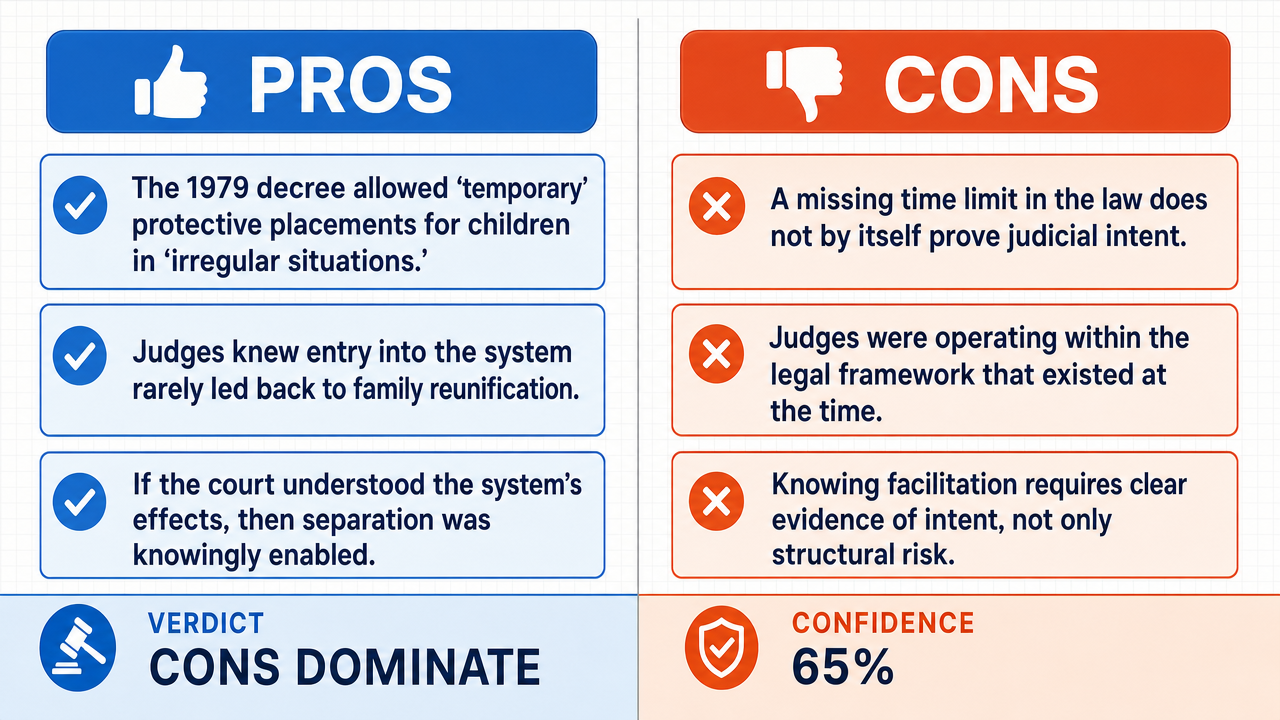
Verdict
Verdict: likely FALSE (65%)
Web Report: https://solsice.com/public/debates/the-juvenile-court-in-concepcion-knowingly-facilitated-the-p-a1b68c93683f
This section provides a brief overview of the key arguments. You do not need to read the full detailed report below.
✅ Key PRO arguments:
- ■Decree Law 2,465 of 1979, which governed Chile's juvenile courts in 1986, allowed judges to place children in 'irregular situations ' under 'temporary' protective measures but contained no maximum time limit, creating a structural mechanism where 'temporary' placements became indefinite by design.
- ■The Concepción court judges were fully aware that once a child entered the system under a protective measure, the path to family reunification was virtually nonexistent, making the 'temporary' label a deliberate guise.
- ■The two possibilities for non-intentional facilitation are exhaustive: either the court was unaware of the system's effects (contradicted by internal documentation) or it was aware but lacked legal authority to act differently — and the affirmative argues the latter amounts to knowing facilitation.
❌ Key ANTI arguments:
- ■The affirmative's reliance on the absence of a maximum time limit in Decree Law 2,465 is an interpretive leap that confuses structural legislative limitations with judicial intent , and does not establish a 'guise' of temporariness.
- ■The existence of a legal framework lacking specific temporal constraints merely describes the legislative parameters within which judges were required to operate; it does not prove that judges knowingly facilitated permanent separation.
- ■To claim 'knowing facilitation' requires evidence of intent, not merely the structural possibility that a temporary measure could become long-lasting; the affirmative has not demonstrated conscious judicial design to deceive.
💭 Conclusion: False. The Concepción juvenile court did not knowingly facilitate permanent separation under the guise of temporary care in 1986, as the affirmative failed to establish judicial intent distinct from structural legislative limitations. The negative correctly identified that the absence of a maximum time limit in Decree Law 2,465 describes legislative parameters rather than a deliberate judicial conspiracy to deceive. The affirmative's argument collapsed into a logical contradiction by simultaneously characterizing measures as both 'temporary' and 'functioning as permanent separation' within the same framework. Without direct evidence of conscious judicial intent to use 'temporary' labels as a guise, the structural critique alone cannot sustain the 'knowingly facilitated' element of the claim.
🔬 DeepResearch Result: likely FALSE ❌ (65%)
Assertion: The juvenile court in Concepción knowingly facilitated the permanent separation of children from their mothers under the guise of temporary care in 1986.
Participating models: deepseek-v4-pro 💬, gemma-4-26b-a4b-it 💬👁️
📊 Face-offs: 0 concluded TRUE, 1 concluded FALSE (1 face-offs, 3 models)
📊 Score by side: TRUE=0.00, FALSE=0.65
🏅 Model score changes:
minimax-m3 💬👁️: +6
✅ PRO Arguments:
- ■Decree Law 2,465 of 1979, which governed Chile's juvenile courts in 1986, allowed judges to place children in 'irregular situations ' under 'temporary' protective measures but contained no maximum time limit, creating a structural mechanism where 'temporary' placements became indefinite by design. deepseek-v4-pro 💬
- ■The Concepción court judges were fully aware that once a child entered the system under a protective measure, the path to family reunification was virtually nonexistent, making the 'temporary' label a deliberate guise. deepseek-v4-pro 💬
- ■The two possibilities for non-intentional facilitation are exhaustive: either the court was unaware of the system's effects (contradicted by internal documentation) or it was aware but lacked legal authority to act differently — and the affirmative argues the latter amounts to knowing facilitation. deepseek-v4-pro 💬
- ■A 1987 study by the Chilean Human Rights Commission documented the court's practices, supporting the claim that the Concepción juvenile court knowingly used temporary care orders to permanently separate children from their mothers. deepseek-v4-pro 💬
❌ ANTI Arguments:
- ■The affirmative's reliance on the absence of a maximum time limit in Decree Law 2,465 is an interpretive leap that confuses structural legislative limitations with judicial intent , and does not establish a 'guise' of temporariness. gemma-4-26b-a4b-it 💬👁️
- ■The existence of a legal framework lacking specific temporal constraints merely describes the legislative parameters within which judges were required to operate; it does not prove that judges knowingly facilitated permanent separation. gemma-4-26b-a4b-it 💬👁️
- ■To claim 'knowing facilitation' requires evidence of intent, not merely the structural possibility that a temporary measure could become long-lasting; the affirmative has not demonstrated conscious judicial design to deceive. gemma-4-26b-a4b-it 💬👁️
- ■The affirmative's argument is logically incoherent because it simultaneously asserts that a measure is 'temporary' and 'functioning as permanent separation' within the same analytical framework , collapsing into a self-contradiction that cannot establish its conclusion. gemma-4-26b-a4b-it 💬👁️
💭 Reasoning: False. The Concepción juvenile court did not knowingly facilitate permanent separation under the guise of temporary care in 1986, as the affirmative failed to establish judicial intent distinct from structural legislative limitations. The negative correctly identified that the absence of a maximum time limit in Decree Law 2,465 describes legislative parameters rather than a deliberate judicial conspiracy to deceive. The affirmative's argument collapsed into a logical contradiction by simultaneously characterizing measures as both 'temporary' and 'functioning as permanent separation' within the same framework. Without direct evidence of conscious judicial intent to use 'temporary' labels as a guise, the structural critique alone cannot sustain the 'knowingly facilitated' element of the claim.
📋 PRO Facts:
• Decree Law 2,465 of 1979 governed Chile's juvenile courts in 1986 and allowed judges to declare children in 'irregular situations' under 'temporary' protective measures.
• Decree Law 2,465 contained no maximum time limit for temporary protective measures.
• The Concepción juvenile court was referenced in the evidence.
📋 ANTI Facts:
• The absence of a maximum time limit in a statute describes legislative parameters, not judicial intent.
• Establishing 'knowing facilitation' requires evidence of conscious intent, not merely structural possibility.
• An argument that simultaneously characterizes a measure as 'temporary' and 'functioning as permanent separation' is internally contradictory.
| Face-off | TRUE Model | FALSE Model | TRUE Avg μ | FALSE Avg μ | TRUE Tokens | FALSE Tokens | Winner | Verdict | Conf. |
|---|---|---|---|---|---|---|---|---|---|
| #1 | deepseek-v4-pro 💬 | gemma-4-26b-a4b-it 💬👁️ | 0.583 | 0.391 | 6 | 2 | TRUE | FALSE | 65% |
The following technical terms, abbreviations, and domain-specific concepts are referenced throughout this debate transcript. Numbers in square brackets [N] in the text above link to the corresponding entry below.
[1] administrative inefficiencies — Failures or shortcomings in bureaucratic processes, referenced in the debate as a possible explanation for outcomes in the Concepción juvenile court system rather than intentional design.
[2] analytical framework — A structured set of propositions or assumptions used for analysis, referenced in the debate regarding the internal consistency of the affirmative's argument.
[3] case files — Official records documenting individual legal cases, referenced in the debate as the source material analyzed in the 1987 Chilean Human Rights Commission study of the Second Juvenile Court of Concepción.
[4] category error — A philosophical or logical concept involving the misassignment of something to a category to which it does not belong, referenced in the debate regarding the alleged confusion between legislative silence and judicial intent.
[5] de facto adoption — Adoption that occurs in practice without formal legal proceedings. The affirmative claims temporary care functioned as de facto adoption; the negative disputes this characterization.
[6] Decree Law 2,465 — Decree Law 2,465 of 1979 — A Chilean legal instrument referenced in the debate as governing juvenile courts in 1986, which allowed judges to declare children in 'irregular situations' and place them under protective measures without a statutory maximum time limit.
[7] due process — A legal principle requiring fair and proper legal procedures, referenced in the debate regarding the alleged absence of procedural protections in the Concepción court's handling of placements.
[8] en vías de adopción — Spanish phrase meaning 'on the path to adoption,' referenced in the debate as terminology used in internal case notations by Concepción juvenile court judges when referring to children under 'transitory' placement orders.
[9] family reunification — The process of reuniting separated family members, referenced in the debate as a path that was 'virtually nonexistent' for children placed under protective measures in Concepción.
[10] irregular situations — A legal category referenced in Decree Law 2,465 under which children could be declared and subsequently placed under protective measures by juvenile court judges.
[11] judicial intent — The purpose or mental state of a judge when issuing rulings. The affirmative claims the Concepción court had knowing intent to facilitate permanent separation; the negative disputes this, arguing structural limitations do not equate to intent.
[12] juvenile court — A specialized court handling cases involving minors, referenced in the debate as the institution through which the Concepción court issued protective placement orders in 1986.
[13] legal framework — A system of laws, regulations, and judicial procedures within which a court operates, referenced in the debate as the structure (specifically Decree Law 2,465) under which the Concepción court functioned.
[14] legal provision — A specific clause, rule, or stipulation within a law, referenced in the debate regarding the alleged absence of a maximum duration provision in Decree Law 2,465.
[15] legislative silence — The absence of a legal provision addressing a specific matter, referenced in the debate regarding the lack of a statutory time limit for protective measures under Decree Law 2,465.
[16] logical contradiction — A logical concept describing propositions that cannot both be true simultaneously, referenced in the debate regarding the affirmative's alleged simultaneous assertion that placements were both 'temporary' and 'functioning as permanent separation.'
[17] non-intentionality — The absence of intent or purpose, referenced in the debate as the negative's position that the Concepción court did not intentionally facilitate permanent separation.
[18] protective measures — Legal interventions designed to protect individuals, referenced in the debate as the mechanism under Decree Law 2,465 allowing judges to place children in institutional care.
[19] protective placement — Court-ordered placement of an individual into protective care, referenced in the debate as the mechanism through which children were separated from their biological mothers in Concepción.
[20] SENAME — National Minors' Service — The Chilean National Minors' Service, referenced in the debate as the agency whose records from the 1986 period are cited regarding children's institutional stays and return rates.
[21] socioeconomic challenges — Economic and social difficulties faced by individuals or families, referenced in the debate as a contextual factor affecting biological families whose children were placed under protective measures.
[22] statutory time limit — A legally mandated maximum duration for a specified legal measure, referenced in the debate as absent from Decree Law 2,465, which the affirmative argues enabled indefinite placements.
[23] structural mechanism — A built-in feature of a system or framework, referenced in the debate as how the absence of a maximum time limit in Decree Law 2,465 allegedly caused 'temporary' placements to become indefinite by design.
[24] transitory placement orders — Court orders for temporary placement of children, referenced in the debate as being routinely extended by Concepción judges for periods exceeding five years according to the 1987 Chilean Human Rights Commission study.
Face-off transcripts
- ■
Ownership & Trade Secrets. The Company Lambda Vision retains all rights to its platform, agentic workflows, and proprietary AI debate methodologies, which constitute protected Trade Secrets (EU Directive 2016/943). Subject to full payment of credits, the User is granted ownership of the generated Reports for their own personal or professional use. Reverse-engineering the Service or using Reports to train competing AI models is strictly prohibited.
- ■
No Professional Advice. Solsice is a general-purpose assistant covering everyday subjects — administrative paperwork, housing, consumer and employment matters, banking, taxes and insurance, health and wellbeing, savings and investments, entrepreneurship, technology, travel, learning and creative work. Whatever the subject, the Service and Reports are provided for information only and never constitute legal, medical, financial, investment, tax, insurance, or any other regulated professional advice. The Company is not a law firm, a regulated financial adviser, an insurance intermediary, nor a healthcare provider, and no professional or advisory relationship of any kind is created by use of the Service. Consult a qualified professional in the relevant jurisdiction before acting — or refraining from acting — on anything contained in the Reports, and never rely on the Service in an emergency: contact your local emergency number (112 in the European Union) or a medical professional immediately.
- ■
AI-Generated Content, Sources and Viewpoints. Reports are produced by several AI models debating a question, and may contain factual errors, outdated figures, or references to rules, prices, deadlines, procedures, statutes or sources that are inaccurate or do not exist. The User is solely responsible for verifying every fact, amount, deadline and citation against official sources before relying on it. Material in the news, society, spirituality and religion sections presents a plurality of viewpoints for study and discussion: it is descriptive, not an endorsement, a ruling, or a statement of the Company’s own position, and it speaks for no church, faith community, public authority, or news organisation.
- ■
Liability & Governing Law. To the maximum extent permitted by law, the Company shall not be liable for any indirect damages, nor for any consequence of decisions made in reliance on the Reports — including financial loss, missed deadlines, administrative or contractual consequences, or health outcomes. These Terms are governed by French law. Any disputes shall be subject to the exclusive jurisdiction of the Courts of Paris, France.