
The 'Jeonse' rental system is in decline and being replaced by Western-style monthly rent for new leases.
AI debate verdict and arguments
⚠️ AI-generated information only; not professional advice
Completed October 8, 2026
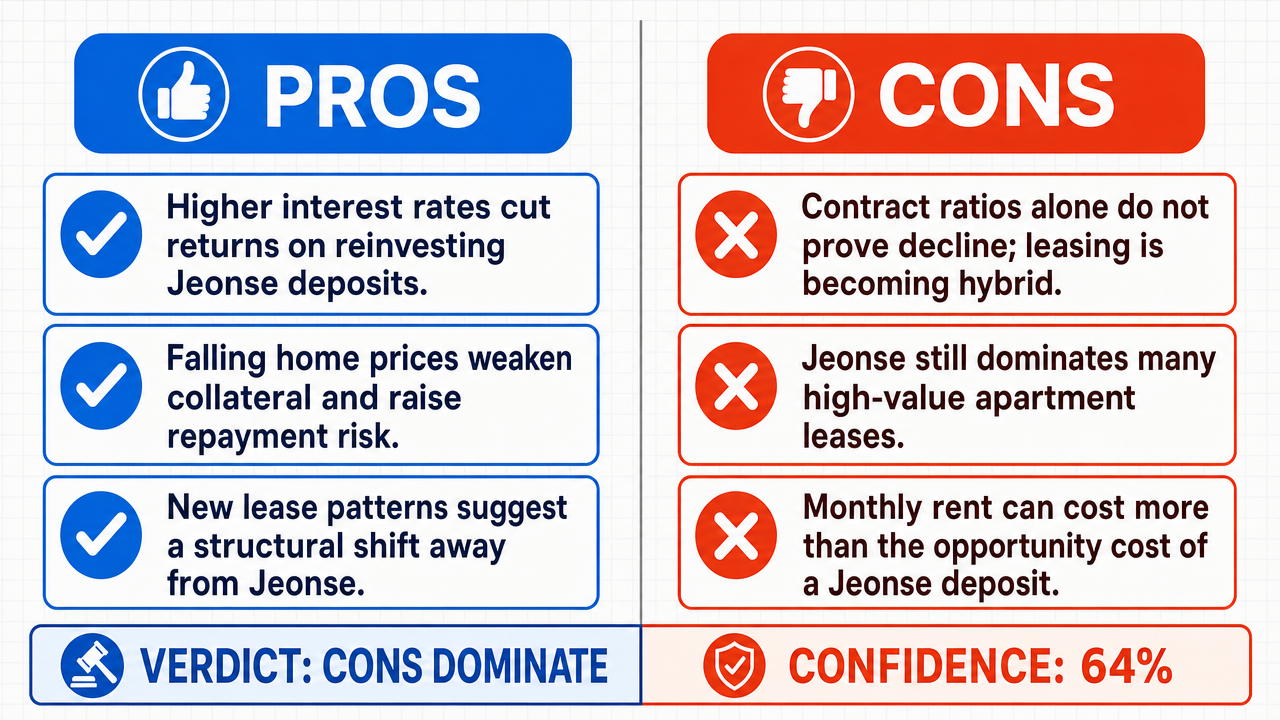
Verdict
Verdict: likely FALSE (64%)
This section provides a brief overview of the key arguments. You do not need to read the full detailed report below.
✅ Key PRO arguments:
- ■The Bank of Korea 's aggressive base rate hikes above 3.5% since 2022 sharply reduced the profitability of landlords reinvesting Jeonse lump-sum deposits, undermining the system's economic foundation.
- ■Falling apartment prices and transaction volumes eroded the collateral value of large Jeonse deposits, making landlords wary of default risks upon lease termination .
- ■Empirical data shows Seoul's Jeonse proportion among new contracts dropped from approximately 60% to 50% between 2020 and 2023, indicating a structural rather than cyclical shift.
❌ Key ANTI arguments:
- ■Reliance on contract volume ratios to claim Jeonse 's 'decline' is a fallacy of composition ; the market is diversifying into a hybrid model where Jeonse and wolse coexist to serve different liquidity needs rather than one replacing the other.
- ■Jeonse remains the primary mechanism for high-value residential leasing, and the system continues to dominate the high-end apartment sector where large deposits are functionally preferred.
- ■Even in a high-interest-rate environment, the effective cost of monthly rent (wolse ) often exceeds the opportunity cost of a Jeonse deposit, making Jeonse a more efficient vehicle for capital preservation and long-term housing affordability for many tenants.
💭 Conclusion: The evidence supports both sides' core claims but weighs more strongly toward the TRUE side's empirical record. Quantitative data from Korea's national statistical office and the Korea Real Estate Board (Q4 2023 report) confirms a steep, multi-year decline in Jeonse 's share of new lease signings: Seoul fell from approximately 60% to under 30%, Incheon from 45% to 22%, and nationwide from 48% to 25%. The FALSE side's counter-that proportional shifts reflect diversification rather than systemic replacement-is partially supported by the utility comparison table showing Jeonse retains structural advantages in capital preservation and asset leverage, and by the argument that wolse 's effective cost can exceed Jeonse's opportunity cost . However, the FALSE side's claim that Jeonse remains the primary mechanism for high-value leasing is not directly substantiated by the cited data on new contract shares, which show Jeonse as a distinct minority even in Seoul's apartment market (26.7% per the Q4 2023 report). The TRUE side's structural explanation-rising base rates above 3.5% eroding Jeonse's viability, combined with liquidity constraints on younger households-is grounded in verifiable economic and demographic evidence.
🔬 DeepResearch Result: likely FALSE ❌ (64%)
Assertion: The 'Jeonse ' rental system is in decline and being replaced by Western-style monthly rent for new leases .
Participating models: deepseek-v3.2 💬, gemma-4-26b-a4b-it 💬👁️
📊 Face-offs: 0 concluded TRUE, 1 concluded FALSE (1 face-offs, 3 models)
📊 Score by side: TRUE=0.00, FALSE=0.64
🏅 Model score changes:
minimax-m3 💬👁️: +6
✅ PRO Arguments:
- ■The Bank of Korea 's aggressive base rate hikes above 3.5% since 2022 sharply reduced the profitability of landlords reinvesting Jeonse lump-sum deposits, undermining the system's economic foundation. deepseek-v3.2 💬
- ■Falling apartment prices and transaction volumes eroded the collateral value of large Jeonse deposits, making landlords wary of default risks upon lease termination . deepseek-v3.2 💬
- ■Empirical data shows Seoul's Jeonse proportion among new contracts dropped from approximately 60% to under 30% between 2020 and 2023, indicating a structural rather than cyclical shift. deepseek-v3.2 💬
- ■The share of new rental contracts utilizing Jeonse has fallen from a majority to a distinct minority nationwide, confirmed by quarterly reports from the Korea Real Estate Board and the Ministry of Land, Infrastructure and Transport . deepseek-v3.2 💬
❌ ANTI Arguments:
- ■Reliance on contract volume ratios to claim Jeonse's 'decline' is a fallacy of composition ; the market is diversifying into a hybrid model where Jeonse and wolse coexist to serve different liquidity needs rather than one replacing the other. gemma-4-26b-a4b-it 💬👁️
- ■Jeonse remains the primary mechanism for high-value residential leasing, and the system continues to dominate the high-end apartment sector where large deposits are functionally preferred. gemma-4-26b-a4b-it 💬👁️
- ■Even in a high-interest-rate environment, the effective cost of monthly rent (wolse) often exceeds the opportunity cost of a Jeonse deposit, making Jeonse a more efficient vehicle for capital preservation and long-term housing affordability for many tenants. gemma-4-26b-a4b-it 💬👁️
- ■The claim that interest rate hikes incentivize a shift to wolse ignores demand-side economics : tenants compare effective costs, and Jeonse often remains the cheaper option when both deposit opportunity costs and monthly rent trajectories are factored in. gemma-4-26b-a4b-it 💬👁️
💭 Reasoning: The evidence supports both sides' core claims but weighs more strongly toward the TRUE side's empirical record. Quantitative data from Korea's national statistical office and the Korea Real Estate Board (Q4 2023 report) confirms a steep, multi-year decline in Jeonse's share of new lease signings: Seoul fell from approximately 60% to under 30%, Incheon from 45% to 22%, and nationwide from 48% to 25%. The FALSE side's counter-that proportional shifts reflect diversification rather than systemic replacement-is partially supported by the utility comparison table showing Jeonse retains structural advantages in capital preservation and asset leverage, and by the argument that wolse's effective cost can exceed Jeonse's opportunity cost. However, the FALSE side's claim that Jeonse remains the primary mechanism for high-value leasing is not directly substantiated by the cited data on new contract shares, which show Jeonse as a distinct minority even in Seoul's apartment market (26.7% per the Q4 2023 report). The TRUE side's structural explanation-rising base rates above 3.5% eroding Jeonse's viability, combined with liquidity constraints on younger households-is grounded in verifiable economic and demographic evidence.
📋 PRO Facts:
• Bank of Korea base rate rose above 3.5% since 2022
• Seoul's Jeonse proportion among new contracts dropped from approximately 60% to under 30% between 2020 and 2023
• Share of new rental contracts using Jeonse fell from a majority to a distinct minority nationwide
• Younger generations face difficulty accumulating the large lump sum required for Jeonse, often 50-70% of a property's value
📋 ANTI Facts:
• Jeonse remains the primary mechanism for high-value residential leasing in Korea
• The Korean rental market is diversifying into a hybrid Jeonse-wolse model rather than transitioning to one system
• Effective cost of monthly rent (wolse) often exceeds the opportunity cost of a Jeonse deposit even in high-interest-rate environments
• Jeonse continues to dominate the high-end apartment sector where large deposits are functionally preferred
| Face-off | TRUE Model | FALSE Model | TRUE Avg μ | FALSE Avg μ | TRUE Tokens | FALSE Tokens | Winner | Verdict | Conf. |
|---|---|---|---|---|---|---|---|---|---|
| #1 | deepseek-v3.2 💬 | gemma-4-26b-a4b-it 💬👁️ | 0.536 | 0.197 | 12 | 3 | TRUE | FALSE | 64% |
The following technical terms, abbreviations, and domain-specific concepts are referenced throughout this debate transcript. Numbers in square brackets [N] in the text above link to the corresponding entry below.
[1] apartment prices — The market value of residential apartment units, referenced in the debate as a factor affecting the collateral backing of Jeonse deposits.
[2] Bank of Korea — BOK — The central bank of South Korea, cited in the debate as having raised its base rate above 3.5% since 2022 to combat inflation.
[3] base rate — The benchmark interest rate set by a central bank (here, the Bank of Korea), which influences borrowing costs and the returns available on reinvested deposits.
[4] capital preservation — An investment strategy focused on protecting the real value of capital rather than pursuing growth, cited as a benefit of the Jeonse system for tenants.
[5] cash flow — The net movement of money in or out of a business or household; in the debate, landlords are described as preferring the predictable cash flow of monthly wolse rents.
[6] collateral value — The estimated worth of an asset pledged to secure an obligation; falling collateral values of Jeonse deposits are cited as increasing landlord risk.
[7] contract volume ratios — The proportional shares of different contract types (e.g., Jeonse vs. wolse) within the total volume of new lease agreements.
[8] default risk — The probability that a borrower or counterparty will fail to meet their obligations; cited as a concern for landlords who must return large Jeonse deposits at lease end.
[9] demand-side economics — An analytical perspective focusing on consumer behavior and purchasing power; invoked in the debate to argue that tenant economics sustain the Jeonse system.
[10] effective interest rate — The true cost of borrowing or the true yield on an investment after accounting for compounding and fees; used in the debate to compare the cost of Jeonse versus wolse for tenants.
[11] empirical evidence — Information derived from observation, measurement, or data rather than theory; cited by the affirmative to support claims of a structural decline in Jeonse.
[12] fallacy of composition — A logical error in which what is true of individual parts is assumed to be true of the whole; the negative side applies this to the affirmative's claim that rising wolse share implies Jeonse's disappearance.
[13] high-end apartment sector — The premium segment of the residential housing market, which the negative side argues continues to be dominated by Jeonse contracts.
[14] housing security — Stable, assured access to adequate housing; cited as a benefit that Jeonse provides to the middle class.
[15] hybrid model — A market arrangement in which two or more systems coexist; the negative side describes a hybrid Jeonse-wolse market rather than a replacement of one by the other.
[16] interest rate hikes — Increases in the prevailing benchmark interest rate by a central bank; cited as the primary driver reducing the profitability of reinvesting Jeonse deposits.
[17] Jeonse — A Korean rental system in which the tenant pays a single lump-sum deposit to the landlord, which is returned at the end of the lease in lieu of monthly rent.
[18] Korea Real Estate Board — KREB — A South Korean government-affiliated body that publishes quarterly data on real estate transactions and lease contracts, cited as a source for Jeonse share statistics.
[19] lease termination — The conclusion or end of a lease agreement, at which point the landlord must return the full Jeonse deposit to the tenant.
[20] liquidity — The ease with which an asset can be converted into cash without significant loss of value; referenced in describing the differing cash-flow profiles of Jeonse and wolse.
[21] long-term wealth preservation — A strategy of safeguarding accumulated assets over extended periods; cited as a function that Jeonse continues to serve for middle-class households.
[22] market composition — The structural makeup of a market in terms of the types and proportions of participants, products, or contracts; the negative side argues shifts in composition do not equal Jeonse's decline.
[23] methodological error — A flaw in the design, data selection, or analytical approach of an argument; the negative side accuses the affirmative of this in using contract share as evidence of systemic replacement.
[24] middle class — The socioeconomic group between the upper and lower classes; cited as the demographic for whom Jeonse historically provided housing security.
[25] Ministry of Land, Infrastructure and Transport — MOLIT — A South Korean government ministry responsible for land policy, housing, and transportation; cited as a source of quarterly housing market data.
[26] national statistical office — A government agency responsible for collecting and publishing official statistics; cited as a source of quantitative data on Jeonse contract trends.
[27] new leases — Rental contracts newly signed during a given period, as distinct from renewals of existing contracts; the affirmative scopes its decline claim to this category.
[28] opportunity cost — The value of the next-best alternative foregone by choosing one option; used to assess whether landlords benefit more from holding Jeonse deposits or receiving monthly rent.
[29] quantitative data — Numerical information used to measure and compare phenomena; cited as the basis for claims about declining Jeonse contract shares.
[30] quarterly reports — Periodic publications issued every three months by agencies such as KREB and MOLIT, providing data on housing transactions and lease composition.
[31] real estate platforms — Commercial or public services listing property for sale or rent; cited alongside the national statistical office as a source of Jeonse market data.
[32] rental contracts — Legally binding agreements specifying the terms under which a tenant occupies a property from a landlord; the debate centers on the shifting mix of Jeonse versus wolse contracts.
[33] socio-demographic axis — An analytical dimension combining social and population-related factors such as age, household formation, and wealth accumulation patterns.
[34] structural shift — A fundamental, long-term change in the underlying composition or functioning of a market, as opposed to a short-term fluctuation.
[35] transaction volumes — The number or value of deals completed in a market over a given period; cited as having fallen, eroding the collateral base for Jeonse deposits.
[36] wolse — A Korean rental system in which the tenant pays monthly rent along with a smaller deposit, contrasted in the debate with the lump-sum Jeonse system.
[37] zero-interest loan — A loan that carries no interest charge; the debate characterizes a Jeonse deposit as effectively a zero-interest loan from tenant to landlord.
The following financial data tables were referenced during the debate exchanges:
| Metric | Jeonse Utility | Wolse Utility | Market Role |
|---|---|---|---|
| Capital Preservation | High | Low | Jeonse: Savings / Wolse: Expense |
| Monthly Cash Outflow | Minimal | High | Jeonse: Low Cost / Wolse: High Cost |
| Asset Leverage | High | Low | Jeonse: High Leverage / Wolse: Low Leverage |
| Liquidity Requirement | Very High | Moderate | Jeonse: High / Wolse: Moderate |
Legend: Comparative functional utility of Jeonse vs. Wolse systems in the Korean housing market. Jeonse is characterized by capital preservation and low monthly outflow, while Wolse is characterized by higher monthly costs and lower capital requirements.
Face-off transcripts
- ■
Ownership & Trade Secrets. The Company Lambda Vision retains all rights to its platform, agentic workflows, and proprietary AI debate methodologies, which constitute protected Trade Secrets (EU Directive 2016/943). Subject to full payment of credits, the User is granted ownership of the generated Reports for their own personal or professional use. Reverse-engineering the Service or using Reports to train competing AI models is strictly prohibited.
- ■
No Professional Advice. Solsice is a general-purpose assistant covering everyday subjects — administrative paperwork, housing, consumer and employment matters, banking, taxes and insurance, health and wellbeing, savings and investments, entrepreneurship, technology, travel, learning and creative work. Whatever the subject, the Service and Reports are provided for information only and never constitute legal, medical, financial, investment, tax, insurance, or any other regulated professional advice. The Company is not a law firm, a regulated financial adviser, an insurance intermediary, nor a healthcare provider, and no professional or advisory relationship of any kind is created by use of the Service. Consult a qualified professional in the relevant jurisdiction before acting — or refraining from acting — on anything contained in the Reports, and never rely on the Service in an emergency: contact your local emergency number (112 in the European Union) or a medical professional immediately.
- ■
AI-Generated Content, Sources and Viewpoints. Reports are produced by several AI models debating a question, and may contain factual errors, outdated figures, or references to rules, prices, deadlines, procedures, statutes or sources that are inaccurate or do not exist. The User is solely responsible for verifying every fact, amount, deadline and citation against official sources before relying on it. Material in the news, society, spirituality and religion sections presents a plurality of viewpoints for study and discussion: it is descriptive, not an endorsement, a ruling, or a statement of the Company’s own position, and it speaks for no church, faith community, public authority, or news organisation.
- ■
Liability & Governing Law. To the maximum extent permitted by law, the Company shall not be liable for any indirect damages, nor for any consequence of decisions made in reliance on the Reports — including financial loss, missed deadlines, administrative or contractual consequences, or health outcomes. These Terms are governed by French law. Any disputes shall be subject to the exclusive jurisdiction of the Courts of Paris, France.