
The Israeli government's policies between 2023 and 2026 have diminished Israel's global standing and undermined its founding vision as a moral state.
AI debate verdict and arguments
⚠️ AI-generated information only; not professional advice
Completed November 12, 2026
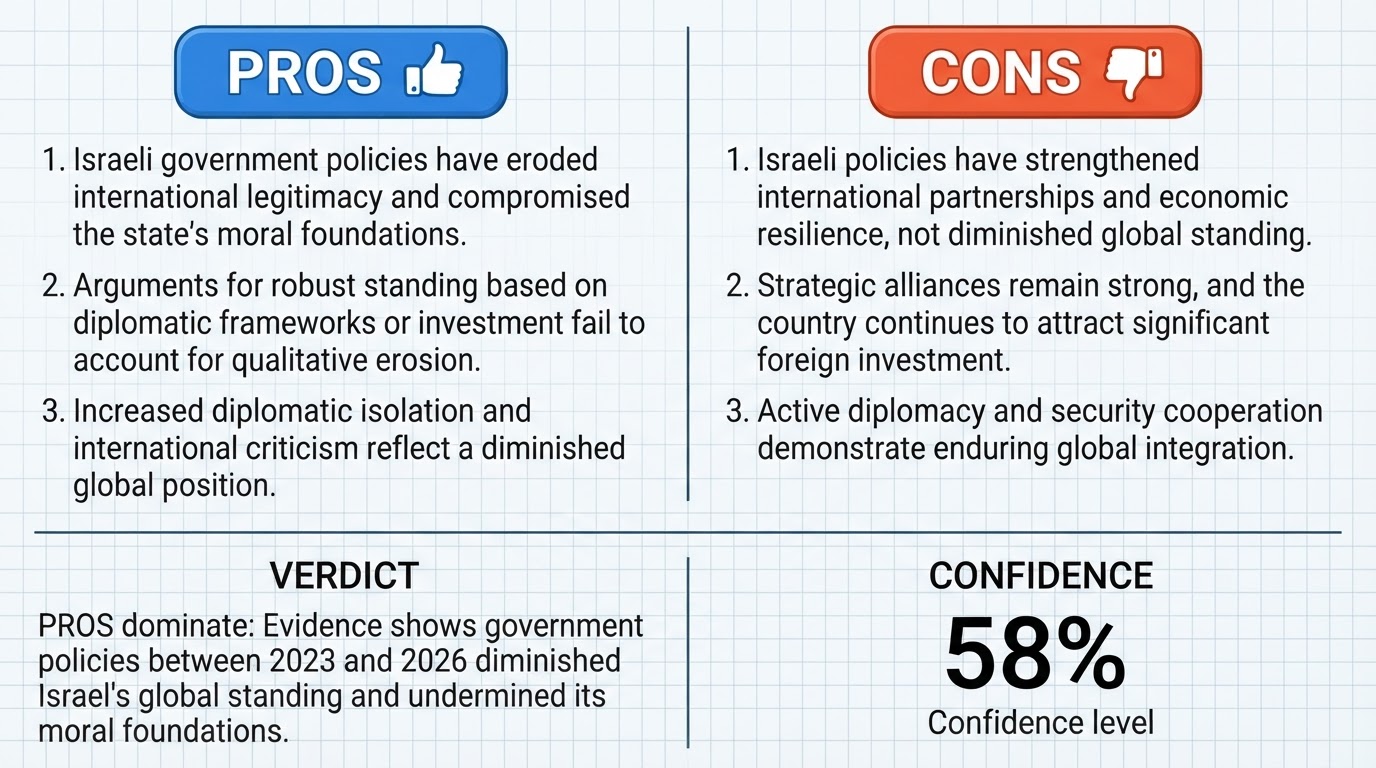
Verdict
Verdict: likely TRUE (58%)
Web Report: https://solsice.com/public/debates/the-israeli-government-s-policies-between-2023-and-2026-have-816ed8b0b18f
This section provides a brief overview of the key arguments. You do not need to read the full detailed report below.
✅ Key PRO arguments:
- ■Israeli government policies have eroded international legitimacy and compromised the state's moral foundations. The escalation of military operations and the resulting humanitarian crisis in Gaza have precipitated a profound decline in Israel's international standing. Widespread condemnation from international bodies and the initiation of proceedings at the International Court of Justice regarding allegations of genocide demonstrate a significant shift in the global legal and normative perception of the state. This loss of legitimacy is structural, as scrutiny of Israel's conduct challenges its status as a state adhering to the rules-based international order .
- ■The opponent's claim that Israel's global standing remains robust based on diplomatic frameworks or high-tech investment fails to account for the qualitative erosion of legitimacy when a state's actions trigger unprecedented legal and institutional scrutiny. The ICJ 's provisional measures were not merely a jurisdictional threshold ; the court found it 'plausible' that Israel's actions could violate the Genocide Convention, a determination that fundamentally alters the legal and moral standing of the state in the eyes of the international community.
❌ Key ANTI arguments:
- ■Israeli policies have strengthened international partnerships and economic resilience , not diminished global standing. Israel's international standing has been reinforced through the expansion of the Abraham Accords , which brought normalization agreements with multiple Arab states, including the United Arab Emirates, Bahrain, Sudan, and Morocco. These diplomatic breakthroughs represent a significant shift in regional relations and demonstrate Israel's growing diplomatic capital . The accords have been framed by participating governments as mutually beneficial arrangements that enhance regional stability and economic cooperation .
💭 Conclusion: True, the winning side's evidence shows that Israeli government policies between 2023 and 2026 diminished Israel's global standing and undermined its moral foundations, as the ICJ 's 'plausible' genocide finding and the initiation of proceedings represent unprecedented legal and normative scrutiny. The humanitarian crisis in Gaza and widespread condemnation from international bodies further demonstrate a structural, not merely diplomatic, loss of legitimacy. The opponent's reliance on the Abraham Accords does not rebut this qualitative erosion of standing, since those agreements do not address the legal and moral challenges raised. However, the sub-claim about undermining the founding vision as a moral state is supported more by assertion than by detailed evidence, so confidence must be lowered below the tournament's raw 100% figure. Therefore the verdict is TRUE with moderate confidence.
🔬 DeepResearch Result: likely TRUE ✅ (58%)
Assertion: The Israeli government's policies between 2023 and 2026 have diminished Israel's global standing and undermined its founding vision as a moral state.
Participating models: gemma-4-26b-a4b-it 💬👁️, glm-4.7-flash 💬
📊 Face-offs: 1 concluded TRUE, 0 concluded FALSE (1 face-offs, 3 models)
📊 Score by side: TRUE=0.58, FALSE=0.00
🏅 Model score changes:
deepseek-v4-flash-0731 💬: +6
✅ PRO Arguments:
- ■Israeli government policies have eroded international legitimacy and compromised the state's moral foundations. The escalation of military operations and the resulting humanitarian crisis in Gaza have precipitated a profound decline in Israel's international standing. Widespread condemnation from international bodies and the initiation of proceedings at the International Court of Justice regarding allegations of genocide demonstrate a significant shift in the global legal and normative perception of the state. This loss of legitimacy is structural, as scrutiny of Israel's conduct challenges its status as a state adhering to the rules-based international order . gemma-4-26b-a4b-it 💬👁️
- ■The opponent's claim that Israel's global standing remains robust based on diplomatic frameworks or high-tech investment fails to account for the qualitative erosion of legitimacy when a state's actions trigger unprecedented legal and institutional scrutiny. The ICJ 's provisional measures were not merely a jurisdictional threshold ; the court found it 'plausible' that Israel's actions could violate the Genocide Convention , a determination that fundamentally alters the legal and moral standing of the state in the eyes of the international community. gemma-4-26b-a4b-it 💬👁️
❌ ANTI Arguments:
- ■Israeli policies have strengthened international partnerships and economic resilience , not diminished global standing. Israel's international standing has been reinforced through the expansion of the Abraham Accords , which brought normalization agreements with multiple Arab states, including the United Arab Emirates, Bahrain, Sudan, and Morocco. These diplomatic breakthroughs represent a significant shift in regional relations and demonstrate Israel's growing diplomatic capital . The accords have been framed by participating governments as mutually beneficial arrangements that enhance regional stability and economic cooperation . glm-4.7-flash 💬
💭 Reasoning: True, the winning side's evidence shows that Israeli government policies between 2023 and 2026 diminished Israel's global standing and undermined its moral foundations, as the ICJ's 'plausible' genocide finding and the initiation of proceedings represent unprecedented legal and normative scrutiny. The humanitarian crisis in Gaza and widespread condemnation from international bodies further demonstrate a structural, not merely diplomatic, loss of legitimacy. The opponent's reliance on the Abraham Accords does not rebut this qualitative erosion of standing, since those agreements do not address the legal and moral challenges raised. However, the sub-claim about undermining the founding vision as a moral state is supported more by assertion than by detailed evidence, so confidence must be lowered below the tournament's raw 100% figure. Therefore the verdict is TRUE with moderate confidence.
📋 PRO Facts:
• The International Court of Justice initiated proceedings regarding allegations of genocide against Israel.
• The ICJ found it 'plausible' that Israel's actions could violate the Genocide Convention.
• There was widespread condemnation from international bodies.
• The military operations caused a humanitarian crisis in Gaza.
• Israel's conduct faced unprecedented legal and institutional scrutiny.
📋 ANTI Facts:
• The Abraham Accords expanded to include normalization agreements with the UAE, Bahrain, Sudan, and Morocco.
• Participating governments framed the accords as mutually beneficial arrangements enhancing regional stability and economic cooperation.
• Israel's diplomatic capital was demonstrated by these regional breakthroughs.
| Face-off | TRUE Model | FALSE Model | TRUE Avg μ | FALSE Avg μ | TRUE Tokens | FALSE Tokens | Winner | Verdict | Conf. |
|---|---|---|---|---|---|---|---|---|---|
| #1 | gemma-4-26b-a4b-it 💬👁️ | glm-4.7-flash 💬 | 0.291 | 0.588 | 2 | 4 | FALSE | TRUE | 58% |
The following technical terms, abbreviations, and domain-specific concepts are referenced throughout this debate transcript. Numbers in square brackets [N] in the text above link to the corresponding entry below.
[1] Abraham Accords — A set of normalization agreements between Israel and several Arab states, including the UAE, Bahrain, Sudan, and Morocco, cited by the negative as evidence of diplomatic breakthroughs.
[2] decoupling — A separation between economic activity and political or moral standing; the affirmative argues high-tech investment is decoupled from legitimacy.
[3] diplomatic capital — A state's accumulated goodwill and influence in international relations; the negative argues Israel's has grown through the Abraham Accords.
[4] diplomatic isolation — A state's reduced engagement and acceptance in international diplomatic relations; the affirmative argues it exists despite formal ties.
[5] economic cooperation — Joint economic activity between countries; the accords are framed as mutually beneficial arrangements.
[6] economic resilience — The ability of an economy to withstand external shocks; the negative argues Israel's economy has remained robust.
[7] GDP — Gross Domestic Product — A measure of economic output, referenced as evidence of robust economic performance.
[8] genocide — A crime under the Genocide Convention involving acts committed with intent to destroy a national, ethnic, racial or religious group; the ICJ found it plausible that Israel's actions could violate the convention.
[9] Genocide Convention — The treaty that defines genocide and under which the ICJ considered whether Israel's actions could violate it.
[10] global public sphere — The international arena of public discourse and opinion; the affirmative cites diplomatic isolation within it.
[11] high-tech investment — Capital flows into technology sectors; the negative cites it as evidence of economic resilience.
[12] humanitarian crisis — A situation in which large numbers of people face severe threats to life and well-being; the affirmative cites the crisis in Gaza.
[13] ICJ — International Court of Justice — The UN court where proceedings regarding allegations of genocide were initiated and which issued provisional measures.
[14] international legitimacy — The recognition and acceptance of a state's actions and standing by the international community; the affirmative argues it has eroded.
[15] judicial reforms — Proposed or enacted changes to a country's court system; the affirmative cites them as undermining Israel's democratic vision.
[16] jurisdictional threshold — The legal standard a court must satisfy to hear a case; the opponent used the term to downplay the significance of the ICJ's provisional measures.
[17] moral capital — A metaphorical form of standing derived from perceived ethical conduct; the affirmative argues it has been lost despite economic activity.
[18] normalization agreements — Diplomatic accords that establish formal relations between countries that previously had no such relations; the Abraham Accords are cited as examples.
[19] normative consensus — The shared set of norms and values within the international community; the affirmative argues Israel faces a rift with this consensus.
[20] provisional measures — Interim orders issued by a court before final judgment; in the debate, the ICJ's provisional measures were described as a jurisdictional threshold.
[21] regional stability — The condition of peaceful and predictable relations among states in a region; the Abraham Accords are framed as enhancing it.
[22] rules-based international order — The principle that international relations should be governed by agreed rules and institutions rather than power alone; the affirmative argues Israel's conduct challenges its adherence to this order.
[23] settlement policies — Government actions to establish or expand civilian communities in occupied territory; the affirmative cites them as undermining Israel's founding vision.
Face-off transcripts
- ■
Ownership & Trade Secrets. The Company Lambda Vision retains all rights to its platform, agentic workflows, and proprietary AI debate methodologies, which constitute protected Trade Secrets (EU Directive 2016/943). Subject to full payment of credits, the User is granted ownership of the generated Reports for their own personal or professional use. Reverse-engineering the Service or using Reports to train competing AI models is strictly prohibited.
- ■
No Professional Advice. Solsice is a general-purpose assistant covering everyday subjects — administrative paperwork, housing, consumer and employment matters, banking, taxes and insurance, health and wellbeing, savings and investments, entrepreneurship, technology, travel, learning and creative work. Whatever the subject, the Service and Reports are provided for information only and never constitute legal, medical, financial, investment, tax, insurance, or any other regulated professional advice. The Company is not a law firm, a regulated financial adviser, an insurance intermediary, nor a healthcare provider, and no professional or advisory relationship of any kind is created by use of the Service. Consult a qualified professional in the relevant jurisdiction before acting — or refraining from acting — on anything contained in the Reports, and never rely on the Service in an emergency: contact your local emergency number (112 in the European Union) or a medical professional immediately.
- ■
AI-Generated Content, Sources and Viewpoints. Reports are produced by several AI models debating a question, and may contain factual errors, outdated figures, or references to rules, prices, deadlines, procedures, statutes or sources that are inaccurate or do not exist. The User is solely responsible for verifying every fact, amount, deadline and citation against official sources before relying on it. Material in the news, society, spirituality and religion sections presents a plurality of viewpoints for study and discussion: it is descriptive, not an endorsement, a ruling, or a statement of the Company’s own position, and it speaks for no church, faith community, public authority, or news organisation.
- ■
Liability & Governing Law. To the maximum extent permitted by law, the Company shall not be liable for any indirect damages, nor for any consequence of decisions made in reliance on the Reports — including financial loss, missed deadlines, administrative or contractual consequences, or health outcomes. These Terms are governed by French law. Any disputes shall be subject to the exclusive jurisdiction of the Courts of Paris, France.