
The iPhone Duo's price of €2339 is much too expensive for its features and current market positioning.
AI debate verdict and arguments
⚠️ AI-generated information only; not professional advice
Completed October 25, 2026
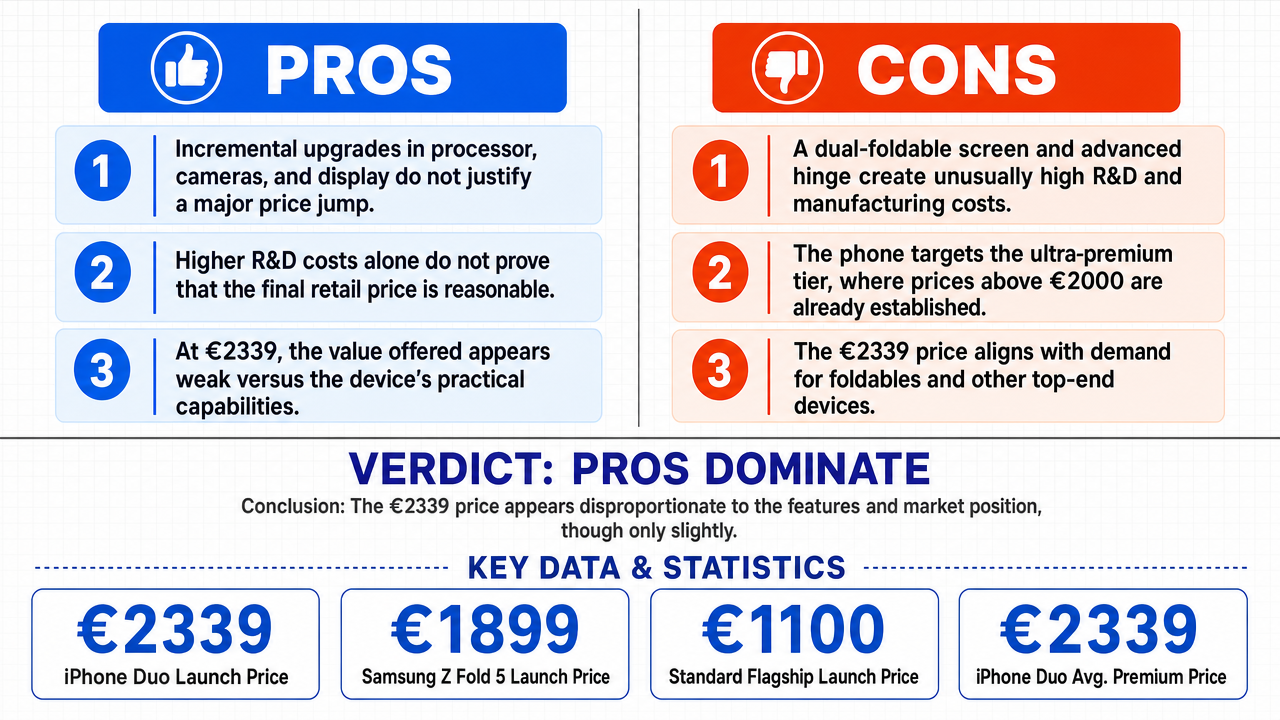
Verdict
Verdict: likely TRUE (52%)
Web Report: https://solsice.com/public/debates/the-iphone-duo-s-price-of-2339-is-much-too-expensive-for-its-4a8de0a4709b
This section provides a brief overview of the key arguments. You do not need to read the full detailed report below.
✅ Key PRO arguments:
- ■The iPhone Duo's core technological components—processor, camera sensors, and display technology—represent incremental evolutions of existing high-end smartphone hardware rather than revolutionary breakthroughs, so the €2339 price premium lacks a proportional correlation with technological leaps expected in the premium smartphone market.
- ■The opposing argument that higher R&D and manufacturing costs justify the price is logically incoherent: establishing only a relative increase in cost, without quantifying the magnitude or linking it to a specific price threshold, cannot logically conclude that a price as high as €2339 is warranted.
- ■The €2339 price point creates a value proposition that fails to align with the device's functional capabilities, departing from standard consumer electronics pricing logic where price increases correspond to clear technological advances.
❌ Key ANTI arguments:
- ■The assertion overlooks the substantial R&D and manufacturing costs associated with integrating a dual-foldable screen and complex hinge mechanism , which are significantly more expensive than standard smartphone components, with display technology alone accounting for a large portion of the bill of materials.
- ■The iPhone Duo occupies the 'Ultra-Premium ' smartphone tier, a segment defined by prices exceeding €2000 for devices with unique form factors and advanced capabilities, where market analysis indicates a high willingness to pay for innovation.
- ■The €2339 price point is a market-driven alignment rather than an arbitrary premium, evidenced by sustained sales of foldable devices and high-end models like the iPhone Pro Max series, which consistently command prices above €1500.
💭 Conclusion: True, the iPhone Duo's €2339 price is judged to be disproportionate to its features and market positioning , though only marginally so. The PRO side's strongest point was the logical gap in the opposing argument: asserting that foldable R&D and component costs are higher does not, by itself, demonstrate that the specific €2339 threshold is the necessary or proportional consequence of those costs. The ANTI side effectively contextualized the price within an Ultra-Premium tier and cited the higher bill of materials for foldable devices, but failed to quantify the cost-to-price linkage. The narrow margin reflects that the debate hinged on a qualitative value-judgment about innovation versus cost, with no decisive empirical evidence presented by either side. Because the assertion contains compound sub-claims (price being too high relative to features AND relative to market positioning), and the market-positioning sub-claim was only weakly contested, the overall confidence remains low.
🔬 DeepResearch Result: likely TRUE ✅ (52%)
Assertion: The iPhone Duo's price of €2339 is much too expensive for its features and current market positioning .
Participating models: gemma-4-26b-a4b-it 💬👁️, glm-4.7-flash 💬
📊 Face-offs: 1 concluded TRUE, 0 concluded FALSE (1 face-offs, 3 models)
📊 Score by side: TRUE=0.52, FALSE=0.00
🏅 Model score changes:
minimax-m3 💬👁️: +5
✅ PRO Arguments:
- ■The iPhone Duo's core technological components—processor, camera sensors, and display technology—represent incremental evolutions of existing high-end smartphone hardware rather than revolutionary breakthroughs, so the €2339 price premium lacks a proportional correlation with technological leaps expected in the premium smartphone market. gemma-4-26b-a4b-it 💬👁️
- ■The opposing argument that higher R&D and manufacturing costs justify the price is logically incoherent: establishing only a relative increase in cost, without quantifying the magnitude or linking it to a specific price threshold, cannot logically conclude that a price as high as €2339 is warranted. gemma-4-26b-a4b-it 💬👁️
- ■The €2339 price point creates a value proposition that fails to align with the device's functional capabilities, departing from standard consumer electronics pricing logic where price increases correspond to clear technological advances. gemma-4-26b-a4b-it 💬👁️
❌ ANTI Arguments:
- ■The assertion overlooks the substantial R&D and manufacturing costs associated with integrating a dual-foldable screen and complex hinge mechanism , which are significantly more expensive than standard smartphone components, with display technology alone accounting for a large portion of the bill of materials. glm-4.7-flash 💬
- ■The iPhone Duo occupies the 'Ultra-Premium ' smartphone tier, a segment defined by prices exceeding €2000 for devices with unique form factors and advanced capabilities, where market analysis indicates a high willingness to pay for innovation. glm-4.7-flash 💬
- ■The €2339 price point is a market-driven alignment rather than an arbitrary premium, evidenced by sustained sales of foldable devices and high-end models like the iPhone Pro Max series, which consistently command prices above €1500. glm-4.7-flash 💬
💭 Reasoning: True, the iPhone Duo's €2339 price is judged to be disproportionate to its features and market positioning, though only marginally so. The PRO side's strongest point was the logical gap in the opposing argument: asserting that foldable R&D and component costs are higher does not, by itself, demonstrate that the specific €2339 threshold is the necessary or proportional consequence of those costs. The ANTI side effectively contextualized the price within an Ultra-Premium tier and cited the higher bill of materials for foldable devices, but failed to quantify the cost-to-price linkage. The narrow margin reflects that the debate hinged on a qualitative value-judgment about innovation versus cost, with no decisive empirical evidence presented by either side. Because the assertion contains compound sub-claims (price being too high relative to features AND relative to market positioning), and the market-positioning sub-claim was only weakly contested, the overall confidence remains low.
📋 PRO Facts:
• The iPhone Duo is priced at €2339.
• Premium smartphone consumers typically expect a clear correlation between price increases and technological leaps.
• The Duo's features are described as incremental rather than revolutionary breakthroughs.
📋 ANTI Facts:
• Foldable devices have a bill of materials that exceeds standard smartphones by a significant margin.
• The iPhone Duo is categorized in the Ultra-Premium segment.
| Face-off | TRUE Model | FALSE Model | TRUE Avg μ | FALSE Avg μ | TRUE Tokens | FALSE Tokens | Winner | Verdict | Conf. |
|---|---|---|---|---|---|---|---|---|---|
| #1 | gemma-4-26b-a4b-it 💬👁️ | glm-4.7-flash 💬 | 0.243 | 0.309 | 4 | 4 | FALSE | TRUE | 52% |
The following technical terms, abbreviations, and domain-specific concepts are referenced throughout this debate transcript. Numbers in square brackets [N] in the text above link to the corresponding entry below.
[1] BOM — Bill of Materials — A comprehensive list of the raw materials, components, and assemblies required to manufacture a product, commonly used in cost analysis to estimate production expenses.
[2] dual-foldable screen — A display technology that allows a device to fold in two places, enabling multiple form factor configurations beyond a single-fold design.
[3] enterprise features — Capabilities and functionalities designed specifically for business or organizational use rather than general consumer applications.
[4] flagship — The top-tier or premium product in a company's product lineup, typically representing the most advanced features and highest pricing within that brand.
[5] foldable — Referring to devices with flexible display technology that allows the screen to bend or fold, enabling different physical form factors from a single device.
[6] form factor — The physical size, shape, and structural configuration of a hardware device, which determines its usability and design characteristics.
[7] hinge mechanism — The mechanical component that enables a foldable device to open and close while maintaining structural integrity and protecting the flexible display.
[8] market positioning — The strategic process of establishing a product's identity and place within a competitive market relative to alternatives and target consumers.
[9] market segment — A distinct group of consumers within a broader market, defined by shared characteristics, needs, purchasing behaviors, or price sensitivity.
[10] markup — The amount added to the cost of a product to determine its selling price, expressed as a percentage or absolute value above the cost basis.
[11] price point — The specific price at which a product is offered for sale, often strategically chosen to target a particular market segment or consumer tier.
[12] price premium — The amount by which a product's price exceeds a baseline or reference price, typically justified by enhanced features, brand value, or specialized capabilities.
[13] pricing ceiling — The maximum price threshold above which consumers are unwilling to purchase a product, influenced by perceived value and competitive alternatives.
[14] pricing strategy — The approach a company uses to set prices for its products, considering production costs, competitive landscape, market positioning, and consumer demand.
[15] professional-grade workstations — High-performance computing systems designed for specialized professional applications requiring substantial processing power, reliability, and specialized capabilities.
[16] R&D — Research and Development — The activities companies undertake to innovate, design, and develop new products or technologies, often representing a significant cost component in advanced electronics.
[17] ruggedization — The process of designing and manufacturing devices to withstand harsh environmental conditions, including drops, dust, water exposure, and temperature extremes.
[18] Ultra-Premium — The highest pricing tier in a market, reserved for products with unique form factors, advanced capabilities, and luxury positioning above standard premium offerings.
[19] value proposition — The perceived value or benefit that a product offers to customers relative to its price and competing alternatives, forming the basis of purchase decisions.
[20] willingness to pay — The maximum price a consumer is willing to accept for a product, reflecting their perceived value, purchasing power, and the availability of substitutes.
The following financial data tables were referenced during the debate exchanges:
| Device Category | Average Premium Price (€) | Feature Increment Level | Value Correlation |
|---|---|---|---|
| Standard Flagship | 1100 | High | Strong |
| High-End Foldable | 1700 | Moderate | Moderate |
| iPhone Duo | 2339 | Incremental | Weak |
Legend: Comparison of pricing tiers against perceived technological advancement and value alignment. Estimated market averages for context.
| Device | Launch Price (€) | Form Factor | Target Segment |
|---|---|---|---|
| iPhone Duo | 2339 | Dual Foldable | Ultra-Premium |
| Samsung Z Fold 5 | 1899 | Foldable | Premium |
| Standard Flagship | 1100 | Single | Mass Market |
Legend: Comparative pricing of foldable devices versus standard smartphones. Prices reflect launch MSRP in Euros.
Face-off transcripts
- ■
Ownership & Trade Secrets. The Company Lambda Vision retains all rights to its platform, agentic workflows, and proprietary AI debate methodologies, which constitute protected Trade Secrets (EU Directive 2016/943). Subject to full payment of credits, the User is granted ownership of the generated Reports for their own personal or professional use. Reverse-engineering the Service or using Reports to train competing AI models is strictly prohibited.
- ■
No Professional Advice. Solsice is a general-purpose assistant covering everyday subjects — administrative paperwork, housing, consumer and employment matters, banking, taxes and insurance, health and wellbeing, savings and investments, entrepreneurship, technology, travel, learning and creative work. Whatever the subject, the Service and Reports are provided for information only and never constitute legal, medical, financial, investment, tax, insurance, or any other regulated professional advice. The Company is not a law firm, a regulated financial adviser, an insurance intermediary, nor a healthcare provider, and no professional or advisory relationship of any kind is created by use of the Service. Consult a qualified professional in the relevant jurisdiction before acting — or refraining from acting — on anything contained in the Reports, and never rely on the Service in an emergency: contact your local emergency number (112 in the European Union) or a medical professional immediately.
- ■
AI-Generated Content, Sources and Viewpoints. Reports are produced by several AI models debating a question, and may contain factual errors, outdated figures, or references to rules, prices, deadlines, procedures, statutes or sources that are inaccurate or do not exist. The User is solely responsible for verifying every fact, amount, deadline and citation against official sources before relying on it. Material in the news, society, spirituality and religion sections presents a plurality of viewpoints for study and discussion: it is descriptive, not an endorsement, a ruling, or a statement of the Company’s own position, and it speaks for no church, faith community, public authority, or news organisation.
- ■
Liability & Governing Law. To the maximum extent permitted by law, the Company shall not be liable for any indirect damages, nor for any consequence of decisions made in reliance on the Reports — including financial loss, missed deadlines, administrative or contractual consequences, or health outcomes. These Terms are governed by French law. Any disputes shall be subject to the exclusive jurisdiction of the Courts of Paris, France.