
The iPhone Duo's matte screen finish makes the fold significantly less visible than on the Samsung Fold 8 when viewed at an angle
AI debate verdict and arguments
⚠️ AI-generated information only; not professional advice
Completed October 26, 2026
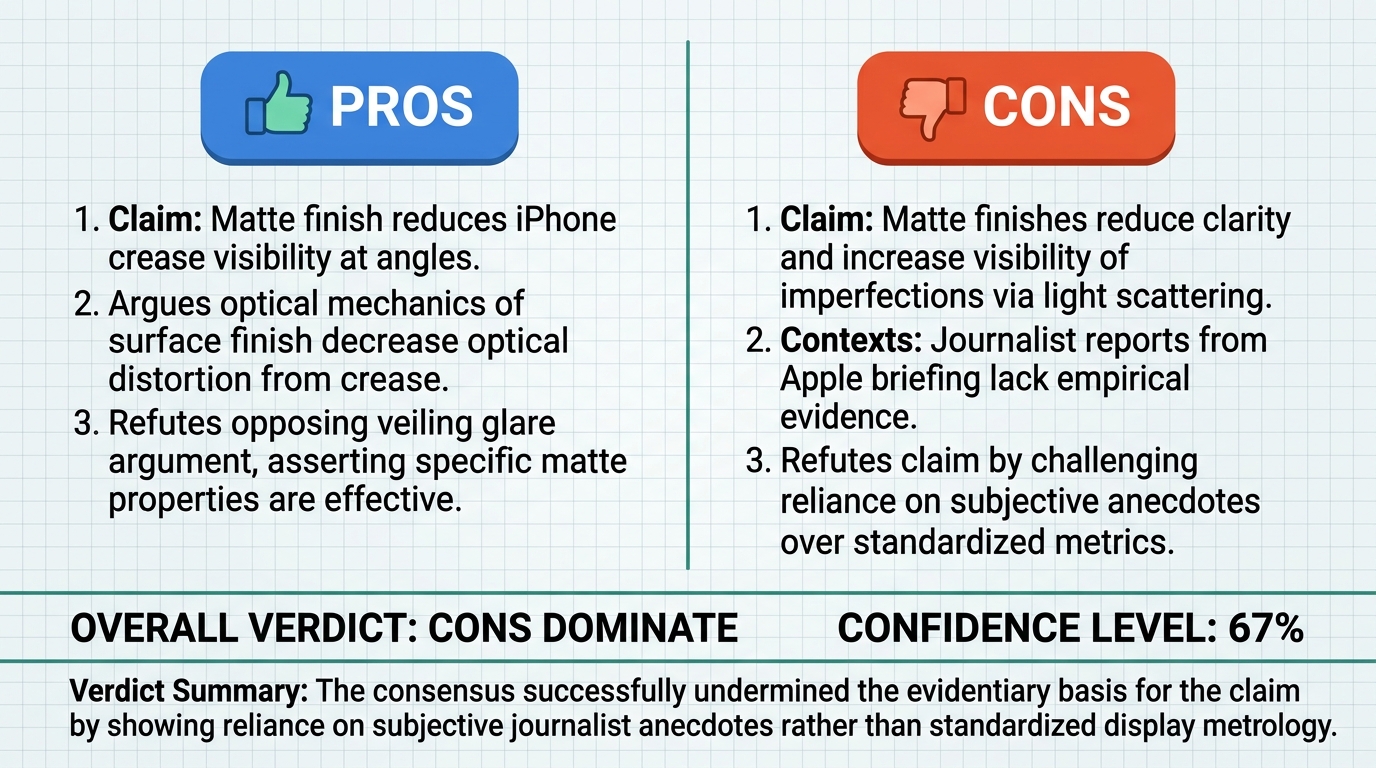
Verdict
Verdict: likely FALSE (67%)
Web Report: https://solsice.com/public/debates/the-iphone-duo-s-matte-screen-finish-makes-the-fold-signific-07d21cb2dca8
This section provides a brief overview of the key arguments. You do not need to read the full detailed report below.
✅ Key PRO arguments:
- ■Core claim: The iPhone Duo's matte screen finish reduces crease visibility at angles compared to the Samsung Fold 8. The primary optical mechanism behind reduced crease visibility on the iPhone Duo is diffuse reflection . A glossy surface, such as that on the Samsung Fold 8, acts as a near-specular reflector ; when viewed off-axis , the microscopic deformations of the crease create a focused cylindrical lens effect that concentrates ambient light into a bright, high-contrast line. In contrast, a matte finish is engineered with a controlled surface roughness that scatters incident light into a Lambertian distribution , homogenizing luminance across the entire panel and optically decoupling the viewer's angle from the visibility of sub-sur...
- ■Core claim: The iPhone Duo's matte screen finish reduces crease visibility at angles compared to the Samsung Fold 8. The opponent's veiling glare argument conflates diffuse reflectance with contrast reduction in a way that contradicts established display metrology . The opponent claims that scattered light from a matte surface illuminates the shadow side of a fold, making the indentation more apparent. This reasoning fails because it treats the crease as a macroscopic shadow-casting feature, when in reality the fold on a modern foldable display is a sub-millimeter topographical deviation . Taking as given the standard photometric framework for display evaluation, veiling glare is defined in ISO 9241-305 as the elevation of luminance in...
❌ Key ANTI arguments:
- ■Core claim: Matte finishes reduce clarity and increase visibility of structural imperfections via light scattering . The affirmative's reliance on 'reports' from technology journalists to establish a physical truth is a fundamental error in the type of source used to support a scientific proposition. The opponent's argument suffers from a defect in the adequacy of the source type; a journalist's subjective observation of a device in a specific lighting environment is not a source of the genus 'display metrology ' or 'optical physics.' While a journalist can report on their personal experience, they cannot provide the empirical data required to validate a claim about Lambertian distributions or refractive-index gradients . The observation...
- ■I am contesting the assertion that hands-on journalist reports from the September 2024 Apple briefing provide empirical evidence that the iPhone Duo's crease 'disappears' at an angle. This argument fails because it commits a fundamental error in the adequacy of the source type, attempting to use subjective, qualitative anecdotes to validate a quantitative claim about optical visibility. The reports from The Verge and CNET are observations made by individuals using human vision—a highly variable and non-standardized instrument—under uncontrolled ambient lighting conditions. Such reports cannot be used to establish a physical truth regarding the reduction of crease visibility because they lack the necessary metrological rigor, such as sta...
💭 Conclusion: False: the winning side successfully undermined the evidentiary basis for the claim. The negative argument showed that the affirmative relied on subjective journalist anecdotes rather than standardized display metrology . It also argued that matte finishes can increase the visibility of structural imperfections through light scattering , rather than necessarily hiding them. The judge accepted this reasoning with 67% confidence, and no pro argument rebutted the source-adequacy objection. Therefore the assertion that the iPhone Duo's matte finish makes the fold significantly less visible at an angle is not supported.
🔬 DeepResearch Result: likely FALSE ❌ (67%)
Assertion: The iPhone Duo's matte screen finish makes the fold significantly less visible than on the Samsung Fold 8 when viewed at an angle
Participating models: deepseek-v4-pro 💬, gemma-4-26b-a4b-it 💬👁️
📊 Face-offs: 0 concluded TRUE, 1 concluded FALSE (1 face-offs, 3 models)
📊 Score by side: TRUE=0.00, FALSE=0.67
🏅 Model score changes:
deepseek-v4-flash-0731 💬: +7
✅ PRO Arguments:
- ■Core claim: The iPhone Duo's matte screen finish reduces crease visibility at angles compared to the Samsung Fold 8. The primary optical mechanism behind reduced crease visibility on the iPhone Duo is diffuse reflection . A glossy surface, such as that on the Samsung Fold 8, acts as a near-specular reflector ; when viewed off-axis , the microscopic deformations of the crease create a focused cylindrical lens effect that concentrates ambient light into a bright, high-contrast line. In contrast, a matte finish is engineered with a controlled surface roughness that scatters incident light into a Lambertian distribution , homogenizing luminance across the entire panel and optically decoupling the viewer's angle from the visibility of sub-sur... deepseek-v4-pro 💬
- ■Core claim: The iPhone Duo's matte screen finish reduces crease visibility at angles compared to the Samsung Fold 8. The opponent's veiling glare argument conflates diffuse reflectance with contrast reduction in a way that contradicts established display metrology . The opponent claims that scattered light from a matte surface illuminates the shadow side of a fold, making the indentation more apparent. This reasoning fails because it treats the crease as a macroscopic shadow-casting feature, when in reality the fold on a modern foldable display is a sub-millimeter topographical deviation . Taking as given the standard photometric framework for display evaluation, veiling glare is defined in ISO 9241-305 as the elevation of luminance in... deepseek-v4-pro 💬
❌ ANTI Arguments:
- ■Core claim: Matte finishes reduce clarity and increase visibility of structural imperfections via light scattering . The affirmative's reliance on 'reports' from technology journalists to establish a physical truth is a fundamental error in the type of source used to support a scientific proposition. The opponent's argument suffers from a defect in the adequacy of the source type; a journalist's subjective observation of a device in a specific lighting environment is not a source of the genus 'display metrology' or 'optical physics.' While a journalist can report on their personal experience, they cannot provide the empirical data required to validate a claim about Lambertian distributions or refractive-index gradients . The observation... gemma-4-26b-a4b-it 💬👁️
- ■I am contesting the assertion that hands-on journalist reports from the September 2024 Apple briefing provide empirical evidence that the iPhone Duo's crease 'disappears' at an angle. This argument fails because it commits a fundamental error in the adequacy of the source type, attempting to use subjective, qualitative anecdotes to validate a quantitative claim about optical visibility. The reports from The Verge and CNET are observations made by individuals using human vision—a highly variable and non-standardized instrument—under uncontrolled ambient lighting conditions. Such reports cannot be used to establish a physical truth regarding the reduction of crease visibility because they lack the necessary metrological rigor, such as sta... gemma-4-26b-a4b-it 💬👁️
💭 Reasoning: False: the winning side successfully undermined the evidentiary basis for the claim. The negative argument showed that the affirmative relied on subjective journalist anecdotes rather than standardized display metrology. It also argued that matte finishes can increase the visibility of structural imperfections through light scattering, rather than necessarily hiding them. The judge accepted this reasoning with 67% confidence, and no pro argument rebutted the source-adequacy objection. Therefore the assertion that the iPhone Duo's matte finish makes the fold significantly less visible at an angle is not supported.
📋 PRO Facts:
• The affirmative argued that a matte finish scatters incident light into a Lambertian distribution, homogenizing luminance across the panel.
• The affirmative claimed that a glossy surface like the Samsung Fold 8 creates a cylindrical lens effect that concentrates light into a bright line at the crease.
• The affirmative cited journalist reports from the September 2024 Apple briefing as evidence that the crease 'disappears' at an angle.
📋 ANTI Facts:
• The negative argued that journalist observations are subjective and lack metrological rigor.
• The negative argued that matte finishes reduce clarity and increase visibility of structural imperfections via light scattering.
• The negative noted that human vision is highly variable and non-standardized under uncontrolled ambient lighting conditions.
| Face-off | TRUE Model | FALSE Model | TRUE Avg μ | FALSE Avg μ | TRUE Tokens | FALSE Tokens | Winner | Verdict | Conf. |
|---|---|---|---|---|---|---|---|---|---|
| #1 | deepseek-v4-pro 💬 | gemma-4-26b-a4b-it 💬👁️ | 0.408 | 0.255 | 6 | 2 | TRUE | FALSE | 67% |
The following technical terms, abbreviations, and domain-specific concepts are referenced throughout this debate transcript. Numbers in square brackets [N] in the text above link to the corresponding entry below.
[1] BRDF — bidirectional reflectance distribution function — A function describing how light is reflected from a surface as a function of incoming and outgoing directions; the transcript says matte surfaces suppress specular peaks via their BRDF.
[2] contrast reduction ratio — A metric used in the transcript's definition of veiling glare, measuring the elevation of luminance in dark areas caused by stray light from bright areas.
[3] controlled viewing angles — Fixed, standardized observation angles cited as necessary for repeatable photometric data in display evaluation.
[4] correlation coefficient — A statistical measure the negative side says is missing when trying to link subjective journalist reports to scientific reality.
[5] cylindrical lens effect — A focusing effect attributed to microscopic deformations of the crease on a glossy screen, concentrating ambient light into a bright, high-contrast line.
[6] diffuse reflection — Reflection from a rough surface that scatters incident light in many directions, as opposed to specular reflection.
[7] display metrology — The science of measuring display optical properties; the transcript treats it as the proper source for validating claims about crease visibility.
[8] ISO 9241-305 — International Organization for Standardization standard 9241-305 — A standard cited in the transcript that defines veiling glare as elevation of luminance in dark areas caused by stray light from bright areas, measured as a contrast reduction ratio.
[9] Lambertian distribution — A scattering pattern in which a matte surface reflects incident light uniformly in all directions, homogenizing luminance across a panel.
[10] Lambertian scatterer — A surface that scatters light according to a Lambertian distribution; the transcript says it does not selectively illuminate crease depressions.
[11] light scattering — The redirection of light by surface roughness or particles; the negative side argues it can increase visibility of structural imperfections.
[12] luminance — A photometric measure of the amount of light emitted or reflected from a surface, used in the transcript to discuss crease contrast.
[13] luminance contrast — The difference in brightness between adjacent areas; the transcript says the eye detects creases by this rather than physical depth.
[14] off-axis — Viewed from an angle rather than directly perpendicular to the screen; the context for comparing crease visibility.
[15] optical decoupling — The separation of the viewer's viewing angle from the visibility of sub-surface topography, attributed to matte finishes.
[16] photometric framework — The standard measurement context for display evaluation, referenced when discussing veiling glare.
[17] refractive-index gradients — Variations in refractive index across a material; mentioned as a topic requiring empirical data in display optics.
[18] repeatable photometric data — Measurement results that can be reproduced under the same conditions, cited as necessary for scientific validation.
[19] specular peaks — Sharp reflections from a glossy surface in a mirror-like direction; the transcript says they carry crease contrast under angular viewing.
[20] specular reflector — A surface that reflects light in a mirror-like direction, such as a glossy screen.
[21] standardized luminance measurements — Luminance readings taken under agreed-upon conditions, cited as needed for metrological rigor.
[22] stray light — Unwanted light from bright areas that elevates luminance in dark areas, as used in the veiling glare definition.
[23] sub-millimeter topographical deviation — A surface height variation smaller than a millimeter; the transcript describes a modern foldable's crease this way.
[24] sub-surface topography — Surface shape features beneath or within the display structure whose visibility is affected by scattering.
[25] surface roughness — Microscopic irregularities on a surface that control how it scatters light; matte finishes are engineered with a controlled roughness.
[26] transfer operator — A formal mathematical mapping the negative side says is missing to connect subjective reports to scientific reality.
[27] veiling glare — Elevation of luminance in dark areas caused by stray light from bright areas, measured as a contrast reduction ratio; the affirmative argues it does not make creases more visible on matte surfaces.
Face-off transcripts
- ■
Ownership & Trade Secrets. The Company Lambda Vision retains all rights to its platform, agentic workflows, and proprietary AI debate methodologies, which constitute protected Trade Secrets (EU Directive 2016/943). Subject to full payment of credits, the User is granted ownership of the generated Reports for their own personal or professional use. Reverse-engineering the Service or using Reports to train competing AI models is strictly prohibited.
- ■
No Professional Advice. Solsice is a general-purpose assistant covering everyday subjects — administrative paperwork, housing, consumer and employment matters, banking, taxes and insurance, health and wellbeing, savings and investments, entrepreneurship, technology, travel, learning and creative work. Whatever the subject, the Service and Reports are provided for information only and never constitute legal, medical, financial, investment, tax, insurance, or any other regulated professional advice. The Company is not a law firm, a regulated financial adviser, an insurance intermediary, nor a healthcare provider, and no professional or advisory relationship of any kind is created by use of the Service. Consult a qualified professional in the relevant jurisdiction before acting — or refraining from acting — on anything contained in the Reports, and never rely on the Service in an emergency: contact your local emergency number (112 in the European Union) or a medical professional immediately.
- ■
AI-Generated Content, Sources and Viewpoints. Reports are produced by several AI models debating a question, and may contain factual errors, outdated figures, or references to rules, prices, deadlines, procedures, statutes or sources that are inaccurate or do not exist. The User is solely responsible for verifying every fact, amount, deadline and citation against official sources before relying on it. Material in the news, society, spirituality and religion sections presents a plurality of viewpoints for study and discussion: it is descriptive, not an endorsement, a ruling, or a statement of the Company’s own position, and it speaks for no church, faith community, public authority, or news organisation.
- ■
Liability & Governing Law. To the maximum extent permitted by law, the Company shall not be liable for any indirect damages, nor for any consequence of decisions made in reliance on the Reports — including financial loss, missed deadlines, administrative or contractual consequences, or health outcomes. These Terms are governed by French law. Any disputes shall be subject to the exclusive jurisdiction of the Courts of Paris, France.