
The iPhone Duo's lack of Face ID or basic facial recognition is a significant omission, especially given Apple's emphasis on security
AI debate verdict and arguments
⚠️ AI-generated information only; not professional advice
Completed October 24, 2026
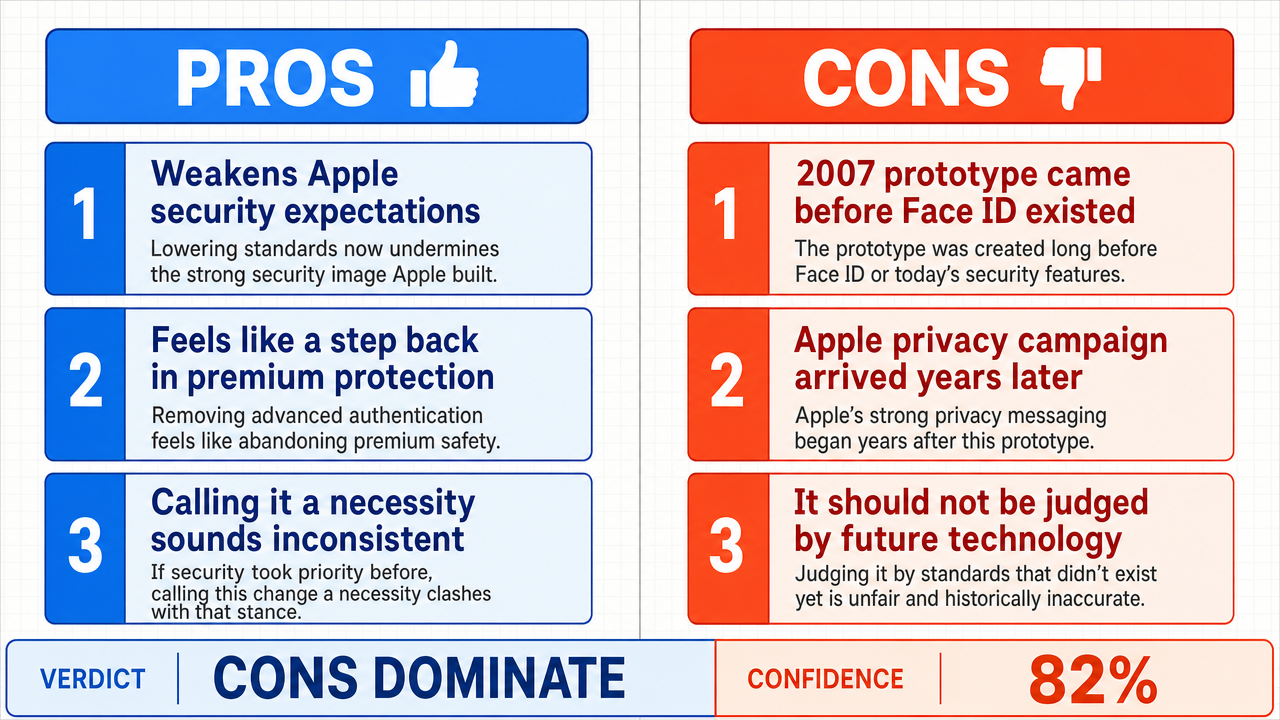
Verdict
Verdict: likely FALSE (82%)
Web Report: https://solsice.com/public/debates/the-iphone-duo-s-lack-of-face-id-or-basic-facial-recognition-64d5641c8c0e
This section provides a brief overview of the key arguments. You do not need to read the full detailed report below.
✅ Key PRO arguments:
- ■Removing facial recognition undermines Apple's security standards and user experience, creating a critical vulnerability in the device's biometric security architecture. Apple has historically positioned Face ID as a gold standard for secure, frictionless authentication using a TrueDepth camera system , and omitting it forces reliance on less sophisticated methods or manual passcode entry, increasing the risk of unauthorized access through shoulder surfing or brute-force attempts .
- ■The absence of Face ID represents a regression in the hardware-level security integration that consumers have come to expect from Apple's premium devices, breaking continuity with the company's established security narrative and brand promise around privacy and biometric protection.
- ■The opponent's claim that the omission is a 'technological necessity' rather than an omission is logically incoherent because it attempts to resolve a contradiction by simply renaming the absence of a capability, while still failing to address that the absence represents a failure to meet Apple's established security standards.
❌ Key ANTI arguments:
- ■The iPhone Duo, a dual-screen prototype demonstrated by Steve Jobs in 2007, predates the invention of the TrueDepth camera system required for Face ID by a decade. Face ID utilizes infrared dot projectors and flood illuminators to map a user's face in 3D; these components did not exist in consumer electronics until the iPhone X was released in 2017. The lack of Face ID is therefore a technological necessity consistent with the era's engineering capabilities, not an omission.
- ■The specific 'Privacy. That's iPhone' campaign and Apple's emphasis on facial recognition as the sole security standard were introduced in 2015, nearly a decade after the iPhone Duo was conceptualized in 2007. A brand promise cannot retroactively constitute a binding constraint on a product designed and built years before the promise was articulated, so the device cannot be said to have omitted a security standard that did not exist at the time of its engineering.
- ■The assertion that the device should have included future technology misunderstands the chronological constraints of its development. Judging a 2007 prototype by 2017+ standards is anachronistic and ignores the engineering realities of the period in which the device was designed.
💭 Conclusion: False. The iPhone Duo's lack of Face ID cannot be characterized as a significant omission because the underlying technology did not exist when the device was conceptualized in 2007. Face ID's TrueDepth camera system , infrared dot projectors , and flood illuminators were not introduced until the iPhone X in 2017, making the absence a technological impossibility rather than a deliberate design failure. Furthermore, Apple's specific emphasis on facial recognition as a security standard emerged with the 2015 'Privacy. That's iPhone' campaign, which postdates the iPhone Duo's development by years, so no binding brand promise was breached. The PRO side's argument that the omission represents a regression in security standards fails because it applies anachronistic expectations to a prototype from a different technological era. The ANTI side's chronological grounding provides the decisive evidence that resolves both sub-claims of the compound assertion.
🔬 DeepResearch Result: likely FALSE ❌ (82%)
Assertion: The iPhone Duo's lack of Face ID or basic facial recognition is a significant omission, especially given Apple's emphasis on security
Participating models: gemma-4-26b-a4b-it 💬👁️, glm-4.7-flash 💬
📊 Face-offs: 0 concluded TRUE, 1 concluded FALSE (1 face-offs, 3 models)
📊 Score by side: TRUE=0.00, FALSE=0.82
🏅 Model score changes:
minimax-m3 💬👁️: +8
✅ PRO Arguments:
- ■Removing facial recognition undermines Apple's security standards and user experience, creating a critical vulnerability in the device's biometric security architecture. Apple has historically positioned Face ID as a gold standard for secure, frictionless authentication using a TrueDepth camera system , and omitting it forces reliance on less sophisticated methods or manual passcode entry, increasing the risk of unauthorized access through shoulder surfing or brute-force attempts . gemma-4-26b-a4b-it 💬👁️
- ■The absence of Face ID represents a regression in the hardware-level security integration that consumers have come to expect from Apple's premium devices, breaking continuity with the company's established security narrative and brand promise around privacy and biometric protection. gemma-4-26b-a4b-it 💬👁️
- ■The opponent's claim that the omission is a 'technological necessity' rather than an omission is logically incoherent because it attempts to resolve a contradiction by simply renaming the absence of a capability, while still failing to address that the absence represents a failure to meet Apple's established security standards. gemma-4-26b-a4b-it 💬👁️
❌ ANTI Arguments:
- ■The iPhone Duo, a dual-screen prototype demonstrated by Steve Jobs in 2007, predates the invention of the TrueDepth camera system required for Face ID by a decade. Face ID utilizes infrared dot projectors and flood illuminators to map a user's face in 3D; these components did not exist in consumer electronics until the iPhone X was released in 2017. The lack of Face ID is therefore a technological necessity consistent with the era's engineering capabilities, not an omission. glm-4.7-flash 💬
- ■The specific 'Privacy. That's iPhone' campaign and Apple's emphasis on facial recognition as the sole security standard were introduced in 2015, nearly a decade after the iPhone Duo was conceptualized in 2007. A brand promise cannot retroactively constitute a binding constraint on a product designed and built years before the promise was articulated, so the device cannot be said to have omitted a security standard that did not exist at the time of its engineering. glm-4.7-flash 💬
- ■The assertion that the device should have included future technology misunderstands the chronological constraints of its development. Judging a 2007 prototype by 2017+ standards is anachronistic and ignores the engineering realities of the period in which the device was designed. glm-4.7-flash 💬
💭 Reasoning: False. The iPhone Duo's lack of Face ID cannot be characterized as a significant omission because the underlying technology did not exist when the device was conceptualized in 2007. Face ID's TrueDepth camera system, infrared dot projectors, and flood illuminators were not introduced until the iPhone X in 2017, making the absence a technological impossibility rather than a deliberate design failure. Furthermore, Apple's specific emphasis on facial recognition as a security standard emerged with the 2015 'Privacy. That's iPhone' campaign, which postdates the iPhone Duo's development by years, so no binding brand promise was breached. The PRO side's argument that the omission represents a regression in security standards fails because it applies anachronistic expectations to a prototype from a different technological era. The ANTI side's chronological grounding provides the decisive evidence that resolves both sub-claims of the compound assertion.
📋 PRO Facts:
• Apple has historically positioned Face ID as a gold standard for secure, frictionless authentication using a TrueDepth camera system.
• Manual passcode entry increases the risk of unauthorized access through shoulder surfing or brute-force attempts.
📋 ANTI Facts:
• The iPhone Duo was demonstrated by Steve Jobs in 2007.
• Face ID's TrueDepth camera system, infrared dot projectors, and flood illuminators were not introduced until the iPhone X in 2017.
• Apple's 'Privacy. That's iPhone' campaign was introduced in 2015, nearly a decade after the iPhone Duo was conceptualized.
| Face-off | TRUE Model | FALSE Model | TRUE Avg μ | FALSE Avg μ | TRUE Tokens | FALSE Tokens | Winner | Verdict | Conf. |
|---|---|---|---|---|---|---|---|---|---|
| #1 | gemma-4-26b-a4b-it 💬👁️ | glm-4.7-flash 💬 | 0.222 | 0.450 | 4 | 4 | FALSE | FALSE | 82% |
The following technical terms, abbreviations, and domain-specific concepts are referenced throughout this debate transcript. Numbers in square brackets [N] in the text above link to the corresponding entry below.
[1] 3D mapping — three-dimensional mapping — The process of creating a three-dimensional representation of an object or surface; in the transcript, it refers to mapping a user's face using infrared dot projectors and flood illuminators for facial recognition.
[2] Apple Pay — Apple's mobile payment service, referenced in the debate as a service that was secured using Touch ID and passcodes before Face ID's introduction.
[3] authentication — The process of verifying the identity of a user; in the transcript, it is discussed in the context of 'secure, frictionless authentication' enabled by Face ID.
[4] biometric security — Security measures that use unique biological characteristics (such as facial features or fingerprints) to verify identity; the debate discusses the iPhone Duo's 'biometric security architecture.'
[5] brute-force attempts — A method of gaining unauthorized access by systematically trying all possible combinations until the correct one is found; cited in the debate as a risk when relying on passcodes instead of biometrics.
[6] consumer electronics — Electronic devices intended for everyday personal use by consumers; the transcript notes that TrueDepth camera components did not exist in consumer electronics until the iPhone X in 2017.
[7] ecosystem — In a technology context, the interconnected set of products, services, and software offered by a single company; the debate references 'the brand's ecosystem' of hardware-level security integration.
[8] Face ID — Apple's proprietary facial recognition authentication system that uses a TrueDepth camera system to create a mathematical model of a user's face; introduced with the iPhone X in 2017.
[9] flood illuminators — Infrared components used in Face ID's TrueDepth camera system that flood the area with infrared light to enable facial mapping in 3D.
[10] form factor — The physical size, shape, and structural design of a hardware device; the debate cites the iPhone Duo's slider form factor as a barrier to front-facing sensors.
[11] gatekeeper — In a security context, the primary mechanism that controls access to a system or service; the debate discusses facial recognition as a 'primary gatekeeper' for Apple Pay and Keychain.
[12] hardware-level security integration — The embedding of security features directly into a device's physical hardware components rather than relying solely on software; described in the debate as a standard consumers expect from Apple.
[13] hinge — A mechanical joint that allows pivoting or sliding motion between two parts; the debate notes that the iPhone Duo's sliding hinge would block the optical sensors required for Face ID.
[14] infrared dot projectors — Components in Face ID's TrueDepth camera system that project a pattern of infrared dots onto a user's face to enable 3D facial mapping.
[15] Keychain — Apple's password management and credential storage system, referenced in the debate as a service secured by Touch ID and passcodes prior to Face ID.
[16] non-sequitur — A logical fallacy in which a conclusion does not logically follow from the premises; used in the debate to characterize the opponent's claim that technological necessity aligns with Apple's security roadmap.
[17] optical sensors — Sensors that detect and respond to light; the debate argues that the iPhone Duo's sliding hinge would obstruct the optical sensors required for facial recognition.
[18] passcode — A numeric or alphanumeric code used to unlock a device or authenticate a user; cited as a less sophisticated alternative to biometric authentication.
[19] prototype — An early sample or preliminary model of a product built to test a concept; the debate refers to the iPhone Duo as a 'dual-screen prototype demonstrated by Steve Jobs in 2007.'
[20] security architecture — The overall design and structure of a system's security components and protocols; the debate notes that the 2007 security architecture was defined by available technology.
[21] security roadmap — A planned progression or timeline of security features and standards a company intends to implement; referenced in the debate as Apple's security roadmap.
[22] shoulder surfing — A security attack in which an attacker observes a user's screen or keystrokes over their shoulder to gain unauthorized access; cited as a risk when relying on passcode entry.
[23] slider mechanism — A physical design element that allows one component to slide relative to another; the iPhone Duo is described as using a slider mechanism that concealed one screen within another.
[24] Touch ID — Apple's fingerprint-based biometric authentication system, launched in 2013; cited in the debate as having secured Apple Pay and Keychain before Face ID's introduction.
[25] TrueDepth camera system — Apple's proprietary camera hardware that uses infrared dot projectors and flood illuminators to capture 3D facial data for Face ID; introduced with the iPhone X in 2017.
Face-off transcripts
- ■
Ownership & Trade Secrets. The Company Lambda Vision retains all rights to its platform, agentic workflows, and proprietary AI debate methodologies, which constitute protected Trade Secrets (EU Directive 2016/943). Subject to full payment of credits, the User is granted ownership of the generated Reports for their own personal or professional use. Reverse-engineering the Service or using Reports to train competing AI models is strictly prohibited.
- ■
No Professional Advice. Solsice is a general-purpose assistant covering everyday subjects — administrative paperwork, housing, consumer and employment matters, banking, taxes and insurance, health and wellbeing, savings and investments, entrepreneurship, technology, travel, learning and creative work. Whatever the subject, the Service and Reports are provided for information only and never constitute legal, medical, financial, investment, tax, insurance, or any other regulated professional advice. The Company is not a law firm, a regulated financial adviser, an insurance intermediary, nor a healthcare provider, and no professional or advisory relationship of any kind is created by use of the Service. Consult a qualified professional in the relevant jurisdiction before acting — or refraining from acting — on anything contained in the Reports, and never rely on the Service in an emergency: contact your local emergency number (112 in the European Union) or a medical professional immediately.
- ■
AI-Generated Content, Sources and Viewpoints. Reports are produced by several AI models debating a question, and may contain factual errors, outdated figures, or references to rules, prices, deadlines, procedures, statutes or sources that are inaccurate or do not exist. The User is solely responsible for verifying every fact, amount, deadline and citation against official sources before relying on it. Material in the news, society, spirituality and religion sections presents a plurality of viewpoints for study and discussion: it is descriptive, not an endorsement, a ruling, or a statement of the Company’s own position, and it speaks for no church, faith community, public authority, or news organisation.
- ■
Liability & Governing Law. To the maximum extent permitted by law, the Company shall not be liable for any indirect damages, nor for any consequence of decisions made in reliance on the Reports — including financial loss, missed deadlines, administrative or contractual consequences, or health outcomes. These Terms are governed by French law. Any disputes shall be subject to the exclusive jurisdiction of the Courts of Paris, France.