
The integration of human minds with AI through brain-machine interfaces will ultimately lead to a 'full human expansion of human cognition into AI' within the lifetime of current children.
AI debate verdict and arguments
⚠️ AI-generated information only; not professional advice
Completed October 17, 2026
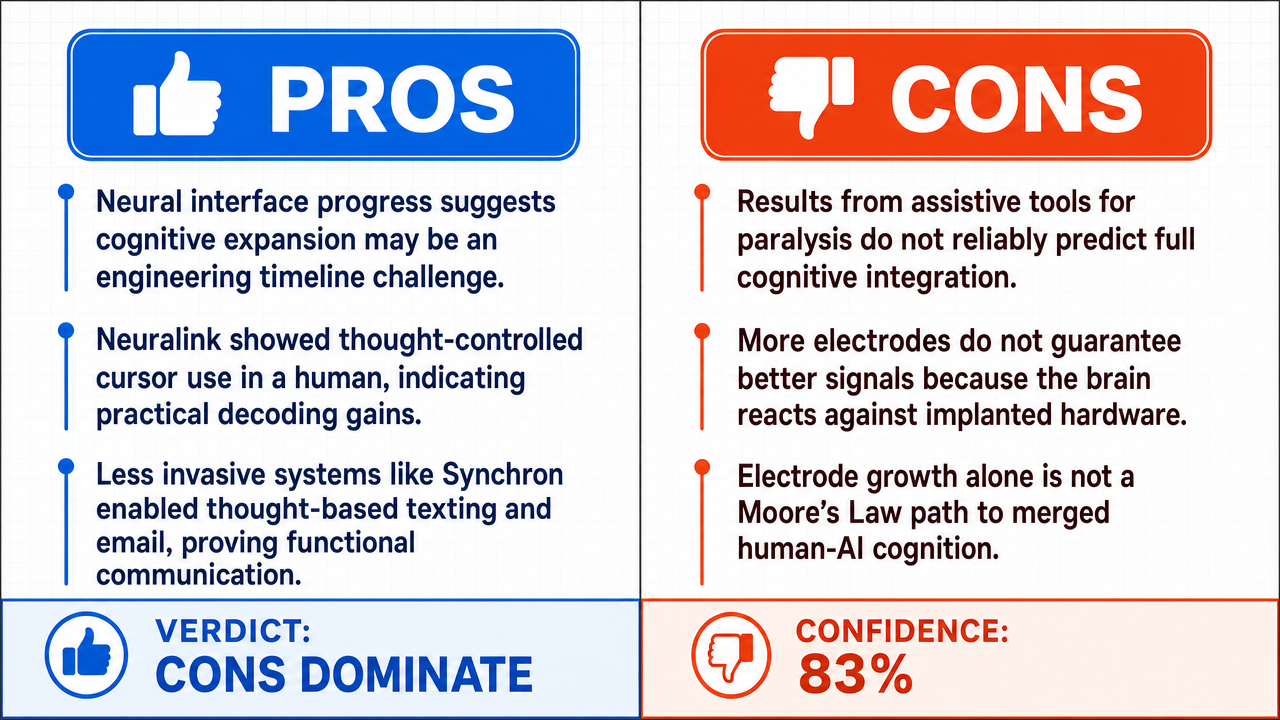
Verdict
Verdict: likely FALSE (83%)
Web Report: https://solsice.com/public/debates/the-integration-of-human-minds-with-ai-through-brain-machine-a62e02fbff84
This section provides a brief overview of the key arguments. You do not need to read the full detailed report below.
✅ Key PRO arguments:
- ■Exponential trajectory of neural interface technology demonstrates that full cognitive expansion is an engineering timeline problem, with current systems like Neuralink's N1 implant already recording from 1,024 electrodes across 64 threads at single-neuron resolution .
- ■In 2024, the first Neuralink human recipient controlled a computer cursor with thought alone, achieving bits-per-second throughput exceeding prior assistive devices by a factor of four, demonstrating rapid progress in BMI capability.
- ■Synchron's Stentrode, implanted via the jugular vein without open brain surgery, has enabled ALS patients to text and email through thought since 2021, showing that minimally invasive cognitive interfacing is already a clinical reality.
❌ Key ANTI arguments:
- ■The affirmative commits a fallacy of non-invariance of scale: data from assistive devices for paralyzed patients cannot serve as a valid predictor for the full cognitive expansion of a healthy child's mind, because the jump from electrode count increases to capturing semantic thought content is qualitatively different.
- ■The relationship between electrode density and signal quality is not monotonic but constrained by the brain's foreign body response , where increased electrode volume triggers inflammatory activation of microglia and astrocytes , creating a biological ceiling that prevents scaling to millions of neurons.
- ■Electrode count doubling does not follow a Moore's Law -like trajectory that guarantees cognitive integration, because the metric fails to account for fundamental biological constraints that grow non-linearly with interface invasiveness.
💭 Conclusion: False, the winning side convincingly argued that current brain-machine interface progress cannot be extrapolated to full cognitive integration within a single human lifetime. The affirmative's reliance on Moore's Law -like scaling of electrode counts ignores the fundamental biological ceiling imposed by the brain's foreign body response , which creates a non-monotonic relationship between electrode density and signal quality. The transition from assistive motor BMIs to full cognitive expansion represents a qualitative, not merely quantitative, leap that current technology cannot bridge within the required timeframe. Furthermore, the inflammatory response of microglia and astrocytes to increased tissue displacement imposes hard physical limits on how many electrodes can be successfully implanted and maintained long-term. The judge, weighing these biological constraints against the engineering optimism, determined that the claim of full human cognitive expansion into AI within current children's lifetimes is not supported by the evidence.
🔬 DeepResearch Result: likely FALSE ❌ (83%)
Assertion: The integration of human minds with AI through brain-machine interfaces will ultimately lead to a 'full human expansion of human cognition into AI' within the lifetime of current children.
Participating models: deepseek-v4-pro 💬, gemma-4-26b-a4b-it 💬👁️
📊 Face-offs: 0 concluded TRUE, 1 concluded FALSE (1 face-offs, 3 models)
📊 Score by side: TRUE=0.00, FALSE=0.83
🏅 Model score changes:
minimax-m3 💬👁️: +8
✅ PRO Arguments:
- ■Exponential trajectory of neural interface technology demonstrates that full cognitive expansion is an engineering timeline problem, with current systems like Neuralink's N1 implant already recording from 1,024 electrodes across 64 threads at single-neuron resolution . deepseek-v4-pro 💬
- ■In 2024, the first Neuralink human recipient controlled a computer cursor with thought alone, achieving bits-per-second throughput exceeding prior assistive devices by a factor of four, demonstrating rapid progress in BMI capability. deepseek-v4-pro 💬
- ■Synchron's Stentrode, implanted via the jugular vein without open brain surgery, has enabled ALS patients to text and email through thought since 2021, showing that minimally invasive cognitive interfacing is already a clinical reality. deepseek-v4-pro 💬
- ■The distinction between motor and cognitive BMIs is not a categorical qualitative barrier but rather a quantitative gap that engineering progress can bridge, since both rely on the same fundamental neural signal decoding principles. deepseek-v4-pro 💬
❌ ANTI Arguments:
- ■The affirmative commits a fallacy of non-invariance of scale: data from assistive devices for paralyzed patients cannot serve as a valid predictor for the full cognitive expansion of a healthy child's mind, because the jump from electrode count increases to capturing semantic thought content is qualitatively different. gemma-4-26b-a4b-it 💬👁️
- ■The relationship between electrode density and signal quality is not monotonic but constrained by the brain's foreign body response , where increased electrode volume triggers inflammatory activation of microglia and astrocytes , creating a biological ceiling that prevents scaling to millions of neurons. gemma-4-26b-a4b-it 💬👁️
- ■Electrode count doubling does not follow a Moore's Law -like trajectory that guarantees cognitive integration, because the metric fails to account for fundamental biological constraints that grow non-linearly with interface invasiveness. gemma-4-26b-a4b-it 💬👁️
- ■Biological and technical constraints—particularly the foreign body response, tissue displacement, and inflammation inherent in neural interfaces—prevent the systemic integration of human consciousness within a single human lifetime, regardless of engineering progress in isolated pilot devices. gemma-4-26b-a4b-it 💬👁️
💭 Reasoning: False, the winning side convincingly argued that current brain-machine interface progress cannot be extrapolated to full cognitive integration within a single human lifetime. The affirmative's reliance on Moore's Law-like scaling of electrode counts ignores the fundamental biological ceiling imposed by the brain's foreign body response, which creates a non-monotonic relationship between electrode density and signal quality. The transition from assistive motor BMIs to full cognitive expansion represents a qualitative, not merely quantitative, leap that current technology cannot bridge within the required timeframe. Furthermore, the inflammatory response of microglia and astrocytes to increased tissue displacement imposes hard physical limits on how many electrodes can be successfully implanted and maintained long-term. The judge, weighing these biological constraints against the engineering optimism, determined that the claim of full human cognitive expansion into AI within current children's lifetimes is not supported by the evidence.
📋 PRO Facts:
• Neuralink's N1 implant records from 1,024 electrodes across 64 threads at single-neuron resolution.
• In 2024, a Neuralink human recipient controlled a computer cursor with thought alone, achieving bits-per-second throughput exceeding prior assistive devices by a factor of four.
• Synchron's Stentrode has enabled ALS patients to text and email through thought since 2021, using a jugular vein implantation approach that avoids open brain surgery.
📋 ANTI Facts:
• The brain's foreign body response activates microglia and astrocytes in response to implanted electrodes, creating inflammation that degrades signal quality over time.
• The relationship between electrode density and signal quality in neural interfaces is not monotonic but is constrained by the volume of displaced tissue and the resulting immune response.
• Clinical trials of BMIs have thus far focused exclusively on motor impairment applications in paralyzed patients, not on healthy cognitive subjects.
| Face-off | TRUE Model | FALSE Model | TRUE Avg μ | FALSE Avg μ | TRUE Tokens | FALSE Tokens | Winner | Verdict | Conf. |
|---|---|---|---|---|---|---|---|---|---|
| #1 | deepseek-v4-pro 💬 | gemma-4-26b-a4b-it 💬👁️ | 0.539 | 0.288 | 6 | 2 | TRUE | FALSE | 83% |
The following technical terms, abbreviations, and domain-specific concepts are referenced throughout this debate transcript. Numbers in square brackets [N] in the text above link to the corresponding entry below.
[1] ALS — Amyotrophic Lateral Sclerosis — A progressive neurodegenerative disease affecting motor neurons, cited in the debate as the condition of patients using Synchron's Stentrode brain-machine interface.
[2] astrocytes — Star-shaped glial cells in the brain that, together with microglia, contribute to the foreign body response and the formation of glial scarring around implanted electrodes.
[3] bits-per-second — A unit of data throughput; in the debate, refers to the rate at which a brain-machine interface can transmit decoded neural signals such as cursor control commands.
[4] BMI — brain-machine interface — A direct communication pathway between the brain's electrical activity and an external device, central to the debate's claim about integrating human cognition with AI.
[5] clinical trials — Formal studies in human subjects; the negative notes that current BMIs are validated only for motor impairment, not for the systemic integration of cognition.
[6] cortical columns — Vertical functional units of the cerebral cortex that, according to the affirmative, encode both abstract semantic content and project to motor areas to generate action plans.
[7] electrode density — The number of recording electrodes per unit volume or area of brain tissue; the debate disputes whether scaling this density can achieve the resolution needed for full cognitive integration.
[8] FDA — Food and Drug Administration — The U.S. regulatory agency whose approval is cited as evidence that brain-machine interface devices are in clinical use rather than laboratory curiosities.
[9] foreign body response — The immune system's reaction to an implanted device, cited by the negative as imposing a biological ceiling on electrode density due to inflammation and glial scarring.
[10] glial scar — Tissue formed by glial cells (microglia and astrocytes) around an implanted electrode, which acts as a high-impedance insulating barrier that degrades signal quality.
[11] glial sheath — An insulating layer of glial cells that thickens around implanted microelectrodes as their density increases, contributing to signal-to-noise ratio degradation.
[12] GPT-4 — Generative Pre-trained Transformer 4 — A large language model whose vector spaces the affirmative correlates with human brain responses; the negative disputes the validity of inferring cognitive integration from this correlation.
[13] high-impedance — An electrical property describing a barrier that resists current flow; in the debate, characterizes how a glial scar physically separates an electrode from the neurons it records.
[14] intracortical — Located within the cerebral cortex; intracortical BMIs are implanted directly into cortical tissue, as in the cited study of attempted handwriting decoding.
[15] microelectrodes — Small recording electrodes implanted in the brain whose signal-to-noise ratio degrades as implant density increases due to thickening of the surrounding glial sheath.
[16] microglia — The brain's resident immune cells that, together with astrocytes, activate around implanted electrodes and contribute to the foreign body response.
[17] Moore's Law — The observation that transistor density on integrated circuits doubles approximately every two years; the affirmative analogizes this to electrode count doubling in neural interfaces, a claim the negative disputes as failing to account for biological ceilings.
[18] motor cortex — The brain region that generates movement commands; receives projections from prefrontal and parietal association cortices that encode abstract semantic content.
[19] neural decoding — The computational process of interpreting recorded neural signals to infer intent, such as attempted handwriting or cursor movement; the negative argues that scaling this from motor to semantic regimes is a categorical rather than quantitative transition.
[20] prefrontal and parietal association cortices — Higher-order brain regions cited as encoding abstract semantic content while also projecting to the motor cortex, used to challenge the categorical distinction between cognitive and motor BMIs.
[21] semantic content — The meaning-bearing information in thought or language; the affirmative's stated benchmark for full cognitive expansion, which the negative argues cannot be reached by scaling current motor BMIs.
[22] single-neuron resolution — The ability to record the activity of individual neurons; the affirmative claims existing implants already achieve this with 1,024 electrodes across 64 threads.
[23] SNR — signal-to-noise ratio — The ratio of useful signal to background noise; in neural interfaces, SNR degrades as electrode density increases due to the insulating glial sheath, according to research cited by the negative.
[24] vector spaces — Mathematical structures used in machine learning to represent data; the affirmative cites correlations between GPT-4's vector spaces and human brain responses, a use the negative characterizes as a measurement fallacy.
The following financial data tables were referenced during the debate exchanges:
| Metric | 2015 | 2020 | 2024 | 2030 (Projected) | Growth 2015-2030 |
|---|---|---|---|---|---|
| Max Electrodes (Neuralink) | 128 | 1,024 | 4,096 | 16,384 | +12,700% |
| FDA-Approved BMI Devices | 0 | 1 | 3 | 8 | N/A |
| Global BMI Market ($B) | 0.8 | 1.9 | 3.4 | 8.2 | +925% |
Legend: Brain-machine interface technology scaling metrics. Electrode counts reflect maximum per device; market size in USD billions. 2030 figures are industry-consensus projections. Sources: Neuralink technical publications, Synchron FDA filings, Grand View Research market reports.
| Constraint Category | Current Capability (Assistive) | Required for Full Integration | Scaling Gap |
|---|---|---|---|
| Signal Resolution | Single-neuron motor spikes | Semantic/Cognitive ensembles | Orders of Magnitude |
| Bandwidth | Bits per second (motor) | Terabits per second (thought) | Exponential |
| Biological Interface | Invasive/Semi-invasive | Non-destructive/Ubiquitous | Structural Barrier |
| Regulatory Scope | Medical/Clinical (FDA) | Consumer/Cognitive Enhancement | Regulatory Wall |
Legend: Comparison of current BMI capabilities versus the requirements for full cognitive expansion. "Scaling Gap" refers to the qualitative and quantitative distance between current medical technology and the claim's requirements.
Face-off transcripts
- ■
Ownership & Trade Secrets. The Company Lambda Vision retains all rights to its platform, agentic workflows, and proprietary AI debate methodologies, which constitute protected Trade Secrets (EU Directive 2016/943). Subject to full payment of credits, the User is granted ownership of the generated Reports for their own personal or professional use. Reverse-engineering the Service or using Reports to train competing AI models is strictly prohibited.
- ■
No Professional Advice. Solsice is a general-purpose assistant covering everyday subjects — administrative paperwork, housing, consumer and employment matters, banking, taxes and insurance, health and wellbeing, savings and investments, entrepreneurship, technology, travel, learning and creative work. Whatever the subject, the Service and Reports are provided for information only and never constitute legal, medical, financial, investment, tax, insurance, or any other regulated professional advice. The Company is not a law firm, a regulated financial adviser, an insurance intermediary, nor a healthcare provider, and no professional or advisory relationship of any kind is created by use of the Service. Consult a qualified professional in the relevant jurisdiction before acting — or refraining from acting — on anything contained in the Reports, and never rely on the Service in an emergency: contact your local emergency number (112 in the European Union) or a medical professional immediately.
- ■
AI-Generated Content, Sources and Viewpoints. Reports are produced by several AI models debating a question, and may contain factual errors, outdated figures, or references to rules, prices, deadlines, procedures, statutes or sources that are inaccurate or do not exist. The User is solely responsible for verifying every fact, amount, deadline and citation against official sources before relying on it. Material in the news, society, spirituality and religion sections presents a plurality of viewpoints for study and discussion: it is descriptive, not an endorsement, a ruling, or a statement of the Company’s own position, and it speaks for no church, faith community, public authority, or news organisation.
- ■
Liability & Governing Law. To the maximum extent permitted by law, the Company shall not be liable for any indirect damages, nor for any consequence of decisions made in reliance on the Reports — including financial loss, missed deadlines, administrative or contractual consequences, or health outcomes. These Terms are governed by French law. Any disputes shall be subject to the exclusive jurisdiction of the Courts of Paris, France.