
The integration of AI into a content creator's work will enable direct, practical support for urgent, real-life cleaning situations.
AI debate verdict and arguments
⚠️ AI-generated information only; not professional advice
Completed October 11, 2026
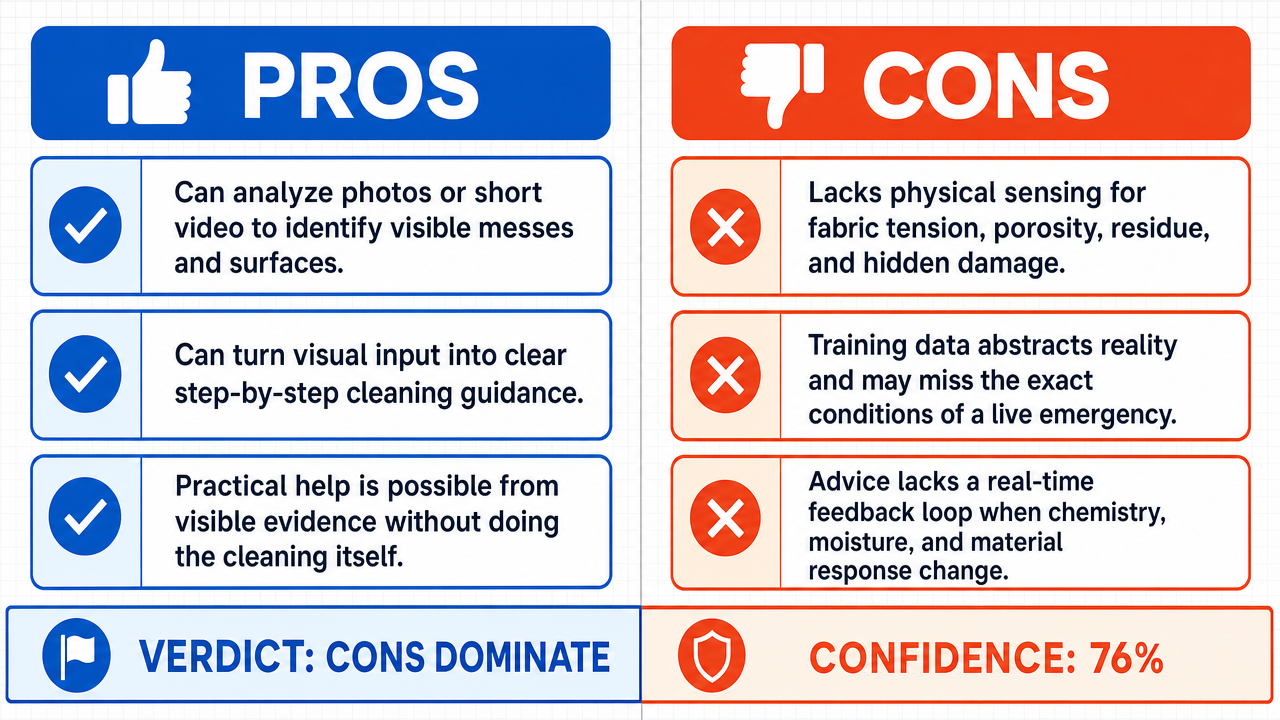
Verdict
Verdict: likely FALSE (76%)
This section provides a brief overview of the key arguments. You do not need to read the full detailed report below.
✅ Key PRO arguments:
- ■Multimodal AI can receive a photo or short video, identify visible objects and surface conditions, and convert that into step-by-step procedural language, which is exactly what urgent cleaning situations require.
- ■Visual question answering and multimodal LLM research establish that image-grounded questions can be answered with text and that models can follow visual instructions, supporting the feasibility of AI-assisted cleaning guidance.
- ■Direct practical support does not require AI to physically clean or sense hidden material properties; it only requires converting the user's visible evidence into safe next actions.
❌ Key ANTI arguments:
- ■AI lacks physical grounding and sensory depth: while it can identify a 'red wine stain,' it cannot assess the tactile tension of a fabric, the porosity of a stone surface, or the chemical reactivity of a substrate in real-time.
- ■AI models are trained on static datasets that represent massive abstractions of reality, not the granular physical nuances of a specific household emergency, so any 'support' is merely a statistical approximation.
- ■Tailored checklists lack the necessary situational feedback loop because the effectiveness of each step depends on real-time physical variables such as chemical reaction rates that AI cannot monitor.
💭 Conclusion: False. The negative side prevailed because it demonstrated that AI integration into content creator workflows cannot reliably bridge the gap between an urgent cleaning emergency and a safe resolution. The affirmative's reliance on multimodal visual recognition was undermined by the structural absence of physical grounding , since images do not reveal porosity or chemical composition. The negative further showed that each of the affirmative's proposed output formats—checklists, safety warnings, and short videos—lacks the situational feedback loop required for high-stakes cleaning tasks involving chemical incompatibility and substrate damage. Because the affirmative's claim required AI to deliver 'direct, practical support' in emergencies where mistakes carry real consequences, the absence of real-time physical sensing proved fatal to the argument. The affirmative did establish that multimodal AI can produce plausible procedural text from images.
🔬 DeepResearch Result: likely FALSE ❌ (76%)
Assertion: The integration of AI into a content creator's work will enable direct, practical support for urgent, real-life cleaning situations.
Participating models: deepseek-v3.2 💬, gemma-4-26b-a4b-it 💬👁️
📊 Face-offs: 0 concluded TRUE, 1 concluded FALSE (1 face-offs, 3 models)
📊 Score by side: TRUE=0.00, FALSE=0.76
🏅 Model score changes:
minimax-m3 💬👁️: +8
✅ PRO Arguments:
- ■Multimodal AI can receive a photo or short video, identify visible objects and surface conditions, and convert that into step-by-step procedural language, which is exactly what urgent cleaning situations require. deepseek-v3.2 💬
- ■Visual question answering and multimodal LLM research establish that image-grounded questions can be answered with text and that models can follow visual instructions, supporting the feasibility of AI-assisted cleaning guidance. deepseek-v3.2 💬
- ■Direct practical support does not require AI to physically clean or sense hidden material properties; it only requires converting the user's visible evidence into safe next actions. deepseek-v3.2 💬
- ■Generative-AI adoption evidence shows these tools are already used for drafting, summarizing, and producing audience-facing media, so the creator pipeline can plausibly extend to cleaning guidance. deepseek-v3.2 💬
❌ ANTI Arguments:
- ■AI lacks physical grounding and sensory depth: while it can identify a 'red wine stain,' it cannot assess the tactile tension of a fabric, the porosity of a stone surface, or the chemical reactivity of a substrate in real-time. gemma-4-26b-a4b-it 💬👁️
- ■AI models are trained on static datasets that represent massive abstractions of reality, not the granular physical nuances of a specific household emergency, so any 'support' is merely a statistical approximation. gemma-4-26b-a4b-it 💬👁️
- ■Tailored checklists lack the necessary situational feedback loop because the effectiveness of each step depends on real-time physical variables such as chemical reaction rates that AI cannot monitor. gemma-4-26b-a4b-it 💬👁️
- ■High-stakes cleaning involves severe risks of chemical incompatibility and permanent surface damage, which AI-generated instructions cannot safely mitigate without a real-time physical feedback loop. gemma-4-26b-a4b-it 💬👁️
- ■The three proposed forms of support (tailored checklists, safety warnings, and short videos) exhaust the affirmative's options, and each one independently fails to provide practical utility in an urgent, real-life cleaning situation. gemma-4-26b-a4b-it 💬👁️
💭 Reasoning: False. The negative side prevailed because it demonstrated that AI integration into content creator workflows cannot reliably bridge the gap between an urgent cleaning emergency and a safe resolution. The affirmative's reliance on multimodal visual recognition was undermined by the structural absence of physical grounding, since images do not reveal porosity or chemical composition. The negative further showed that each of the affirmative's proposed output formats—checklists, safety warnings, and short videos—lacks the situational feedback loop required for high-stakes cleaning tasks involving chemical incompatibility and substrate damage. Because the affirmative's claim required AI to deliver 'direct, practical support' in emergencies where mistakes carry real consequences, the absence of real-time physical sensing proved fatal to the argument. The affirmative did establish that multimodal AI can produce plausible procedural text from images.
📋 PRO Facts:
• Visual question answering and multimodal LLM research demonstrate that image-grounded questions can be answered with procedural text.
• AI-integrated creator workflows can turn urgent household situations into usable next steps.
📋 ANTI Facts:
• Multimodal models can hallucinate, and images do not reveal porosity or chemical composition.
• Urgent cleaning involves physical properties such as porosity and chemical composition that images cannot reveal.
• High-stakes cleaning carries risks of chemical incompatibility and substrate damage that require physical feedback to mitigate safely.
| Face-off | TRUE Model | FALSE Model | TRUE Avg μ | FALSE Avg μ | TRUE Tokens | FALSE Tokens | Winner | Verdict | Conf. |
|---|---|---|---|---|---|---|---|---|---|
| #1 | deepseek-v3.2 💬 | gemma-4-26b-a4b-it 💬👁️ | 0.577 | 0.471 | 12 | 3 | TRUE | FALSE | 76% |
The following technical terms, abbreviations, and domain-specific concepts are referenced throughout this debate transcript. Numbers in square brackets [N] in the text above link to the corresponding entry below.
[1] anomaly — In the context of this debate, a deviation from expected behavior or a counterexample that complicates a claim (e.g., AI hallucinations are described as a real anomaly rather than a refutation).
[2] auxiliary assumption — A supporting premise that must hold for a main claim to be valid; in argumentation, identifying the weakest auxiliary assumption is a common attack point.
[3] chemical incompatibility — A condition in which two or more substances react dangerously when combined, a risk highlighted in cleaning contexts where AI may suggest mixing agents.
[4] chemical reactivity — The tendency of a substance to undergo a chemical reaction with another material, relevant to whether a cleaning product is safe for a given surface.
[5] cognitive load — The amount of mental effort and working memory required to process information; cited as a barrier to using video instructions during an active emergency.
[6] feedback loop — A process in which outputs of a system are fed back as inputs, enabling iterative adjustment; the negative argues AI-generated checklists lack this real-time loop.
[7] Generative-AI — AI systems designed to produce new content such as text, images, audio, or video, as opposed to only classifying or retrieving existing data.
[8] hallucination (in AI context) — When an AI model generates false, fabricated, or unsupported information and presents it as factual; acknowledged by both sides as a real risk in multimodal models.
[9] image-grounded — Referring to questions, prompts, or tasks that are anchored in visual input (a photo or video) rather than text alone.
[10] latency — The delay between an input and the corresponding response in a system; cited as a reason video-based AI support is impractical during an urgent cleaning event.
[11] multimodal AI — AI systems that can process and integrate multiple types of data inputs (e.g., text, images, video, audio) rather than a single modality.
[12] multimodal grounding — The process of connecting language outputs to visual or perceptual elements so that model responses are tied to actual image content.
[13] multimodal Large Language Models (LLMs) — Large language models extended beyond text to process additional input types such as images, enabling image-grounded question answering.
[14] physical grounding — The connection between a model's digital representations and actual physical properties of the real world; the negative argues multimodal AI lacks this.
[15] porosity — The measure of void spaces in a material, which determines how readily it absorbs liquids; cited as a hidden property AI cannot assess from a photo.
[16] refutation — An argument that disproves, undermines, or successfully challenges an opposing claim.
[17] spot test — A preliminary test applied to a small, inconspicuous area of a surface to check for adverse reactions before full treatment.
[18] substrate — The underlying surface or material being treated, cleaned, or otherwise acted upon.
[19] tactile tension — A physical property of a fabric relating to its stretch, firmness, or resistance; cited as an example of a tactile property AI cannot measure from an image.
[20] visual proxy — A visual representation (such as a photo) that stands in for but does not fully capture the underlying physical reality of a situation.
[21] visual question answering — VQA — A computer vision task in which a model receives an image and a natural-language question and produces a text answer grounded in the image.
Face-off transcripts
- ■
Ownership & Trade Secrets. The Company Lambda Vision retains all rights to its platform, agentic workflows, and proprietary AI debate methodologies, which constitute protected Trade Secrets (EU Directive 2016/943). Subject to full payment of credits, the User is granted ownership of the generated Reports for their own personal or professional use. Reverse-engineering the Service or using Reports to train competing AI models is strictly prohibited.
- ■
No Professional Advice. Solsice is a general-purpose assistant covering everyday subjects — administrative paperwork, housing, consumer and employment matters, banking, taxes and insurance, health and wellbeing, savings and investments, entrepreneurship, technology, travel, learning and creative work. Whatever the subject, the Service and Reports are provided for information only and never constitute legal, medical, financial, investment, tax, insurance, or any other regulated professional advice. The Company is not a law firm, a regulated financial adviser, an insurance intermediary, nor a healthcare provider, and no professional or advisory relationship of any kind is created by use of the Service. Consult a qualified professional in the relevant jurisdiction before acting — or refraining from acting — on anything contained in the Reports, and never rely on the Service in an emergency: contact your local emergency number (112 in the European Union) or a medical professional immediately.
- ■
AI-Generated Content, Sources and Viewpoints. Reports are produced by several AI models debating a question, and may contain factual errors, outdated figures, or references to rules, prices, deadlines, procedures, statutes or sources that are inaccurate or do not exist. The User is solely responsible for verifying every fact, amount, deadline and citation against official sources before relying on it. Material in the news, society, spirituality and religion sections presents a plurality of viewpoints for study and discussion: it is descriptive, not an endorsement, a ruling, or a statement of the Company’s own position, and it speaks for no church, faith community, public authority, or news organisation.
- ■
Liability & Governing Law. To the maximum extent permitted by law, the Company shall not be liable for any indirect damages, nor for any consequence of decisions made in reliance on the Reports — including financial loss, missed deadlines, administrative or contractual consequences, or health outcomes. These Terms are governed by French law. Any disputes shall be subject to the exclusive jurisdiction of the Courts of Paris, France.