
The integration of additive manufacturing into end-use automotive production provides a superior return on investment compared to traditional subtractive manufacturing methods for low-volume vehicle components.
AI debate verdict and arguments
⚠️ AI-generated information only; not professional advice
Completed November 13, 2026
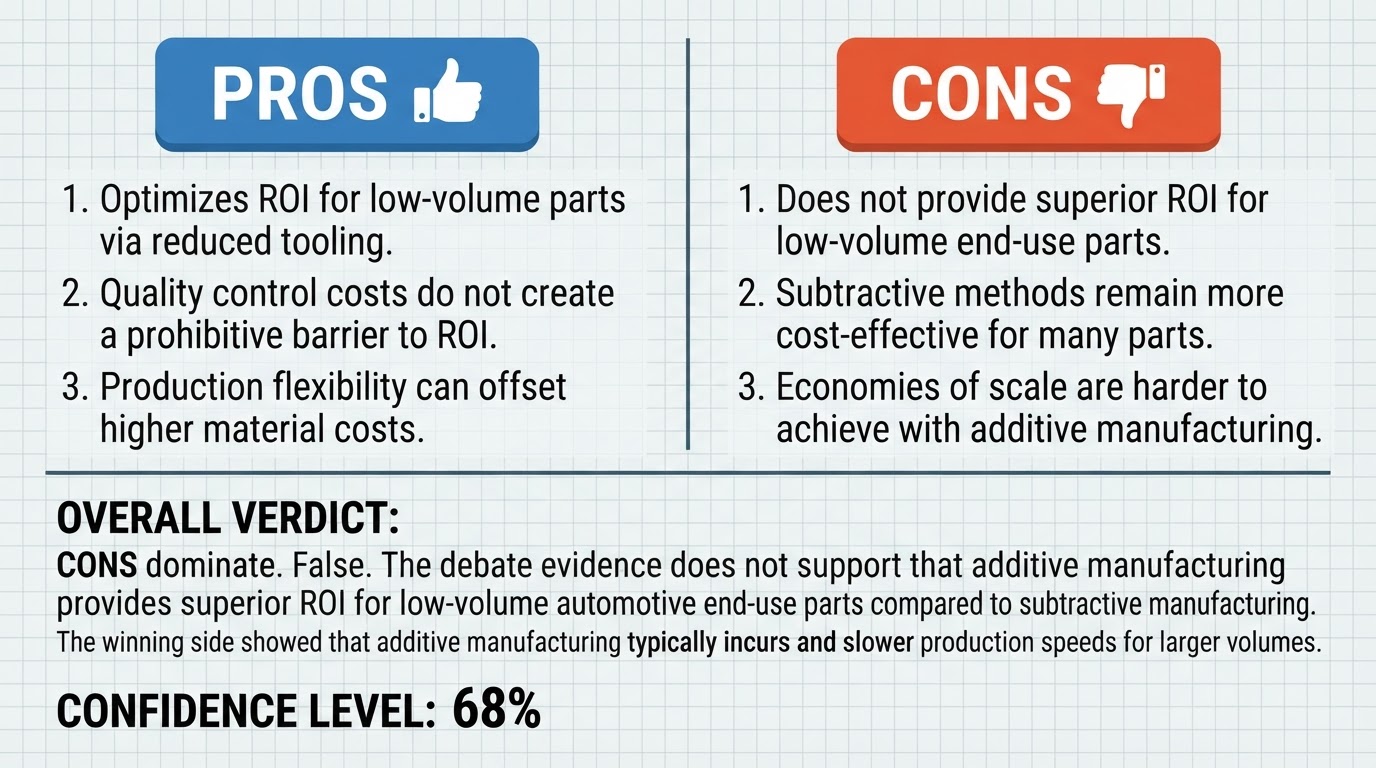
Verdict
Verdict: likely FALSE (68%)
Web Report: https://solsice.com/public/debates/the-integration-of-additive-manufacturing-into-end-use-autom-153862f3bfd2
This section provides a brief overview of the key arguments. You do not need to read the full detailed report below.
✅ Key PRO arguments:
- ■Additive manufacturing optimizes ROI for low-volume automotive parts through reduced tooling and complexity. The primary driver of superior ROI in low-volume production is the elimination of high non-recurring engineering (NRE ) costs associated with traditional manufacturing. Subtractive methods require significant upfront investment in specialized tooling, jigs , and custom fixtures ; for low-volume runs these fixed costs are amortized over very few units, leading to high cost-per-part . Additive manufacturing operates on a 'tool-less' paradigm where the digital file serves as the primary manufacturing input.
- ■Quality control and certification costs do not create a prohibitive barrier to ROI for additive manufacturing in low-volume automotive production. Certification complexity is a systemic requirement for all automotive manufacturing, not a unique burden of additive methods. For low-volume, high-complexity components, additive manufacturing can simplify the certification pathway by reducing the number of individual parts that must be validated, consolidating parts into a single integrated component.
❌ Key ANTI arguments:
- ■Additive manufacturing does not provide superior ROI for low-volume automotive end-use parts compared to subtractive methods. Additive manufacturing typically incurs significantly higher material costs per part, as the process builds parts layer-by-layer using expensive feedstocks that must be precisely controlled for dimensional accuracy and surface finish . Furthermore, production rates for additive manufacturing are generally an order of magnitude slower than CNC machining or other subtractive processes, which can machine multiple parts simultaneously on multi-axis machines .
💭 Conclusion: False. The debate evidence does not support that additive manufacturing provides superior ROI for low-volume automotive end-use parts compared to subtractive manufacturing . The winning side showed that additive manufacturing typically incurs significantly higher material costs per part because it builds parts layer-by-layer from expensive feedstocks . It also demonstrated that production rates for additive manufacturing are generally an order of magnitude slower than CNC machining , which can machine multiple parts simultaneously on multi-axis machines . These cost and throughput disadvantages directly undermine the claimed ROI advantage, especially for low-volume end-use parts where per-part economics are decisive. The judge assigned 68% confidence to the FALSE verdict, and the confidence-weighted score for FALSE was 0.68 versus 0.00 for TRUE.
🔬 DeepResearch Result: likely FALSE ❌ (68%)
Assertion: The integration of additive manufacturing into end-use automotive production provides a superior return on investment compared to traditional subtractive manufacturing methods for low-volume vehicle components .
Participating models: gemma-4-26b-a4b-it 💬👁️, glm-4.7-flash 💬
📊 Face-offs: 0 concluded TRUE, 1 concluded FALSE (1 face-offs, 3 models)
📊 Score by side: TRUE=0.00, FALSE=0.68
🏅 Model score changes:
deepseek-v4-flash-0731 💬: +7
✅ PRO Arguments:
- ■Additive manufacturing optimizes ROI for low-volume automotive parts through reduced tooling and complexity. The primary driver of superior ROI in low-volume production is the elimination of high non-recurring engineering (NRE ) costs associated with traditional manufacturing. Subtractive methods require significant upfront investment in specialized tooling, jigs , and custom fixtures ; for low-volume runs these fixed costs are amortized over very few units, leading to high cost-per-part . Additive manufacturing operates on a 'tool-less' paradigm where the digital file serves as the primary manufacturing input. gemma-4-26b-a4b-it 💬👁️
- ■Quality control and certification costs do not create a prohibitive barrier to ROI for additive manufacturing in low-volume automotive production. Certification complexity is a systemic requirement for all automotive manufacturing, not a unique burden of additive methods. For low-volume, high-complexity components, additive manufacturing can simplify the certification pathway by reducing the number of individual parts that must be validated, consolidating parts into a single integrated component. gemma-4-26b-a4b-it 💬👁️
❌ ANTI Arguments:
- ■Additive manufacturing does not provide superior ROI for low-volume automotive end-use parts compared to subtractive methods. Additive manufacturing typically incurs significantly higher material costs per part, as the process builds parts layer-by-layer using expensive feedstocks that must be precisely controlled for dimensional accuracy and surface finish . Furthermore, production rates for additive manufacturing are generally an order of magnitude slower than CNC machining or other subtractive processes, which can machine multiple parts simultaneously on multi-axis machines . glm-4.7-flash 💬
💭 Reasoning: False. The debate evidence does not support that additive manufacturing provides superior ROI for low-volume automotive end-use parts compared to subtractive manufacturing. The winning side showed that additive manufacturing typically incurs significantly higher material costs per part because it builds parts layer-by-layer from expensive feedstocks. It also demonstrated that production rates for additive manufacturing are generally an order of magnitude slower than CNC machining, which can machine multiple parts simultaneously on multi-axis machines. These cost and throughput disadvantages directly undermine the claimed ROI advantage, especially for low-volume end-use parts where per-part economics are decisive. The judge assigned 68% confidence to the FALSE verdict, and the confidence-weighted score for FALSE was 0.68 versus 0.00 for TRUE.
📋 PRO Facts:
• Additive manufacturing eliminates high non-recurring engineering costs associated with traditional tooling.
• Additive manufacturing uses a tool-less paradigm where the digital file is the primary manufacturing input.
• Additive manufacturing can consolidate multiple parts into a single integrated component, potentially simplifying certification.
📋 ANTI Facts:
• Additive manufacturing typically incurs higher material costs per part than subtractive methods.
• Additive manufacturing production rates are generally an order of magnitude slower than CNC machining.
• Subtractive processes can machine multiple parts simultaneously on multi-axis machines.
| Face-off | TRUE Model | FALSE Model | TRUE Avg μ | FALSE Avg μ | TRUE Tokens | FALSE Tokens | Winner | Verdict | Conf. |
|---|---|---|---|---|---|---|---|---|---|
| #1 | gemma-4-26b-a4b-it 💬👁️ | glm-4.7-flash 💬 | 0.275 | 0.267 | 2 | 4 | TRUE | FALSE | 68% |
The following technical terms, abbreviations, and domain-specific concepts are referenced throughout this debate transcript. Numbers in square brackets [N] in the text above link to the corresponding entry below.
[1] additive manufacturing — A manufacturing process that builds parts layer-by-layer from digital files, described in the debate as tool-less and enabling part consolidation.
[2] AM — additive manufacturing — A manufacturing process that builds parts layer-by-layer from digital files, described in the debate as tool-less and enabling part consolidation.
[3] break-even point — The production volume at which total costs are recovered; additive manufacturing is claimed to reach it earlier than subtractive methods.
[4] capital expenditures — Upfront spending on long-term assets such as tooling and machinery.
[5] certification — The process of validating that parts meet regulatory and performance requirements; in the debate, each part or assembly requires certification packages.
[6] closed-loop control systems — Systems that use sensor feedback to automatically adjust manufacturing parameters in real time.
[7] CNC machining — computer numerical control machining — A subtractive manufacturing process using computer-controlled tools; cited as able to machine multiple parts simultaneously on multi-axis machines.
[8] cost-per-part — The total manufacturing cost attributed to each individual part.
[9] dimensional accuracy — The degree to which a manufactured part's dimensions match the design specifications.
[10] end-use automotive production — Manufacturing of final functional parts for vehicles, as opposed to prototypes or non-production items.
[11] feedstocks — Raw materials used in additive manufacturing, described as expensive and requiring precise control.
[12] fixed costs — Costs that do not vary with production volume, such as tooling and non-recurring engineering.
[13] fixtures — Custom work-holding devices used to secure parts during machining.
[14] in-situ monitoring — Real-time observation of the manufacturing process as it occurs, cited as mitigating process sensitivity.
[15] injection molding — A traditional manufacturing process for plastic components that requires significant upfront investment in specialized tooling.
[16] jigs — Custom guides used in manufacturing to hold parts and ensure repeatability.
[17] lifecycle testing — Testing performed to validate that a part performs over its expected service life.
[18] low-volume vehicle components — Vehicle parts produced in small quantities, where tooling amortization is minimal and per-part costs dominate.
[19] machine cycle time — The time required to complete one manufacturing cycle for a part.
[20] material characterization — Testing and analysis to determine the properties of materials used in parts.
[21] material cost — The cost of raw material consumed to produce a part; cited as higher in additive manufacturing.
[22] multi-axis machines — Machining equipment capable of moving tools or parts along multiple axes, allowing simultaneous machining of multiple parts.
[23] NRE — non-recurring engineering — One-time engineering costs incurred before production, cited as a major fixed cost in traditional manufacturing.
[24] operational expenditures — Ongoing costs incurred during production, such as materials and machine operation.
[25] part consolidation — Combining multiple discrete parts into a single integrated component, reducing the number of parts requiring separate validation.
[26] precision — The exactness with which a manufacturing process reproduces specified dimensions.
[27] process sensitivity — The susceptibility of a manufacturing process's output to variations in process conditions.
[28] production rate — The speed at which parts are produced; additive manufacturing is cited as an order of magnitude slower.
[29] quality assurance — Systematic activities designed to ensure that manufacturing processes and products meet quality requirements.
[30] quality control — Operational techniques used to verify that manufactured parts meet specifications.
[31] real-time sensor data — Data collected from sensors during production and used for immediate process control.
[32] repeatability — The ability of a manufacturing process to produce consistent results across multiple runs.
[33] ROI — return on investment — A measure of the profitability of an investment; the debate centers on whether additive manufacturing yields a superior ROI for low-volume parts.
[34] subtractive manufacturing — Manufacturing methods that create parts by removing material from a workpiece, such as CNC machining.
[35] surface finish — The quality and texture of a part's surface, cited as requiring precise control in additive manufacturing.
[36] throughput — The volume of parts produced in a given time period.
[37] tool-less paradigm — An additive manufacturing approach that uses digital files instead of physical tooling, shifting costs from fixed capital to variable operational expenditures.
[38] tooling — Specialized equipment such as molds, dies, and fixtures used in traditional manufacturing; requires significant upfront investment.
[39] tooling amortization — The spreading of tooling costs over the number of units produced; minimal for low volumes.
[40] topological optimization — A design method that optimizes material distribution within a part, cited as a source of cost savings in additive manufacturing.
[41] unit cost — The cost to produce a single unit, driven by material cost and machine cycle time.
Face-off transcripts
- ■
Ownership & Trade Secrets. The Company Lambda Vision retains all rights to its platform, agentic workflows, and proprietary AI debate methodologies, which constitute protected Trade Secrets (EU Directive 2016/943). Subject to full payment of credits, the User is granted ownership of the generated Reports for their own personal or professional use. Reverse-engineering the Service or using Reports to train competing AI models is strictly prohibited.
- ■
No Professional Advice. Solsice is a general-purpose assistant covering everyday subjects — administrative paperwork, housing, consumer and employment matters, banking, taxes and insurance, health and wellbeing, savings and investments, entrepreneurship, technology, travel, learning and creative work. Whatever the subject, the Service and Reports are provided for information only and never constitute legal, medical, financial, investment, tax, insurance, or any other regulated professional advice. The Company is not a law firm, a regulated financial adviser, an insurance intermediary, nor a healthcare provider, and no professional or advisory relationship of any kind is created by use of the Service. Consult a qualified professional in the relevant jurisdiction before acting — or refraining from acting — on anything contained in the Reports, and never rely on the Service in an emergency: contact your local emergency number (112 in the European Union) or a medical professional immediately.
- ■
AI-Generated Content, Sources and Viewpoints. Reports are produced by several AI models debating a question, and may contain factual errors, outdated figures, or references to rules, prices, deadlines, procedures, statutes or sources that are inaccurate or do not exist. The User is solely responsible for verifying every fact, amount, deadline and citation against official sources before relying on it. Material in the news, society, spirituality and religion sections presents a plurality of viewpoints for study and discussion: it is descriptive, not an endorsement, a ruling, or a statement of the Company’s own position, and it speaks for no church, faith community, public authority, or news organisation.
- ■
Liability & Governing Law. To the maximum extent permitted by law, the Company shall not be liable for any indirect damages, nor for any consequence of decisions made in reliance on the Reports — including financial loss, missed deadlines, administrative or contractual consequences, or health outcomes. These Terms are governed by French law. Any disputes shall be subject to the exclusive jurisdiction of the Courts of Paris, France.