
The inclusion of a high-demand software title in a hardware bundle provides more consumer value than a standalone console of the same price.
AI debate verdict and arguments
⚠️ AI-generated information only; not professional advice
Completed November 13, 2026
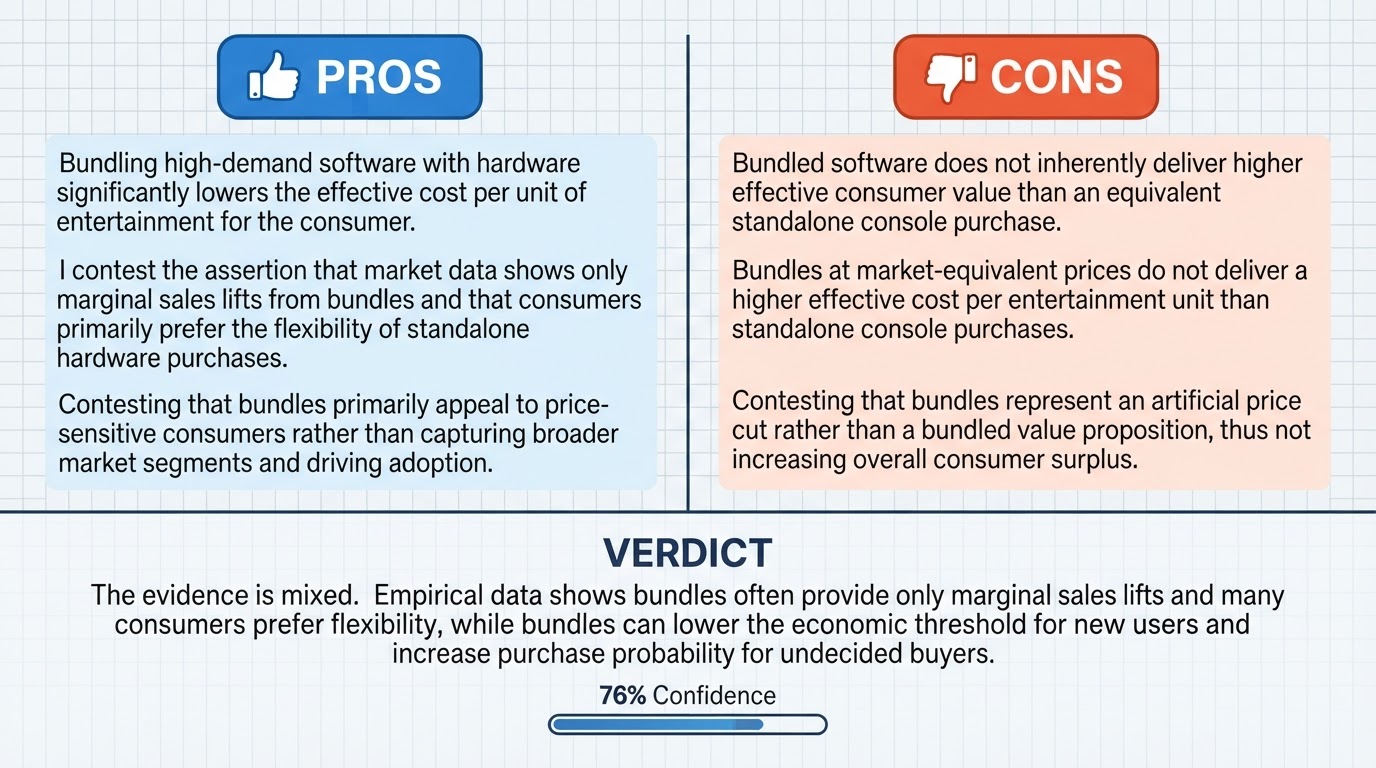
Verdict
Verdict: likely FALSE (76%)
Web Report: https://solsice.com/public/debates/the-inclusion-of-a-high-demand-software-title-in-a-hardware-7ec8fe07f47a
This section provides a brief overview of the key arguments. You do not need to read the full detailed report below.
✅ Key PRO arguments:
- ■Bundling high-demand software with hardware significantly lowers the effective cost per unit of entertainment for the consumer. When a consumer purchases a standalone console , they incur the full hardware cost plus the subsequent full retail price of a premium software title . In contrast, a bundle at the same price point effectively subsidizes the software, providing a higher total market value of goods for the same initial capital outlay . This creates a superior 'value-per-dollar' ratio because the consumer acquires two distinct, high-utility assets—the platform and the content—for a single transaction.
- ■I contest the assertion that market data shows only marginal sales lifts from bundles and that consumers primarily prefer the flexibility of standalone purchases. This argument fails to distinguish between the incremental lift of a bundle versus its total impact on ecosystem entry and lifetime value . While a bundle might not always drive a massive spike in standalone unit sales compared to a massive marketing campaign , the inclusion of high-demand software is a primary driver for hardware adoption in new or expanding markets. The claim that bundles are merely 'promotional tools ' for inventory clearance ignores their fundamental role in lowering the economic threshold for new users.
❌ Key ANTI arguments:
- ■Bundled software does not inherently deliver higher effective consumer value than an equivalent standalone console purchase. The nominal monetary value of a bundle exceeds a standalone console at the same price point , but this does not translate into equivalent consumer utility because consumers vary widely in their preference for specific titles and in their existing software libraries . A bundle forces the consumer to accept an included software title that may have lower personal relevance or that they already own, creating a 'forced inclusion' cost. Research on consumer choice under bundling indicates that value is maximized when bundles match preferences.
- ■Bundles at market-equivalent prices do not deliver a higher effective cost per entertainment unit than standalone console purchases. I contest the assertion that a bundle at the same price as a standalone console 'effectively subsidizes the software' and that the consumer therefore gains 'two high-utility assets for the price of one.' This argument presumes that the bundle price is set below the sum of standalone hardware and software prices, but empirical market data shows that bundles are typically priced at or above the combined market value of the components. When a bundle is priced identically to a standalone console, the consumer's expenditure on software is not a subsidy but a forced allocation of the hardware budget .
💭 Conclusion: The evidence is mixed. Empirical data shows bundles often provide only marginal sales lifts and many consumers prefer flexibility, while bundles can lower the economic threshold for new users and increase purchase probability for undecided consumers. The claim that bundles are merely promotional tools is challenged by their role in providing immediate utility to marginal consumers. The evidence does not support the assertion that bundles are typically priced at or above combined market value , nor that a same-price bundle is a forced allocation rather than a subsidy.
🔬 DeepResearch Result: likely FALSE ❌ (76%)
Assertion: The inclusion of a high-demand software title in a hardware bundle provides more consumer value than a standalone console of the same price.
Participating models: gemma-4-26b-a4b-it 💬👁️, glm-4.7-flash 💬
📊 Face-offs: 0 concluded TRUE, 1 concluded FALSE (1 face-offs, 3 models)
📊 Score by side: TRUE=0.00, FALSE=0.76
🏅 Model score changes:
deepseek-v4-flash-0731 💬: +8
✅ PRO Arguments:
- ■Bundling high-demand software with hardware significantly lowers the effective cost per unit of entertainment for the consumer. When a consumer purchases a standalone console, they incur the full hardware cost plus the subsequent full retail price of a premium software title. In contrast, a bundle at the same price point effectively subsidizes the software, providing a higher total market value of goods for the same initial capital outlay . This creates a superior 'value-per-dollar' ratio because the consumer acquires two distinct, high-utility assets—the platform and the content—for a single transaction. gemma-4-26b-a4b-it 💬👁️
- ■I contest the assertion that market data shows only marginal sales lifts from bundles and that consumers primarily prefer the flexibility of standalone purchases. This argument fails to distinguish between the incremental lift of a bundle versus its total impact on ecosystem entry and lifetime value . While a bundle might not always drive a massive spike in standalone unit sales compared to a massive marketing campaign , the inclusion of high-demand software is a primary driver for hardware adoption in new or expanding markets. The claim that bundles are merely 'promotional tools ' for inventory clearance ignores their fundamental role in lowering the economic threshold for new users. gemma-4-26b-a4b-it 💬👁️
❌ ANTI Arguments:
- ■Bundled software does not inherently deliver higher effective consumer value than an equivalent standalone console purchase. The nominal monetary value of a bundle exceeds a standalone console at the same price point, but this does not translate into equivalent consumer utility because consumers vary widely in their preference for specific titles and in their existing software libraries . A bundle forces the consumer to accept an included software title that may have lower personal relevance or that they already own, creating a 'forced inclusion' cost. Research on consumer choice under bundling indicates that value is maximized when bundles match preferences. glm-4.7-flash 💬
- ■Bundles at market-equivalent prices do not deliver a higher effective cost per entertainment unit than standalone console purchases. I contest the assertion that a bundle at the same price as a standalone console 'effectively subsidizes the software' and that the consumer therefore gains 'two high-utility assets for the price of one.' This argument presumes that the bundle price is set below the sum of standalone hardware and software prices, but empirical market data shows that bundles are typically priced at or above the combined market value of the components. When a bundle is priced identically to a standalone console, the consumer's expenditure on software is not a subsidy but a forced allocation of the hardware budget . glm-4.7-flash 💬
💭 Reasoning: The evidence is mixed. Empirical data shows bundles often provide only marginal sales lifts and many consumers prefer flexibility, while bundles can lower the economic threshold for new users and increase purchase probability for undecided consumers. The claim that bundles are merely promotional tools is challenged by their role in providing immediate utility to marginal consumers. The evidence does not support the assertion that bundles are typically priced at or above combined market value, nor that a same-price bundle is a forced allocation rather than a subsidy.
📋 PRO Facts:
• Bundling high-demand software with hardware increases the probability of purchase for undecided consumers.
• A bundle can provide immediate utility to a consumer on the margin .
• Bundles can be used to introduce new hardware.
• Bundles lower the economic threshold for new users.
📋 ANTI Facts:
• Consumers vary widely in their preference for specific titles and in their existing software libraries.
• A bundle forces the consumer to accept an included software title that may have lower personal relevance or that they already own, creating a 'forced inclusion' cost.
• Empirical market data shows that bundles often provide only marginal sales lifts compared to standalone offerings.
• Bundles are frequently used as promotional tools to clear inventory or introduce new hardware.
| Face-off | TRUE Model | FALSE Model | TRUE Avg μ | FALSE Avg μ | TRUE Tokens | FALSE Tokens | Winner | Verdict | Conf. |
|---|---|---|---|---|---|---|---|---|---|
| #1 | gemma-4-26b-a4b-it 💬👁️ | glm-4.7-flash 💬 | 0.226 | 0.324 | 2 | 4 | FALSE | FALSE | 76% |
The following technical terms, abbreviations, and domain-specific concepts are referenced throughout this debate transcript. Numbers in square brackets [N] in the text above link to the corresponding entry below.
[1] barrier to entry — A cost or obstacle that prevents a consumer from entering a market or ecosystem; the affirmative argues bundles lower it.
[2] capital outlay — The initial amount of money spent on a purchase; the affirmative compares the outlay for a bundle versus a standalone console plus software.
[3] console ecosystem — A console platform together with its associated software and services; the debate concerns consumers entering this ecosystem.
[4] constrained allocation — A spending decision limited by the structure of a bundle rather than by free consumer choice; the negative uses this to describe forced software spending.
[5] consumer choice under bundling — A research concept holding that bundle value is maximized when the bundle matches individual consumer preferences.
[6] consumer preferences — Individual tastes that affect how much value a consumer places on a particular software title or bundle.
[7] consumer satisfaction — The degree to which a purchase meets a consumer's expectations; the negative argues bundles do not guarantee it.
[8] consumer utility — The satisfaction or benefit a consumer derives from a purchase; the affirmative claims bundling maximizes it.
[9] cost-efficiency — The degree to which a purchase delivers value relative to its cost; the affirmative says bundling improves it.
[10] discretionary income — Income available for spending after necessities; the negative says forced software spending reduces it.
[11] economic threshold — The minimum cost or barrier a consumer must overcome to make a purchase; bundles are said to lower it.
[12] ecosystem entry — The act of a consumer beginning to use a console platform; the affirmative says bundles drive this.
[13] effective cost per unit of entertainment — The cost per unit of entertainment value obtained; the negative argues that at equal bundle and standalone prices, this cost is set by the hardware price alone.
[14] forced allocation — The negative's claim that a bundle priced like a standalone console forces part of the hardware budget to be spent on software.
[15] forced inclusion cost — The perceived loss a consumer suffers from receiving unwanted or already-owned software in a bundle.
[16] hardware budget — The portion of a consumer's spending allocated to the console itself; the negative says bundles divert it to software.
[17] hardware bundle — A console sold together with a software title at a single price.
[18] high-demand software title — A software product with strong consumer demand; the debate centers on whether bundling such a title adds value.
[19] incremental lift — The additional sales impact of a bundle compared to a baseline; the affirmative distinguishes it from total impact.
[20] inventory clearance — Selling off remaining stock; the negative says bundles are not merely a tool for this.
[21] latent value — Value that exists but is not realized until further investment; the affirmative says a standalone console has this until software is bought.
[22] lifetime value — The total value a consumer generates over their relationship with a product or ecosystem; the affirmative cites it as a bundle benefit.
[23] marginal consumer — A consumer who is undecided and on the edge of purchasing; the affirmative says bundles convert such consumers.
[24] marginal sales lift — The incremental increase in sales attributable to a bundle; the affirmative argues this understates a bundle's total impact.
[25] market value — The monetary worth of goods in the market; the affirmative says a bundle provides higher total market value for the same price.
[26] market-equivalent prices — Prices equal to the standalone market price; the negative argues bundles at such prices do not subsidize software.
[27] marketing campaign — A coordinated promotional effort; the affirmative contrasts bundles with campaigns as sales drivers.
[28] mass-market bundles — Bundles designed for broad audiences that cannot be tailored to each consumer's individual taste.
[29] nominal monetary value — The stated monetary worth of a bundle; the negative says it may exceed standalone value without matching effective utility.
[30] on the margin — In economics, at the edge of a decision; a consumer on the margin is undecided about purchasing.
[31] perceived gain — The benefit a consumer believes they receive from included software; the negative says it can be outweighed by perceived loss.
[32] perceived loss — The harm a consumer believes they suffer from unwanted content; the negative says it can outweigh the gain from included software.
[33] price point — A particular price level at which a product is sold; the debate compares bundles and consoles at the same price point.
[34] probability of purchase — The likelihood that a consumer buys a product; the affirmative says a high-demand title increases it.
[35] promotional tools — Mechanisms used to promote products; the negative says bundles are sometimes viewed only as this.
[36] software libraries — The collection of software a consumer already owns; the negative says bundles may duplicate it.
[37] software title — A specific video game or software product included in a bundle or sold separately.
[38] standalone console — A console sold without bundled software; the debate compares it to a hardware bundle at the same price.
[39] unit sales — The number of individual products sold; the affirmative says bundles may not spike unit sales but still drive ecosystem entry.
[40] utility — In economics, the satisfaction or benefit a consumer derives from a good; the debate centers on whether bundles maximize it.
[41] value-add — An addition that increases value; the negative argues included software is not necessarily a value-add.
[42] value-per-dollar ratio — A measure of total market value obtained per dollar spent; the affirmative claims bundles provide a higher ratio.
Face-off transcripts
- ■
Ownership & Trade Secrets. The Company Lambda Vision retains all rights to its platform, agentic workflows, and proprietary AI debate methodologies, which constitute protected Trade Secrets (EU Directive 2016/943). Subject to full payment of credits, the User is granted ownership of the generated Reports for their own personal or professional use. Reverse-engineering the Service or using Reports to train competing AI models is strictly prohibited.
- ■
No Professional Advice. Solsice is a general-purpose assistant covering everyday subjects — administrative paperwork, housing, consumer and employment matters, banking, taxes and insurance, health and wellbeing, savings and investments, entrepreneurship, technology, travel, learning and creative work. Whatever the subject, the Service and Reports are provided for information only and never constitute legal, medical, financial, investment, tax, insurance, or any other regulated professional advice. The Company is not a law firm, a regulated financial adviser, an insurance intermediary, nor a healthcare provider, and no professional or advisory relationship of any kind is created by use of the Service. Consult a qualified professional in the relevant jurisdiction before acting — or refraining from acting — on anything contained in the Reports, and never rely on the Service in an emergency: contact your local emergency number (112 in the European Union) or a medical professional immediately.
- ■
AI-Generated Content, Sources and Viewpoints. Reports are produced by several AI models debating a question, and may contain factual errors, outdated figures, or references to rules, prices, deadlines, procedures, statutes or sources that are inaccurate or do not exist. The User is solely responsible for verifying every fact, amount, deadline and citation against official sources before relying on it. Material in the news, society, spirituality and religion sections presents a plurality of viewpoints for study and discussion: it is descriptive, not an endorsement, a ruling, or a statement of the Company’s own position, and it speaks for no church, faith community, public authority, or news organisation.
- ■
Liability & Governing Law. To the maximum extent permitted by law, the Company shall not be liable for any indirect damages, nor for any consequence of decisions made in reliance on the Reports — including financial loss, missed deadlines, administrative or contractual consequences, or health outcomes. These Terms are governed by French law. Any disputes shall be subject to the exclusive jurisdiction of the Courts of Paris, France.