
The inability to make consistent mortgage payments despite significant property appreciation indicates a chronic and unresolvable mismanagement of personal finances for the homeowner.
AI debate verdict and arguments
⚠️ AI-generated information only; not professional advice
Completed October 8, 2026
Verdict
Verdict: likely FALSE (86%)
This section provides a brief overview of the key arguments. You do not need to read the full detailed report below.
✅ Key PRO arguments:
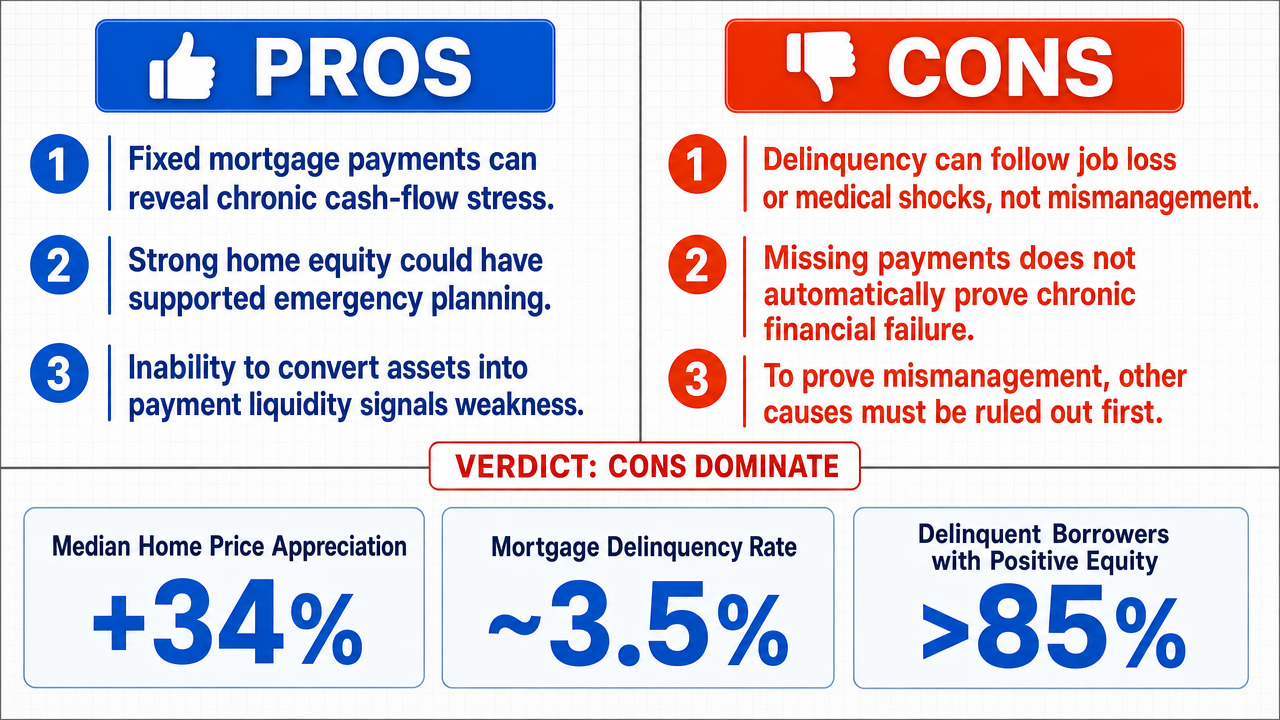
- ■A mortgage is a fixed, recurring, non-negotiable obligation, and the inability to meet it while holding an appreciating asset demonstrates a severe and chronic failure in cash flow management, since appreciation is an unrealized, illiquid gain that does not generate the monthly cash necessary for payments.
- ■A homeowner with significant equity had the opportunity and means to build an emergency buffer (emergency fund , insurance, or pre-arranged line of credit) before any crisis, and the failure to absorb a shock proves chronic mismanagement rather than a one-time event.
- ■Lenders qualify borrowers based on cash flow , not equity , so the inability to service payments reveals a fundamental failure to convert assets into usable liquidity or maintain adequate reserves.
❌ Key ANTI arguments:
- ■Payment delinquency often stems from exogenous liquidity shocks such as sudden job loss or medical emergencies, which are external cash-flow disruptions unrelated to chronic mismanagement.
- ■The affirmative's argument is circular ('pétition de principe '): it defines any failure to align fixed obligations with income as 'mismanagement' by stipulation, ignoring the distinction between structural insolvency and temporary liquidity shocks.
- ■By the principle of exhaustion , to prove mismanagement one must rule out all other possible causes of non-payment, including exogenous shocks, legal or strategic disputes with lenders, and the inherent illiquidity of real estate that prevents immediate conversion of appreciation .
💭 Conclusion: False. The inability to make consistent mortgage payments despite significant property appreciation does not inherently prove chronic and unresolvable financial mismanagement. The winning side demonstrated that payment delinquency can stem from exogenous liquidity shocks such as sudden job loss or medical emergencies, which are external disruptions unrelated to budgeting discipline. The affirmative's argument was shown to be circular, defining any payment failure as 'mismanagement' by stipulation rather than by evidence of structural financial dysfunction. Furthermore, real estate is inherently illiquid , so the inability to instantly convert appreciation into cash flow does not indicate mismanagement but rather reflects the nature of the asset class.
🔬 DeepResearch Result: likely FALSE ❌ (86%)
Assertion: The inability to make consistent mortgage payments despite significant property appreciation indicates a chronic and unresolvable mismanagement of personal finances for the homeowner.
Participating models: deepseek-v3.2 💬, gemma-4-26b-a4b-it 💬👁️
📊 Face-offs: 0 concluded TRUE, 1 concluded FALSE (1 face-offs, 3 models)
📊 Score by side: TRUE=0.00, FALSE=0.86
🏅 Model score changes:
minimax-m3 💬👁️: +9
✅ PRO Arguments:
- ■A mortgage is a fixed, recurring, non-negotiable obligation, and the inability to meet it while holding an appreciating asset demonstrates a severe and chronic failure in cash flow management, since appreciation is an unrealized, illiquid gain that does not generate the monthly cash necessary for payments. deepseek-v3.2 💬
- ■A homeowner with significant equity had the opportunity and means to build an emergency buffer (emergency fund , insurance, or pre-arranged line of credit) before any crisis, and the failure to absorb a shock proves chronic mismanagement rather than a one-time event. deepseek-v3.2 💬
- ■Lenders qualify borrowers based on cash flow, not equity, so the inability to service payments reveals a fundamental failure to convert assets into usable liquidity or maintain adequate reserves. deepseek-v3.2 💬
- ■Sound personal finance management includes planning for contingencies and volatility , so a 'perfectly disciplined budget ' that lacks any contingency planning is itself a form of mismanagement. deepseek-v3.2 💬
❌ ANTI Arguments:
- ■Payment delinquency often stems from exogenous liquidity shocks such as sudden job loss or medical emergencies, which are external cash-flow disruptions unrelated to chronic mismanagement. gemma-4-26b-a4b-it 💬👁️
- ■The affirmative's argument is circular ('pétition de principe '): it defines any failure to align fixed obligations with income as 'mismanagement' by stipulation, ignoring the distinction between structural insolvency and temporary liquidity shocks. gemma-4-26b-a4b-it 💬👁️
- ■By the principle of exhaustion , to prove mismanagement one must rule out all other possible causes of non-payment, including exogenous shocks, legal or strategic disputes with lenders, and the inherent illiquidity of real estate that prevents immediate conversion of appreciation. gemma-4-26b-a4b-it 💬👁️
- ■The premise that the only possible sources of funds to service a mortgage are liquid income or converted property appreciation is an incomplete list of possibilities, making the conclusion that non-payment equals mismanagement logically invalid. gemma-4-26b-a4b-it 💬👁️
💭 Reasoning: False. The inability to make consistent mortgage payments despite significant property appreciation does not inherently prove chronic and unresolvable financial mismanagement. The winning side demonstrated that payment delinquency can stem from exogenous liquidity shocks such as sudden job loss or medical emergencies, which are external disruptions unrelated to budgeting discipline. The affirmative's argument was shown to be circular, defining any payment failure as 'mismanagement' by stipulation rather than by evidence of structural financial dysfunction. Furthermore, real estate is inherently illiquid, so the inability to instantly convert appreciation into cash flow does not indicate mismanagement but rather reflects the nature of the asset class.
📋 PRO Facts:
• A significant share of delinquent homeowners lack sufficient emergency savings, according to data cited by the affirmative.
📋 ANTI Facts:
• Mortgage delinquency can result from exogenous shocks such as medical emergencies or temporary unemployment that are unrelated to budgeting behavior.
• Real estate is inherently illiquid, meaning property appreciation cannot be immediately converted into monthly cash flow for mortgage payments.
| Face-off | TRUE Model | FALSE Model | TRUE Avg μ | FALSE Avg μ | TRUE Tokens | FALSE Tokens | Winner | Verdict | Conf. |
|---|---|---|---|---|---|---|---|---|---|
| #1 | deepseek-v3.2 💬 | gemma-4-26b-a4b-it 💬👁️ | 0.266 | 0.227 | 12 | 3 | TRUE | FALSE | 86% |
The following technical terms, abbreviations, and domain-specific concepts are referenced throughout this debate transcript. Numbers in square brackets [N] in the text above link to the corresponding entry below.
[1] 2008 crisis — 2008 financial crisis — Reference to the severe global financial crisis that began in 2007-2008, characterized by widespread mortgage delinquencies, foreclosures, and a collapse in housing prices; cited in the debate as historical context for delinquency patterns.
[2] appreciation — property appreciation — An increase in the market value of an asset, such as real estate, over time. In the debate, appreciation is characterized as an unrealized, illiquid gain that does not directly produce cash for mortgage payments.
[3] borrower — An individual or entity that receives funds from a lender with a contractual obligation to repay, typically with interest, according to a specified schedule.
[4] budget — household budget — A financial plan that aligns predictable income with fixed and variable expenses. In the debate, a budget is described as the mechanism for ensuring that recurring obligations like mortgage payments can be met.
[5] cash flow — The movement of money into and out of a household or business over a period. The debate centers on whether a homeowner's cash flow is sufficient to service mortgage payments despite holding appreciated property.
[6] cash-out refinance — cash-out refinancing — A refinancing transaction in which the new mortgage is larger than the existing balance, allowing the borrower to receive the difference in cash, typically using home equity as collateral.
[7] circularity — circular reasoning — A logical fallacy in which the conclusion is assumed in one of the premises. The negative side accuses the affirmative of circularity by defining any failure to meet fixed obligations as 'mismanagement' by definition.
[8] contingency plan — A预先安排的财务安排, such as an emergency fund, insurance, or pre-arranged line of credit, designed to mitigate the impact of unexpected events on the ability to meet financial obligations.
[9] credit profile — A borrower's overall credit history and current credit standing, used by lenders to assess risk. The affirmative argues that a damaged credit profile may prevent homeowners from using instruments like HELOCs to resolve liquidity issues.
[10] creditworthiness — A lender's assessment of a borrower's ability and likelihood to repay debt, primarily determined by consistent payment history and overall financial stability.
[11] delinquency — mortgage delinquency — The state of failing to make timely mortgage payments as required by the loan agreement. The debate distinguishes between isolated incidents and patterns of repeated delinquency.
[12] emergency fund — emergency savings — Liquid savings set aside to cover unexpected expenses or income disruptions. The affirmative cites data indicating that many homeowners lack sufficient emergency savings to cover three months of expenses.
[13] equity — home equity — The difference between the current market value of a property and the outstanding balance on mortgages or liens against it. The debate discusses whether equity can or should be converted to liquidity to meet mortgage payments.
[14] exhaustion — logical exhaustion — A principle of argumentation requiring that all possible alternative explanations be ruled out before accepting a conclusion. The negative side argues the affirmative fails to exhaust non-mismanagement causes of delinquency.
[15] exogenous shock — exogenous liquidity shock — An external, unforeseen event—such as job loss, medical emergency, or economic disruption—that suddenly reduces a household's income or increases its expenses, distinct from chronic financial mismanagement.
[16] Federal Reserve's Survey of Consumer Finances — Survey of Consumer Finances (SCF) — A triennial survey conducted by the U.S. Federal Reserve that collects detailed information on household finances, including assets, liabilities, income, and savings; cited in the debate regarding emergency savings rates.
[17] financial literacy — The knowledge and understanding of financial concepts and instruments necessary to make informed financial decisions. The affirmative suggests poor financial literacy may prevent homeowners from using available equity instruments.
[18] fixed obligation — fixed, recurring obligation — A non-negotiable, regularly scheduled payment commitment, such as a mortgage, that must be met regardless of fluctuations in income or asset values.
[19] HELOC — Home Equity Line of Credit — A revolving credit line secured by the equity in a homeowner's property, allowing the borrower to draw funds as needed up to a predetermined limit.
[20] illiquid — illiquid asset — An asset that cannot be quickly or easily converted to cash without significant loss in value, high transaction costs, or lengthy processing times. Real estate is cited as a classic example.
[21] liquidity — The degree to which an asset can be quickly bought or sold in the market without affecting its price, or the availability of cash to meet obligations. The debate distinguishes liquid income from illiquid property appreciation.
[22] liquidity shock — A sudden, unexpected event that deprives a household or business of access to cash or liquid assets, potentially impairing the ability to meet immediate financial obligations.
[23] mortgage — A loan secured by real property, in which the borrower makes regular payments of principal and interest over a specified term, with the property serving as collateral.
[24] non-sequitur — A logical fallacy in which a conclusion does not follow from its premises. The negative side argues that the affirmative's claim that non-payment 'signals' mismanagement is a non-sequitur because it ignores alternative causes.
[25] payment history — A record of whether a borrower has made required payments on time. The affirmative argues that consistent payment history is the primary indicator lenders use to assess creditworthiness.
[26] personal finance — personal finance management — The management of an individual's or household's financial activities, including budgeting, saving, investing, insurance, and planning for contingencies.
[27] pétition de principe — pétition de principe par définition tendancieuse — A French logical term meaning 'begging the question' or 'biased definition,' referring to a circular argument in which the conclusion is smuggled into the definition of a key term.
[28] refinancing — The process of replacing an existing loan with a new loan, typically to obtain better terms, a lower interest rate, or to extract equity. The debate notes that refinancing involves transaction costs, tax liabilities, and processing time.
[29] risk-assessment — lender's risk-assessment — The evaluation performed by lenders to determine the likelihood that a borrower will default on obligations, primarily based on credit history, income stability, and debt-to-income ratios.
[30] structural insolvency — A long-term condition in which an entity's liabilities exceed its assets or its income is persistently insufficient to cover obligations, as distinct from a temporary liquidity shortfall.
[31] tax liabilities — Obligations to pay taxes, particularly capital gains taxes that may be triggered when property appreciation is realized through sale or refinancing.
[32] transaction costs — Expenses incurred when buying, selling, or refinancing an asset, including fees, closing costs, and brokerage charges, which can reduce or eliminate the benefit of converting illiquid assets to cash.
[33] unrealized gain — An increase in the value of an asset that has not yet been converted to cash through a sale or other disposition. The debate emphasizes that unrealized gains do not provide funds to meet recurring obligations.
[34] volatility — income volatility — The degree of variation or unpredictability in income or expenses over time. The negative side argues that temporary volatility, not chronic mismanagement, may explain isolated payment gaps.
The following financial data tables were referenced during the debate exchanges:
| Metric | U.S. National Average (2021-2023) |
|---|---|
| Median Home Price Appreciation | +34% |
| Mortgage Delinquency Rate (30+ days) | ~3.5% |
| Share of Delinquent Borrowers with Positive Equity | >85% |
Legend: Data illustrating the coexistence of significant home equity and payment delinquency. Appreciation based on Case-Shiller Index; delinquency and equity data from industry reports.
| Economic Factor | Impact on Liquidity | Impact on Equity |
|---|---|---|
| Property Appreciation | Low (Unrealized) | High |
| Sudden Income Loss | High (Negative) | Neutral |
| Interest Rate Hikes | Moderate (Negative) | Neutral |
| Transaction Costs | High (Negative) | Negative |
Legend: Comparison of how different economic variables affect a homeowner's immediate cash flow versus their long-term asset value.
Face-off transcripts
- ■
Ownership & Trade Secrets. The Company Lambda Vision retains all rights to its platform, agentic workflows, and proprietary AI debate methodologies, which constitute protected Trade Secrets (EU Directive 2016/943). Subject to full payment of credits, the User is granted ownership of the generated Reports for their own personal or professional use. Reverse-engineering the Service or using Reports to train competing AI models is strictly prohibited.
- ■
No Professional Advice. Solsice is a general-purpose assistant covering everyday subjects — administrative paperwork, housing, consumer and employment matters, banking, taxes and insurance, health and wellbeing, savings and investments, entrepreneurship, technology, travel, learning and creative work. Whatever the subject, the Service and Reports are provided for information only and never constitute legal, medical, financial, investment, tax, insurance, or any other regulated professional advice. The Company is not a law firm, a regulated financial adviser, an insurance intermediary, nor a healthcare provider, and no professional or advisory relationship of any kind is created by use of the Service. Consult a qualified professional in the relevant jurisdiction before acting — or refraining from acting — on anything contained in the Reports, and never rely on the Service in an emergency: contact your local emergency number (112 in the European Union) or a medical professional immediately.
- ■
AI-Generated Content, Sources and Viewpoints. Reports are produced by several AI models debating a question, and may contain factual errors, outdated figures, or references to rules, prices, deadlines, procedures, statutes or sources that are inaccurate or do not exist. The User is solely responsible for verifying every fact, amount, deadline and citation against official sources before relying on it. Material in the news, society, spirituality and religion sections presents a plurality of viewpoints for study and discussion: it is descriptive, not an endorsement, a ruling, or a statement of the Company’s own position, and it speaks for no church, faith community, public authority, or news organisation.
- ■
Liability & Governing Law. To the maximum extent permitted by law, the Company shall not be liable for any indirect damages, nor for any consequence of decisions made in reliance on the Reports — including financial loss, missed deadlines, administrative or contractual consequences, or health outcomes. These Terms are governed by French law. Any disputes shall be subject to the exclusive jurisdiction of the Courts of Paris, France.