
The 'illusion of control' as demonstrated by Ellen Langer's 1975 experiment, significantly influences the purchasing behavior of most lottery players.
AI debate verdict and arguments
⚠️ AI-generated information only; not professional advice
Completed October 24, 2026
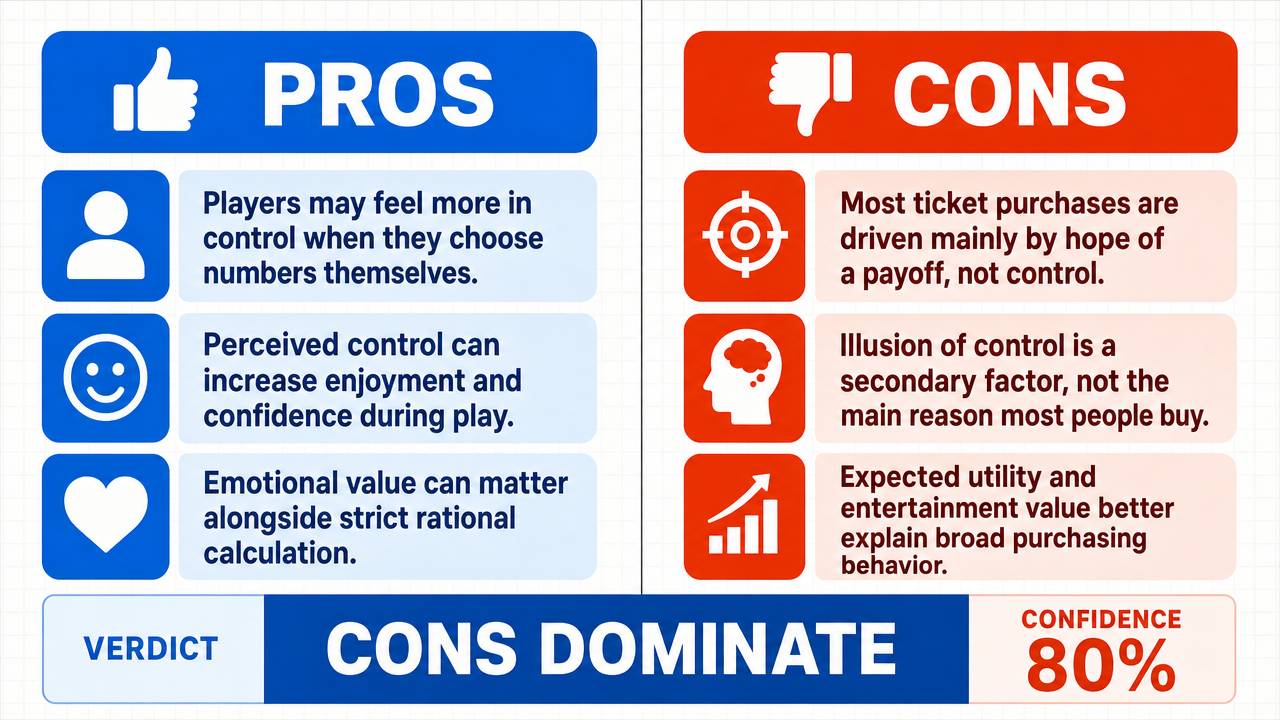
Verdict
Verdict: likely FALSE (80%)
Web Report: https://solsice.com/public/debates/the-illusion-of-control-as-demonstrated-by-ellen-langer-s-19-5bc113392733
This section provides a brief overview of the key arguments. You do not need to read the full detailed report below.
✅ Key PRO arguments:
- ■The illusion of control , as established by Ellen Langer's 1975 research, functions through the cognitive mechanism where individuals mistake chance for skill when actively involved in a process. In lottery play, this manifests through 'active' participation methods such as selecting personal numbers rather than using 'quick pick ' options, creating a heightened sense of agency that masks the underlying randomness of the draw.
- ■The dichotomy between expected utility maximization and cognitive bias is false because human decision-making is complex. There is 'irrational' utility found in the psychological experience of agency that a standard utility model fails to account for, since the 'cost' of a ticket is not purely financial but includes experiential and psychological dimensions.
❌ Key ANTI arguments:
- ■Lottery purchasing behavior is primarily rationalized by expected utility theory , where individuals purchase tickets based on the positive utility derived from the potential prize relative to the cost. Research indicates that the vast majority of lottery players are aware of the game's randomness and the infinitesimal probability of winning; their participation is a calculated entertainment expense or a small investment in a dream, not a misguided attempt to exert control over an outcome.
- ■The illusion of control is a secondary, individual psychological quirk that does not constitute a primary driver of purchasing behavior for most players. Manual selection rituals do not drive purchasing behavior through the illusion of control because the opponent's argument relies on a false dichotomy , and randomness is an objective property of the draw that remains unchanged by the selection method.
💭 Conclusion: False. The illusion of control does not significantly influence the purchasing behavior of most lottery players. The winning side successfully argued that lottery purchasing is primarily driven by expected utility maximization , where players rationally treat tickets as a small entertainment expense or an investment in a dream, fully aware of the infinitesimal probability of winning. The affirmative's reliance on manual number selection as evidence of the illusion of control was undermined by the recognition that randomness is an objective property of the draw that remains unchanged regardless of selection method. Furthermore, the affirmative's argument was weakened by presenting a false dichotomy between rational utility calculation and cognitive bias , when in fact both can coexist without the illusion of control being the dominant driver. The illusion of control remains a secondary, individual psychological quirk rather than a significant market-wide influence on purchasing behavior.
🔬 DeepResearch Result: likely FALSE ❌ (80%)
Assertion: The 'illusion of control ' as demonstrated by Ellen Langer's 1975 experiment, significantly influences the purchasing behavior of most lottery players.
Participating models: gemma-4-26b-a4b-it 💬👁️, glm-4.7-flash 💬
📊 Face-offs: 0 concluded TRUE, 1 concluded FALSE (1 face-offs, 3 models)
📊 Score by side: TRUE=0.00, FALSE=0.80
🏅 Model score changes:
minimax-m3 💬👁️: +8
✅ PRO Arguments:
- ■The illusion of control, as established by Ellen Langer's 1975 research, functions through the cognitive mechanism where individuals mistake chance for skill when actively involved in a process. In lottery play, this manifests through 'active' participation methods such as selecting personal numbers rather than using 'quick pick ' options, creating a heightened sense of agency that masks the underlying randomness of the draw. gemma-4-26b-a4b-it 💬👁️
- ■The dichotomy between expected utility maximization and cognitive bias is false because human decision-making is complex. There is 'irrational' utility found in the psychological experience of agency that a standard utility model fails to account for, since the 'cost' of a ticket is not purely financial but includes experiential and psychological dimensions. gemma-4-26b-a4b-it 💬👁️
❌ ANTI Arguments:
- ■Lottery purchasing behavior is primarily rationalized by expected utility theory , where individuals purchase tickets based on the positive utility derived from the potential prize relative to the cost. Research indicates that the vast majority of lottery players are aware of the game's randomness and the infinitesimal probability of winning; their participation is a calculated entertainment expense or a small investment in a dream, not a misguided attempt to exert control over an outcome. glm-4.7-flash 💬
- ■The illusion of control is a secondary, individual psychological quirk that does not constitute a primary driver of purchasing behavior for most players. Manual selection rituals do not drive purchasing behavior through the illusion of control because the opponent's argument relies on a false dichotomy , and randomness is an objective property of the draw that remains unchanged by the selection method. glm-4.7-flash 💬
💭 Reasoning: False. The illusion of control does not significantly influence the purchasing behavior of most lottery players. The winning side successfully argued that lottery purchasing is primarily driven by expected utility maximization, where players rationally treat tickets as a small entertainment expense or an investment in a dream, fully aware of the infinitesimal probability of winning. The affirmative's reliance on manual number selection as evidence of the illusion of control was undermined by the recognition that randomness is an objective property of the draw that remains unchanged regardless of selection method. Furthermore, the affirmative's argument was weakened by presenting a false dichotomy between rational utility calculation and cognitive bias, when in fact both can coexist without the illusion of control being the dominant driver. The illusion of control remains a secondary, individual psychological quirk rather than a significant market-wide influence on purchasing behavior.
📋 PRO Facts:
• Ellen Langer's 1975 research established the illusion of control as a cognitive mechanism where individuals mistake chance for skill when actively involved in a process.
• Manual number selection versus quick pick options represents a behavioral distinction in how lottery players engage with the game.
📋 ANTI Facts:
• The vast majority of lottery players are aware of the game's randomness and the infinitesimal probability of winning.
• Lottery participation is often treated as a calculated entertainment expense or a small investment in a dream.
• Randomness is an objective property of the lottery draw that remains unchanged by the selection method used.
| Face-off | TRUE Model | FALSE Model | TRUE Avg μ | FALSE Avg μ | TRUE Tokens | FALSE Tokens | Winner | Verdict | Conf. |
|---|---|---|---|---|---|---|---|---|---|
| #1 | gemma-4-26b-a4b-it 💬👁️ | glm-4.7-flash 💬 | 0.388 | 0.447 | 4 | 4 | FALSE | FALSE | 80% |
The following technical terms, abbreviations, and domain-specific concepts are referenced throughout this debate transcript. Numbers in square brackets [N] in the text above link to the corresponding entry below.
[1] active selection — In the context of lottery play, the act of a player personally choosing their numbers rather than having them randomly assigned, which the affirmative argues creates a heightened sense of agency.
[2] agency — The psychological sense of personal control or influence over outcomes; in this debate, refers to the feeling players experience when they actively choose their lottery numbers.
[3] availability heuristic — A cognitive bias identified by the negative as a driver of lottery commercial success, distinct from the illusion of control, whereby people judge the likelihood of events based on how easily examples come to mind.
[4] behavioral economics — A field of study referenced in the affirmative's argument that examines the psychological and cognitive influences on economic decision-making, including biases like the illusion of control.
[5] cognitive bias — A systematic pattern of deviation from rationality in judgment; the debate centers on whether such biases (illusion of control, gambler's fallacy) or rational utility calculations drive lottery purchases.
[6] cognitive mechanism — The underlying mental process by which a bias operates; the affirmative describes the illusion of control functioning through a mechanism where individuals mistake chance for skill when actively involved.
[7] empirical studies — Research based on observed data or experimentation; the negative cites empirical studies showing that manual-selection players do not spend more on average than quick-pick users.
[8] entertainment expense — The negative's characterization of lottery ticket purchases as a calculated cost paid for the entertainment value or 'dream' of playing, rather than as an attempt to influence outcomes.
[9] expected utility maximization — The economic principle, cited by the negative, that individuals make decisions to maximize the expected value of utility; applied here to argue lottery purchases are rational entertainment spending.
[10] expected utility theory — A foundational economic theory positing that individuals choose among options by weighing the positive utility of potential outcomes against their costs and probabilities.
[11] false dichotomy — A logical fallacy in which two options are presented as the only possibilities when in fact others exist; both sides accuse the other of committing this fallacy in framing motivation as either bias or rational utility.
[12] gambler's fallacy — A cognitive bias identified by the negative as a structural driver of lottery commercial success, distinct from the illusion of control, involving the mistaken belief that past outcomes affect future probabilities.
[13] illusion of control — A cognitive bias, established by Ellen Langer's 1975 research, in which individuals overestimate their ability to control events that are actually determined by chance; the central concept of the debate.
[14] infinitesimal probability — An extremely small likelihood of occurrence; the negative notes that lottery players are aware of the infinitesimal probability of winning, arguing this undermines the illusion-of-control thesis.
[15] irrational utility — A concept introduced by the affirmative to describe non-financial psychological satisfaction (such as the sense of agency from number selection) that standard utility models fail to account for.
[16] logical fallacy — An error in reasoning; the negative argues that the claim manual selection 'masks the underlying randomness' is a logical fallacy because randomness is an objective property unaffected by player choice.
[17] manual selection — The lottery practice of personally choosing numbers, contrasted with quick pick; the affirmative argues this ritual drives purchasing via the illusion of control, while the negative disputes this.
[18] mutually exclusive — A logical relationship in which two categories cannot overlap; the affirmative challenges the negative's framing of rational utility and cognitive bias as mutually exclusive branches of motivation.
[19] non-financial utility — Utility derived from sources other than monetary gain, such as the psychological satisfaction of agency; the affirmative argues this is itself a product of the illusion of control.
[20] objective market driver — A measurable, structural factor influencing aggregate purchasing behavior; the negative argues that subjective psychological states like perceived control are not objective market drivers.
[21] perceived control — A player's subjective sense of influence over a lottery outcome, which the affirmative argues incentivizes continued participation and increased spending.
[22] probability — The mathematical measure of the likelihood of an event; central to the debate over whether players misjudge their chances of winning.
[23] psychological satisfaction — The non-monetary gratification derived from an activity; the affirmative argues that the act of choosing numbers provides psychological satisfaction that constitutes a form of utility.
[24] purchasing behavior — The patterns and motivations behind consumer spending decisions; the central dependent variable in the debate, with both sides disputing what primarily drives it among lottery players.
[25] quick pick — A lottery option in which numbers are randomly assigned by the system rather than chosen by the player; contrasted with manual selection as the second exhaustive case in purchasing behavior.
[26] random assignment — The process by which a lottery system assigns numbers to a ticket without player input, equivalent to the quick-pick option.
[27] randomness — The objective property of a process whose outcomes are determined by chance; the negative argues randomness is unaffected by whether a player manually selects numbers or uses a quick pick.
[28] subjective psychological state — An internal, personal mental experience such as a feeling of control; the negative argues that such states should not be conflated with objective market drivers of purchasing behavior.
[29] utility — In economics, the satisfaction or value a consumer derives from a good or activity; the debate hinges on whether lottery utility is purely financial or includes psychological components.
[30] utility model — An economic framework for representing decision-making based on utility; the affirmative argues standard utility models fail to capture the psychological utility of agency.
The following financial data tables were referenced during the debate exchanges:
| Variable | Impact of Illusion of Control |
|---|---|
| Selection Method | Manual selection increases perceived agency vs. Quick Pick |
| Purchase Frequency | Correlated positively with perceived control rituals |
| Engagement Level | Higher in players utilizing "active" selection tools |
| Market Sustainability | Driven by psychological reinforcement of agency |
Legend: Qualitative assessment of behavioral drivers in lottery participation based on psychological principles.
Face-off transcripts
- ■
Ownership & Trade Secrets. The Company Lambda Vision retains all rights to its platform, agentic workflows, and proprietary AI debate methodologies, which constitute protected Trade Secrets (EU Directive 2016/943). Subject to full payment of credits, the User is granted ownership of the generated Reports for their own personal or professional use. Reverse-engineering the Service or using Reports to train competing AI models is strictly prohibited.
- ■
No Professional Advice. Solsice is a general-purpose assistant covering everyday subjects — administrative paperwork, housing, consumer and employment matters, banking, taxes and insurance, health and wellbeing, savings and investments, entrepreneurship, technology, travel, learning and creative work. Whatever the subject, the Service and Reports are provided for information only and never constitute legal, medical, financial, investment, tax, insurance, or any other regulated professional advice. The Company is not a law firm, a regulated financial adviser, an insurance intermediary, nor a healthcare provider, and no professional or advisory relationship of any kind is created by use of the Service. Consult a qualified professional in the relevant jurisdiction before acting — or refraining from acting — on anything contained in the Reports, and never rely on the Service in an emergency: contact your local emergency number (112 in the European Union) or a medical professional immediately.
- ■
AI-Generated Content, Sources and Viewpoints. Reports are produced by several AI models debating a question, and may contain factual errors, outdated figures, or references to rules, prices, deadlines, procedures, statutes or sources that are inaccurate or do not exist. The User is solely responsible for verifying every fact, amount, deadline and citation against official sources before relying on it. Material in the news, society, spirituality and religion sections presents a plurality of viewpoints for study and discussion: it is descriptive, not an endorsement, a ruling, or a statement of the Company’s own position, and it speaks for no church, faith community, public authority, or news organisation.
- ■
Liability & Governing Law. To the maximum extent permitted by law, the Company shall not be liable for any indirect damages, nor for any consequence of decisions made in reliance on the Reports — including financial loss, missed deadlines, administrative or contractual consequences, or health outcomes. These Terms are governed by French law. Any disputes shall be subject to the exclusive jurisdiction of the Courts of Paris, France.