
The human mind's tendency to worry about future problems can be effectively mitigated by grounding techniques focused on present sensory experience.
AI debate verdict and arguments
⚠️ AI-generated information only; not professional advice
Completed October 11, 2026
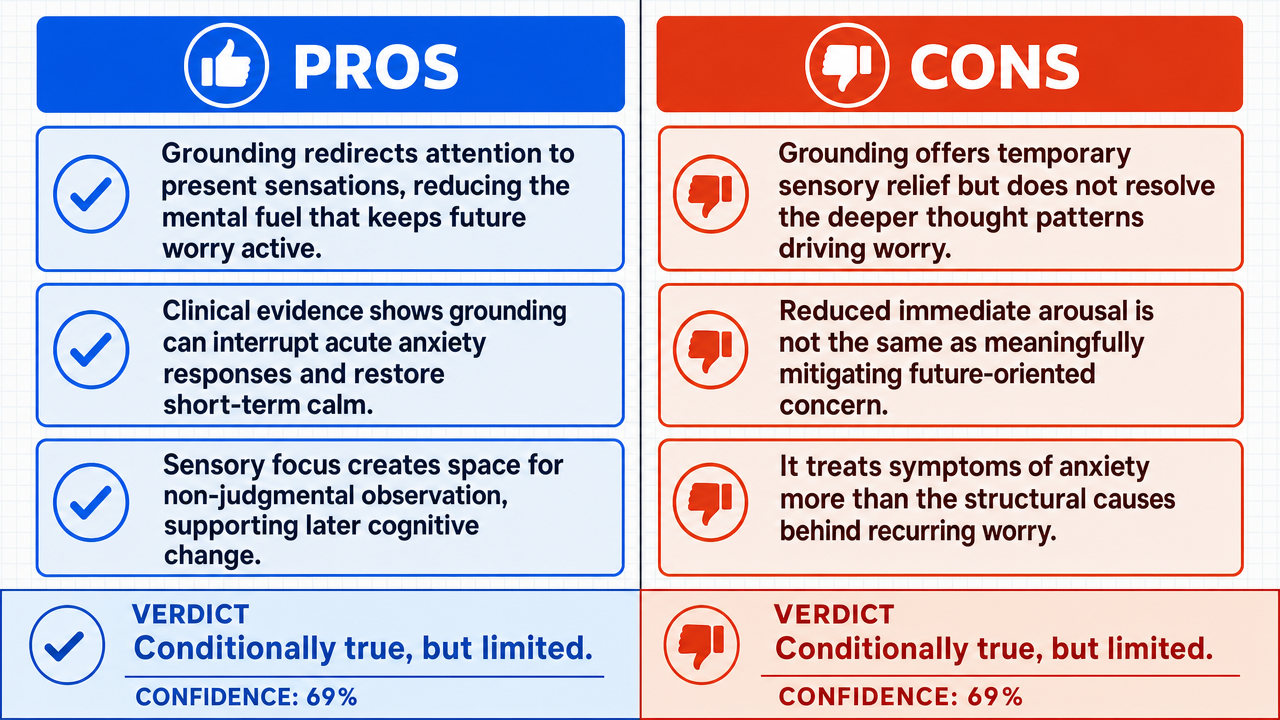
Verdict
Verdict: likely FALSE (69%)
This section provides a brief overview of the key arguments. You do not need to read the full detailed report below.
✅ Key PRO arguments:
- ■Future worry is a form of mental time travel that consumes working memory and attentional resources ; grounding by present sensory experience removes fuel from that loop by retraining attention to breath, sounds, touch, or body contact, directly interrupting the cognitive chain that keeps anticipatory problems alive.
- ■Clinical evidence from the NHS and various studies demonstrates grounding's profound capacity to disrupt the acute physiological and psychological components of worry, and interventions can function along a spectrum rather than requiring a strict symptom-versus-cause dichotomy.
- ■Sensory engagement creates a space for non-judgmental observation , bridging the gap between acute physiological stabilization and long-term cognitive change by allowing the mind to notice anxious thoughts without following them.
❌ Key ANTI arguments:
- ■Grounding suffers from a fundamental category error : it is a transient state of sensory engagement that does not resolve the underlying cognitive processes generating future-oriented projections, and no transfer operator has been established between temporary sensory distraction and the structural persistence of anxious schemas.
- ■The affirmative substitutes a proxy by measuring the temporary reduction of acute physiological arousal and concluding that this constitutes mitigation of the cognitive tendency to worry, failing to provide the psychological mechanism by which acute sensory engagement produces durable change in worry tendencies.
- ■Grounding techniques are fundamentally insufficient because they address only the transient symptoms of anxiety rather than the structural cognitive and physiological roots of anticipatory worry , and such interruptions lack a demonstrated mechanism for transferring acute relief into long-term mitigation of the worry tendency.
💭 Conclusion: Conditionally true. The evidence indicates the claim is true when read charitably and conditionally: it does not assert that grounding always eliminates future worry, nor that it is sufficient for severe, chronic, or biologically driven anxiety without other supports. Public-health sources present grounding as a tool for stress and anxiety more generally, not confined to crisis management. However, the Negative correctly identified that the affirmative's clinical evidence addresses acute symptom relief and temporary stabilization rather than durable change in the structural cognitive roots of anticipatory worry . The claim risks conflating temporary stabilization with effective mitigation of the tendency to worry, and the inability to address the physiological drivers of chronic anticipatory anxiety limits grounding's scope as a comprehensive mitigation tool.
🔬 DeepResearch Result: likely FALSE ❌ (69%)
Assertion: The human mind's tendency to worry about future problems can be effectively mitigated by grounding techniques focused on present sensory experience.
Participating models: deepseek-v3.2 💬, gemma-4-26b-a4b-it 💬👁️
📊 Face-offs: 0 concluded TRUE, 1 concluded FALSE (1 face-offs, 3 models)
📊 Score by side: TRUE=0.00, FALSE=0.69
🏅 Model score changes:
minimax-m3 💬👁️: +7
✅ PRO Arguments:
- ■Future worry is a form of mental time travel that consumes working memory and attentional resources ; grounding by present sensory experience removes fuel from that loop by retraining attention to breath, sounds, touch, or body contact, directly interrupting the cognitive chain that keeps anticipatory problems alive. deepseek-v3.2 💬
- ■Clinical evidence from the NHS and various studies demonstrates grounding's profound capacity to disrupt the acute physiological and psychological components of worry, and interventions can function along a spectrum rather than requiring a strict symptom-versus-cause dichotomy. deepseek-v3.2 💬
- ■Sensory engagement creates a space for non-judgmental observation , bridging the gap between acute physiological stabilization and long-term cognitive change by allowing the mind to notice anxious thoughts without following them. deepseek-v3.2 💬
❌ ANTI Arguments:
- ■Grounding suffers from a fundamental category error : it is a transient state of sensory engagement that does not resolve the underlying cognitive processes generating future-oriented projections, and no transfer operator has been established between temporary sensory distraction and the structural persistence of anxious schemas. gemma-4-26b-a4b-it 💬👁️
- ■The affirmative substitutes a proxy by measuring the temporary reduction of acute physiological arousal and concluding that this constitutes mitigation of the cognitive tendency to worry, failing to provide the psychological mechanism by which acute sensory engagement produces durable change in worry tendencies. gemma-4-26b-a4b-it 💬👁️
- ■Grounding techniques are fundamentally insufficient because they address only the transient symptoms of anxiety rather than the structural cognitive and physiological roots of anticipatory worry , and such interruptions lack a demonstrated mechanism for transferring acute relief into long-term mitigation of the worry tendency. gemma-4-26b-a4b-it 💬👁️
💭 Reasoning: Conditionally true. The evidence indicates the claim is true when read charitably and conditionally: it does not assert that grounding always eliminates future worry, nor that it is sufficient for severe, chronic, or biologically driven anxiety without other supports. Public-health sources present grounding as a tool for stress and anxiety more generally, not confined to crisis management. However, the Negative correctly identified that the affirmative's clinical evidence addresses acute symptom relief and temporary stabilization rather than durable change in the structural cognitive roots of anticipatory worry. The claim risks conflating temporary stabilization with effective mitigation of the tendency to worry, and the inability to address the physiological drivers of chronic anticipatory anxiety limits grounding's scope as a comprehensive mitigation tool.
📋 PRO Facts:
• The NHS cites grounding techniques as part of clinical practice for anxiety and panic.
📋 ANTI Facts:
• Grounding techniques have not been demonstrated to provide a transfer operator between transient sensory engagement and durable change in anxious cognitive schemas.
• Clinical evidence for grounding primarily measures acute physiological arousal reduction rather than long-term mitigation of worry tendencies.
| Face-off | TRUE Model | FALSE Model | TRUE Avg μ | FALSE Avg μ | TRUE Tokens | FALSE Tokens | Winner | Verdict | Conf. |
|---|---|---|---|---|---|---|---|---|---|
| #1 | deepseek-v3.2 💬 | gemma-4-26b-a4b-it 💬👁️ | 0.580 | 0.360 | 12 | 3 | TRUE | FALSE | 69% |
The following technical terms, abbreviations, and domain-specific concepts are referenced throughout this debate transcript. Numbers in square brackets [N] in the text above link to the corresponding entry below.
[1] anticipatory worry — Worry directed at future events or outcomes, characterized in the debate as sustained verbal imagining of feared futures that consumes attentional resources.
[2] attentional absorption — A state in which attention is fully captured by a mental activity (such as rehearsing future outcomes), leaving fewer resources available for present sensory input.
[3] attentional drift — The tendency of attention to wander away from a chosen focus; in the debate, the affirmative treats it as a symptom that grounding addresses, while the negative treats it as a surface-level target.
[4] attentional resources — The finite cognitive capacity available for processing information; the affirmative argues that future worry consumes these resources, which grounding can redirect.
[5] attentional retraining — The practice of repeatedly redirecting attention in order to modify habitual attentional patterns; the negative argues this is a category error when applied to worry.
[6] bottom-up — bottom-up processing — In cognitive psychology, processing that begins with incoming sensory data rather than prior expectations; the negative uses the term to describe transient sensory grounding.
[7] category error — A philosophical/logical error of assigning something to a category to which it does not belong; the negative claims grounding suffers from this by treating a distraction as a structural fix.
[8] cognitive appraisal — The mental evaluation of a situation as threatening, benign, or irrelevant; the negative argues that grounding fails to alter this underlying appraisal of future threats.
[9] cognitive chain — A linked sequence of mental events (e.g., attention, imagery, appraisal) that sustains worry; the affirmative claims grounding interrupts this chain.
[10] cognitive load — The total amount of mental effort being used in working memory; the negative argues that forcing sensory focus during high arousal can increase this load.
[11] cognitive loop — A self-reinforcing cycle of thoughts that recurs without resolution; the affirmative describes worry as such a loop that grounding can interrupt.
[12] grounding techniques — Psychological exercises that anchor a person to present-moment sensory experience (breath, sound, touch, sight) in order to interrupt distressing mental activity.
[13] high-arousal states — Physiological and psychological states of elevated activation such as panic or acute anxiety; the negative questions whether findings from these states generalize to everyday worry.
[14] high-trait anxiety — A stable individual disposition toward experiencing anxiety across situations; the negative argues that for such individuals, brief grounding cannot decouple deeply embedded physiological drivers.
[15] longitudinal data — Research data collected over extended time periods to track changes; the negative argues the affirmative lacks this evidence for lasting effects of grounding.
[16] mental time travel — The cognitive capacity to mentally project oneself into past or future scenarios; the affirmative frames future worry as a form of this that grounding can interrupt.
[17] metacognitive awareness — Awareness of one's own thought processes; the affirmative argues repeated grounding cultivates this, while the negative disputes the mechanism.
[18] metacognitive skill — A learned ability to monitor and regulate one's own thinking; the negative argues the affirmative has not shown grounding produces durable change in this skill.
[19] mindfulness — A practice of paying deliberate, non-judgmental attention to present-moment experience; cited by the affirmative as the broader tradition underlying grounding.
[20] non-judgmental observation — Noticing thoughts or sensations without evaluating them; the affirmative claims grounding creates a space for this, which the negative calls a substitution of a proxy.
[21] present-moment anchoring — The act of directing and sustaining attention on immediate sensory experience; cited as a way to notice anxious thoughts without following them.
[22] rebound effect — The phenomenon in which a suppressed thought or emotion returns with greater intensity once suppression ends; cited by the negative as a risk of forced sensory focus.
[23] scale invariance — The property of a relationship holding across different magnitudes or contexts; the negative argues the affirmative lacks this between acute clinical states and everyday worry.
[24] top-down — top-down processing — Cognitive processing driven by prior expectations, goals, or beliefs rather than incoming sensory data; the negative argues lasting change requires this, not bottom-up sensory input.
[25] transfer operator — A demonstrated mechanism linking an intervention to its claimed outcome; the negative argues the affirmative has not provided one between sensory grounding and durable cognitive change.
[26] working memory — The cognitive system that temporarily holds and manipulates information for ongoing tasks; the affirmative argues future worry consumes this capacity.
Face-off transcripts
- ■
Ownership & Trade Secrets. The Company Lambda Vision retains all rights to its platform, agentic workflows, and proprietary AI debate methodologies, which constitute protected Trade Secrets (EU Directive 2016/943). Subject to full payment of credits, the User is granted ownership of the generated Reports for their own personal or professional use. Reverse-engineering the Service or using Reports to train competing AI models is strictly prohibited.
- ■
No Professional Advice. Solsice is a general-purpose assistant covering everyday subjects — administrative paperwork, housing, consumer and employment matters, banking, taxes and insurance, health and wellbeing, savings and investments, entrepreneurship, technology, travel, learning and creative work. Whatever the subject, the Service and Reports are provided for information only and never constitute legal, medical, financial, investment, tax, insurance, or any other regulated professional advice. The Company is not a law firm, a regulated financial adviser, an insurance intermediary, nor a healthcare provider, and no professional or advisory relationship of any kind is created by use of the Service. Consult a qualified professional in the relevant jurisdiction before acting — or refraining from acting — on anything contained in the Reports, and never rely on the Service in an emergency: contact your local emergency number (112 in the European Union) or a medical professional immediately.
- ■
AI-Generated Content, Sources and Viewpoints. Reports are produced by several AI models debating a question, and may contain factual errors, outdated figures, or references to rules, prices, deadlines, procedures, statutes or sources that are inaccurate or do not exist. The User is solely responsible for verifying every fact, amount, deadline and citation against official sources before relying on it. Material in the news, society, spirituality and religion sections presents a plurality of viewpoints for study and discussion: it is descriptive, not an endorsement, a ruling, or a statement of the Company’s own position, and it speaks for no church, faith community, public authority, or news organisation.
- ■
Liability & Governing Law. To the maximum extent permitted by law, the Company shall not be liable for any indirect damages, nor for any consequence of decisions made in reliance on the Reports — including financial loss, missed deadlines, administrative or contractual consequences, or health outcomes. These Terms are governed by French law. Any disputes shall be subject to the exclusive jurisdiction of the Courts of Paris, France.