
The housing market will experience a year-over-year decline in new home sales exceeding 20% in Q4 2026 due to rising mortgage rates.
AI debate verdict and arguments
⚠️ AI-generated information only; not professional advice
Completed October 11, 2026
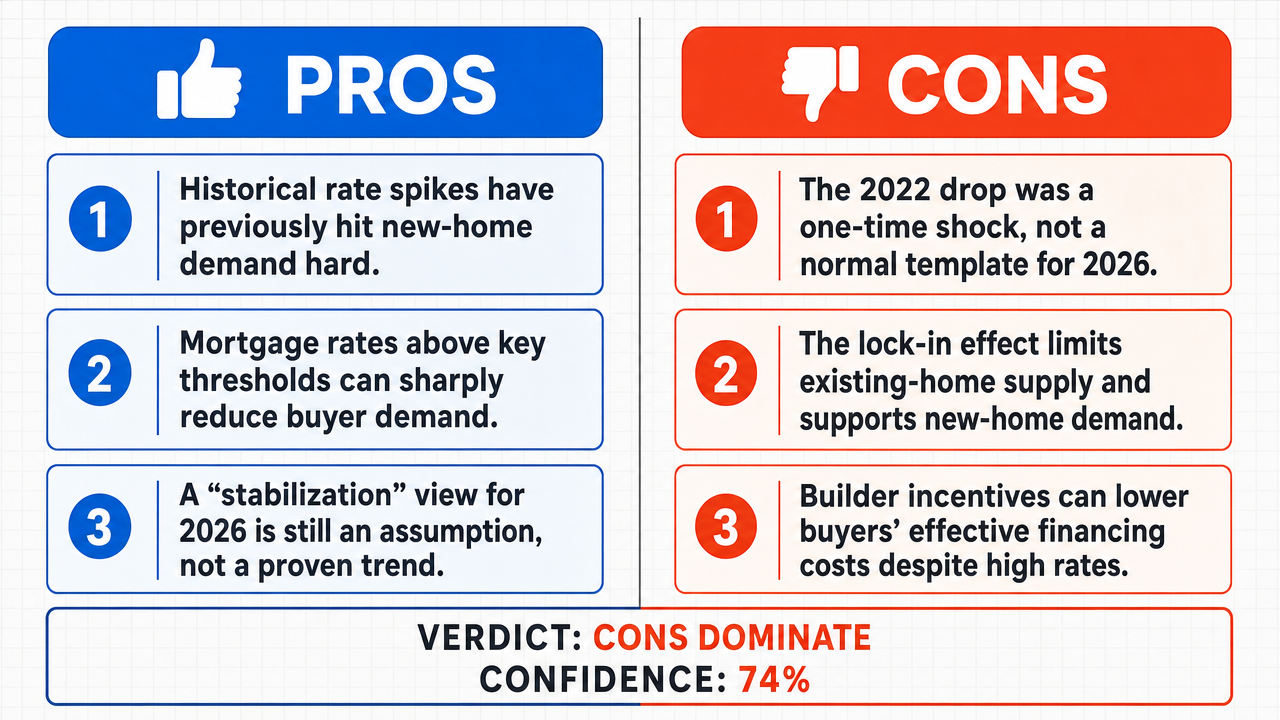
Verdict
Verdict: likely FALSE (74%)
This section provides a brief overview of the key arguments. You do not need to read the full detailed report below.
✅ Key PRO arguments:
- ■Historical precedent demonstrates high sensitivity: when the average 30-year fixed mortgage rate rose from approximately 3.9% in Q4 2021 to approximately 7.1% in Q4 2022, new home sales fell from 885,000 SAAR to 616,000 SAAR, a year-over-year decline of 30.4%, exceeding the 20% threshold.
- ■The 30-year fixed mortgage rate is a key policy transmission channel; sustained increases above a 6-7% threshold precipitate sharp contractions in buyer demand for new construction , making the rate-to-sales mechanism robust and measurable.
- ■The opponent's framing of 2026 as 'Moderate (Stabilization)' rate volatility is itself a scenario assumption rather than an established observation, meaning the negative side is presupposing the very conditions that would prevent the predicted decline.
❌ Key ANTI arguments:
- ■The 2022 historical precedent is an error of temporal anchoring and scale: that period was an unprecedented rapid transition from near-zero rates creating a system shock, whereas by Q4 2026 the market will have undergone several years of rate normalization , fundamentally changing the elasticity conditions.
- ■The 'lock-in effect ' of existing homeowners with sub-market mortgage rates creates a persistent inventory shortage in the pre-owned market , which structurally redirects demand toward new construction and cushions new home sales from rate-driven declines.
- ■Builder-led incentives such as mortgage rate buydowns effectively decouple the consumer's effective financing cost from prevailing market rates, meaning the rate-to-sales transmission mechanism assumed by the affirmative is not direct but heavily mediated by builder behavior.
💭 Conclusion: False. The negative side's strongest argument is that the 2022 historical precedent cited by the affirmative represents an unrepeatable shock scenario rather than a baseline for projecting 2026 outcomes, since the market will have undergone years of rate normalization by then. The affirmative's reliance on a single 30.4% YoY decline from 885,000 SAAR to 616,000 SAAR as a predictive anchor fails to account for structural changes in the housing market, including the lock-in effect that redirects demand toward new construction and builder incentives like rate buydowns that decouple consumer financing costs from prevailing rates. The negative side correctly identified that the affirmative's model treats builder response capacity as a finite resource without rigorous testing against actual market mechanisms. While the rate-to-sales sensitivity is empirically established, the negative side demonstrated that this transmission is heavily mediated by structural factors that prevent a clean extrapolation to a >20% Q4 2026 decline. The negative side's structural arguments substantially weakened but did not completely eliminate the rate-sensitivity mechanism.
🔬 DeepResearch Result: likely FALSE ❌ (74%)
Assertion: The housing market will experience a year-over-year decline in new home sales exceeding 20% in Q4 2026 due to rising mortgage rates .
Participating models: deepseek-v3.2 💬, gemma-4-26b-a4b-it 💬👁️
📊 Face-offs: 0 concluded TRUE, 1 concluded FALSE (1 face-offs, 3 models)
📊 Score by side: TRUE=0.00, FALSE=0.74
🏅 Model score changes:
minimax-m3 💬👁️: +7
✅ PRO Arguments:
- ■Historical precedent demonstrates high sensitivity: when the average 30-year fixed mortgage rate rose from approximately 3.9% in Q4 2021 to approximately 7.1% in Q4 2022, new home sales fell from 885,000 SAAR to 616,000 SAAR, a year-over-year decline of 30.4%, exceeding the 20% threshold. deepseek-v3.2 💬
- ■The 30-year fixed mortgage rate is a key policy transmission channel; sustained increases above a 6-7% threshold precipitate sharp contractions in buyer demand for new construction , making the rate-to-sales mechanism robust and measurable. deepseek-v3.2 💬
- ■The opponent's framing of 2026 as 'Moderate (Stabilization)' rate volatility is itself a scenario assumption rather than an established observation, meaning the negative side is presupposing the very conditions that would prevent the predicted decline. deepseek-v3.2 💬
❌ ANTI Arguments:
- ■The 2022 historical precedent is an error of temporal anchoring and scale: that period was an unprecedented rapid transition from near-zero rates creating a system shock, whereas by Q4 2026 the market will have undergone several years of rate normalization , fundamentally changing the elasticity conditions. gemma-4-26b-a4b-it 💬👁️
- ■The 'lock-in effect ' of existing homeowners with sub-market mortgage rates creates a persistent inventory shortage in the pre-owned market , which structurally redirects demand toward new construction and cushions new home sales from rate-driven declines. gemma-4-26b-a4b-it 💬👁️
- ■Builder-led incentives such as mortgage rate buydowns effectively decouple the consumer's effective financing cost from prevailing market rates, meaning the rate-to-sales transmission mechanism assumed by the affirmative is not direct but heavily mediated by builder behavior. gemma-4-26b-a4b-it 💬👁️
💭 Reasoning: False. The negative side's strongest argument is that the 2022 historical precedent cited by the affirmative represents an unrepeatable shock scenario rather than a baseline for projecting 2026 outcomes, since the market will have undergone years of rate normalization by then. The affirmative's reliance on a single 30.4% YoY decline from 885,000 SAAR to 616,000 SAAR as a predictive anchor fails to account for structural changes in the housing market, including the lock-in effect that redirects demand toward new construction and builder incentives like rate buydowns that decouple consumer financing costs from prevailing rates. The negative side correctly identified that the affirmative's model treats builder response capacity as a finite resource without rigorous testing against actual market mechanisms. While the rate-to-sales sensitivity is empirically established, the negative side demonstrated that this transmission is heavily mediated by structural factors that prevent a clean extrapolation to a >20% Q4 2026 decline. The negative side's structural arguments substantially weakened but did not completely eliminate the rate-sensitivity mechanism.
📋 PRO Facts:
• Average 30-year fixed mortgage rate rose from approximately 3.9% in Q4 2021 to approximately 7.1% in Q4 2022.
• New home sales fell from 885,000 SAAR to 616,000 SAAR between Q4 2021 and Q4 2022, a 30.4% year-over-year decline.
• Sustained mortgage rate increases above a 6-7% threshold have historically precipitated sharp contractions in buyer demand for new construction.
📋 ANTI Facts:
• The 2022 rate transition was an unprecedented rapid shift from near-zero rates, creating a unique shock not representative of normalized rate environments.
• The lock-in effect from existing homeowners with sub-market mortgage rates creates persistent inventory shortages in the pre-owned market.
• Builder-led mortgage rate buydowns can effectively decouple consumer financing costs from prevailing market rates.
| Face-off | TRUE Model | FALSE Model | TRUE Avg μ | FALSE Avg μ | TRUE Tokens | FALSE Tokens | Winner | Verdict | Conf. |
|---|---|---|---|---|---|---|---|---|---|
| #1 | deepseek-v3.2 💬 | gemma-4-26b-a4b-it 💬👁️ | 0.395 | 0.209 | 12 | 3 | TRUE | FALSE | 74% |
The following technical terms, abbreviations, and domain-specific concepts are referenced throughout this debate transcript. Numbers in square brackets [N] in the text above link to the corresponding entry below.
[1] 30-year fixed mortgage rate — A mortgage product with a constant interest rate over a 30-year term. In the debate it is identified as a key policy transmission channel affecting housing affordability and new home sales.
[2] basis points — bps — A unit equal to 1/100th of a percentage point (0.01%). The transcript cites a ~320 basis point increase in mortgage rates between Q4 2021 and Q4 2022.
[3] build-to-rent — A real estate development model in which homes are built specifically for the rental market rather than for sale to individual buyers. The negative position argues this segment provides a more stable, less rate-sensitive demand pillar.
[4] builder incentives — Concessions or benefits offered by home builders to attract or retain buyers. The debate discusses their role in maintaining sales velocity when market mortgage rates rise.
[5] demand pillar — A structural source of demand in a market. The negative position argues that institutionalized build-to-rent demand provides a more stable demand pillar than retail buyers.
[6] effective rate — The actual interest rate a borrower pays after accounting for buydowns or other adjustments. The negative position argues that buydowns create an effective rate that differs from prevailing market rates.
[7] existing inventory — The supply of previously-owned homes available on the market. The debate discusses how critically low existing inventory affects the new construction market.
[8] financing concessions — Reductions in financing costs offered to buyers. The affirmative notes that rate buydowns are financing concessions paid from builder margin.
[9] forward guidance — Communication by central banks or other institutions about expected future economic or policy conditions. The affirmative references forward guidance as a factor shaping rate expectations.
[10] housing affordability — The ability of households to bear housing costs relative to their income or financing costs. The debate treats mortgage rates as a primary driver of housing affordability.
[11] institutionalized demand — Demand originating from large institutional investors rather than individual owner-occupiers. The negative position cites this as a less rate-sensitive demand source.
[12] inventory shortage — A condition in which the available supply of homes is insufficient to meet buyer demand. The negative position argues persistent inventory shortages will support new home sales.
[13] lock-in effect — The phenomenon in which existing homeowners are reluctant to sell and give up low mortgage rates. The negative position argues this creates structural scarcity in the pre-owned market.
[14] macroeconomic floor — A lower bound on aggregate economic activity supported by structural factors. The affirmative argues that rate buydowns are not a permanent macroeconomic floor.
[15] margin-driven — Determined or constrained by profit margins. The debate characterizes builder incentive capability as margin-driven.
[16] mortgage rates — The interest rates charged on home loans. The debate centers on how rising mortgage rates affect new home sales volume.
[17] new construction — Newly built homes as opposed to existing or previously-owned homes. The debate discusses demand being redirected toward new construction when existing inventory is scarce.
[18] new home sales — Sales of newly built homes, the central metric of the debate. The affirmative frames the claim as a test of the U.S. new-home sales seasonally adjusted annual rate.
[19] pre-owned market — The market for previously-owned homes. The negative position argues structural scarcity in this market redirects demand to new construction.
[20] Q4 — fourth quarter — The fourth quarter of a calendar year (October–December). The debate's central claim concerns Q4 2026.
[21] rate buydowns — A financing concession in which a builder or seller pays to reduce the buyer's mortgage rate, typically for an initial period. The debate disputes whether buydowns can sustain sales during rising rate environments.
[22] rate normalization — The process by which interest rates return to more typical levels after a period of unusually high or low rates. The negative position argues the market will have undergone rate normalization by 2026.
[23] rate shock — A sudden, significant change in interest rates. The affirmative cites the 2021–2022 increase as a rate shock that drove a 30.4% decline in new home sales.
[24] rate volatility — The degree of variation in interest rates over time. The debate references scenarios of moderate rate volatility.
[25] retail buyer — An individual homebuyer purchasing for personal occupancy rather than investment. The negative position contrasts retail buyers with institutionalized build-to-rent demand.
[26] SAAR — Seasonally Adjusted Annual Rate — A presentation method for economic data that removes seasonal patterns and expresses the figure as if it were an annual rate. The transcript explicitly defines this term in the data legend.
[27] sales velocity — The speed at which homes are sold in a given market. The debate discusses how builders use incentives to maintain sales velocity when rates rise.
[28] structural decoupling — A separation between two variables that would normally be expected to move together. The negative position argues mortgage rates are structurally decoupled from purchase prices in the new construction segment.
[29] structural scarcity — A persistent shortage caused by underlying market structure rather than temporary cyclical factors. The negative position attributes this to the lock-in effect.
[30] transmission mechanism — The channel through which a change in one economic variable affects another. The debate discusses the transmission mechanism between mortgage rates and new home sales volume.
[31] YoY — Year-over-year — A comparison of a metric in one period against the same period in the previous year. The debate's central claim concerns a year-over-year decline exceeding 20%.
The following financial data tables were referenced during the debate exchanges:
| Period | Avg. 30-Yr Mortgage Rate | New Home Sales (SAAR) | YoY Change |
|---|---|---|---|
| Q4 2021 | 3.90% | 885,000 | — |
| Q4 2022 | 7.10% | 616,000 | -30.4% |
Legend: Historical correlation between mortgage rates and new home sales in the US. Sales are Seasonally Adjusted Annual Rate (SAAR). Source: U.S. Census Bureau and Freddie Mac.
| Metric | 2022 Context (Shock) | 2026 Projection (Normalized) | Impact on Sales |
|---|---|---|---|
| Rate Volatility | Extreme (Rapid Rise) | Moderate (Stabilization) | Lower |
| Inventory Level | High (Existing) | Critically Low (Existing) | Higher Demand |
| Builder Incentive Capability | Low | High (Margin-driven) | Volume Support |
Legend: Comparison of the market environment during the 2022 rate shock versus the projected 2026 environment. "Impact on Sales" refers to the downward pressure on new home sales volume.
| Indicator | Value |
|---|---|
| December 2021 new home sales SAAR | 885,000 |
| December 2024 new home sales SAAR | 711,000 |
| Shortfall from December 2021 | -19.7% |
| 80% of a 700,000 SAAR baseline | 560,000 |
Legend: SAAR = seasonally adjusted annual rate. Shortfall computed as (711,000 − 885,000) / 885,000 = −19.7%; threshold computed as 700,000 × 0.80 = 560,000.
| Period | New Home Sales SAAR | Prior-Year SAAR | YoY Change |
|---|---|---|---|
| Q4 2022 | 616,000 | 885,000 | -30.4% |
Legend: U.S. new home sales seasonally adjusted annual rate (SAAR), Q4 2022 compared with Q4 2021. YoY change = (616,000 − 885,000) / 885,000 = −30.4%.
Face-off transcripts
- ■
Ownership & Trade Secrets. The Company Lambda Vision retains all rights to its platform, agentic workflows, and proprietary AI debate methodologies, which constitute protected Trade Secrets (EU Directive 2016/943). Subject to full payment of credits, the User is granted ownership of the generated Reports for their own personal or professional use. Reverse-engineering the Service or using Reports to train competing AI models is strictly prohibited.
- ■
No Professional Advice. Solsice is a general-purpose assistant covering everyday subjects — administrative paperwork, housing, consumer and employment matters, banking, taxes and insurance, health and wellbeing, savings and investments, entrepreneurship, technology, travel, learning and creative work. Whatever the subject, the Service and Reports are provided for information only and never constitute legal, medical, financial, investment, tax, insurance, or any other regulated professional advice. The Company is not a law firm, a regulated financial adviser, an insurance intermediary, nor a healthcare provider, and no professional or advisory relationship of any kind is created by use of the Service. Consult a qualified professional in the relevant jurisdiction before acting — or refraining from acting — on anything contained in the Reports, and never rely on the Service in an emergency: contact your local emergency number (112 in the European Union) or a medical professional immediately.
- ■
AI-Generated Content, Sources and Viewpoints. Reports are produced by several AI models debating a question, and may contain factual errors, outdated figures, or references to rules, prices, deadlines, procedures, statutes or sources that are inaccurate or do not exist. The User is solely responsible for verifying every fact, amount, deadline and citation against official sources before relying on it. Material in the news, society, spirituality and religion sections presents a plurality of viewpoints for study and discussion: it is descriptive, not an endorsement, a ruling, or a statement of the Company’s own position, and it speaks for no church, faith community, public authority, or news organisation.
- ■
Liability & Governing Law. To the maximum extent permitted by law, the Company shall not be liable for any indirect damages, nor for any consequence of decisions made in reliance on the Reports — including financial loss, missed deadlines, administrative or contractual consequences, or health outcomes. These Terms are governed by French law. Any disputes shall be subject to the exclusive jurisdiction of the Courts of Paris, France.