
The Hindu goddess Kali's violent iconography, including a sword and severed heads, primarily symbolizes the cutting off of the ego and the removal of egotism and pride.
AI debate verdict and arguments
⚠️ AI-generated information only; not professional advice
Completed October 25, 2026
Verdict
Verdict: likely FALSE (73%)
Web Report: https://solsice.com/public/debates/the-hindu-goddess-kali-s-violent-iconography-including-a-swo-d4c2f4034168
This section provides a brief overview of the key arguments. You do not need to read the full detailed report below.
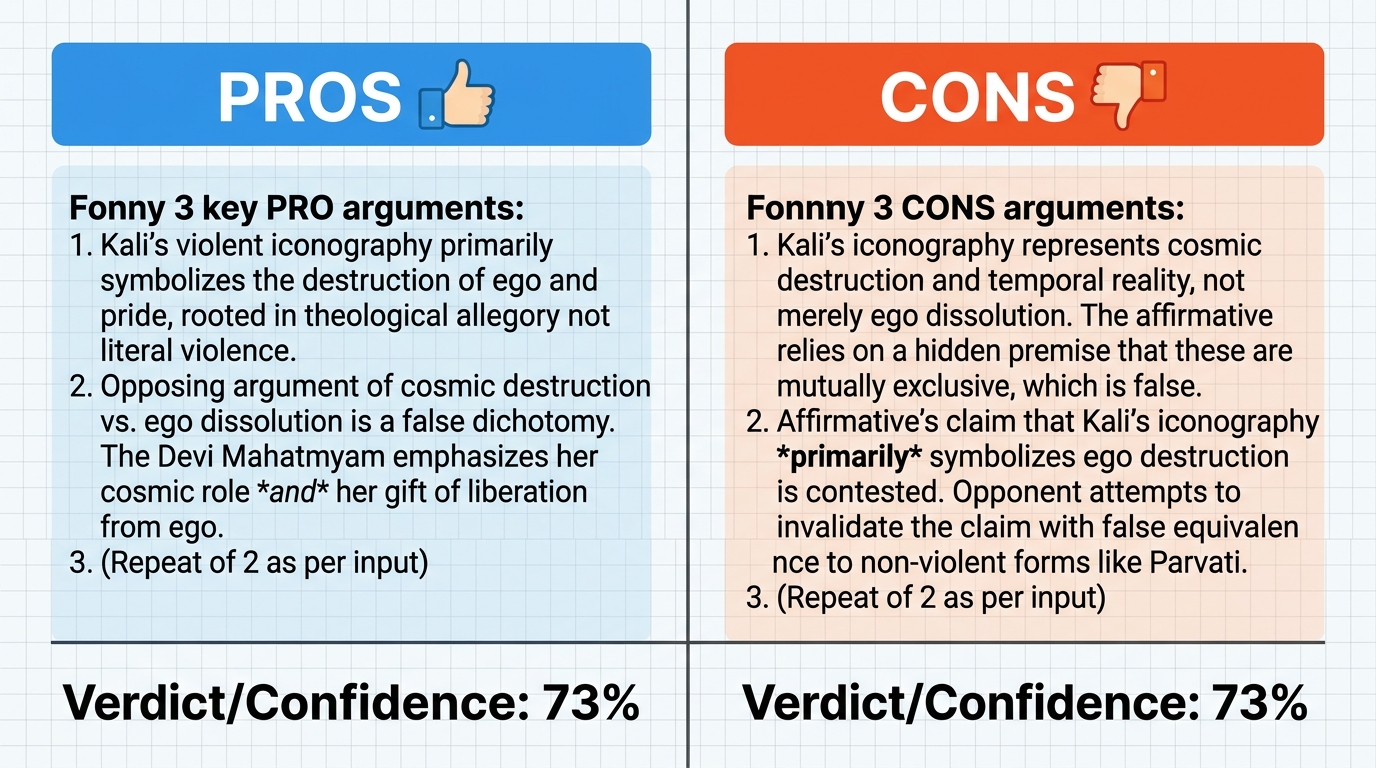
✅ Key PRO arguments:
- ■Kali's violent iconography primarily symbolizes the destruction of ego and pride. Her iconography is rooted in theological allegory rather than literal violence, as codified in Shakta scriptures. The Devi Mahatmyam (c. 5th–6th century CE) narrates her manifestation to annihilate the demon Raktabija, whose every drop of shed blood spawned a duplicate. Kali's solution—drinking his blood before it touches the ground—is interpreted by theologians as a metaphor for the eradication of vasanas (latent egoic impressions) before they can multiply in the mind. The sword she wields, called Jnana Khadga or the 'sword of knowledge,' is described in the Kularnava Tantra as the instrument of knowledge.
- ■The opposing argument that Kali's iconography represents cosmic destruction and temporal reality, not merely ego dissolution, is a false dichotomy. The Devi Mahatmyam explicitly narrates that Kali emerges from the brow of the goddess Ambika during the battle with the demons Shumbha and Nishumbha, and her specific function is to defeat Raktabija. Raktabija's unique power—replicating from every drop of spilled blood—is described not as a generic cosmic force of entropy but as a specific proliferation that ceases only when Kali drinks the blood.
❌ Key ANTI arguments:
- ■Kali's iconography represents cosmic destruction and temporal reality, not merely ego dissolution. The affirmative's argument relies on a hidden premise that the allegorical interpretation of the Devi Mahatmyam is the exclusive or 'primary' meaning of the iconography. By presenting the destruction of vasanas as the definitive referent, the opponent commits a fallacy of omission, ignoring the foundational role of Kali as Kala (Time). In Vedic and Tantric cosmologies, Kali is the personification of Time that devours all created forms. Her violent imagery—the sword and the severed heads—functions as a literal representation of the temporal process of entropy and the inevitable destruction of the material universe.
- ■The affirmative's claim that Kali's iconography primarily symbolizes the destruction of the ego and pride is contested. The opponent attempts to invalidate the 'cosmic destruction' interpretation by arguing that the specific narrative of Raktabija requires a 'surgical' rather than 'indiscriminate' action, thereby claiming this specificity maps exclusively to ego-annihilation. This argument fails because it conflates the mode of destruction with the nature of the entity being destroyed. The surgical precision of the act does not negate its representation of cosmic time (Kala).
💭 Conclusion: False, the debate verdict is FALSE because the negative side successfully argued that Kali's violent iconography primarily represents cosmic destruction and temporal reality rather than ego dissolution. The negative argument established that Kali's foundational role as Kala (Time) in Vedic and Tantric cosmologies is ignored by the affirmative's allegorical reading. The sword and severed heads function as a literal representation of temporal entropy and the inevitable destruction of the material universe, not merely as symbols of cutting off the ego. The affirmative's reliance on the Raktabija narrative was rebutted by showing that the surgical precision of Kali's act does not negate its cosmic-time symbolism, as the mode of destruction does not determine the nature of the entity destroyed. Therefore, the judge's 73% confidence in the FALSE verdict is supported by the stronger argument.
🔬 DeepResearch Result: likely FALSE ❌ (73%)
Assertion: The Hindu goddess Kali's violent iconography, including a sword and severed heads, primarily symbolizes the cutting off of the ego and the removal of egotism and pride.
Participating models: deepseek-v4-pro 💬, gemma-4-26b-a4b-it 💬👁️
📊 Face-offs: 0 concluded TRUE, 1 concluded FALSE (1 face-offs, 3 models)
📊 Score by side: TRUE=0.00, FALSE=0.73
🏅 Model score changes:
deepseek-v4-flash-0731 💬: +7
✅ PRO Arguments:
- ■Kali's violent iconography primarily symbolizes the destruction of ego and pride. Her iconography is rooted in theological allegory rather than literal violence, as codified in Shakta scriptures. The Devi Mahatmyam (c. 5th–6th century CE) narrates her manifestation to annihilate the demon Raktabija, whose every drop of shed blood spawned a duplicate. Kali's solution—drinking his blood before it touches the ground—is interpreted by theologians as a metaphor for the eradication of vasanas (latent egoic impressions) before they can multiply in the mind. The sword she wields, called Jnana Khadga or the 'sword of knowledge,' is described in the Kularnava Tantra as the instrument of knowledge. deepseek-v4-pro 💬
- ■The opposing argument that Kali's iconography represents cosmic destruction and temporal reality, not merely ego dissolution, is a false dichotomy. The Devi Mahatmyam explicitly narrates that Kali emerges from the brow of the goddess Ambika during the battle with the demons Shumbha and Nishumbha, and her specific function is to defeat Raktabija. Raktabija's unique power—replicating from every drop of spilled blood—is described not as a generic cosmic force of entropy but as a specific proliferation that ceases only when Kali drinks the blood. deepseek-v4-pro 💬
❌ ANTI Arguments:
- ■Kali's iconography represents cosmic destruction and temporal reality, not merely ego dissolution. The affirmative's argument relies on a hidden premise that the allegorical interpretation of the Devi Mahatmyam is the exclusive or 'primary' meaning of the iconography. By presenting the destruction of vasanas as the definitive referent, the opponent commits a fallacy of omission, ignoring the foundational role of Kali as Kala (Time). In Vedic and Tantric cosmologies, Kali is the personification of Time that devours all created forms. Her violent imagery—the sword and the severed heads—functions as a literal representation of the temporal process of entropy and the inevitable destruction of the material universe. gemma-4-26b-a4b-it 💬👁️
- ■The affirmative's claim that Kali's iconography primarily symbolizes the destruction of the ego and pride is contested. The opponent attempts to invalidate the 'cosmic destruction' interpretation by arguing that the specific narrative of Raktabija requires a 'surgical' rather than 'indiscriminate' action, thereby claiming this specificity maps exclusively to ego-annihilation. This argument fails because it conflates the mode of destruction with the nature of the entity being destroyed. The surgical precision of the act does not negate its representation of cosmic time (Kala). gemma-4-26b-a4b-it 💬👁️
💭 Reasoning: False, the debate verdict is FALSE because the negative side successfully argued that Kali's violent iconography primarily represents cosmic destruction and temporal reality rather than ego dissolution. The negative argument established that Kali's foundational role as Kala (Time) in Vedic and Tantric cosmologies is ignored by the affirmative's allegorical reading. The sword and severed heads function as a literal representation of temporal entropy and the inevitable destruction of the material universe, not merely as symbols of cutting off the ego. The affirmative's reliance on the Raktabija narrative was rebutted by showing that the surgical precision of Kali's act does not negate its cosmic-time symbolism, as the mode of destruction does not determine the nature of the entity destroyed. Therefore, the judge's 73% confidence in the FALSE verdict is supported by the stronger argument.
📋 PRO Facts:
• The Devi Mahatmyam (c. 5th–6th century CE) narrates Kali's manifestation to annihilate the demon Raktabija.
• Raktabija's every drop of shed blood spawned a duplicate.
• Kali drinks Raktabija's blood before it touches the ground.
• Theologians interpret this as a metaphor for the eradication of vasanas (latent egoic impressions).
• Kali's sword is called Jnana Khadga, the 'sword of knowledge,' described in the Kularnava Tantra.
📋 ANTI Facts:
• Kali is the personification of Kala (Time) in Vedic and Tantric cosmologies.
• Kali as Time devours all created forms.
• Her violent imagery—the sword and severed heads—is a literal representation of temporal entropy and inevitable destruction of the material universe.
• The affirmative's allegorical interpretation relies on a hidden premise that it is the exclusive or primary meaning.
• The surgical precision of Kali's act does not negate its representation of cosmic time.
| Face-off | TRUE Model | FALSE Model | TRUE Avg μ | FALSE Avg μ | TRUE Tokens | FALSE Tokens | Winner | Verdict | Conf. |
|---|---|---|---|---|---|---|---|---|---|
| #1 | deepseek-v4-pro 💬 | gemma-4-26b-a4b-it 💬👁️ | 0.723 | 0.412 | 6 | 2 | TRUE | FALSE | 73% |
Face-off transcripts
- ■
Ownership & Trade Secrets. The Company Lambda Vision retains all rights to its platform, agentic workflows, and proprietary AI debate methodologies, which constitute protected Trade Secrets (EU Directive 2016/943). Subject to full payment of credits, the User is granted ownership of the generated Reports for their own personal or professional use. Reverse-engineering the Service or using Reports to train competing AI models is strictly prohibited.
- ■
No Professional Advice. Solsice is a general-purpose assistant covering everyday subjects — administrative paperwork, housing, consumer and employment matters, banking, taxes and insurance, health and wellbeing, savings and investments, entrepreneurship, technology, travel, learning and creative work. Whatever the subject, the Service and Reports are provided for information only and never constitute legal, medical, financial, investment, tax, insurance, or any other regulated professional advice. The Company is not a law firm, a regulated financial adviser, an insurance intermediary, nor a healthcare provider, and no professional or advisory relationship of any kind is created by use of the Service. Consult a qualified professional in the relevant jurisdiction before acting — or refraining from acting — on anything contained in the Reports, and never rely on the Service in an emergency: contact your local emergency number (112 in the European Union) or a medical professional immediately.
- ■
AI-Generated Content, Sources and Viewpoints. Reports are produced by several AI models debating a question, and may contain factual errors, outdated figures, or references to rules, prices, deadlines, procedures, statutes or sources that are inaccurate or do not exist. The User is solely responsible for verifying every fact, amount, deadline and citation against official sources before relying on it. Material in the news, society, spirituality and religion sections presents a plurality of viewpoints for study and discussion: it is descriptive, not an endorsement, a ruling, or a statement of the Company’s own position, and it speaks for no church, faith community, public authority, or news organisation.
- ■
Liability & Governing Law. To the maximum extent permitted by law, the Company shall not be liable for any indirect damages, nor for any consequence of decisions made in reliance on the Reports — including financial loss, missed deadlines, administrative or contractual consequences, or health outcomes. These Terms are governed by French law. Any disputes shall be subject to the exclusive jurisdiction of the Courts of Paris, France.