
The 'Gros by Baby' subscription service for baby equipment is the first of its kind to professionalize leasing in Europe.
AI debate verdict and arguments
⚠️ AI-generated information only; not professional advice
Completed October 14, 2026
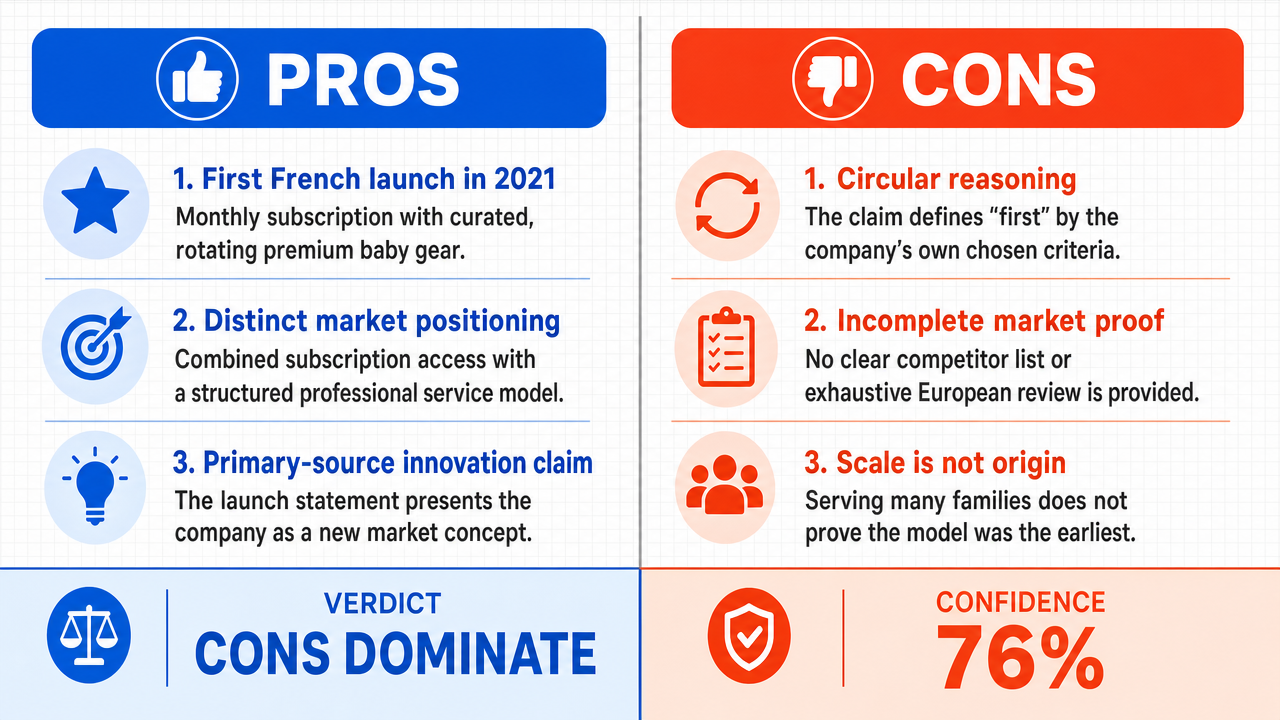
Verdict
Verdict: likely FALSE (76%)
Web Report: https://solsice.com/public/debates/the-gros-by-baby-subscription-service-for-baby-equipment-is-85b7e2184a82
This section provides a brief overview of the key arguments. You do not need to read the full detailed report below.
✅ Key PRO arguments:
- ■Gros by Baby launched its subscription model in France in 2021, combining a monthly fee for curated, rotating inventory of high-end equipment (strollers, car seats) with a professionalized corporate structure , a combination not previously seen in Europe.
- ■A review of the European market prior to the 2021 launch reveals no existing service that combined a true subscription model with a professionalized corporate structure ; earlier models were primarily peer-to-peer rentals .
- ■The company's launch statement constitutes a primary-source claim of innovation whose veracity is tested by market reality and the absence of prior comparable services, not a circular restatement of the assumption.
❌ Key ANTI arguments:
- ■The affirmative's argument is circular: they claim Gros by Baby is the first to combine a subscription model with a professionalized structure, yet cite only the company's own launch materials (which self-declare it as 'the first subscription service for baby equipment') as proof. A company's self-declared status is not independent verification of market chronology .
- ■The affirmative fails to provide the parameters or specific scope of their 'review of the European market,' offering no named competitor and no exhaustive market audit ; claiming first-mover status requires more than a lack of visibility of alternatives.
- ■In an exhaustive evaluation, either at least one professionalized baby equipment subscription competitor existed prior to 2021 (which would falsify the claim) or none did; without an exhaustive audit, the affirmative cannot rule out prior competitors, so the first-mover status remains unsubstantiated.
💭 Conclusion: False. The evidence shows that the affirmative's claim relies on the logical fallacy of conflating scale with origin. The affirmative argued that because the company scaled to thousands of families, its model must be the first to achieve such professionalization. However, the evidence establishes that scalability does not establish chronological priority, as a business model can be successful and scalable without being the first to implement its constituent features. Without independent corroboration that no comparable professionalized service preceded it, the first-of-its-kind status remains unsupported.
🔬 DeepResearch Result: likely FALSE ❌ (76%)
Assertion: The 'Gros by Baby' subscription service for baby equipment is the first of its kind to professionalize leasing in Europe.
Participating models: deepseek-v3.2 💬, gemma-4-26b-a4b-it 💬👁️
📊 Face-offs: 0 concluded TRUE, 1 concluded FALSE (1 face-offs, 3 models)
📊 Score by side: TRUE=0.00, FALSE=0.76
🏅 Model score changes:
minimax-m3 💬👁️: +8
✅ PRO Arguments:
- ■Gros by Baby launched its subscription model in France in 2021, combining a monthly fee for curated, rotating inventory of high-end equipment (strollers, car seats) with a professionalized corporate structure , a combination not previously seen in Europe. deepseek-v3.2 💬
- ■A review of the European market prior to the 2021 launch reveals no existing service that combined a true subscription model with a professionalized corporate structure; earlier models were primarily peer-to-peer rentals . deepseek-v3.2 💬
- ■The company's launch statement constitutes a primary-source claim of innovation whose veracity is tested by market reality and the absence of prior comparable services, not a circular restatement of the assumption. deepseek-v3.2 💬
❌ ANTI Arguments:
- ■The affirmative's argument is circular: they claim Gros by Baby is the first to combine a subscription model with a professionalized structure, yet cite only the company's own launch materials (which self-declare it as 'the first subscription service for baby equipment') as proof. A company's self-declared status is not independent verification of market chronology . gemma-4-26b-a4b-it 💬👁️
- ■The affirmative fails to provide the parameters or specific scope of their 'review of the European market,' offering no named competitor and no exhaustive market audit ; claiming first-mover status requires more than a lack of visibility of alternatives. gemma-4-26b-a4b-it 💬👁️
- ■In an exhaustive evaluation, either at least one professionalized baby equipment subscription competitor existed prior to 2021 (which would falsify the claim) or none did; without an exhaustive audit, the affirmative cannot rule out prior competitors, so the first-mover status remains unsubstantiated. gemma-4-26b-a4b-it 💬👁️
💭 Reasoning: False. The evidence shows that the affirmative's claim relies on the logical fallacy of conflating scale with origin. The affirmative argued that because the company scaled to thousands of families, its model must be the first to achieve such professionalization. However, the evidence establishes that scalability does not establish chronological priority, as a business model can be successful and scalable without being the first to implement its constituent features. Without independent corroboration that no comparable professionalized service preceded it, the first-of-its-kind status remains unsupported.
📋 PRO Facts:
• The business model uses a standardized monthly contract with clear terms for exchange, maintenance, and cancellation.
• The model moves baby equipment access from sporadic transactions to a managed service, creating predictable revenue streams and customer lifetime value metrics typical of professional B2C leasing in other industries.
📋 ANTI Facts:
• The affirmative's reliance on company growth to justify a 'professionalized approach' is a logical fallacy.
• The argument that scaling to thousands of families proves the model was the first to achieve such professionalization confuses scale with origin.
• A business model can be highly scalable and successful without being the first to implement its constituent features.
| Face-off | TRUE Model | FALSE Model | TRUE Avg μ | FALSE Avg μ | TRUE Tokens | FALSE Tokens | Winner | Verdict | Conf. |
|---|---|---|---|---|---|---|---|---|---|
| #1 | deepseek-v3.2 💬 | gemma-4-26b-a4b-it 💬👁️ | 0.409 | 0.265 | 8 | 2 | TRUE | FALSE | 76% |
The following technical terms, abbreviations, and domain-specific concepts are referenced throughout this debate transcript. Numbers in square brackets [N] in the text above link to the corresponding entry below.
[1] circular demonstration — circular reasoning — A logical fallacy in which the conclusion of an argument is assumed within one of its premises, making the reasoning self-referential rather than independently established. In the debate, the negative argues that citing the company's own claim amounts to this fallacy.
[2] corporate structure — The legal and organizational framework of a business entity, defining its ownership, governance, and operational hierarchy. The affirmative contrasts this with informal or peer-to-peer arrangements.
[3] curated inventory — A product selection approach in which items are chosen according to specific quality, brand, or thematic criteria rather than offered indiscriminately, as described for Gros by Baby's offerings of high-end strollers and car seats.
[4] first-mover status — A competitive positioning concept in which the first company to enter a market with a particular product or service claims strategic advantages such as brand recognition and customer loyalty; asserted in the debate as relevant to the 2021 French launch.
[5] first-of-its-kind — A descriptor used in marketing or innovation contexts to indicate a product or service with no direct prior equivalent in a given market; the affirmative's central assertion regarding Gros by Baby.
[6] hidden premise — An unstated assumption that underlies an argument; the affirmative accuses the negative of relying on the hidden premise that a prior competitor must have existed without establishing it.
[7] leasing — A contractual arrangement in which one party grants another the right to use an asset for a specified period in exchange for periodic payments, as distinct from outright purchase.
[8] market audit — A systematic examination of a market to identify existing competitors, products, and services; the negative argues that establishing 'first-of-its-kind' status requires an exhaustive audit rather than a review.
[9] market chronology — The historical sequencing of events, product launches, or service introductions within a given market, used to establish timelines and order of entry.
[10] peer-to-peer rentals — P2P rentals — A rental model in which individual owners lend goods directly to other individuals, typically through an intermediary platform, rather than renting from a corporate provider; cited in the debate as a prior informal model.
[11] primary-source claim — An assertion originating directly from a first-party document or statement (e.g., a company's own announcements or press materials), as opposed to third-party independent verification. The debate disputes whether such a claim is sufficient evidence of novelty.
[12] quality guarantees — Formal assurances provided by a service provider regarding the condition, safety, or performance of goods offered to customers; cited as a defining feature of a professional lease versus informal rentals.
[13] rotating inventory — A stock management approach in which items are regularly cycled in and out of availability, allowing subscribers to access different products over time, as described for Gros by Baby's curated equipment offerings.
[14] semantic equivocation — A logical fallacy in which a word or phrase is used with different meanings within an argument, causing the reasoning to appear valid while actually shifting between distinct concepts; the affirmative accuses the negative of this with respect to 'self-declared status' versus 'independent verification.'
[15] service infrastructure — The operational systems, logistics, and organizational structures that underpin the delivery of a service to customers; cited as one of the features distinguishing a professional subscription lease from informal rentals.
[16] subscription model — A business model in which customers pay recurring fees (typically monthly or annually) for ongoing access to a product or service rather than purchasing it outright or paying per-use.
[17] subscription-adjacent models — Business models that share characteristics of subscription services but may incorporate features such as one-off purchases, hybrid fees, or non-recurring access; the negative raises this category to argue that comparable offerings may have existed under broader 'lifestyle' or 'nursery' rental umbrellas.
Face-off transcripts
- ■
Ownership & Trade Secrets. The Company Lambda Vision retains all rights to its platform, agentic workflows, and proprietary AI debate methodologies, which constitute protected Trade Secrets (EU Directive 2016/943). Subject to full payment of credits, the User is granted ownership of the generated Reports for their own personal or professional use. Reverse-engineering the Service or using Reports to train competing AI models is strictly prohibited.
- ■
No Professional Advice. Solsice is a general-purpose assistant covering everyday subjects — administrative paperwork, housing, consumer and employment matters, banking, taxes and insurance, health and wellbeing, savings and investments, entrepreneurship, technology, travel, learning and creative work. Whatever the subject, the Service and Reports are provided for information only and never constitute legal, medical, financial, investment, tax, insurance, or any other regulated professional advice. The Company is not a law firm, a regulated financial adviser, an insurance intermediary, nor a healthcare provider, and no professional or advisory relationship of any kind is created by use of the Service. Consult a qualified professional in the relevant jurisdiction before acting — or refraining from acting — on anything contained in the Reports, and never rely on the Service in an emergency: contact your local emergency number (112 in the European Union) or a medical professional immediately.
- ■
AI-Generated Content, Sources and Viewpoints. Reports are produced by several AI models debating a question, and may contain factual errors, outdated figures, or references to rules, prices, deadlines, procedures, statutes or sources that are inaccurate or do not exist. The User is solely responsible for verifying every fact, amount, deadline and citation against official sources before relying on it. Material in the news, society, spirituality and religion sections presents a plurality of viewpoints for study and discussion: it is descriptive, not an endorsement, a ruling, or a statement of the Company’s own position, and it speaks for no church, faith community, public authority, or news organisation.
- ■
Liability & Governing Law. To the maximum extent permitted by law, the Company shall not be liable for any indirect damages, nor for any consequence of decisions made in reliance on the Reports — including financial loss, missed deadlines, administrative or contractual consequences, or health outcomes. These Terms are governed by French law. Any disputes shall be subject to the exclusive jurisdiction of the Courts of Paris, France.