
The 'gooey butter cake' shaped like a T-Rav with spiced carrot cake filling is a traditional St. Louis dessert.
AI debate verdict and arguments
⚠️ AI-generated information only; not professional advice
Completed October 11, 2026
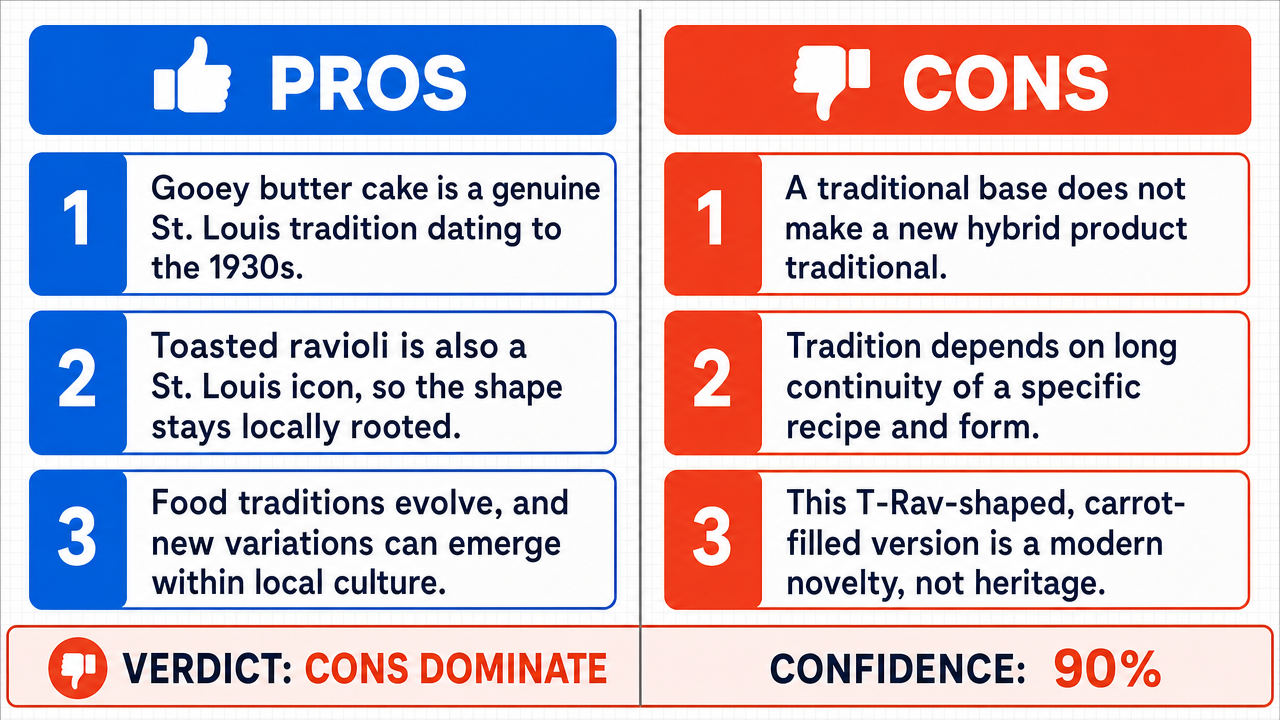
Verdict
Verdict: likely FALSE (90%)
This section provides a brief overview of the key arguments. You do not need to read the full detailed report below.
✅ Key PRO arguments:
- ■Gooey butter cake is an incontrovertible traditional St. Louis creation originating in the 1930s, deeply embedded in the city's culinary identity and recognized by authoritative culinary sources as a definitive regional food.
- ■Toasted ravioli (T-Rav ) is another documented St. Louis food invention and local icon, so combining the shape with gooey butter cake keeps the dessert within the St. Louis culinary tradition .
- ■Culinary tradition is not static; authoritative definitions from cultural heritage bodies (e.g., UNESCO) treat tradition as living, continuously recreated, and providing identity and continuity, so a reimagined gooey butter cake can still qualify as traditional.
❌ Key ANTI arguments:
- ■The assertion commits a category error by confusing the existence of a traditional base (gooey butter cake ) with the identity of a specific, novel product; adding non-traditional elements like a carrot cake filling and a toasted ravioli shape does not retain 'traditional' status.
- ■Tradition in culinary history is defined by the continuity of specific recipes and forms over time, and the T-Rav -shaped carrot-filled variant is a modern hybrid that breaks that continuity.
- ■The TRUE side's position relies on a logical contradiction : asserting that the general category of gooey butter cake is traditional while simultaneously claiming this specific modified variant is also traditional—these cannot both be true under the same evaluative framework .
💭 Conclusion: False. The T-Rav -shaped gooey butter cake with spiced carrot cake filling is a modern novelty rather than a traditional St. Louis dessert. While gooey butter cake itself is an undisputed St. Louis tradition originating in the 1930s, the specific variant in question combines non-traditional elements—a carrot cake filling and a toasted ravioli shape—into a hybrid product that lacks the historical continuity required for traditional status. The TRUE side's argument that culinary tradition is 'living' and evolving was effectively countered by the observation that even living traditions require recognizable continuity of form and recipe, which this novelty dessert does not possess. The judge found the FALSE side's category-error framing and emphasis on the distinction between a traditional base and a novel derivative more persuasive.
🔬 DeepResearch Result: likely FALSE ❌ (90%)
Assertion: The 'gooey butter cake ' shaped like a T-Rav with spiced carrot cake filling is a traditional St. Louis dessert.
Participating models: deepseek-v3.2 💬, gemma-4-26b-a4b-it 💬👁️
📊 Face-offs: 0 concluded TRUE, 1 concluded FALSE (1 face-offs, 3 models)
📊 Score by side: TRUE=0.00, FALSE=0.90
🏅 Model score changes:
minimax-m3 💬👁️: +9
✅ PRO Arguments:
- ■Gooey butter cake is an incontrovertible traditional St. Louis creation originating in the 1930s, deeply embedded in the city's culinary identity and recognized by authoritative culinary sources as a definitive regional food. deepseek-v3.2 💬
- ■Toasted ravioli (T-Rav) is another documented St. Louis food invention and local icon, so combining the shape with gooey butter cake keeps the dessert within the St. Louis culinary tradition . deepseek-v3.2 💬
- ■Culinary tradition is not static; authoritative definitions from cultural heritage bodies (e.g., UNESCO) treat tradition as living, continuously recreated, and providing identity and continuity, so a reimagined gooey butter cake can still qualify as traditional. deepseek-v3.2 💬
- ■The dessert in question is fundamentally a gooey butter cake—the traditional base—presented through the shape of another St. Louis food icon and incorporating a spiced carrot cake filling, a common flavor profile in the region. deepseek-v3.2 💬
❌ ANTI Arguments:
- ■The assertion commits a category error by confusing the existence of a traditional base (gooey butter cake) with the identity of a specific, novel product; adding non-traditional elements like a carrot cake filling and a toasted ravioli shape does not retain 'traditional' status. gemma-4-26b-a4b-it 💬👁️
- ■Tradition in culinary history is defined by the continuity of specific recipes and forms over time, and the T-Rav-shaped carrot-filled variant is a modern hybrid that breaks that continuity. gemma-4-26b-a4b-it 💬👁️
- ■The TRUE side's position relies on a logical contradiction : asserting that the general category of gooey butter cake is traditional while simultaneously claiming this specific modified variant is also traditional—these cannot both be true under the same evaluative framework . gemma-4-26b-a4b-it 💬👁️
- ■Even under a 'living tradition' framework, the addition of a spiced carrot cake filling and a non-traditional toasted ravioli shape creates a new, novel entity that does not meet the criteria for traditional status. gemma-4-26b-a4b-it 💬👁️
💭 Reasoning: False. The T-Rav-shaped gooey butter cake with spiced carrot cake filling is a modern novelty rather than a traditional St. Louis dessert. While gooey butter cake itself is an undisputed St. Louis tradition originating in the 1930s, the specific variant in question combines non-traditional elements—a carrot cake filling and a toasted ravioli shape—into a hybrid product that lacks the historical continuity required for traditional status. The TRUE side's argument that culinary tradition is 'living' and evolving was effectively countered by the observation that even living traditions require recognizable continuity of form and recipe, which this novelty dessert does not possess. The judge found the FALSE side's category-error framing and emphasis on the distinction between a traditional base and a novel derivative more persuasive.
📋 PRO Facts:
• Gooey butter cake originated in St. Louis in the 1930s and is recognized as a classic regional dessert.
• Toasted ravioli (T-Rav) is a documented St. Louis food invention and local icon.
• UNESCO defines intangible cultural heritage as living, continuously recreated traditions providing identity and continuity.
📋 ANTI Facts:
• Tradition in culinary history is defined by the continuity of specific recipes and forms over time.
• The T-Rav-shaped gooey butter cake with spiced carrot cake filling is a contemporary hybrid, not a historically continuous recipe.
• Adding non-traditional elements such as a carrot cake filling and a toasted ravioli shape creates a new, novel entity distinct from the traditional gooey butter cake.
| Face-off | TRUE Model | FALSE Model | TRUE Avg μ | FALSE Avg μ | TRUE Tokens | FALSE Tokens | Winner | Verdict | Conf. |
|---|---|---|---|---|---|---|---|---|---|
| #1 | deepseek-v3.2 💬 | gemma-4-26b-a4b-it 💬👁️ | 0.276 | 0.337 | 12 | 3 | FALSE | FALSE | 90% |
The following technical terms, abbreviations, and domain-specific concepts are referenced throughout this debate transcript. Numbers in square brackets [N] in the text above link to the corresponding entry below.
[1] category error — A logical fallacy cited in the debate, referring to the alleged mistake of treating a novel hybrid product as belonging to the same category as a traditional base item.
[2] core claim — The central assertion that each debater is defending or contesting in a given round of the debate.
[3] counter-argument — An argument raised in opposition to the opposing side's position, which the debater then attempts to refute.
[4] culinary identity — The set of foods, recipes, and foodways that characterize and distinguish a particular region's culture, referenced in relation to St. Louis.
[5] culinary lineage — The line of culinary descent or tradition connecting related dishes, used in the debate to argue that the hybrid dessert belongs within St. Louis food history.
[6] culinary mashup — A contemporary food item that combines elements from multiple distinct culinary traditions or dishes, characterized in the debate as a modern novelty.
[7] culinary tradition — A food or recipe recognized as historically established within a community; the debate disputes whether this requires strict recipe/form continuity or allows creative reinterpretation.
[8] cultural work — A sociological concept invoked in the debate to describe how a food item performs the function of signaling local identity and continuity.
[9] evaluative framework — The set of criteria or definitions used to judge whether a proposition is true, referenced in the debate as the basis for assessing 'traditional' status.
[10] facet — A labeled sub-argument or dimension of a debater's position within a round, used to organize the structure of the argument.
[11] fallacy — A flaw in reasoning; the debate references a fallacy of treating any modification to a traditional dish as itself constituting a new tradition.
[12] fusion — A culinary term for a dish that blends elements from different food traditions, used in the debate to characterize the hybrid dessert as a contemporary fusion.
[13] gimmick — A novelty item designed more for novelty or attention than for culinary substance, used in the debate to describe the hybrid dessert.
[14] gooey butter cake — A St. Louis dessert with a characteristic soft, buttery, gooey topping on a dense cake base, described in the debate as originating in the city in the 1930s.
[15] heritage — Traditions, practices, and items passed down within a community; the debate cites heritage definitions to argue tradition is living and recreated rather than fixed.
[16] hybrid — An item combining elements from multiple distinct sources, used in the debate to characterize the T-Rav-shaped gooey butter cake with carrot filling.
[17] intangible cultural heritage — A UNESCO concept cited in the debate defining heritage as living, transmitted across generations, and continuously recreated by communities to provide identity and continuity.
[18] local identity — The distinctive cultural character of a specific place, referenced in the debate as a function performed by traditional foods.
[19] logical contradiction — A situation in which two propositions asserted together cannot both be true; the negative side claims the affirmative's position contains one.
[20] novelty — A new or unusual item; in the debate, the negative side argues the hybrid dessert is a modern novelty rather than a traditional one.
[21] pillar — A foundational supporting element of an argument; the affirmative side structures its position around three such pillars.
[22] recipe continuity — The preservation of a specific recipe and form over time, cited in the debate as one possible criterion for 'traditional' status.
[23] sociological perspective — An academic viewpoint focused on social structures and cultural practices, acknowledged in the debate as a lens for viewing living culinary tradition.
[24] T-Rav — toasted ravioli — A St. Louis-style toasted ravioli, referenced in the debate as an iconic local food whose shape is borrowed for the dessert in question.
[25] toasted ravioli — A St. Louis culinary invention referenced in the debate as an iconic local food whose shape is borrowed for the dessert in question.
Face-off transcripts
- ■
Ownership & Trade Secrets. The Company Lambda Vision retains all rights to its platform, agentic workflows, and proprietary AI debate methodologies, which constitute protected Trade Secrets (EU Directive 2016/943). Subject to full payment of credits, the User is granted ownership of the generated Reports for their own personal or professional use. Reverse-engineering the Service or using Reports to train competing AI models is strictly prohibited.
- ■
No Professional Advice. Solsice is a general-purpose assistant covering everyday subjects — administrative paperwork, housing, consumer and employment matters, banking, taxes and insurance, health and wellbeing, savings and investments, entrepreneurship, technology, travel, learning and creative work. Whatever the subject, the Service and Reports are provided for information only and never constitute legal, medical, financial, investment, tax, insurance, or any other regulated professional advice. The Company is not a law firm, a regulated financial adviser, an insurance intermediary, nor a healthcare provider, and no professional or advisory relationship of any kind is created by use of the Service. Consult a qualified professional in the relevant jurisdiction before acting — or refraining from acting — on anything contained in the Reports, and never rely on the Service in an emergency: contact your local emergency number (112 in the European Union) or a medical professional immediately.
- ■
AI-Generated Content, Sources and Viewpoints. Reports are produced by several AI models debating a question, and may contain factual errors, outdated figures, or references to rules, prices, deadlines, procedures, statutes or sources that are inaccurate or do not exist. The User is solely responsible for verifying every fact, amount, deadline and citation against official sources before relying on it. Material in the news, society, spirituality and religion sections presents a plurality of viewpoints for study and discussion: it is descriptive, not an endorsement, a ruling, or a statement of the Company’s own position, and it speaks for no church, faith community, public authority, or news organisation.
- ■
Liability & Governing Law. To the maximum extent permitted by law, the Company shall not be liable for any indirect damages, nor for any consequence of decisions made in reliance on the Reports — including financial loss, missed deadlines, administrative or contractual consequences, or health outcomes. These Terms are governed by French law. Any disputes shall be subject to the exclusive jurisdiction of the Courts of Paris, France.