
The global economy will experience a significant recession in 2024 or 2025, primarily driven by an unsustainable housing bubble, substantial unrealized losses in the banking sector, and a downturn in commercial real estate.
AI debate verdict and arguments
⚠️ AI-generated information only; not professional advice
Completed October 14, 2026
Verdict
Verdict: likely FALSE (55%)
Web Report: https://solsice.com/public/debates/the-global-economy-will-experience-a-significant-recession-i-170d99b117a7
This section provides a brief overview of the key arguments. You do not need to read the full detailed report below.
✅ Key PRO arguments:
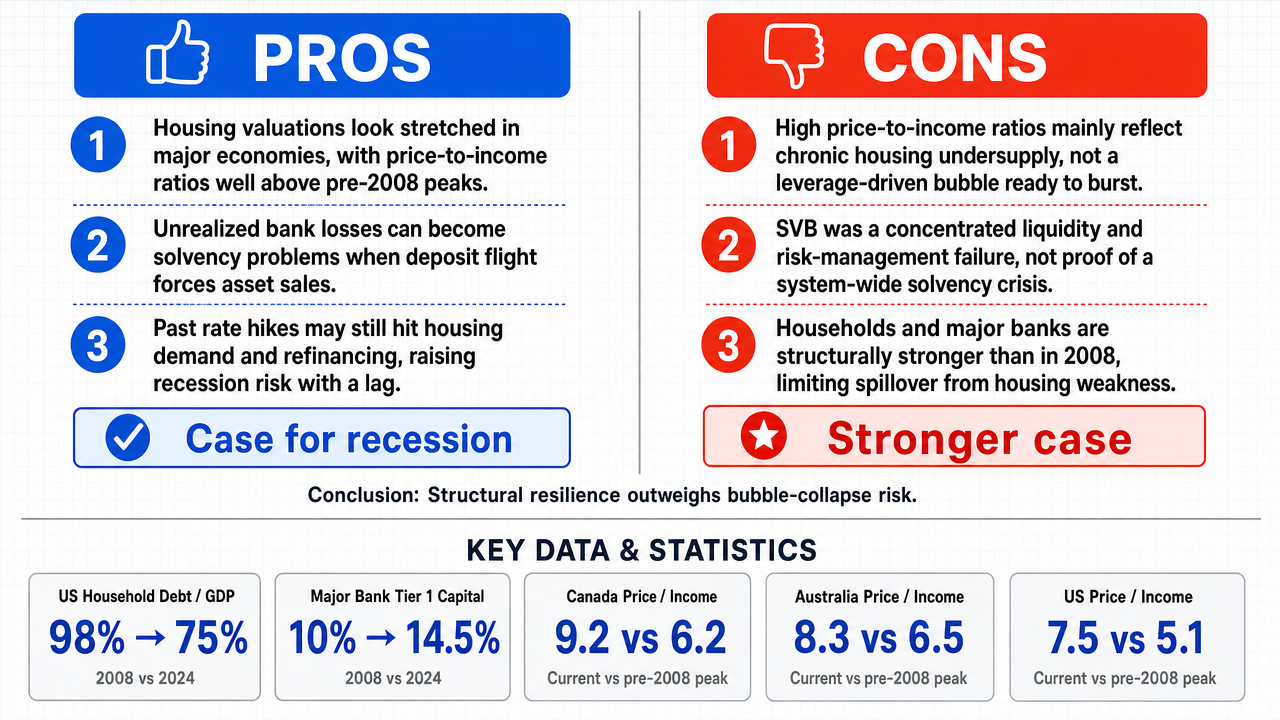
- ■Residential real estate markets in major economies exhibit bubble characteristics, with the US median house price to median household income ratio at approximately 7.5, far exceeding the pre-2008 crisis peak of 5.1, suggesting an unsustainable valuation propped up by ultra-low interest rates that will correct sharply.
- ■Unrealized losses in the banking sector are binding and can trigger solvency crises, as demonstrated by the March 2023 failure of Silicon Valley Bank, which was forced to sell held-to-maturity securities at a loss to meet deposit outflows, crystallizing $1.8 billion in losses and eroding market confidence .
- ■The delayed effect of aggressive monetary tightening will inevitably trigger a downturn in housing markets, as the decade of ultra-low rates that inflated valuations unwinds.
❌ Key ANTI arguments:
- ■High price-to-income ratios do not equate to imminent systemic collapse because current high valuations are driven by chronic housing undersupply rather than excessive leverage , unlike the 2008 crisis, and the homeownership rate remains resilient with a significantly lower proportion of variable-rate mortgages .
- ■The SVB failure was a localized liquidity crisis driven by interest-rate risk management failures and deposit concentration , not a systemic solvency failure, and capital buffers and regulatory frameworks prevent widespread insolvency across the banking sector.
- ■Household balance sheets show unprecedented strength compared to prior cycles, providing structural resilience against a housing correction translating into a broader recession.
💭 Conclusion: False. The negative side successfully argued that high housing price-to-income ratios reflect structural supply constraints rather than leverage -driven bubbles, undermining the claim of an imminent housing collapse. The SVB failure was characterized as a localized liquidity event rather than evidence of systemic banking insolvency, weakening the unrealized losses argument. Because the assertion is compound with three distinct sub-claims and only two were meaningfully contested, confidence is moderated to reflect the least-supported component. Overall, the evidence presented does not establish that a significant global recession driven by these specific factors is imminent in 2024 or 2025.
🔬 DeepResearch Result: likely FALSE ❌ (55%)
Assertion: The global economy will experience a significant recession in 2024 or 2025, primarily driven by an unsustainable housing bubble , substantial unrealized losses in the banking sector, and a downturn in commercial real estate .
Participating models: deepseek-v3.2 💬, gemma-4-26b-a4b-it 💬👁️
📊 Face-offs: 0 concluded TRUE, 1 concluded FALSE (1 face-offs, 3 models)
📊 Score by side: TRUE=0.00, FALSE=0.70
🏅 Model score changes:
minimax-m3 💬👁️: +7
✅ PRO Arguments:
- ■Residential real estate markets in major economies exhibit bubble characteristics, with the US median house price to median household income ratio at approximately 7.5, far exceeding the pre-2008 crisis peak of 5.1, suggesting an unsustainable valuation propped up by ultra-low interest rates that will correct sharply. deepseek-v3.2 💬
- ■Unrealized losses in the banking sector are binding and can trigger solvency crises, as demonstrated by the March 2023 failure of Silicon Valley Bank, which was forced to sell held-to-maturity securities at a loss to meet deposit outflows, crystallizing $1.8 billion in losses and eroding market confidence . deepseek-v3.2 💬
- ■The delayed effect of aggressive monetary tightening will inevitably trigger a downturn in housing markets, as the decade of ultra-low rates that inflated valuations unwinds. deepseek-v3.2 💬
❌ ANTI Arguments:
- ■High price-to-income ratios do not equate to imminent systemic collapse because current high valuations are driven by chronic housing undersupply rather than excessive leverage , unlike the 2008 crisis, and the homeownership rate remains resilient with a significantly lower proportion of variable-rate mortgages . gemma-4-26b-a4b-it 💬👁️
- ■The SVB failure was a localized liquidity crisis driven by interest-rate risk management failures and deposit concentration , not a systemic solvency failure, and capital buffers and regulatory frameworks prevent widespread insolvency across the banking sector. gemma-4-26b-a4b-it 💬👁️
- ■Household balance sheets show unprecedented strength compared to prior cycles, providing structural resilience against a housing correction translating into a broader recession. gemma-4-26b-a4b-it 💬👁️
💭 Reasoning: False. The negative side successfully argued that high housing price-to-income ratios reflect structural supply constraints rather than leverage-driven bubbles, undermining the claim of an imminent housing collapse. The SVB failure was characterized as a localized liquidity event rather than evidence of systemic banking insolvency, weakening the unrealized losses argument. Because the assertion is compound with three distinct sub-claims and only two were meaningfully contested, confidence is moderated to reflect the least-supported component. Overall, the evidence presented does not establish that a significant global recession driven by these specific factors is imminent in 2024 or 2025.
📋 PRO Facts:
• US median house price to median household income ratio reached approximately 7.5, exceeding the pre-2008 crisis peak of 5.1
• Silicon Valley Bank was forced to sell held-to-maturity securities to meet deposit outflows exceeding $42 billion in a single day in March 2023
📋 ANTI Facts:
• Current US housing valuations are driven by chronic undersupply rather than excessive leverage, unlike the 2008 crisis
• The proportion of variable-rate mortgages in the US is significantly lower than in previous housing cycles
• SVB's failure was attributed to interest-rate risk management failures and deposit concentration, not systemic solvency issues
| Face-off | TRUE Model | FALSE Model | TRUE Avg μ | FALSE Avg μ | TRUE Tokens | FALSE Tokens | Winner | Verdict | Conf. |
|---|---|---|---|---|---|---|---|---|---|
| #1 | deepseek-v3.2 💬 | gemma-4-26b-a4b-it 💬👁️ | 0.482 | 0.218 | 8 | 2 | TRUE | FALSE | 70% |
The following technical terms, abbreviations, and domain-specific concepts are referenced throughout this debate transcript. Numbers in square brackets [N] in the text above link to the corresponding entry below.
[1] accounting treatment — The classification of financial assets under specific accounting rules (e.g., held-to-maturity), which determines how they are reported on financial statements. In the debate, this is described as a 'conditional' rather than 'unconditional' designation.
[2] bond holdings — Investments in debt securities (bonds) held by an entity, such as a bank. The debate notes that banks held bonds whose value declined as interest rates rose.
[3] capital buffers — Reserves of capital held by banks above regulatory minimums, intended to absorb potential losses and maintain solvency under stress.
[4] commercial real estate — Property used for business purposes (offices, retail, industrial, multifamily), as distinct from residential real estate. Cited in the debate as one of three drivers of the predicted recession.
[5] consumer spending — Expenditure by households on goods and services, a key component of aggregate economic activity and GDP.
[6] defeasible — Capable of being voided or overridden upon the occurrence of certain conditions. In the debate, used to describe how the held-to-maturity accounting treatment can be undone by liquidity stress.
[7] deposit concentration — A condition in which a bank's deposits are heavily concentrated among a small number of depositors, increasing vulnerability to large or rapid withdrawals.
[8] deposit run — A situation in which many depositors withdraw their funds from a bank simultaneously, typically triggered by loss of confidence or fear of insolvency.
[9] FDIC — Federal Deposit Insurance Corporation — A U.S. government agency that insures bank deposits and supervises insured financial institutions. The debate references its post-mortem review of the Silicon Valley Bank failure.
[10] Federal Reserve — The central bank of the United States, responsible for monetary policy and financial stability. The debate cites Federal Reserve data on banking sector unrealized losses.
[11] fixed-rate mortgages — Home loans with an interest rate that remains constant over the life of the loan, insulating borrowers from changes in market interest rates.
[12] funding pressure — Stress on a financial institution's ability to meet its funding obligations, which may force the sale of assets to raise cash.
[13] held-to-maturity — An accounting classification for debt securities that an entity intends and is able to hold until they mature, allowing them to be carried at amortized cost rather than marked to current market value.
[14] homeownership rate — The proportion of households that own their homes, as opposed to renting. Cited in the debate as evidence of housing market resilience.
[15] household balance sheets — The financial position of households, summarizing their assets (e.g., home equity) and liabilities (e.g., mortgage debt).
[16] housing bubble — A situation in which house prices rise to levels detached from fundamentals (such as income), typically driven by speculation or excessive demand, and are expected to correct sharply.
[17] interest-rate risk management — The practice of identifying and managing a financial institution's exposure to losses resulting from changes in interest rates.
[18] latent vulnerability — A hidden or unrealized risk that has not yet materialized but could cause losses under stress conditions.
[19] leverage — The use of borrowed funds to amplify potential returns or losses, often measured as a ratio of debt to equity or assets. The debate contrasts current low leverage with the high leverage that preceded the 2008 crisis.
[20] liquidity crisis — A situation in which an entity lacks sufficient liquid assets to meet its short-term obligations, even if its longer-term solvency is intact.
[21] liquidity shock — A sudden, unexpected event that creates urgent demand for cash or liquid assets, potentially forcing the sale of less-liquid holdings.
[22] market confidence — The degree of trust that investors, depositors, and other market participants place in the stability and prospects of financial institutions or markets.
[23] monetary tightening — Central bank policy actions that raise interest rates or reduce the money supply, typically to combat inflation or cool an overheating economy.
[24] negative wealth effect — The reduction in consumer spending that occurs when households perceive a decline in their wealth, such as from falling home or asset prices.
[25] paper losses — Losses on assets that have declined in value below their purchase price but have not yet been sold (i.e., unrealized losses).
[26] price-to-income ratio — The ratio of house prices to household income, used as an indicator of housing affordability and potential bubble conditions. The debate cites elevated ratios in the U.S., Canada, and Australia.
[27] realized losses — Losses that occur when an asset is sold for less than its book value, converting previously unrealized (paper) losses into actual losses.
[28] regional banking failures — The collapse or insolvency of banks that operate primarily within specific geographic regions rather than nationally. The debate cites the 2023 failures as relevant precedent.
[29] solvency crisis — A situation in which an entity's liabilities exceed its assets, rendering it unable to meet its long-term obligations. Distinguished in the debate from a liquidity crisis.
[30] structural shift — A fundamental, long-lasting change in the underlying drivers of an economic variable (such as housing supply), as opposed to a cyclical fluctuation.
[31] supply dynamics — The forces affecting the availability of goods or housing, including construction rates, regulatory constraints, land availability, and demographic trends.
[32] SVB — Silicon Valley Bank — A U.S. bank that failed in March 2023 following a concentrated deposit run and losses on its held-to-maturity securities portfolio. Cited in the debate as evidence that paper losses can become binding under liquidity stress.
[33] systemic resilience — The ability of the financial system as a whole to withstand shocks without widespread disruption or contagion.
[34] systemic solvency crisis — A widespread insolvency affecting multiple institutions across the financial system simultaneously, as opposed to an isolated bank failure.
[35] ultra-low interest rates — Interest rates set at very low levels, typically near zero, often used as a monetary policy tool to stimulate borrowing and economic activity.
[36] unrealized losses — Losses on assets that have declined in value below their purchase price but have not yet been sold. The debate notes that U.S. banks held over $500 billion in such losses as of Q4 2023.
[37] variable-rate mortgages — Home loans with interest rates that fluctuate with a benchmark rate, exposing borrowers directly to changes in monetary policy.
[38] wealth effect — The change in spending behavior that results from perceived changes in household wealth, such as rising or falling home values.
The following financial data tables were referenced during the debate exchanges:
| Country | House Price-to-Income Ratio (Current) | Pre-2008 Crisis Peak | Bubble Indicator |
|---|---|---|---|
| United States | 7.5 | 5.1 | +47% |
| Canada | 9.2 | 6.2 | +48% |
| Australia | 8.3 | 6.5 | +28% |
Legend: Current house price-to-income ratios for major Anglosphere economies versus their pre-Global Financial Crisis peaks. Ratios are rounded; source: national statistical agencies and central banks (2023-2024 data).
| Metric | 2008 Context | 2024 Context | Trend |
|---|---|---|---|
| Tier 1 Capital Ratio (Avg Major Banks) | ~10% | ~14.5% | +45.0% |
| Household Debt-to-GDP (US) | ~98% | ~75% | -23.5% |
| Variable-Rate Mortgage Share (US) | High | Very Low | Decreasing |
Legend: Comparative structural indicators between the 2008 financial crisis and current market conditions. Data reflects aggregate trends in banking stability and household leverage.
| Institution/Event | Unrealized Loss (Pre-Crisis) | Trigger | Result |
|---|---|---|---|
| Silicon Valley Bank (2023) | ~$15B on HTM portfolio | Deposit flight (>$42B in 1 day) | Insolvency & failure |
| Signature Bank (2023) | Significant on securities book | Contagion & liquidity run | Insolvency & failure |
| First Republic Bank (2023) | Large embedded losses | Loss of confidence & deposit outflows | Forced sale & failure |
Legend: Case studies from the 2023 US regional banking crisis demonstrating how unrealized losses on held-to-maturity (HTM) and available-for-sale (AFS) securities became realized and triggered insolvency under liquidity pressure. Source: FDIC, FRB reports.
| Banking Metric (Global/US Systemic) | Pre-2008 Average | 2024 Estimate | Status |
|---|---|---|---|
| Common Equity Tier 1 (CET1) Ratio | ~7.0% | ~13.5% | Significantly Improved |
| Liquidity Coverage Ratio (LCR) | N/A (Pre-Basel III) | >120% | Robust |
| Deposit Diversification Index | Low | High (Systemic) | Improved |
Legend: Comparison of key stability metrics between the pre-2008 era and the current regulatory environment. Higher ratios in CET1 and LCR indicate greater systemic resilience.
Face-off transcripts
- ■
Ownership & Trade Secrets. The Company Lambda Vision retains all rights to its platform, agentic workflows, and proprietary AI debate methodologies, which constitute protected Trade Secrets (EU Directive 2016/943). Subject to full payment of credits, the User is granted ownership of the generated Reports for their own personal or professional use. Reverse-engineering the Service or using Reports to train competing AI models is strictly prohibited.
- ■
No Professional Advice. Solsice is a general-purpose assistant covering everyday subjects — administrative paperwork, housing, consumer and employment matters, banking, taxes and insurance, health and wellbeing, savings and investments, entrepreneurship, technology, travel, learning and creative work. Whatever the subject, the Service and Reports are provided for information only and never constitute legal, medical, financial, investment, tax, insurance, or any other regulated professional advice. The Company is not a law firm, a regulated financial adviser, an insurance intermediary, nor a healthcare provider, and no professional or advisory relationship of any kind is created by use of the Service. Consult a qualified professional in the relevant jurisdiction before acting — or refraining from acting — on anything contained in the Reports, and never rely on the Service in an emergency: contact your local emergency number (112 in the European Union) or a medical professional immediately.
- ■
AI-Generated Content, Sources and Viewpoints. Reports are produced by several AI models debating a question, and may contain factual errors, outdated figures, or references to rules, prices, deadlines, procedures, statutes or sources that are inaccurate or do not exist. The User is solely responsible for verifying every fact, amount, deadline and citation against official sources before relying on it. Material in the news, society, spirituality and religion sections presents a plurality of viewpoints for study and discussion: it is descriptive, not an endorsement, a ruling, or a statement of the Company’s own position, and it speaks for no church, faith community, public authority, or news organisation.
- ■
Liability & Governing Law. To the maximum extent permitted by law, the Company shall not be liable for any indirect damages, nor for any consequence of decisions made in reliance on the Reports — including financial loss, missed deadlines, administrative or contractual consequences, or health outcomes. These Terms are governed by French law. Any disputes shall be subject to the exclusive jurisdiction of the Courts of Paris, France.