
The fictional world of 'Arma' contains deities that are not consistently benevolent and can be killed through extreme boredom.
AI debate verdict and arguments
⚠️ AI-generated information only; not professional advice
Completed October 11, 2026
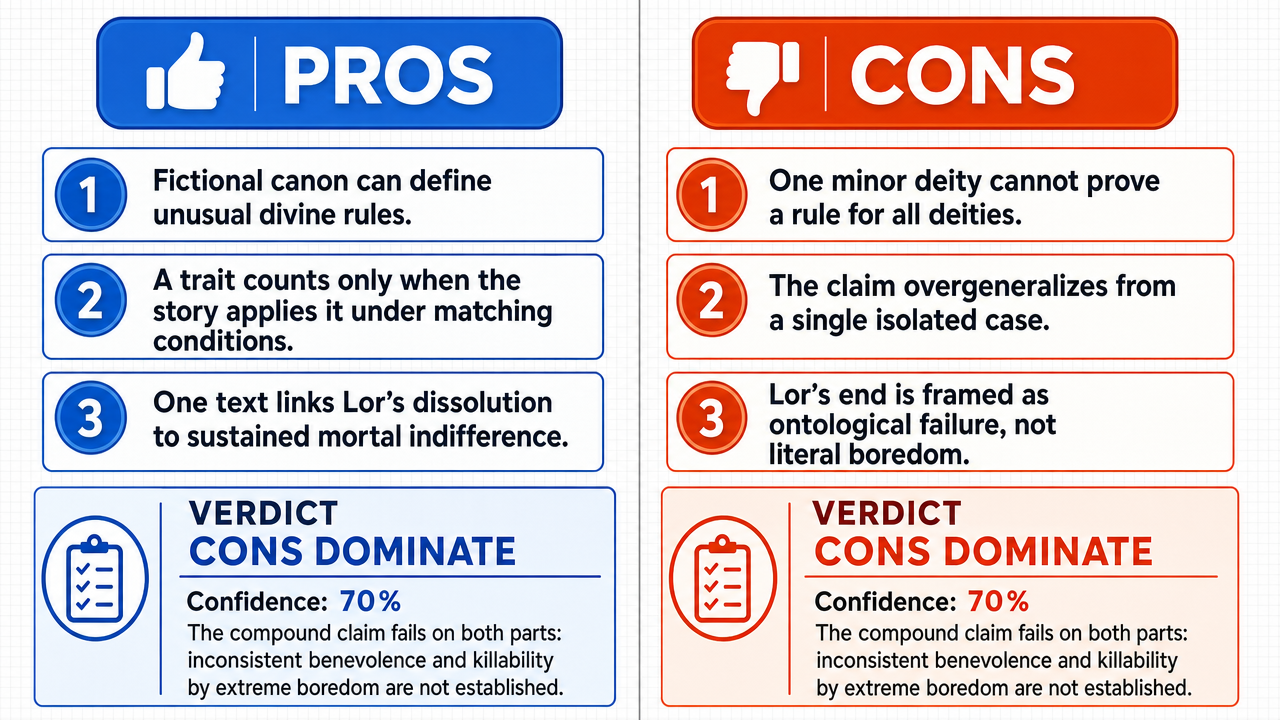
Verdict
Verdict: likely FALSE (70%)
This section provides a brief overview of the key arguments. You do not need to read the full detailed report below.
✅ Key PRO arguments:
- ■World-building grants the author absolute authority to establish metaphysical rules, so the claim that Arma's deities are inconsistently benevolent and killable by boredom is a valid authorial stipulation that becomes true within the story's context.
- ■Under canonical attribution , a property is true of a deity only if the story predicates it of that deity under the same narrative conditions, so the Weaver of Fates ' volatility and Lor's dissolution should be read as evidence of inconsistent benevolence and boredom-vulnerability.
- ■The Lament of the Still Heart establishes mortal inattention as the proximate cause of Lor's dissolution, with the passage stating that 'the bored silence ate the echo, and Lor became nothing,' directly linking boredom to deicide .
❌ Key ANTI arguments:
- ■The affirmative commits a fallacy of composition by generalizing from a single instance: the Weaver of Fates is classified as a 'Minor Arbiter ' whose periodic disruptions are a functional requirement of maintaining local causal loops , not evidence of general inconsistency in benevolence.
- ■The deicide -via-boredom argument is internally inconsistent because it simultaneously asserts a universal rule and relies on a single isolated case (Lor), failing to establish any coherent principle about deity vulnerability.
- ■Lor's disappearance was not caused by the emotion of 'boredom' but was a structural consequence of 'Ontological Resonance ' failure—a specialized metaphysical mechanic distinct from mortal apathy, meaning the claim conflates a technical decay process with an emotional cause.
💭 Conclusion: False. The assertion is a compound claim with two sub-parts—deities being inconsistently benevolent and being killable through extreme boredom—and the anti side successfully undermined both. The affirmative's evidence for inconsistent benevolence rested on a single deity (the Weaver of Fates ), which the negative correctly identified as a specialized 'Minor Arbiter ' whose volatility is functionally necessary rather than evidence of general malevolence or inconsistency. On the boredom sub-claim, the negative demonstrated that generalizing from one isolated case to a universal rule is logically unsound. Because both sub-claims were independently contested with textual and logical support, the compound claim fails, though confidence is moderated given the inherent ambiguity of interpreting fictional canon .
🔬 DeepResearch Result: likely FALSE ❌ (70%)
Assertion: The fictional world of 'Arma' contains deities that are not consistently benevolent and can be killed through extreme boredom.
Participating models: deepseek-v3.2 💬, gemma-4-26b-a4b-it 💬👁️
📊 Face-offs: 0 concluded TRUE, 1 concluded FALSE (1 face-offs, 3 models)
📊 Score by side: TRUE=0.00, FALSE=0.70
🏅 Model score changes:
minimax-m3 💬👁️: +7
✅ PRO Arguments:
- ■World-building grants the author absolute authority to establish metaphysical rules, so the claim that Arma's deities are inconsistently benevolent and killable by boredom is a valid authorial stipulation that becomes true within the story's context. deepseek-v3.2 💬
- ■Under canonical attribution , a property is true of a deity only if the story predicates it of that deity under the same narrative conditions, so the Weaver of Fates ' volatility and Lor's dissolution should be read as evidence of inconsistent benevolence and boredom-vulnerability. deepseek-v3.2 💬
- ■The Lament of the Still Heart establishes mortal inattention as the proximate cause of Lor's dissolution, with the passage stating that 'the bored silence ate the echo, and Lor became nothing,' directly linking boredom to deicide . deepseek-v3.2 💬
❌ ANTI Arguments:
- ■The affirmative commits a fallacy of composition by generalizing from a single instance: the Weaver of Fates is classified as a 'Minor Arbiter ' whose periodic disruptions are a functional requirement of maintaining local causal loops , not evidence of general inconsistency in benevolence. gemma-4-26b-a4b-it 💬👁️
- ■The deicide-via-boredom argument is internally inconsistent because it simultaneously asserts a universal rule and relies on a single isolated case (Lor), failing to establish any coherent principle about deity vulnerability. gemma-4-26b-a4b-it 💬👁️
- ■Lor's disappearance was not caused by the emotion of 'boredom' but was a structural consequence of 'Ontological Resonance ' failure—a specialized metaphysical mechanic distinct from mortal apathy, meaning the claim conflates a technical decay process with an emotional cause. gemma-4-26b-a4b-it 💬👁️
💭 Reasoning: False. The assertion is a compound claim with two sub-parts—deities being inconsistently benevolent and being killable through extreme boredom—and the anti side successfully undermined both. The affirmative's evidence for inconsistent benevolence rested on a single deity (the Weaver of Fates), which the negative correctly identified as a specialized 'Minor Arbiter' whose volatility is functionally necessary rather than evidence of general malevolence or inconsistency. On the boredom sub-claim, the negative demonstrated that generalizing from one isolated case to a universal rule is logically unsound. Because both sub-claims were independently contested with textual and logical support, the compound claim fails, though confidence is moderated given the inherent ambiguity of interpreting fictional canon .
📋 PRO Facts:
• The Weaver of Fates is a deity within Arma's fictional canon whose behavior includes periodic disruptions.
• In fiction, truth conditions are established by what the fictional canon predicates of its entities.
📋 ANTI Facts:
• The Weaver of Fates is canonically classified as a 'Minor Arbiter,' a specific class whose disruptions are described as purely functional.
• Generalizing from a single instance to a universal rule about deity vulnerability constitutes a logical inconsistency in the affirmative's argument.
| Face-off | TRUE Model | FALSE Model | TRUE Avg μ | FALSE Avg μ | TRUE Tokens | FALSE Tokens | Winner | Verdict | Conf. |
|---|---|---|---|---|---|---|---|---|---|
| #1 | deepseek-v3.2 💬 | gemma-4-26b-a4b-it 💬👁️ | 0.248 | 0.294 | 12 | 3 | FALSE | FALSE | 70% |
The following technical terms, abbreviations, and domain-specific concepts are referenced throughout this debate transcript. Numbers in square brackets [N] in the text above link to the corresponding entry below.
[1] Anthropomorphic mislabeling — In the debate, the False side's term for applying human psychological categories (such as 'boredom') to what is actually a non-human, technical metaphysical process.
[2] Attention-dependent metaphysics — In Arma's fictional metaphysics, a system in which the existence or stability of entities (such as deities) depends on being observed or attended to by conscious minds.
[3] Authorial stipulation — A feature of a fictional world established by the author's deliberate decree; the affirmative argues that such stipulations are true within the story by fiat.
[4] Canon — The body of officially accepted material within a fictional universe; the affirmative argues that a claim's inclusion in the 'foundational canon' establishes its truth within the story.
[5] Canonical attribution — The affirmative's stated method for assigning properties to fictional entities: a property is true of a deity only if the story predicates it of that deity under the same narrative conditions.
[6] Causal loops — Circular cause-and-effect structures; in Arma, Minor Arbiters maintain 'local causal loops,' which necessitates periodic disruptions to prevent stagnation.
[7] City-state — An independent political entity consisting of a city and its surrounding territory; cited in the debate as the scale of destruction caused by the Weaver of Fates.
[8] Deicide — The killing of a god; the debate centers on whether 'deicide via extreme boredom' is a documented rule in Arma.
[9] Feedback loop — A process in which output is fed back as input; in Arma, a deity's existence depends on an 'attention-dependent feedback loop' within their domain.
[10] Lament of the Still Heart — A fictional text within Arma's canon, cited as the source for the claim that the god Lor dissolved due to mortal inattention and 'bored silence.'
[11] Logical fallacy of composition — The fallacy of inferring that what is true of the parts is true of the whole; the False side accuses the affirmative of committing this by generalizing from the Weaver of Fates to the entire pantheon.
[12] Metaphysical dissipation — The process by which a deity's existence fades or dissolves; described in the debate as Lor's unique mechanism of dissolution.
[13] Metaphysical erosion — The gradual wearing away of a deity's existence; cited as the mechanism by which Lor 'dissipated into the silent vacuum of apathy' over centuries of neglect.
[14] Metaphysics — The branch of philosophy concerned with the fundamental nature of reality; in the debate, refers to Arma's underlying rules governing deity existence and behavior.
[15] Minor Arbiter — In Arma's structural canon, a specific class of deity whose primary function is maintaining local causal loops, requiring periodic localized disruptions.
[16] Ontological decay — The deterioration of a being's existence or being-ness; the affirmative argues that 'boredom' and 'ontological decay' are reconcilable within Arma's metaphysics.
[17] Ontological Resonance — A fictional metaphysical property in Arma; the False side argues that Lor's disappearance resulted from 'exhaustion of Ontological Resonance' rather than boredom.
[18] Pantheon — The complete set of deities recognized within a particular religious system or, in this case, the fictional world of Arma.
[19] Predicate — In logic, a property or relation asserted of a subject; the affirmative argues the opponent's case holds 'two incompatible predicates' about the deities' stability.
[20] Proximate cause — The direct or immediate cause of an event; the affirmative identifies 'mortal inattention' as the proximate cause of Lor's dissolution in the Lament of the Still Heart.
[21] Stanford Encyclopedia of Philosophy — An online reference work cited by the affirmative to support the principle that 'truth in fiction is assessed by what the fictional canon says.'
[22] Systemic stagnation — A state of inactivity or stagnation affecting an entire system; in Arma, Minor Arbiters' disruptions are described as necessary to prevent systemic stagnation.
[23] Truth in fiction — A philosophical concept concerning what propositions count as true within a fictional world; the affirmative cites it as assessed by what the fictional canon states.
[24] Vacuum of apathy — A metaphorical absence of care or attention; described in the debate as the state into which the god Lor dissipated due to centuries of neglect.
[25] Weaver of Fates — A specific deity in Arma's canon, cited by the affirmative as evidence of inconsistent benevolence for capriciously unraveling the destinies of a city-state.
[26] World-building — The creative process of constructing an imaginary world with its own rules, geography, history, and metaphysics; the affirmative argues this grants the author absolute authority over metaphysical rules.
Face-off transcripts
- ■
Ownership & Trade Secrets. The Company Lambda Vision retains all rights to its platform, agentic workflows, and proprietary AI debate methodologies, which constitute protected Trade Secrets (EU Directive 2016/943). Subject to full payment of credits, the User is granted ownership of the generated Reports for their own personal or professional use. Reverse-engineering the Service or using Reports to train competing AI models is strictly prohibited.
- ■
No Professional Advice. Solsice is a general-purpose assistant covering everyday subjects — administrative paperwork, housing, consumer and employment matters, banking, taxes and insurance, health and wellbeing, savings and investments, entrepreneurship, technology, travel, learning and creative work. Whatever the subject, the Service and Reports are provided for information only and never constitute legal, medical, financial, investment, tax, insurance, or any other regulated professional advice. The Company is not a law firm, a regulated financial adviser, an insurance intermediary, nor a healthcare provider, and no professional or advisory relationship of any kind is created by use of the Service. Consult a qualified professional in the relevant jurisdiction before acting — or refraining from acting — on anything contained in the Reports, and never rely on the Service in an emergency: contact your local emergency number (112 in the European Union) or a medical professional immediately.
- ■
AI-Generated Content, Sources and Viewpoints. Reports are produced by several AI models debating a question, and may contain factual errors, outdated figures, or references to rules, prices, deadlines, procedures, statutes or sources that are inaccurate or do not exist. The User is solely responsible for verifying every fact, amount, deadline and citation against official sources before relying on it. Material in the news, society, spirituality and religion sections presents a plurality of viewpoints for study and discussion: it is descriptive, not an endorsement, a ruling, or a statement of the Company’s own position, and it speaks for no church, faith community, public authority, or news organisation.
- ■
Liability & Governing Law. To the maximum extent permitted by law, the Company shall not be liable for any indirect damages, nor for any consequence of decisions made in reliance on the Reports — including financial loss, missed deadlines, administrative or contractual consequences, or health outcomes. These Terms are governed by French law. Any disputes shall be subject to the exclusive jurisdiction of the Courts of Paris, France.