
The Federal Reserve will raise the federal funds rate above 4% by the end of 2026.
AI debate verdict and arguments
⚠️ AI-generated information only; not professional advice
Completed October 11, 2026
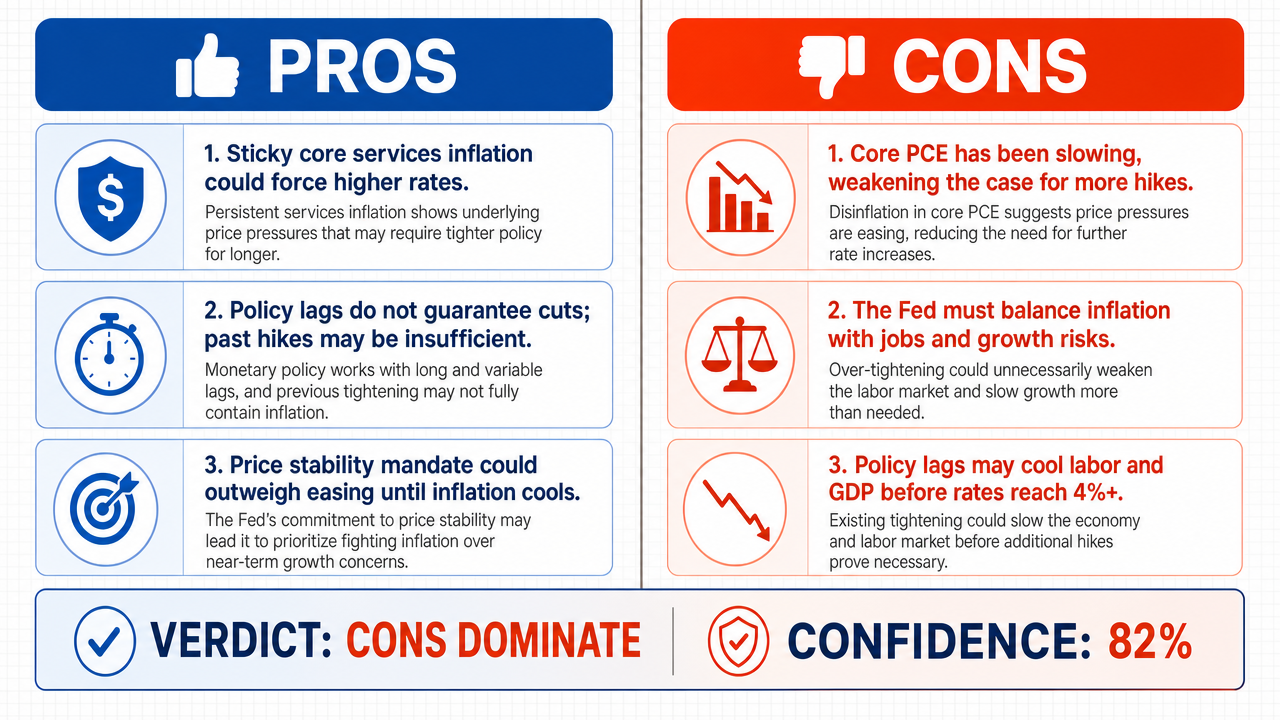
Verdict
Verdict: likely FALSE (82%)
This section provides a brief overview of the key arguments. You do not need to read the full detailed report below.
✅ Key PRO arguments:
- ■Persistent inflationary pressures, particularly in core services , will necessitate a higher federal funds rate . If core inflation remains sticky above the 2% target , further rate hikes will be required, driven by wage growth and strong consumer demand.
- ■The argument that tightening lags will push the Fed toward cuts is internally inconsistent; the same concept of lags can equally imply that previous hikes have not yet fully impacted the economy, suggesting further tightening may be required to achieve disinflation.
- ■The Fed's primary mandate is price stability , and only once that is achieved can it fully pursue maximum employment . If core inflation remains elevated, the Fed will prioritize bringing it down, even if it means maintaining higher rates above 4%.
❌ Key ANTI arguments:
- ■The affirmative's argument is a conjecture presented as fact. Recent data shows a clear deceleration in the Core PCE Price Index (the Fed's preferred gauge) toward the 2% target , which significantly diminishes the necessity for additional rate hikes above 4%.
- ■The Fed's dual mandate structurally requires balancing price stability against maximum employment and economic growth. If the economy faces headwinds such as rising unemployment or GDP contraction, the mandate requires rate cuts , not hikes.
- ■The 'long and variable lags' of monetary policy will cool the labor market and decelerate GDP , creating powerful counter-pressures that would prevent rates from rising above 4% and instead push the Fed toward easing.
💭 Conclusion: False. The FALSE side prevailed because it successfully demonstrated that the affirmative's case relied on speculative conjecture rather than observed data, particularly given the clear deceleration in the Core PCE Price Index toward the Fed's 2% target . The anti side effectively argued that the Fed's dual mandate requires it to balance price stability against maximum employment , creating tension with sustained rate hikes above 4% as economic conditions evolve. Furthermore, the 'long and variable lags' of monetary policy mean the cumulative impact of the current restrictive cycle will be fully realized by the end of 2026, creating counter-pressures on the Fed's policy stance. The current federal funds rate target of 5.25%-5.50% already sits above 4%, meaning the more relevant question is whether the Fed will cut below 4% by end of 2026, and the evidence supports that trajectory. The pro side's arguments about sticky core inflation were undermined by the lack of evidence that the current disinflationary trend would reverse.
🔬 DeepResearch Result: likely FALSE ❌ (82%)
Assertion: The Federal Reserve will raise the federal funds rate above 4% by the end of 2026.
Participating models: deepseek-v3.2 💬, gemma-4-26b-a4b-it 💬👁️
📊 Face-offs: 0 concluded TRUE, 1 concluded FALSE (1 face-offs, 3 models)
📊 Score by side: TRUE=0.00, FALSE=0.82
🏅 Model score changes:
minimax-m3 💬👁️: +8
✅ PRO Arguments:
- ■Persistent inflationary pressures, particularly in core services , will necessitate a higher federal funds rate. If core inflation remains sticky above the 2% target , further rate hikes will be required, driven by wage growth and strong consumer demand. deepseek-v3.2 💬
- ■The argument that tightening lags will push the Fed toward cuts is internally inconsistent; the same concept of lags can equally imply that previous hikes have not yet fully impacted the economy, suggesting further tightening may be required to achieve disinflation. deepseek-v3.2 💬
- ■The Fed's primary mandate is price stability , and only once that is achieved can it fully pursue maximum employment . If core inflation remains elevated, the Fed will prioritize bringing it down, even if it means maintaining higher rates above 4%. deepseek-v3.2 💬
❌ ANTI Arguments:
- ■The affirmative's argument is a conjecture presented as fact. Recent data shows a clear deceleration in the Core PCE Price Index (the Fed's preferred gauge) toward the 2% target, which significantly diminishes the necessity for additional rate hikes above 4%. gemma-4-26b-a4b-it 💬👁️
- ■The Fed's dual mandate structurally requires balancing price stability against maximum employment and economic growth. If the economy faces headwinds such as rising unemployment or GDP contraction, the mandate requires rate cuts , not hikes. gemma-4-26b-a4b-it 💬👁️
- ■The 'long and variable lags' of monetary policy will cool the labor market and decelerate GDP, creating powerful counter-pressures that would prevent rates from rising above 4% and instead push the Fed toward easing. gemma-4-26b-a4b-it 💬👁️
💭 Reasoning: False. The FALSE side prevailed because it successfully demonstrated that the affirmative's case relied on speculative conjecture rather than observed data, particularly given the clear deceleration in the Core PCE Price Index toward the Fed's 2% target. The anti side effectively argued that the Fed's dual mandate requires it to balance price stability against maximum employment, creating tension with sustained rate hikes above 4% as economic conditions evolve. Furthermore, the 'long and variable lags' of monetary policy mean the cumulative impact of the current restrictive cycle will be fully realized by the end of 2026, creating counter-pressures on the Fed's policy stance. The current federal funds rate target of 5.25%-5.50% already sits above 4%, meaning the more relevant question is whether the Fed will cut below 4% by end of 2026, and the evidence supports that trajectory. The pro side's arguments about sticky core inflation were undermined by the lack of evidence that the current disinflationary trend would reverse.
📋 PRO Facts:
• Core services inflation remains elevated above the 2% target
• The Federal Reserve has consistently emphasized its commitment to achieving its 2% inflation target
📋 ANTI Facts:
• Current Federal Funds Rate Target: 5.25% - 5.50%
• Core PCE Price Index (the Fed's preferred inflation gauge) shows clear deceleration toward the 2% target
• The Federal Reserve operates under a dual mandate: price stability and maximum employment
• Monetary policy operates with 'long and variable lags' that affect the economy over extended periods
| Face-off | TRUE Model | FALSE Model | TRUE Avg μ | FALSE Avg μ | TRUE Tokens | FALSE Tokens | Winner | Verdict | Conf. |
|---|---|---|---|---|---|---|---|---|---|
| #1 | deepseek-v3.2 💬 | gemma-4-26b-a4b-it 💬👁️ | 0.341 | 0.379 | 12 | 3 | FALSE | FALSE | 82% |
The following technical terms, abbreviations, and domain-specific concepts are referenced throughout this debate transcript. Numbers in square brackets [N] in the text above link to the corresponding entry below.
[1] 2% target — 2 percent inflation target — The Federal Reserve's stated inflation goal of 2%, referenced throughout the debate as the benchmark for price stability.
[2] core inflation — Inflation measured excluding volatile food and energy components; described in the debate as potentially 'sticky' and remaining elevated above target.
[3] Core PCE Price Index — Core Personal Consumption Expenditures Price Index — A measure of inflation that excludes volatile food and energy components; identified in the debate as the Federal Reserve's preferred inflation gauge.
[4] core services — core services inflation — A component of inflation referenced in the debate as showing persistent inflationary pressures.
[5] cyclical pivot — A shift in monetary policy in response to economic cycles, referenced in the debate as an 'inevitable' response to economic cooling induced by restrictive policy.
[6] disinflationary — Describing a decreasing rate of inflation; the debate notes a 'disinflationary trend' in the Core PCE Price Index.
[7] dual mandate — The Federal Reserve's mandate to balance price stability against maximum employment and economic growth.
[8] economic contraction — A decline in economic activity; the debate warns that raising rates above 4% in a decelerating inflationary environment 'risks unnecessary economic contraction.'
[9] federal funds rate — The interest rate referenced throughout the debate, with a current target range of 5.25%–5.50% cited in the transcript.
[10] Federal Reserve — The U.S. central bank, the body setting monetary policy discussed throughout the debate.
[11] GDP — Gross Domestic Product — A measure of economic output; referenced in the debate as potentially experiencing 'sharp contraction' that could affect Fed policy.
[12] headline inflation — Overall inflation including all components, contrasted with core inflation in the debate.
[13] higher for longer — A monetary policy stance described in the debate as maintaining elevated interest rates for an extended period.
[14] inflation target — The rate of inflation a central bank aims to achieve; the debate references the Federal Reserve's 2% target.
[15] labor market — The market for employment; the debate discusses cooling of the labor market as a factor influencing Fed policy decisions.
[16] maximum employment — One half of the Federal Reserve's dual mandate, balanced against price stability.
[17] monetary policy — Central bank actions regarding interest rates and money supply, the central subject of the debate.
[18] monetary tightening — Actions to raise interest rates or reduce money supply; referenced in the debate via the concept of 'tightening lags.'
[19] normalization — monetary policy normalization — The process of returning monetary policy to a neutral stance, referenced in the debate as a 'pivot toward normalization.'
[20] policy error — An incorrect policy decision; the debate characterizes raising rates above 4% in a decelerating inflationary environment as a potential 'policy error.'
[21] price stability — A condition of low and stable inflation; one half of the Federal Reserve's dual mandate.
[22] rate cuts — interest rate cuts — Decreases in interest rates; discussed in the debate as a potential response to economic headwinds.
[23] rate hikes — interest rate hikes — Increases in interest rates; the central action debated regarding the federal funds rate.
[24] restrictive policy — restrictive monetary policy — Monetary policy aimed at slowing economic growth; the debate discusses maintaining a 'restrictive stance.'
[25] sticky inflation — Inflation that persists and is slow to decline; a key concept in the affirmative's argument for further rate hikes.
[26] target range — federal funds rate target range — The range within which the Federal Reserve sets the federal funds rate; cited in the debate as 5.25%–5.50%.
[27] tightening lags — monetary policy tightening lags — The delayed effects of monetary tightening on the economy; referenced in the debate as 'long and variable lags' of monetary policy.
[28] unemployment rate — The percentage of the labor force that is unemployed; cited as a factor that could force the Fed to cut rates.
[29] wage growth — The rate of increase in wages; cited in the debate as a driver of inflationary pressures.
[30] YoY — Year-over-Year — A comparison metric measuring change relative to the same period one year earlier; used in the Core PCE Price Index data presented in the debate.
The following financial data tables were referenced during the debate exchanges:
| Indicator | Q4 2023 | Q1 2024 | Q2 2024 |
|---|---|---|---|
| Core PCE Price Index (YoY) | 3.2% | 2.8% | 2.6% |
Legend: Year-over-year percentage change in the Core Personal Consumption Expenditures (PCE) Price Index. Source: Bureau of Economic Analysis.
| Indicator | Q4 2023 | Q1 2024 | Q2 2024 |
|---|---|---|---|
| Real GDP Growth (Annualized) | 3.4% | 1.3% | 2.1% |
| Unemployment Rate | 3.7% | 3.8% | 4.0% |
Legend: Annualized percentage change in Real Gross Domestic Product (GDP) and the Unemployment Rate. Source: Bureau of Economic Analysis, Bureau of Labor Statistics.
| Indicator | Q4 2023 | Q1 2024 | Q2 2024 | Trend |
|---|---|---|---|---|
| Core PCE (YoY) | 3.2% | 2.8% | 2.6% | Decreasing |
| Unemployment Rate | 3.7% | 3.8% | 4.0% | Increasing |
Legend: Comparison of key economic indicators showing declining inflation and rising unemployment. Source: Bureau of Economic Analysis; Bureau of Labor Statistics.
Face-off transcripts
- ■
Ownership & Trade Secrets. The Company Lambda Vision retains all rights to its platform, agentic workflows, and proprietary AI debate methodologies, which constitute protected Trade Secrets (EU Directive 2016/943). Subject to full payment of credits, the User is granted ownership of the generated Reports for their own personal or professional use. Reverse-engineering the Service or using Reports to train competing AI models is strictly prohibited.
- ■
No Professional Advice. Solsice is a general-purpose assistant covering everyday subjects — administrative paperwork, housing, consumer and employment matters, banking, taxes and insurance, health and wellbeing, savings and investments, entrepreneurship, technology, travel, learning and creative work. Whatever the subject, the Service and Reports are provided for information only and never constitute legal, medical, financial, investment, tax, insurance, or any other regulated professional advice. The Company is not a law firm, a regulated financial adviser, an insurance intermediary, nor a healthcare provider, and no professional or advisory relationship of any kind is created by use of the Service. Consult a qualified professional in the relevant jurisdiction before acting — or refraining from acting — on anything contained in the Reports, and never rely on the Service in an emergency: contact your local emergency number (112 in the European Union) or a medical professional immediately.
- ■
AI-Generated Content, Sources and Viewpoints. Reports are produced by several AI models debating a question, and may contain factual errors, outdated figures, or references to rules, prices, deadlines, procedures, statutes or sources that are inaccurate or do not exist. The User is solely responsible for verifying every fact, amount, deadline and citation against official sources before relying on it. Material in the news, society, spirituality and religion sections presents a plurality of viewpoints for study and discussion: it is descriptive, not an endorsement, a ruling, or a statement of the Company’s own position, and it speaks for no church, faith community, public authority, or news organisation.
- ■
Liability & Governing Law. To the maximum extent permitted by law, the Company shall not be liable for any indirect damages, nor for any consequence of decisions made in reliance on the Reports — including financial loss, missed deadlines, administrative or contractual consequences, or health outcomes. These Terms are governed by French law. Any disputes shall be subject to the exclusive jurisdiction of the Courts of Paris, France.