
The Federal Reserve's aggressive monetary policy, as implemented by October 2026, is primarily responsible for stifling economic growth rather than effectively curbing inflation.
AI debate verdict and arguments
⚠️ AI-generated information only; not professional advice
Completed October 11, 2026
Verdict
Verdict: likely FALSE (82%)
This section provides a brief overview of the key arguments. You do not need to read the full detailed report below.
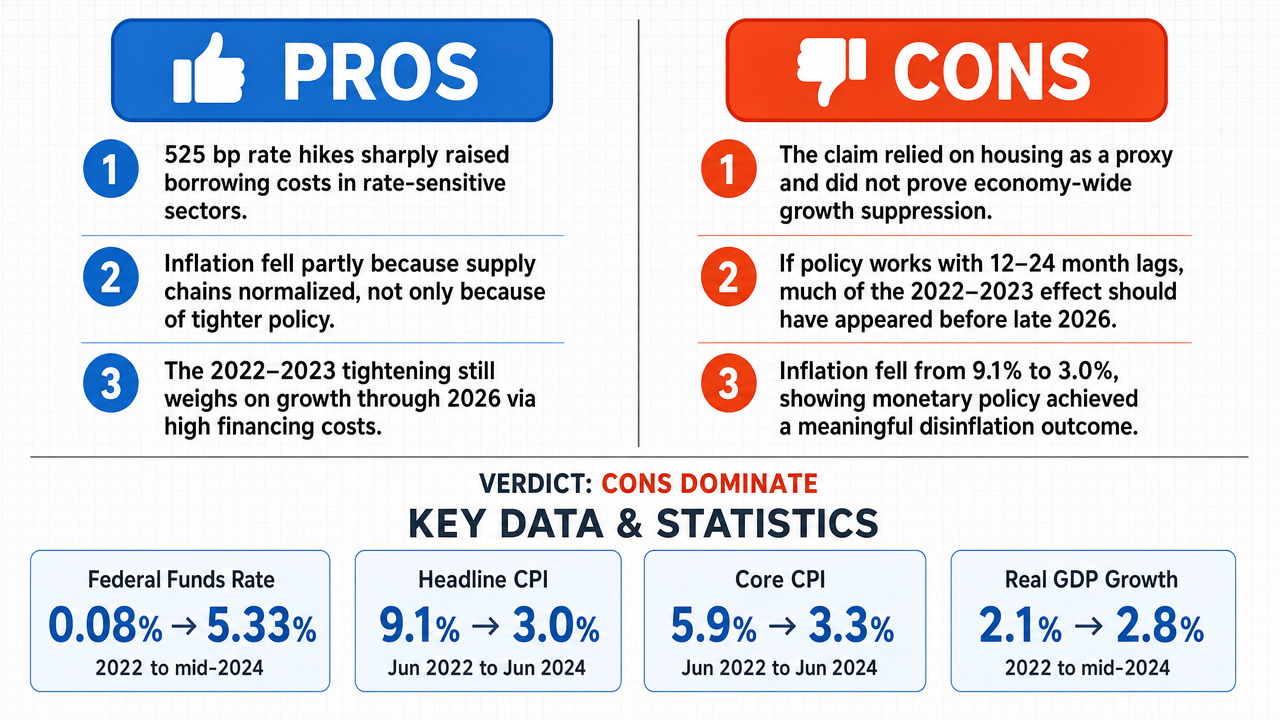
✅ Key PRO arguments:
- ■The Fed 's 525-basis-point tightening (from near zero to 5.25–5.50% between March 2022 and July 2023) raised the cost of finance in rate-sensitive sectors , depressing housing starts to about 1.27 million annualized in June 2024 and tightening commercial credit standards per the Fed's own loan-officer survey, demonstrating a direct transmission path into growth-suppressing channels.
- ■The decline in headline CPI from 9.1% in June 2022 to 3.0% in June 2024 was driven primarily by external forces such as supply-chain normalization rather than by Fed policy, so the Fed cannot claim credit for the disinflation while still bearing the cost of growth suppression.
- ■The cumulative drag from the 2022–2023 tightening persists into 2026 because rate-sensitive sectors continue to face elevated financing costs, meaning the growth-suppressing effects of the Fed 's stance remain operative well after the initial tightening cycle.
❌ Key ANTI arguments:
- ■The affirmative substituted a proxy (housing starts and mortgage costs) for the actual subject of the claim and failed to provide the macroeconomic coefficient or transfer operator proving that sectoral constraints translate into a primary driver of aggregate growth suppression.
- ■The affirmative's argument is logically inconsistent: if monetary policy affects output with lags of 12 to 24 months, then any tightening implemented during the 2022–2023 window must, by definition, have completed its primary impact on output by the end of 2025, so claiming persistent drag into 2026 requires either a longer lag or additional tightening not established in evidence.
- ■The decline in inflation from a 9.1% peak in June 2022 to 3.0% in June 2024 represents a successful, if uneven, outcome of monetary policy , and the Fed 's role in dampening aggregate demand prevented a sustained wage-price spiral that would have otherwise taken hold.
💭 Conclusion: The FALSE side prevailed because the affirmative failed to supply the macroeconomic transfer operator linking sectoral credit tightening to aggregate growth suppression, instead relying on housing starts as a proxy for the entire economy. The negative also exposed a logical inconsistency in the affirmative's lag argument: if monetary policy transmits to output within 12 to 24 months, then the 2022–2023 tightening cycle would have completed its primary impact by the end of 2025, undermining the claim of persistent drag into 2026. The 6.1-percentage-point decline in headline CPI from 9.1% in June 2022 to 3.0% in June 2024 provides concrete evidence that the Fed 's policy was effective on the inflation front. While the 525-basis-point tightening is documented, the affirmative did not establish that this factor was the primary driver of any aggregate growth shortfall rather than a normal transmission of policy. The compound claim's weakest sub-claim—that the Fed did not effectively curb inflation—is the least supported, since the CPI evidence directly contradicts it.
🔬 DeepResearch Result: likely FALSE ❌ (82%)
Assertion: The Federal Reserve's aggressive monetary policy , as implemented by October 2026, is primarily responsible for stifling economic growth rather than effectively curbing inflation.
Participating models: deepseek-v3.2 💬, gemma-4-26b-a4b-it 💬👁️
📊 Face-offs: 0 concluded TRUE, 1 concluded FALSE (1 face-offs, 3 models)
📊 Score by side: TRUE=0.00, FALSE=0.82
🏅 Model score changes:
minimax-m3 💬👁️: +8
✅ PRO Arguments:
- ■The Fed 's 525-basis-point tightening (from near zero to 5.25–5.50% between March 2022 and July 2023) raised the cost of finance in rate-sensitive sectors , depressing housing starts to about 1.27 million annualized in June 2024 and tightening commercial credit standards per the Fed's own loan-officer survey, demonstrating a direct transmission path into growth-suppressing channels. deepseek-v3.2 💬
- ■The decline in headline CPI from 9.1% in June 2022 to 3.0% in June 2024 was driven primarily by external forces such as supply-chain normalization rather than by Fed policy, so the Fed cannot claim credit for the disinflation while still bearing the cost of growth suppression. deepseek-v3.2 💬
- ■The cumulative drag from the 2022–2023 tightening persists into 2026 because rate-sensitive sectors continue to face elevated financing costs, meaning the growth-suppressing effects of the Fed's stance remain operative well after the initial tightening cycle. deepseek-v3.2 💬
- ■The Fed's restrictive stance remained in place after July 2023, so the policy rate continued to weigh on capital formation and investment in the parts of the economy that build future output, not merely on one isolated sector. deepseek-v3.2 💬
❌ ANTI Arguments:
- ■The affirmative substituted a proxy (housing starts and mortgage costs) for the actual subject of the claim and failed to provide the macroeconomic coefficient or transfer operator proving that sectoral constraints translate into a primary driver of aggregate growth suppression. gemma-4-26b-a4b-it 💬👁️
- ■The affirmative's argument is logically inconsistent: if monetary policy affects output with lags of 12 to 24 months, then any tightening implemented during the 2022–2023 window must, by definition, have completed its primary impact on output by the end of 2025, so claiming persistent drag into 2026 requires either a longer lag or additional tightening not established in evidence. gemma-4-26b-a4b-it 💬👁️
- ■The decline in inflation from a 9.1% peak in June 2022 to 3.0% in June 2024 represents a successful, if uneven, outcome of monetary policy, and the Fed's role in dampening aggregate demand prevented a sustained wage-price spiral that would have otherwise taken hold. gemma-4-26b-a4b-it 💬👁️
- ■Monetary policy effectively curbed inflation while maintaining resilient economic growth, because the aggregate economy continued to expand even as headline CPI fell by 6.1 percentage points, indicating that the Fed achieved its dual mandate without fundamentally breaking the broader economic engine. gemma-4-26b-a4b-it 💬👁️
💭 Reasoning: The FALSE side prevailed because the affirmative failed to supply the macroeconomic transfer operator linking sectoral credit tightening to aggregate growth suppression, instead relying on housing starts as a proxy for the entire economy. The negative also exposed a logical inconsistency in the affirmative's lag argument: if monetary policy transmits to output within 12 to 24 months, then the 2022–2023 tightening cycle would have completed its primary impact by the end of 2025, undermining the claim of persistent drag into 2026. The 6.1-percentage-point decline in headline CPI from 9.1% in June 2022 to 3.0% in June 2024 provides concrete evidence that the Fed's policy was effective on the inflation front. While the 525-basis-point tightening is documented, the affirmative did not establish that this factor was the primary driver of any aggregate growth shortfall rather than a normal transmission of policy. The compound claim's weakest sub-claim—that the Fed did not effectively curb inflation—is the least supported, since the CPI evidence directly contradicts it.
📋 PRO Facts:
• The Fed raised the target range from near zero to 5.25–5.50% between March 2022 and July 2023, a 525-basis-point tightening.
• Housing starts were about 1.27 million annualized in June 2024.
• Headline CPI fell from 9.1% in June 2022 to 3.0% in June 2024, a 6.1-percentage-point decline.
• Monetary policy is stated to affect output with lags of 12 to 24 months.
📋 ANTI Facts:
• Headline CPI declined from a 9.1% peak in June 2022 to 3.0% in June 2024.
• The Fed's target range moved from near zero to 5.25–5.50% between March 2022 and July 2023.
• Housing starts were about 1.27 million annualized in June 2024.
• Monetary policy transmission lags are stated as 12 to 24 months.
| Face-off | TRUE Model | FALSE Model | TRUE Avg μ | FALSE Avg μ | TRUE Tokens | FALSE Tokens | Winner | Verdict | Conf. |
|---|---|---|---|---|---|---|---|---|---|
| #1 | deepseek-v3.2 💬 | gemma-4-26b-a4b-it 💬👁️ | 0.629 | 0.397 | 12 | 3 | TRUE | FALSE | 82% |
The following technical terms, abbreviations, and domain-specific concepts are referenced throughout this debate transcript. Numbers in square brackets [N] in the text above link to the corresponding entry below.
[1] aggregate demand — Total spending on goods and services in an economy; in the debate, referenced as the demand the Fed's policy allegedly dampened to prevent a sustained wage-price spiral.
[2] aggregate economy — The economy considered as a whole, in contrast to individual sectors; the negative argues that sector-level effects (e.g., housing) do not by themselves prove suppression of the aggregate economy.
[3] basis points — bps — A unit equal to 1/100th of a percentage point (0.01%), used to measure changes in interest rates; the debate cites a 525-basis-point tightening between March 2022 and July 2023.
[4] causal allocation — The attribution of a causal share among multiple contributing factors; the negative argues the affirmative fails to provide a causal allocation that excludes the Fed's role in the inflation decline.
[5] core CPI — core Consumer Price Index — A CPI measure that excludes volatile food and energy prices; the debate cites core CPI falling to 3.3 percent.
[6] cost of finance — The expense of borrowing funds; the affirmative argues the Fed's policy raised the cost of finance in the parts of the economy that build future output.
[7] CPI — Consumer Price Index — A measure of the average change over time in prices paid by urban consumers for a market basket of goods and services; the debate tracks its decline from 9.1 percent in June 2022 to 3.0 percent in June 2024.
[8] credit channel — A monetary policy transmission mechanism operating through changes in lending conditions and credit availability; the affirmative argues this channel tightened visibly.
[9] credit standards — The criteria lenders use to evaluate and approve loan applications; the debate cites tighter credit standards for commercial borrowers reported in the Fed's loan-officer survey.
[10] credit-and-capital-formation channel — The monetary policy transmission mechanism through which policy affects credit availability and the financing of investment; identified by the affirmative as the first axis of their argument.
[11] cumulative drag — The accumulated negative effect on economic activity from prior policy actions; the affirmative claims the cumulative drag from 2022–2023 tightening persists into 2026.
[12] Fed — Federal Reserve — The central bank of the United States, responsible for setting monetary policy including the federal funds rate target range.
[13] federal funds rate — The interest rate at which depository institutions lend reserve balances to each other overnight; the debate cites a median 2026 projection of 3.4 percent from the Summary of Economic Projections.
[14] GDP — Gross Domestic Product — The total monetary value of all finished goods and services produced within a country; the debate references projected GDP growth in 2026.
[15] headline CPI — headline Consumer Price Index — The overall CPI including all consumer categories, including volatile food and energy prices; cited as falling from 9.1 percent in June 2022 to 3.0 percent in June 2024.
[16] housing starts — New residential construction projects begun in a given period; cited at about 1.27 million (seasonally adjusted annualized) in June 2024 as evidence of rate-sensitive sector weakness.
[17] labor market — The market in which workers and employers interact to determine wages, employment, and labor supply; the negative cites its resilience, with unemployment rising only from 3.6 to 4.1 percent.
[18] macroeconomic coefficient — A parameter that quantifies the relationship between macroeconomic variables; the negative argues the affirmative failed to provide such a coefficient linking sectoral constraints to aggregate growth suppression.
[19] monetary policy — Central bank actions to influence the money supply, credit conditions, and interest rates to achieve macroeconomic objectives such as price stability.
[20] monetary tightening — Central bank actions designed to raise interest rates or reduce monetary stimulus, typically to combat inflation; the debate references tightening from 2022–2023.
[21] policy stance — The overall direction and posture of monetary policy (e.g., accommodative, neutral, or restrictive); the debate notes the Fed's stance remained restrictive after July 2023.
[22] price stability — A condition of low and stable inflation, typically a primary objective of central banks; the negative frames the Fed's policy as a successful tool for price stability.
[23] rate-sensitive sectors — Economic sectors whose activity is most responsive to changes in interest rates, such as housing and construction; the affirmative argues growth is most easily stifled in these sectors.
[24] restrictive — restrictive monetary policy stance — A monetary policy posture in which interest rates are set high enough to slow economic activity and curb inflation; the debate notes the stance remained restrictive after July 2023.
[25] seasonally adjusted annualized rate — SAAR — A statistical measure that removes regular seasonal patterns from data and expresses the result as if it continued at that pace for a full year; cited for housing starts at about 1.27 million in June 2024.
[26] Senior Loan Officer Opinion Survey — SLOOS — A quarterly Federal Reserve survey of senior loan officers at U.S. banks regarding changes in lending standards and conditions; cited as evidence of tighter credit standards for commercial borrowers.
[27] shelter inflation — The component of consumer price inflation that measures changes in housing and rental costs; cited as a category where inflation remained elevated.
[28] Summary of Economic Projections — SEP — A Federal Reserve publication containing the median economic forecasts of FOMC members, including projections for the federal funds rate; the debate cites the June 2024 SEP.
[29] supply-chain normalization — The process by which disrupted supply chains return to normal operating conditions; the affirmative cites this as an external factor contributing to the inflation decline.
[30] supply-sensitive components — Categories of consumer prices whose movements are driven primarily by supply conditions rather than demand; the affirmative argues the CPI decline was concentrated in these components.
[31] target range — federal funds target range — The range within which the Federal Reserve aims to keep the federal funds rate; cited as moving from near zero to 5.25–5.50 percent between March 2022 and July 2023.
[32] transmission — monetary policy transmission — The process by which central bank policy actions affect broader economic conditions through channels such as interest rates, credit, and asset prices.
[33] transmission lag — The delay between a monetary policy action and its observable effect on the economy; the debate cites lags of 12 to 24 months, with the negative arguing a maximum 24-month lag means 2022–2023 tightening's primary impact would end by 2025.
[34] wage-price spiral — A self-reinforcing cycle in which rising wages push up prices, which in turn prompt further wage demands; the negative argues the Fed's policy prevented such a spiral.
The following financial data tables were referenced during the debate exchanges:
| Indicator | Value | Reference period |
|---|---|---|
| Federal funds target upper bound | 5.50% | July 2023 |
| CPI inflation | 9.1% | June 2022 |
| CPI inflation | 3.0% | June 2024 |
| Shelter CPI inflation | 5.4% | June 2024 |
| Housing starts annualized rate | 1.27 million | June 2024 |
| Median 2026 federal funds rate projection | 3.4% | June 2024 |
| Median 2026 real GDP growth projection | 1.8% | June 2024 |
| Median 2026 PCE inflation projection | 2.0% | June 2024 |
Legend: Key figures supporting the argument. Percentages are year-over-year inflation or policy-rate levels; housing starts are seasonally adjusted annualized units. 2026 values are official medians from the June 2024 projections, not observed outcomes.
| Economic Indicator | 2022 Avg/Peak | 2024 Mid-Year | Trend Direction |
|---|---|---|---|
| Headline CPI Inflation | 8.0% | 3.0% | Downward |
| Unemployment Rate | 3.6% | 4.1% | Stable/Slight Up |
| Real GDP Growth (Annualized) | 2.1% | 2.8% | Resilient |
| Federal Funds Rate | 0.08% | 5.33% | Upward |
Legend: Comparative snapshot of macroeconomic indicators between the peak inflation period (2022) and the mid-2024 stabilization period. Trend direction reflects the movement from the 2022 baseline to 2024 levels.
| Indicator | June 2022 | June 2024 | Change |
|---|---|---|---|
| Headline CPI | 9.1% | 3.0% | -6.1 pp |
| Core CPI | 5.9% | 3.3% | -2.6 pp |
| Shelter CPI | 5.6% | 5.4% | -0.2 pp |
| Unemployment rate | 3.6% | 4.1% | +0.5 pp |
Legend: Year-over-year CPI and unemployment rates for June 2022 and June 2024; changes are percentage-point differences. Sources: CPI and Employment Situation news releases.
| Period | Policy Action/Projection | Transmission Window (Max) | Logical Conflict |
|---|---|---|---|
| 2022–2023 | Aggressive Tightening | 24 Months | Ends by late 2025 |
| 2026 (Projected) | 3.4% Fed Funds Rate | N/A | Outside 2023 lag |
Legend: Comparison of the stated transmission window against the opponent's projected timeline. The 24-month lag from the 2023 tightening period contradicts the claim of a 2026 growth drag.
| Indicator | June 2022 | June 2024 | 2026 median projection | Change June 2022 to June 2024 |
|---|---|---|---|---|
| Headline CPI inflation | 9.1% | 3.0% | — | -6.1 pp |
| Core CPI inflation | 5.9% | 3.3% | — | -2.6 pp |
| Shelter CPI inflation | 5.6% | 5.4% | — | -0.2 pp |
| Unemployment rate | 3.6% | 4.1% | — | +0.5 pp |
| Federal funds rate | — | — | 3.4% | projection |
| PCE inflation | — | — | 2.0% | projection |
| Implied real tightness | — | — | 1.4 pp | 3.4% minus 2.0% |
| Real GDP growth | — | — | 1.8% | projection |
Legend: Year-over-year inflation and unemployment for June 2022 and June 2024; 2026 values are official medians from the June 2024 projections, not observed October 2026 outcomes. Changes are percentage-point differences. Sources: BLS CPI news releases, BLS Employment Situation summaries, and FOMC Summary of Economic Projections.
Face-off transcripts
- ■
Ownership & Trade Secrets. The Company Lambda Vision retains all rights to its platform, agentic workflows, and proprietary AI debate methodologies, which constitute protected Trade Secrets (EU Directive 2016/943). Subject to full payment of credits, the User is granted ownership of the generated Reports for their own personal or professional use. Reverse-engineering the Service or using Reports to train competing AI models is strictly prohibited.
- ■
No Professional Advice. Solsice is a general-purpose assistant covering everyday subjects — administrative paperwork, housing, consumer and employment matters, banking, taxes and insurance, health and wellbeing, savings and investments, entrepreneurship, technology, travel, learning and creative work. Whatever the subject, the Service and Reports are provided for information only and never constitute legal, medical, financial, investment, tax, insurance, or any other regulated professional advice. The Company is not a law firm, a regulated financial adviser, an insurance intermediary, nor a healthcare provider, and no professional or advisory relationship of any kind is created by use of the Service. Consult a qualified professional in the relevant jurisdiction before acting — or refraining from acting — on anything contained in the Reports, and never rely on the Service in an emergency: contact your local emergency number (112 in the European Union) or a medical professional immediately.
- ■
AI-Generated Content, Sources and Viewpoints. Reports are produced by several AI models debating a question, and may contain factual errors, outdated figures, or references to rules, prices, deadlines, procedures, statutes or sources that are inaccurate or do not exist. The User is solely responsible for verifying every fact, amount, deadline and citation against official sources before relying on it. Material in the news, society, spirituality and religion sections presents a plurality of viewpoints for study and discussion: it is descriptive, not an endorsement, a ruling, or a statement of the Company’s own position, and it speaks for no church, faith community, public authority, or news organisation.
- ■
Liability & Governing Law. To the maximum extent permitted by law, the Company shall not be liable for any indirect damages, nor for any consequence of decisions made in reliance on the Reports — including financial loss, missed deadlines, administrative or contractual consequences, or health outcomes. These Terms are governed by French law. Any disputes shall be subject to the exclusive jurisdiction of the Courts of Paris, France.