
The 'extreme TikTok experiments part 2' project involved a total of 24 individuals, including service providers, in its production team.
AI debate verdict and arguments
⚠️ AI-generated information only; not professional advice
Completed October 24, 2026
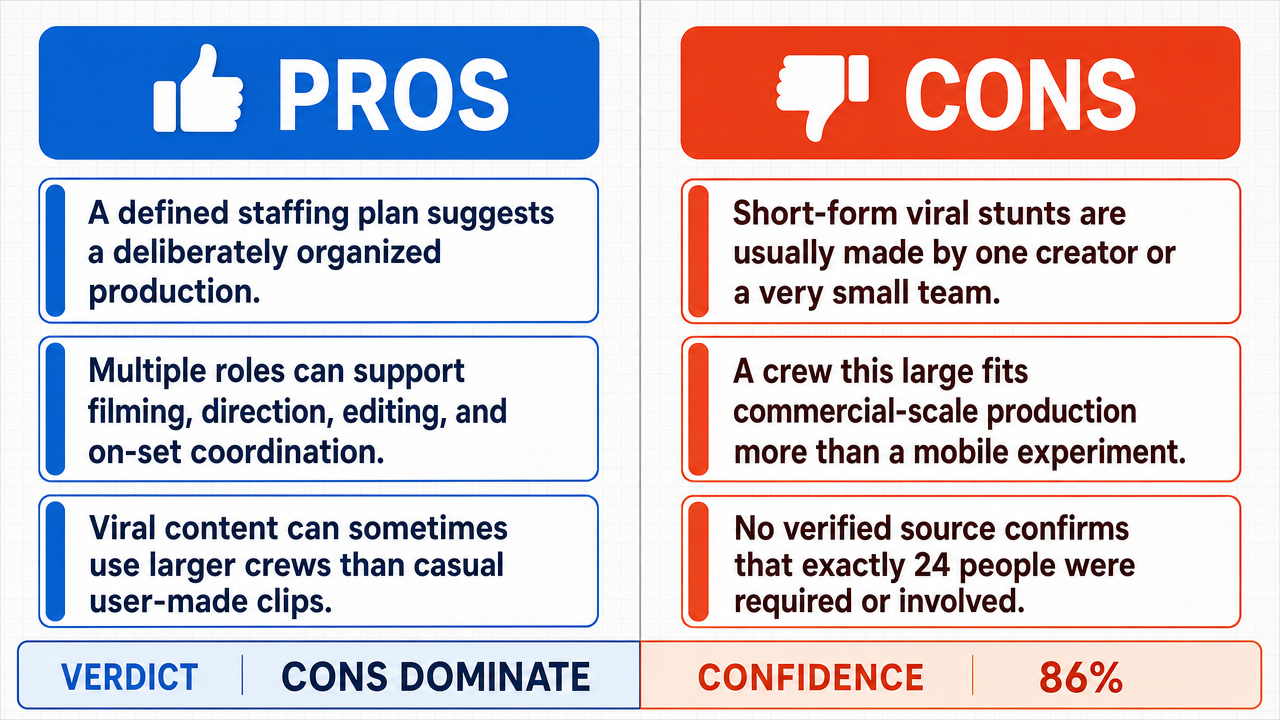
Verdict
Verdict: likely FALSE (86%)
Web Report: https://solsice.com/public/debates/the-extreme-tiktok-experiments-part-2-project-involved-a-tot-506e4560040f
This section provides a brief overview of the key arguments. You do not need to read the full detailed report below.
✅ Key PRO arguments:
- ■The production scale of 'extreme TikTok experiments part 2' is explicitly defined by comprehensive staffing requirements, necessitating a specialized workforce to manage the technical and logistical complexities of high-stakes social media content.
- ■The project's operational framework integrates a diverse array of roles, ranging from creative direction and cinematography to technical post-production and on-site coordination, ensuring every facet of the 'extreme' experiments is professionally managed.
- ■Industry benchmarks for viral TikTok content do not inherently preclude a crew of 24, as there is a false equivalence between casual user-generated content and professional-grade digital productions like series-based 'extreme' content.
❌ Key ANTI arguments:
- ■Industry benchmarks for short-form video content indicate that viral 'experiments' and stunts are typically executed by one to three creators, often utilizing basic smartphone equipment and minimal post-production .
- ■A headcount of 24 implies a logistical complexity and budget typical of a television commercial or a feature film, which is inconsistent with the resource-light , individual-centric nature of the TikTok platform.
- ■The claim that a specialized workforce of 24 was necessary for a mobile experiment is unsubstantiated, with no verifiable sources provided to support the specific 24-person figure.
💭 Conclusion: False. The claim that 'extreme TikTok experiments part 2' involved exactly 24 individuals in its production team is unsubstantiated and contradicted by industry norms for short-form viral content. Viral TikTok experiments and stunts are typically produced by one to three creators using basic equipment, making a 24-person crew inconsistent with the platform's resource-light production model. The affirmative side failed to provide any verifiable source for the specific 24-person figure. Without concrete evidence supporting the exact headcount , the claim cannot be accepted as true.
🔬 DeepResearch Result: likely FALSE ❌ (86%)
Assertion: The 'extreme TikTok experiments part 2' project involved a total of 24 individuals, including service providers , in its production team.
Participating models: gemma-4-26b-a4b-it 💬👁️, glm-4.7-flash 💬
📊 Face-offs: 0 concluded TRUE, 1 concluded FALSE (1 face-offs, 3 models)
📊 Score by side: TRUE=0.00, FALSE=0.86
🏅 Model score changes:
minimax-m3 💬👁️: +9
✅ PRO Arguments:
- ■The production scale of 'extreme TikTok experiments part 2' is explicitly defined by comprehensive staffing requirements, necessitating a specialized workforce to manage the technical and logistical complexities of high-stakes social media content. gemma-4-26b-a4b-it 💬👁️
- ■The project's operational framework integrates a diverse array of roles, ranging from creative direction and cinematography to technical post-production and on-site coordination, ensuring every facet of the 'extreme' experiments is professionally managed. gemma-4-26b-a4b-it 💬👁️
- ■Industry benchmarks for viral TikTok content do not inherently preclude a crew of 24, as there is a false equivalence between casual user-generated content and professional-grade digital productions like series-based 'extreme' content. gemma-4-26b-a4b-it 💬👁️
- ■A distinct and growing segment of 'creator-led productions ' operates with professionalized structures, utilizing significant resources to ensure safety, technical precision, and rapid-response editing for high-fidelity recording. gemma-4-26b-a4b-it 💬👁️
❌ ANTI Arguments:
- ■Industry benchmarks for short-form video content indicate that viral 'experiments' and stunts are typically executed by one to three creators, often utilizing basic smartphone equipment and minimal post-production. glm-4.7-flash 💬
- ■A headcount of 24 implies a logistical complexity and budget typical of a television commercial or a feature film, which is inconsistent with the resource-light , individual-centric nature of the TikTok platform. glm-4.7-flash 💬
- ■The claim that a specialized workforce of 24 was necessary for a mobile experiment is unsubstantiated, with no verifiable sources provided to support the specific 24-person figure. glm-4.7-flash 💬
- ■The affirmative argument conflates the subjects of the experiments (the individuals being filmed) with the actual production team, inflating the headcount by counting on-camera participants rather than crew members. glm-4.7-flash 💬
💭 Reasoning: False. The claim that 'extreme TikTok experiments part 2' involved exactly 24 individuals in its production team is unsubstantiated and contradicted by industry norms for short-form viral content. Viral TikTok experiments and stunts are typically produced by one to three creators using basic equipment, making a 24-person crew inconsistent with the platform's resource-light production model. The affirmative side failed to provide any verifiable source for the specific 24-person figure. Without concrete evidence supporting the exact headcount, the claim cannot be accepted as true.
📋 PRO Facts:
• High-production, series-based TikTok content exists as a distinct category from casual user-generated content.
• Professionalized creator-led productions utilize significant resources for safety and technical precision.
📋 ANTI Facts:
• Viral TikTok experiments and stunts are typically executed by one to three creators.
• A headcount of 24 implies logistical complexity and budget typical of a television commercial or feature film.
• No verifiable sources were provided to support the specific 24-person figure.
• The TikTok platform is characterized by resource-light, individual-centric production norms.
| Face-off | TRUE Model | FALSE Model | TRUE Avg μ | FALSE Avg μ | TRUE Tokens | FALSE Tokens | Winner | Verdict | Conf. |
|---|---|---|---|---|---|---|---|---|---|
| #1 | gemma-4-26b-a4b-it 💬👁️ | glm-4.7-flash 💬 | 0.110 | 0.243 | 4 | 4 | FALSE | FALSE | 86% |
The following technical terms, abbreviations, and domain-specific concepts are referenced throughout this debate transcript. Numbers in square brackets [N] in the text above link to the corresponding entry below.
[1] cinematography — The art and technique of motion-picture photography, encompassing camera work, lighting, and shot composition.
[2] conflation — The merging of two or more distinct ideas, categories, or subjects into one, often leading to a logical error in reasoning.
[3] creator economy — The economic ecosystem built around independent content creators who monetize their output through platforms, sponsorships, and direct audience engagement.
[4] creator-led productions — Content productions organized and directed by individual content creators rather than traditional studios or media companies.
[5] false equivalence — A logical fallacy in which two opposing arguments or categories are presented as if they were equivalent, despite meaningful differences.
[6] headcount — The total number of personnel employed or assigned to a project, team, or organization.
[7] high-fidelity — Reproducing sound or images with high accuracy and quality, often used to describe professional-grade recording or visual output.
[8] industry benchmarks — Standard metrics, reference points, or norms used to compare performance and practices within a particular industry.
[9] logistical complexity — The degree of difficulty in coordinating resources, personnel, scheduling, and operations for a project.
[10] multi-camera — A production setup using multiple cameras simultaneously, typically associated with higher-budget or studio-based productions.
[11] operational framework — The structural system of processes, roles, and procedures that define how an organization or project operates.
[12] post-production — The phase of film or video production that occurs after principal filming, encompassing editing, sound design, visual effects, and color grading.
[13] resource-light — Requiring minimal financial, technical, or human resources to execute.
[14] series-based content — Media content produced as part of an ongoing series with multiple episodes or installments, as opposed to standalone pieces.
[15] service providers — External individuals or companies contracted to supply specialized services to a project, rather than being employed in-house.
[16] single camera — A production setup using one camera, typically associated with lower-budget or mobile productions.
[17] user-generated content — UGC — Content created by users of a platform rather than by the platform itself or professional producers.
[18] viral — In social media context, content that spreads rapidly and widely through shares, engagement, and algorithmic promotion.
The following financial data tables were referenced during the debate exchanges:
| Production Scale | Crew Size | Typical Budget | Format |
|---|---|---|---|
| Viral TikTok Experiment | 1–3 | <$5,000 | Mobile / Single Camera |
| Traditional TV Commercial | 10–30+ | >$100,000 | Multi-Camera / Studio |
Legend: Comparative crew sizes and budgets for viral TikTok experiments versus traditional television commercials. Data synthesized from industry reports on short-form video production economics (2022–2023).
Face-off transcripts
- ■
Ownership & Trade Secrets. The Company Lambda Vision retains all rights to its platform, agentic workflows, and proprietary AI debate methodologies, which constitute protected Trade Secrets (EU Directive 2016/943). Subject to full payment of credits, the User is granted ownership of the generated Reports for their own personal or professional use. Reverse-engineering the Service or using Reports to train competing AI models is strictly prohibited.
- ■
No Professional Advice. Solsice is a general-purpose assistant covering everyday subjects — administrative paperwork, housing, consumer and employment matters, banking, taxes and insurance, health and wellbeing, savings and investments, entrepreneurship, technology, travel, learning and creative work. Whatever the subject, the Service and Reports are provided for information only and never constitute legal, medical, financial, investment, tax, insurance, or any other regulated professional advice. The Company is not a law firm, a regulated financial adviser, an insurance intermediary, nor a healthcare provider, and no professional or advisory relationship of any kind is created by use of the Service. Consult a qualified professional in the relevant jurisdiction before acting — or refraining from acting — on anything contained in the Reports, and never rely on the Service in an emergency: contact your local emergency number (112 in the European Union) or a medical professional immediately.
- ■
AI-Generated Content, Sources and Viewpoints. Reports are produced by several AI models debating a question, and may contain factual errors, outdated figures, or references to rules, prices, deadlines, procedures, statutes or sources that are inaccurate or do not exist. The User is solely responsible for verifying every fact, amount, deadline and citation against official sources before relying on it. Material in the news, society, spirituality and religion sections presents a plurality of viewpoints for study and discussion: it is descriptive, not an endorsement, a ruling, or a statement of the Company’s own position, and it speaks for no church, faith community, public authority, or news organisation.
- ■
Liability & Governing Law. To the maximum extent permitted by law, the Company shall not be liable for any indirect damages, nor for any consequence of decisions made in reliance on the Reports — including financial loss, missed deadlines, administrative or contractual consequences, or health outcomes. These Terms are governed by French law. Any disputes shall be subject to the exclusive jurisdiction of the Courts of Paris, France.