
The examples of Instagram and WhatsApp demonstrate that starting an online business is essentially a sequence of computer actions, not a matter of luck or market conditions.
AI debate verdict and arguments
⚠️ AI-generated information only; not professional advice
Completed October 27, 2026
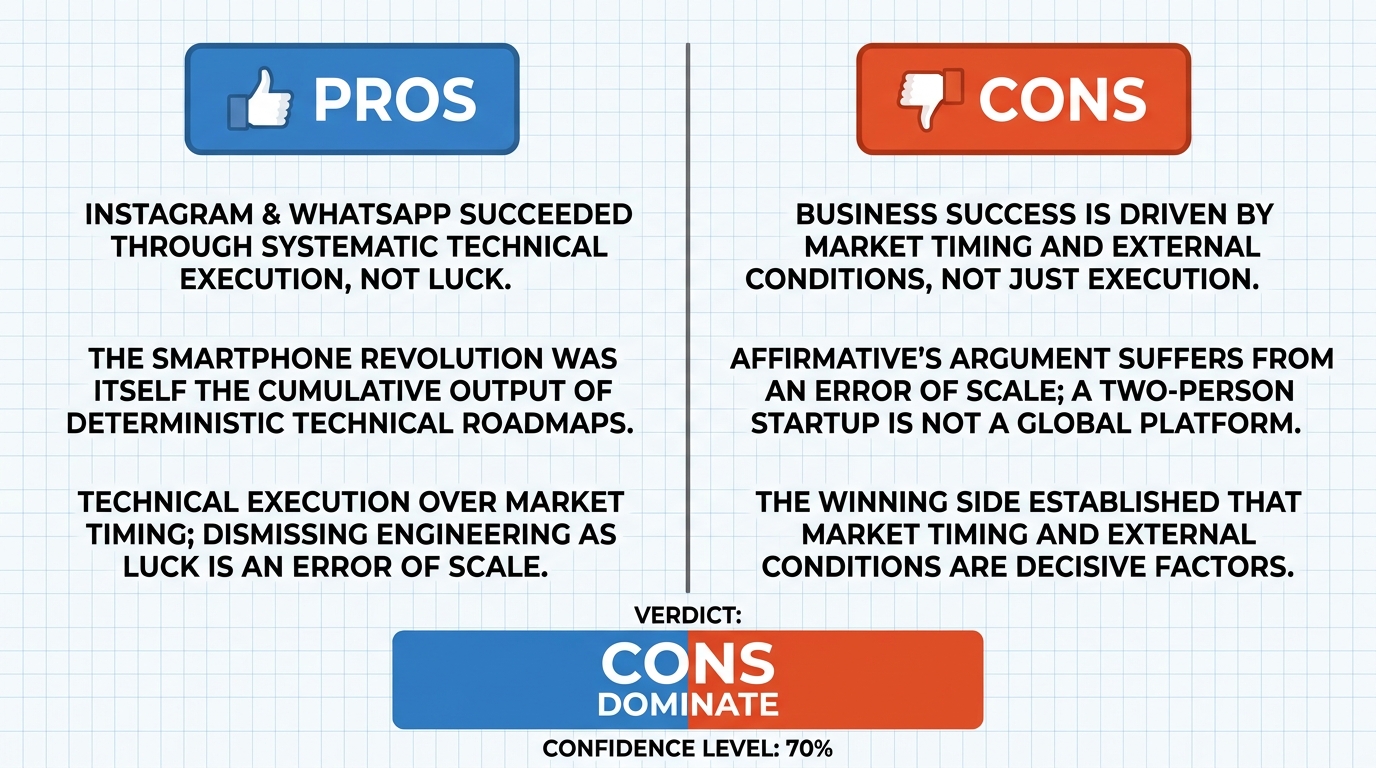
Verdict
Verdict: likely FALSE (70%)
Web Report: https://solsice.com/public/debates/the-examples-of-instagram-and-whatsapp-demonstrate-that-star-544fcd434b10
This section provides a brief overview of the key arguments. You do not need to read the full detailed report below.
✅ Key PRO arguments:
- ■Instagram and WhatsApp succeeded through systematic technical execution , not luck or market timing . Instagram's launch on October 6, 2010 used a Python /Django backend with PostgreSQL on AWS EC2 ; its square photos and filters were programmed image-processing algorithms, and the prototype was coded in eight weeks.
- ■The smartphone revolution that supposedly created the market window was itself the cumulative output of engineering teams executing deterministic technical roadmaps, from ARM processor designs to Apple's iOS SDK to the LTE protocol stack standardized by 3GPP . WhatsApp's founders did not wait for a market window; they built the technical capability to exploit it.
- ■The success of Instagram and WhatsApp was a product of technical execution rather than market timing or luck; dismissing engineering by calling the smartphone revolution an exogenous opportunity confuses the existence of a market window with the specific technical capabilities required to exploit it.
❌ Key ANTI arguments:
- ■Business success is driven by market timing and external conditions, not just technical execution . The affirmative's argument suffers from an error of scale: the constraints of a two-person startup are not invariant to a global platform competing in a saturated ecosystem, and technical execution that worked for two engineers does not account for massive capital requirements .
💭 Conclusion: False. The winning side established that market timing and external conditions, not just a sequence of computer actions, are decisive for business success, citing the error of scale between a two-person startup and a global platform in a saturated ecosystem. The affirmative's technical details about Instagram's stack and WhatsApp's engineering do not refute the role of massive capital requirements and market windows. The compound claim's 'not a matter of luck or market conditions ' component is the weakest link and was directly contradicted by the negative's argument. Because the technical-execution component received some support but the overall assertion requires both sub-claims, the verdict is false with moderate confidence.
🔬 DeepResearch Result: likely FALSE ❌ (70%)
Assertion: The examples of Instagram and WhatsApp demonstrate that starting an online business is essentially a sequence of computer actions, not a matter of luck or market conditions .
Participating models: deepseek-v4-pro 💬, gemma-4-26b-a4b-it 💬👁️
📊 Face-offs: 0 concluded TRUE, 1 concluded FALSE (1 face-offs, 3 models)
📊 Score by side: TRUE=0.00, FALSE=0.84
🏅 Model score changes:
deepseek-v4-flash-0731 💬: +8
✅ PRO Arguments:
- ■Instagram and WhatsApp succeeded through systematic technical execution , not luck or market timing . Instagram's launch on October 6, 2010 used a Python /Django backend with PostgreSQL on AWS EC2 ; its square photos and filters were programmed image-processing algorithms, and the prototype was coded in eight weeks. deepseek-v4-pro 💬
- ■The smartphone revolution that supposedly created the market window was itself the cumulative output of engineering teams executing deterministic technical roadmaps, from ARM processor designs to Apple's iOS SDK to the LTE protocol stack standardized by 3GPP . WhatsApp's founders did not wait for a market window; they built the technical capability to exploit it. deepseek-v4-pro 💬
- ■The success of Instagram and WhatsApp was a product of technical execution rather than market timing or luck; dismissing engineering by calling the smartphone revolution an exogenous opportunity confuses the existence of a market window with the specific technical capabilities required to exploit it. gemma-4-26b-a4b-it 💬👁️
❌ ANTI Arguments:
- ■Business success is driven by market timing and external conditions, not just technical execution. The affirmative's argument suffers from an error of scale: the constraints of a two-person startup are not invariant to a global platform competing in a saturated ecosystem, and technical execution that worked for two engineers does not account for massive capital requirements . gemma-4-26b-a4b-it 💬👁️
💭 Reasoning: False. The winning side established that market timing and external conditions, not just a sequence of computer actions, are decisive for business success, citing the error of scale between a two-person startup and a global platform in a saturated ecosystem. The affirmative's technical details about Instagram's stack and WhatsApp's engineering do not refute the role of massive capital requirements and market windows. The compound claim's 'not a matter of luck or market conditions' component is the weakest link and was directly contradicted by the negative's argument. Because the technical-execution component received some support but the overall assertion requires both sub-claims, the verdict is false with moderate confidence.
📋 PRO Facts:
• Instagram launched on October 6, 2010.
• Instagram's initial stack was Python/Django with PostgreSQL running on AWS EC2.
• Instagram's prototype was coded in eight weeks.
• Instagram's defining features included square photos and filters such as X-Pro II and Earlybird .
• The smartphone revolution was built on ARM processor designs, Apple's iOS SDK, and the LTE protocol stack standardized by 3GPP.
📋 ANTI Facts:
• Market timing and external conditions are decisive for business success.
• The constraints of a two-person startup differ from those of a global platform in a saturated ecosystem.
• Massive capital requirements are not accounted for by technical execution alone.
• The existence of a market window is distinct from the technical capability required to exploit it.
| Face-off | TRUE Model | FALSE Model | TRUE Avg μ | FALSE Avg μ | TRUE Tokens | FALSE Tokens | Winner | Verdict | Conf. |
|---|---|---|---|---|---|---|---|---|---|
| #1 | deepseek-v4-pro 💬 | gemma-4-26b-a4b-it 💬👁️ | 0.295 | 0.277 | 6 | 2 | TRUE | FALSE | 84% |
The following technical terms, abbreviations, and domain-specific concepts are referenced throughout this debate transcript. Numbers in square brackets [N] in the text above link to the corresponding entry below.
[1] 3GPP — 3rd Generation Partnership Project — A standards organization that standardized the LTE protocol stack, cited as part of the technical substrate.
[2] ARM — Advanced RISC Machine — A processor architecture company whose chip designs are cited as part of the technical substrate enabling smartphones.
[3] backend — The server-side part of an application; the transcript describes Instagram's Python/Django backend.
[4] bandwidth — The amount of data that can be transmitted in a given time; WhatsApp's protocol choices aimed to minimize bandwidth consumption.
[5] capital requirements — The funding needed to start and grow a business; the negative cites them as a market condition affecting success.
[6] Cassandra — Apache Cassandra — A distributed database used by Instagram for high-throughput feeds.
[7] computer vision — A field of computing that enables machines to interpret images; the transcript cites Instagram's filters as applications of computer vision techniques.
[8] deterministic — Describing a process whose outcome is fully determined by its steps; the affirmative claims business success is a deterministic sequence of computer actions.
[9] Django — A Python web framework used to build Instagram's backend.
[10] Earlybird — One of the Instagram filters mentioned as a signature image-processing feature.
[11] EC2 — Amazon Elastic Compute Cloud — Amazon's virtual server service; Instagram initially ran on a single EC2 instance.
[12] exogenous — Originating outside a system; the negative treats the smartphone revolution as an exogenous market condition.
[13] image processing — The manipulation of digital images using algorithms; Instagram's filters are described as a programmed sequence of image processing algorithms.
[14] iOS SDK — iOS Software Development Kit — Apple's toolkit for building iOS apps; cited as part of the technical substrate.
[15] latency — The delay before data is transferred; the affirmative mentions low-latency services as a technical requirement.
[16] LTE — Long-Term Evolution — A standard for high-speed wireless communication; its protocol stack is cited as part of the technical substrate.
[17] market conditions — The economic and competitive environment at a given time; the debate disputes their role in business success.
[18] market timing — The practice of entering a market at a favorable moment; the debate contrasts it with technical execution.
[19] market window — A favorable period for entering a market; the affirmative says WhatsApp did not wait for one.
[20] network effect — The phenomenon whereby a product becomes more valuable as more people use it; the negative cites network effect battles as a market condition.
[21] niche market — A small, specialized market segment; the negative mentions a two-person startup in a niche market.
[22] offline queueing — A messaging feature that stores and delivers messages when a user is offline; WhatsApp extended XMPP to support it.
[23] PostgreSQL — An open-source relational database; Instagram migrated to a sharded PostgreSQL architecture.
[24] protocol stack — A layered set of communication protocols; the transcript cites the LTE protocol stack.
[25] Python — A programming language used in Instagram's backend.
[26] quantifier — A logical term indicating scope, such as 'all' or 'some'; the affirmative accuses the negative of shifting the claim's quantifier.
[27] regulatory hurdles — Legal and compliance obstacles; the negative cites them as external conditions affecting success.
[28] scalable — Able to grow to handle increased demand; the affirmative argues that building scalable services was technical execution.
[29] sharded architecture — A database design that splits data across multiple machines to distribute load; Instagram migrated to a sharded PostgreSQL architecture.
[30] smartphone revolution — The widespread adoption of smartphones; the negative treats it as an external market condition, while the affirmative argues it was created by technical actions.
[31] substrate — An underlying layer or foundation; the affirmative describes existing technical infrastructure as a substrate that code exploits.
[32] technical execution — The implementation of engineering decisions; the debate centers on whether it or market conditions drive success.
[33] technical roadmap — A plan for engineering development; the affirmative says the smartphone revolution was the output of technical roadmaps.
[34] technical stack — The combination of technologies used to build an application; the transcript cites Instagram's stack as Python/Django, PostgreSQL, and AWS EC2.
[35] throughput — The amount of data processed in a given time; Cassandra was chosen for high-throughput feeds.
[36] user experience design — The process of designing products for ease of use; the transcript credits Instagram's growth to technical performance and user experience design.
[37] X-Pro II — One of the Instagram filters mentioned as a signature image-processing feature.
[38] XMPP — Extensible Messaging and Presence Protocol — An open communication protocol used by WhatsApp, extended for offline queueing and minimal bandwidth consumption.
The following financial data tables were referenced during the debate exchanges:
| Platform | Launch Date | Time to 1M Users | Initial Team Size | Acquisition Price |
|---|---|---|---|---|
| Oct 2010 | 2 months | 2 engineers | $1.0B | |
| Jan 2009 | 10 months | 2 engineers | $19.0B |
Legend: Growth trajectory and acquisition outcomes for Instagram and WhatsApp. Acquisition prices in USD billions. Sources: Meta SEC filings, historical tech press coverage.
| Business Factor | Startup Phase (Instagram/WhatsApp) | Mature Market Phase (Current Tech) | Impact on Success |
|---|---|---|---|
| Capital Intensity | Low (Bootstrapped/Seed) | Extremely High (VC/Public) | High |
| Regulatory Complexity | Minimal | Extreme (GDPR/Antitrust) | High |
| Competition Density | Low (Niche) | Hyper-competitive (Global) | High |
| Market Entry Barrier | Technical Skill | Network Effects & Capital | High |
Legend: Comparison of operational constraints between early-stage success stories and the current broader market. Values represent qualitative impact levels.
Face-off transcripts
- ■
Ownership & Trade Secrets. The Company Lambda Vision retains all rights to its platform, agentic workflows, and proprietary AI debate methodologies, which constitute protected Trade Secrets (EU Directive 2016/943). Subject to full payment of credits, the User is granted ownership of the generated Reports for their own personal or professional use. Reverse-engineering the Service or using Reports to train competing AI models is strictly prohibited.
- ■
No Professional Advice. Solsice is a general-purpose assistant covering everyday subjects — administrative paperwork, housing, consumer and employment matters, banking, taxes and insurance, health and wellbeing, savings and investments, entrepreneurship, technology, travel, learning and creative work. Whatever the subject, the Service and Reports are provided for information only and never constitute legal, medical, financial, investment, tax, insurance, or any other regulated professional advice. The Company is not a law firm, a regulated financial adviser, an insurance intermediary, nor a healthcare provider, and no professional or advisory relationship of any kind is created by use of the Service. Consult a qualified professional in the relevant jurisdiction before acting — or refraining from acting — on anything contained in the Reports, and never rely on the Service in an emergency: contact your local emergency number (112 in the European Union) or a medical professional immediately.
- ■
AI-Generated Content, Sources and Viewpoints. Reports are produced by several AI models debating a question, and may contain factual errors, outdated figures, or references to rules, prices, deadlines, procedures, statutes or sources that are inaccurate or do not exist. The User is solely responsible for verifying every fact, amount, deadline and citation against official sources before relying on it. Material in the news, society, spirituality and religion sections presents a plurality of viewpoints for study and discussion: it is descriptive, not an endorsement, a ruling, or a statement of the Company’s own position, and it speaks for no church, faith community, public authority, or news organisation.
- ■
Liability & Governing Law. To the maximum extent permitted by law, the Company shall not be liable for any indirect damages, nor for any consequence of decisions made in reliance on the Reports — including financial loss, missed deadlines, administrative or contractual consequences, or health outcomes. These Terms are governed by French law. Any disputes shall be subject to the exclusive jurisdiction of the Courts of Paris, France.