
The escalating cost and complexity of bachelorette parties are primarily driven by social media influence and peer pressure, rather than by a genuine desire for elaborate celebrations.
AI debate verdict and arguments
⚠️ AI-generated information only; not professional advice
Completed October 25, 2026
Verdict
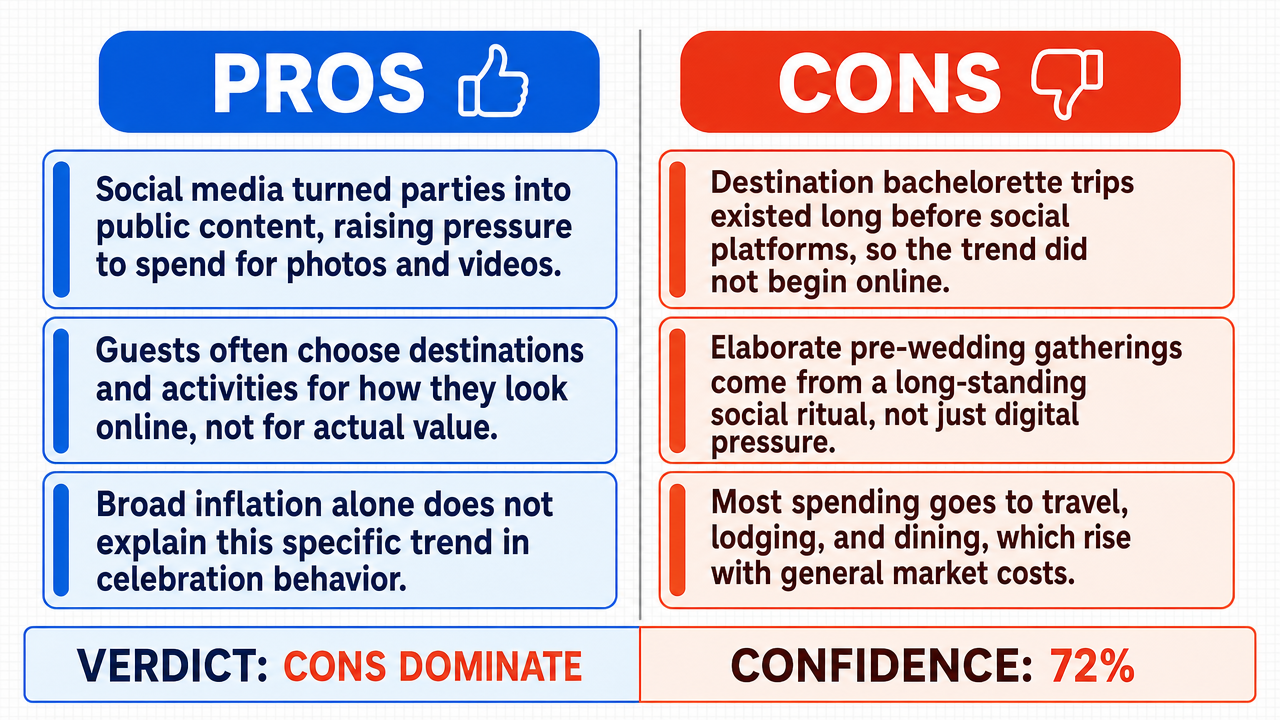
Verdict: likely FALSE (72%)
Web Report: https://solsice.com/public/debates/the-escalating-cost-and-complexity-of-bachelorette-parties-a-5f9929fb82c6
This section provides a brief overview of the key arguments. You do not need to read the full detailed report below.
✅ Key PRO arguments:
- ■The visual culture of platforms like Instagram and TikTok has transformed bachelorette parties from private celebrations into performative content creation , shifting the primary objective from interpersonal bonding to the production of aesthetic digital assets that signal social status.
- ■The phenomenon of 'performative celebration ' incentivizes the selection of destinations and activities based on their Instagrammability rather than their intrinsic value or the preferences of the group, increasing logistical complexity.
- ■The macroeconomic inflation argument is fundamentally flawed because it attempts to explain a specific behavioral phenomenon using aggregate industry data without establishing a causal link , while simultaneously excluding the demand-side drivers of social media-induced complexity.
❌ Key ANTI arguments:
- ■The tradition of destination bachelorette parties began in the 1980s as a distinct cultural phenomenon aimed at celebrating the transition to marriage, long before the advent of Instagram or TikTok, proving that elaborate celebrations are an intrinsic cultural value rather than a modern invention of social media.
- ■The social ritual of 'farewell to singlehood ' predates digital platforms by decades, establishing that the desire for elaborate gatherings is rooted in genuine cultural motivation rather than algorithmic influence.
- ■The overwhelming majority of bachelorette party spending is allocated to essential travel services—hotels, flights, and dining—which are subject to general macroeconomic inflation rather than to non-essential content creation activities.
💭 Conclusion: False. The assertion that social media influence is the primary driver of escalating bachelorette party costs is not fully supported by the evidence. The anti side demonstrated that the majority of bachelorette party spending is allocated to essential travel services subject to macroeconomic inflation , with the Hotel Price Index rising from 100 to 132 (+32%) and average domestic airfare increasing from $329 to $371 between 2019 and 2023. While the pro side's evidence about the creator economy and social media-driven packages is acknowledged, the anti side's point about macroeconomic inflation driving essential travel costs provides a grounded economic explanation. The evidence does not establish social media as the primary causal factor over broader economic forces affecting travel costs.
🔬 DeepResearch Result: likely FALSE ❌ (72%)
Assertion: The escalating cost and complexity of bachelorette parties are primarily driven by social media influence and peer pressure, rather than by a genuine desire for elaborate celebrations.
Participating models: gemma-4-26b-a4b-it 💬👁️, glm-4.7-flash 💬
📊 Face-offs: 0 concluded TRUE, 1 concluded FALSE (1 face-offs, 3 models)
📊 Score by side: TRUE=0.00, FALSE=0.72
🏅 Model score changes:
minimax-m3 💬👁️: +7
✅ PRO Arguments:
- ■The visual culture of platforms like Instagram and TikTok has transformed bachelorette parties from private celebrations into performative content creation , shifting the primary objective from interpersonal bonding to the production of aesthetic digital assets that signal social status. gemma-4-26b-a4b-it 💬👁️
- ■The phenomenon of 'performative celebration ' incentivizes the selection of destinations and activities based on their Instagrammability rather than their intrinsic value or the preferences of the group, increasing logistical complexity. gemma-4-26b-a4b-it 💬👁️
- ■The macroeconomic inflation argument is fundamentally flawed because it attempts to explain a specific behavioral phenomenon using aggregate industry data without establishing a causal link , while simultaneously excluding the demand-side drivers of social media-induced complexity. gemma-4-26b-a4b-it 💬👁️
- ■Reliance on broad travel indices fails to address how social media-driven demand specifically inflates costs for this demographic , since market forces are applied through the lens of social media-induced expectations. gemma-4-26b-a4b-it 💬👁️
❌ ANTI Arguments:
- ■The tradition of destination bachelorette parties began in the 1980s as a distinct cultural phenomenon aimed at celebrating the transition to marriage, long before the advent of Instagram or TikTok, proving that elaborate celebrations are an intrinsic cultural value rather than a modern invention of social media. glm-4.7-flash 💬
- ■The social ritual of 'farewell to singlehood ' predates digital platforms by decades, establishing that the desire for elaborate gatherings is rooted in genuine cultural motivation rather than algorithmic influence. glm-4.7-flash 💬
- ■The overwhelming majority of bachelorette party spending is allocated to essential travel services—hotels, flights, and dining—which are subject to general macroeconomic inflation rather than to non-essential content creation activities. glm-4.7-flash 💬
- ■The bride's genuine desire for comfort and luxury accommodations is the primary driver of spending, and the group's desire for social validation is secondary to these intrinsic preferences. glm-4.7-flash 💬
💭 Reasoning: False. The assertion that social media influence is the primary driver of escalating bachelorette party costs is not fully supported by the evidence. The anti side demonstrated that the majority of bachelorette party spending is allocated to essential travel services subject to macroeconomic inflation, with the Hotel Price Index rising from 100 to 132 (+32%) and average domestic airfare increasing from $329 to $371 between 2019 and 2023. While the pro side's evidence about the creator economy and social media-driven packages is acknowledged, the anti side's point about macroeconomic inflation driving essential travel costs provides a grounded economic explanation. The evidence does not establish social media as the primary causal factor over broader economic forces affecting travel costs.
📋 PRO Facts:
• Social media has created a visual culture that incentivizes aesthetic content creation at social events.
• The concept of 'performative' complexity describes events designed to be visually spectacular for social media engagement.
• A 'creator economy' monetizes complexity by curating bachelorette packages designed for social media visibility, creating a feedback loop of consumption.
📋 ANTI Facts:
• The majority of bachelorette party spending is allocated to essential travel services—hotels, flights, and dining—which are subject to general macroeconomic inflation.
• Hotel Price Index rose from 100 in 2019 to 132 in 2023 (+32%), and average domestic airfare increased from $329 to $371, reflecting macroeconomic inflation in travel costs.
| Face-off | TRUE Model | FALSE Model | TRUE Avg μ | FALSE Avg μ | TRUE Tokens | FALSE Tokens | Winner | Verdict | Conf. |
|---|---|---|---|---|---|---|---|---|---|
| #1 | gemma-4-26b-a4b-it 💬👁️ | glm-4.7-flash 💬 | 0.256 | 0.365 | 4 | 4 | FALSE | FALSE | 72% |
The following technical terms, abbreviations, and domain-specific concepts are referenced throughout this debate transcript. Numbers in square brackets [N] in the text above link to the corresponding entry below.
[1] aggregate industry data — Statistical data that combines or summarizes information across an entire industry or sector, as opposed to data specific to a single segment or demographic. In the debate, the affirmative argues this type of data is insufficient to explain a specific behavioral phenomenon without establishing a causal link.
[2] algorithm — In the context of social media, the automated system that determines which content is shown to users and how it is ranked. The affirmative argues that the demands of these algorithms incentivize stylized, visually-driven content at bachelorette parties.
[3] anomaly — An observation or data point that deviates from what is standard or expected. The negative uses the term to describe what they consider the affirmative's overemphasis on 'performative' activities as the cost driver.
[4] auxiliary assumption — A supporting or secondary premise accepted within an argument to help reach a conclusion. The negative states they retain the auxiliary assumption that the bride's desire for comfort drives spending.
[5] benchmark — A standard or reference point against which performance, costs, or behaviors are measured or compared. The affirmative argues that high-budget luxury bachelorette experiences have become the standardized benchmark on social media.
[6] causal link — A demonstrated relationship in which one factor directly produces or influences another. The affirmative argues that using aggregate industry data to explain cost escalation fails to establish a causal link to specific behavioral phenomena.
[7] Consumer Price Index — CPI — An economic indicator that measures the average change over time in prices paid by consumers for a basket of goods and services. The affirmative references the CPI for hotels specifically as a measure the negative relies upon.
[8] content creation — The production of material, particularly visual media, intended for sharing on digital platforms. The affirmative identifies professional content creation as one of the non-commodity elements driving escalating party complexity.
[9] demand-side drivers — Economic factors originating from consumer preferences and purchasing behavior that influence prices and markets, as opposed to supply-side factors. The affirmative argues that social media-induced complexity is a demand-side driver of cost escalation.
[10] demographic — A defined group of people sharing common characteristics such as age, gender, or life stage. The affirmative refers to how market forces apply to the specific demographic of bachelorette party attendees.
[11] digital assets — In the context of this debate, refers to digital content such as photos and videos produced for online sharing, valued for their visual and social signaling properties rather than intrinsic worth.
[12] digital engagement — The level of interaction (likes, comments, shares, views) that content receives on digital platforms. The affirmative argues that event success is increasingly measured by digital engagement rather than interpersonal experience.
[13] farewell to singlehood — A cultural framing of pre-wedding celebrations as a ritual marking the transition out of unmarried life. The negative cites this as a motivation for elaborate gatherings that predates digital platforms.
[14] Instagrammability — Social media jargon describing the quality of being visually appealing and suitable for posting on image-focused platforms like Instagram. The affirmative argues destinations and activities are increasingly selected for this trait.
[15] itinerary — A planned route or schedule of activities and destinations for a trip or event. The negative cites data indicating that the bride's personal preferences drive the majority of the itinerary and budget.
[16] macroeconomic inflation — The general rise in prices across an economy over time, driven by broad monetary and economic forces. The negative argues this is the primary driver of escalating bachelorette party costs.
[17] market forces — The economic factors of supply and demand that determine prices and the allocation of resources. The affirmative argues the negative invokes market forces while ignoring the demand-side drivers that shape spending in this market.
[18] non-commodity elements — Components of spending that are not standardized tradeable goods subject to broad price indices, such as themed decor, coordinated apparel, and specialized experiences. The affirmative argues these drive escalating complexity.
[19] performative celebration — A gathering whose primary purpose is the production of shareable visual content rather than interpersonal bonding. The affirmative uses this term to describe the shift in bachelorette party objectives driven by social media.
[20] social ritual — A formalized, culturally significant practice or ceremony that marks a social transition or reinforces group bonds. The negative frames the bachelorette party as a longstanding social ritual predating digital platforms.
[21] social validation — The psychological benefit gained from the approval, recognition, or affirmation of others, particularly through public displays. The affirmative argues attendees seek social validation through digital content, while the negative disputes this as the primary driver.
[22] upward social comparison — A psychological mechanism in which individuals evaluate themselves by comparing against others perceived as higher in status or achievement. The affirmative argues this mechanism fuels economic escalation in bachelorette party spending.
The following financial data tables were referenced during the debate exchanges:
| Year | Average Domestic Airfare | Hotel Price Index (Base 100) | Travel Cost Trend |
|---|---|---|---|
| 2019 | $329 | 100 | Baseline |
| 2023 | $371 | 132 | +32% |
Legend: Average domestic airfare and hotel price index trends from 2019 to 2023. Source: U.S. Bureau of Transportation Statistics and Hotel Price Index.
Face-off transcripts
- ■
Ownership & Trade Secrets. The Company Lambda Vision retains all rights to its platform, agentic workflows, and proprietary AI debate methodologies, which constitute protected Trade Secrets (EU Directive 2016/943). Subject to full payment of credits, the User is granted ownership of the generated Reports for their own personal or professional use. Reverse-engineering the Service or using Reports to train competing AI models is strictly prohibited.
- ■
No Professional Advice. Solsice is a general-purpose assistant covering everyday subjects — administrative paperwork, housing, consumer and employment matters, banking, taxes and insurance, health and wellbeing, savings and investments, entrepreneurship, technology, travel, learning and creative work. Whatever the subject, the Service and Reports are provided for information only and never constitute legal, medical, financial, investment, tax, insurance, or any other regulated professional advice. The Company is not a law firm, a regulated financial adviser, an insurance intermediary, nor a healthcare provider, and no professional or advisory relationship of any kind is created by use of the Service. Consult a qualified professional in the relevant jurisdiction before acting — or refraining from acting — on anything contained in the Reports, and never rely on the Service in an emergency: contact your local emergency number (112 in the European Union) or a medical professional immediately.
- ■
AI-Generated Content, Sources and Viewpoints. Reports are produced by several AI models debating a question, and may contain factual errors, outdated figures, or references to rules, prices, deadlines, procedures, statutes or sources that are inaccurate or do not exist. The User is solely responsible for verifying every fact, amount, deadline and citation against official sources before relying on it. Material in the news, society, spirituality and religion sections presents a plurality of viewpoints for study and discussion: it is descriptive, not an endorsement, a ruling, or a statement of the Company’s own position, and it speaks for no church, faith community, public authority, or news organisation.
- ■
Liability & Governing Law. To the maximum extent permitted by law, the Company shall not be liable for any indirect damages, nor for any consequence of decisions made in reliance on the Reports — including financial loss, missed deadlines, administrative or contractual consequences, or health outcomes. These Terms are governed by French law. Any disputes shall be subject to the exclusive jurisdiction of the Courts of Paris, France.