
The Dolby Theatre is an appropriate venue for the type of live event being held on 2026-10-08.
AI debate verdict and arguments
⚠️ AI-generated information only; not professional advice
Completed October 8, 2026
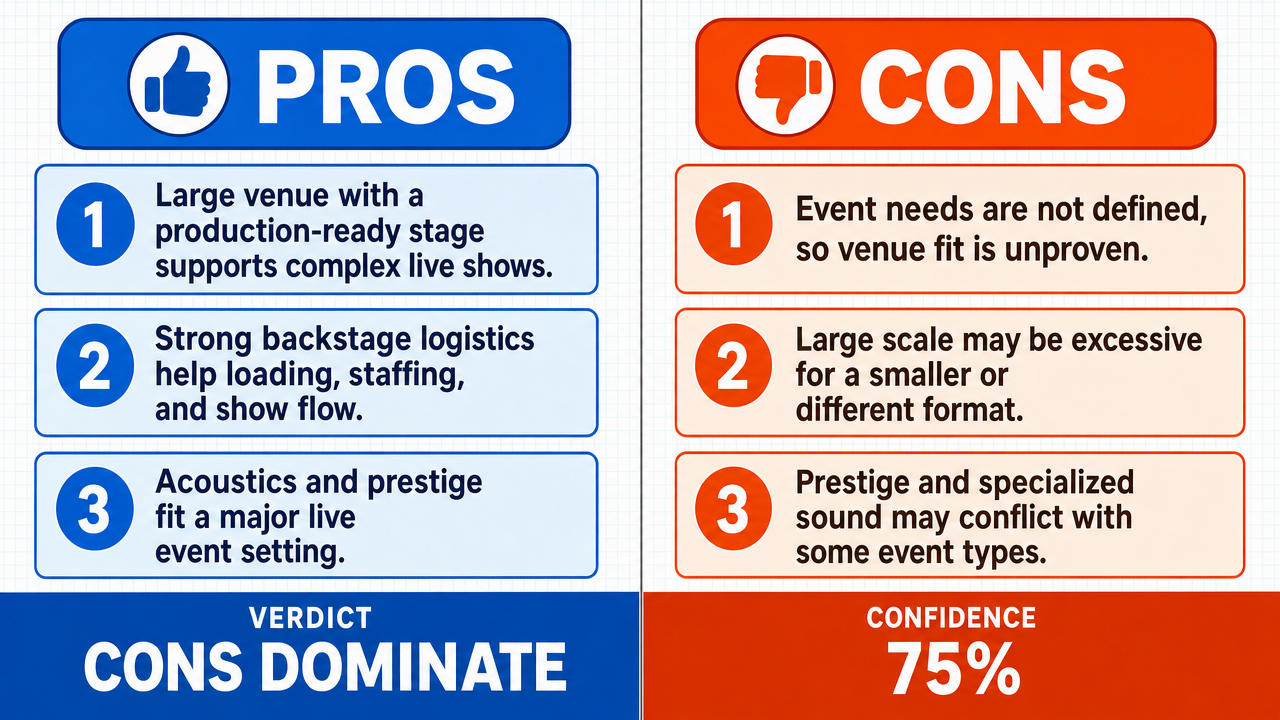
Verdict
Verdict: likely FALSE (75%)
This section provides a brief overview of the key arguments. You do not need to read the full detailed report below.
✅ Key PRO arguments:
- ■The Dolby Theatre's physical specifications—approximately 3,400 seats, production-ready stage , and technical rigging designed for complex productions—make it a strong match for a major live event, as demonstrated by its decades of hosting the Academy Awards.
- ■The venue's proven logistical infrastructure , including dedicated loading docks , dressing rooms , and backstage areas , ensures smooth operations for the event on October 8, 2026.
- ■The Dolby Theatre's world-class acoustics and cultural prestige align with the demands of a high-profile live event, making it an appropriate venue for the scheduled date.
❌ Key ANTI arguments:
- ■The affirmative relies on a hidden premise that the event on 2026-10-08 is a high-profile, large-scale production similar to the Academy Awards, without establishing the nature of the specific event in question.
- ■Venue appropriateness is not a universal constant but depends on the specific requirements of a given event; the Dolby Theatre's 3,400-seat capacity and massive technical overhead create a high barrier to entry that can render it inappropriate for many event types.
- ■The venue's specialized acoustic calibration for cinematic/orchestral sound and high-prestige branding create inherent incompatibilities for events requiring different acoustic profiles (e.g., high-decibel rock music) or alternative cultural identities (e.g., grassroots or subcultural gatherings ).
💭 Conclusion: False. The Dolby Theatre is not demonstrably an appropriate venue for the event on 2026-10-08 because the specific nature of that event has not been established. The FALSE side correctly identified that the TRUE side's argument rests on an unverified assumption that the event is a large-scale, high-profile production similar to the Academy Awards. The venue's specialized design—including its 3,400-seat capacity, cinematic acoustic calibration , and premium branding—creates inherent mismatches for many plausible event types such as niche community gatherings, mid-sized productions, or subcultural events. Without concrete evidence about the specific event scheduled for that date, the claim of appropriateness remains unsupported. The TRUE side's counter that the opponent committed a scope-shift fallacy was unconvincing, as the burden of establishing the event's nature lies with the party asserting appropriateness.
🔬 DeepResearch Result: likely FALSE ❌ (75%)
Assertion: The Dolby Theatre is an appropriate venue for the type of live event being held on 2026-10-08.
Participating models: deepseek-v3.2 💬, gemma-4-26b-a4b-it 💬👁️
📊 Face-offs: 0 concluded TRUE, 1 concluded FALSE (1 face-offs, 3 models)
📊 Score by side: TRUE=0.00, FALSE=0.75
🏅 Model score changes:
minimax-m3 💬👁️: +8
✅ PRO Arguments:
- ■The Dolby Theatre's physical specifications—approximately 3,400 seats, production-ready stage , and technical rigging designed for complex productions—make it a strong match for a major live event, as demonstrated by its decades of hosting the Academy Awards. deepseek-v3.2 💬
- ■The venue's proven logistical infrastructure , including dedicated loading docks , dressing rooms , and backstage areas , ensures smooth operations for the event on October 8, 2026. deepseek-v3.2 💬
- ■The Dolby Theatre's world-class acoustics and cultural prestige align with the demands of a high-profile live event, making it an appropriate venue for the scheduled date. deepseek-v3.2 💬
- ■The opponent's argument commits a scope-shift fallacy by broadening the claim to 'many live event types' rather than addressing the specific event scheduled for 2026-10-08. deepseek-v3.2 💬
❌ ANTI Arguments:
- ■The affirmative relies on a hidden premise that the event on 2026-10-08 is a high-profile, large-scale production similar to the Academy Awards, without establishing the nature of the specific event in question. gemma-4-26b-a4b-it 💬👁️
- ■Venue appropriateness is not a universal constant but depends on the specific requirements of a given event; the Dolby Theatre's 3,400-seat capacity and massive technical overhead create a high barrier to entry that can render it inappropriate for many event types. gemma-4-26b-a4b-it 💬👁️
- ■The venue's specialized acoustic calibration for cinematic/orchestral sound and high-prestige branding create inherent incompatibilities for events requiring different acoustic profiles (e.g., high-decibel rock music) or alternative cultural identities (e.g., grassroots or subcultural gatherings ). gemma-4-26b-a4b-it 💬👁️
- ■Without knowing the specific scale, genre, or audience of the event on 2026-10-08, the Dolby Theatre's premium features could become significant logistical and financial liabilities rather than assets. gemma-4-26b-a4b-it 💬👁️
💭 Reasoning: False. The Dolby Theatre is not demonstrably an appropriate venue for the event on 2026-10-08 because the specific nature of that event has not been established. The FALSE side correctly identified that the TRUE side's argument rests on an unverified assumption that the event is a large-scale, high-profile production similar to the Academy Awards. The venue's specialized design—including its 3,400-seat capacity, cinematic acoustic calibration, and premium branding—creates inherent mismatches for many plausible event types such as niche community gatherings, mid-sized productions, or subcultural events. Without concrete evidence about the specific event scheduled for that date, the claim of appropriateness remains unsupported. The TRUE side's counter that the opponent committed a scope-shift fallacy was unconvincing, as the burden of establishing the event's nature lies with the party asserting appropriateness.
📋 PRO Facts:
• The Dolby Theatre has a seating capacity of approximately 3,400.
• The Dolby Theatre has hosted the Academy Awards for decades, involving elaborate sets, large casts, and live broadcasts .
• The venue features dedicated loading docks, dressing rooms, and backstage areas.
📋 ANTI Facts:
• The specific nature, scale, and type of the live event scheduled for 2026-10-08 at the Dolby Theatre has not been established or disclosed in the debate.
• The Dolby Theatre's acoustic calibration is specifically designed for cinematic and orchestral sound, which may not suit all live event types.
• The venue's 3,400-seat capacity and high-prestige branding create a high barrier to entry that could be inappropriate for smaller or niche events.
| Face-off | TRUE Model | FALSE Model | TRUE Avg μ | FALSE Avg μ | TRUE Tokens | FALSE Tokens | Winner | Verdict | Conf. |
|---|---|---|---|---|---|---|---|---|---|
| #1 | deepseek-v3.2 💬 | gemma-4-26b-a4b-it 💬👁️ | 0.398 | 0.205 | 12 | 3 | TRUE | FALSE | 75% |
The following technical terms, abbreviations, and domain-specific concepts are referenced throughout this debate transcript. Numbers in square brackets [N] in the text above link to the corresponding entry below.
[1] acoustic calibration — The precise tuning of a venue's sound system and physical architecture to optimize audio reproduction for specific performance types, such as cinematic or orchestral presentations.
[2] acoustic energy — The sound energy distributed throughout a performance space, which can dissipate or feel diluted in a venue whose seating capacity exceeds the audience size, producing what the debaters call an 'empty hall effect.'
[3] acoustics — The properties of a venue that determine how sound travels within it, including reverberation, clarity, and sound distribution to audience members.
[4] audience engagement — The degree of attention, emotional involvement, and interactive participation that attendees exhibit during a live event, which can be diminished when a venue is too large for the crowd.
[5] backstage areas — The off-stage zones of a theatre used for performer preparation, set storage, and production operations, considered part of a venue's logistical infrastructure.
[6] barrier to entry — An economic concept referring to the high cost, technical complexity, or specialized requirements that make a venue or market difficult to access or utilize for certain events.
[7] budgetary — Relating to the financial budget or cost considerations associated with renting and operating a venue for an event.
[8] cultural cachet — The prestige, symbolic value, or brand recognition that a venue carries, which can elevate the perceived status of an event held there.
[9] dressing rooms — Private backstage rooms provided for performers to change costumes, apply makeup, and prepare before appearing on stage.
[10] empty hall effect — The degradation of acoustic energy and audience atmosphere that occurs when a venue's seating capacity significantly exceeds the actual attendance, leaving many seats unfilled.
[11] financial inefficiency — A situation in which the cost of a resource (such as a high-end venue) is disproportionate to the needs of the event, resulting in wasted expenditure.
[12] grassroots — Describing events, movements, or gatherings that originate from community-level or local constituencies rather than from large institutional organizers.
[13] hidden premise — In debate logic, an unstated assumption that an argument depends upon but does not explicitly declare, which the opposing side identifies as a weakness in the argument.
[14] high-decibel — Referring to sound measured at a high intensity level on the decibel scale, characteristic of amplified rock concerts and similar loud performances.
[15] live broadcasts — Real-time transmission of an event to remote audiences via television, radio, or streaming platforms, requiring specialized production infrastructure.
[16] loading docks — Dedicated areas at a venue where trucks and equipment are unloaded, forming part of the logistical infrastructure needed for large-scale productions.
[17] logistical infrastructure — The physical and operational facilities—such as loading docks, dressing rooms, and backstage areas—that enable the smooth execution of an event.
[18] logistical liabilities — Operational disadvantages or complications that arise when a venue's scale, cost, or complexity exceeds the requirements of the event being hosted.
[19] production-ready stage — A stage equipped with the technical rigging, lighting, and broadcast infrastructure necessary to support complex, large-scale live productions.
[20] resource-allocation — resource allocation — The process of distributing financial, technical, and human resources across the various needs of an event, which the negative side argues is inefficient when a venue is oversized.
[21] seating capacity — The maximum number of spectators that a venue can accommodate, cited in the debate as approximately 3,400 for the Dolby Theatre.
[22] subcultural gatherings — Events organized around niche or non-mainstream cultural identities, which the negative side argues would be mismatched with the Dolby Theatre's mainstream prestige branding.
[23] technical rigging — The system of ropes, pulleys, motors, and mounting points used in a theatre to suspend lighting, scenery, and audio equipment above the stage.
[24] technical risks — Potential failures or complications arising from the use of complex production infrastructure, which the negative side argues are unnecessarily introduced for events that do not require such equipment.
Face-off transcripts
- ■
Ownership & Trade Secrets. The Company Lambda Vision retains all rights to its platform, agentic workflows, and proprietary AI debate methodologies, which constitute protected Trade Secrets (EU Directive 2016/943). Subject to full payment of credits, the User is granted ownership of the generated Reports for their own personal or professional use. Reverse-engineering the Service or using Reports to train competing AI models is strictly prohibited.
- ■
No Professional Advice. Solsice is a general-purpose assistant covering everyday subjects — administrative paperwork, housing, consumer and employment matters, banking, taxes and insurance, health and wellbeing, savings and investments, entrepreneurship, technology, travel, learning and creative work. Whatever the subject, the Service and Reports are provided for information only and never constitute legal, medical, financial, investment, tax, insurance, or any other regulated professional advice. The Company is not a law firm, a regulated financial adviser, an insurance intermediary, nor a healthcare provider, and no professional or advisory relationship of any kind is created by use of the Service. Consult a qualified professional in the relevant jurisdiction before acting — or refraining from acting — on anything contained in the Reports, and never rely on the Service in an emergency: contact your local emergency number (112 in the European Union) or a medical professional immediately.
- ■
AI-Generated Content, Sources and Viewpoints. Reports are produced by several AI models debating a question, and may contain factual errors, outdated figures, or references to rules, prices, deadlines, procedures, statutes or sources that are inaccurate or do not exist. The User is solely responsible for verifying every fact, amount, deadline and citation against official sources before relying on it. Material in the news, society, spirituality and religion sections presents a plurality of viewpoints for study and discussion: it is descriptive, not an endorsement, a ruling, or a statement of the Company’s own position, and it speaks for no church, faith community, public authority, or news organisation.
- ■
Liability & Governing Law. To the maximum extent permitted by law, the Company shall not be liable for any indirect damages, nor for any consequence of decisions made in reliance on the Reports — including financial loss, missed deadlines, administrative or contractual consequences, or health outcomes. These Terms are governed by French law. Any disputes shall be subject to the exclusive jurisdiction of the Courts of Paris, France.