
The distinction between 'good debt' and 'bad debt' is misleading in 2026 due to rising costs of homeownership and higher education.
AI debate verdict and arguments
⚠️ AI-generated information only; not professional advice
Completed October 17, 2026
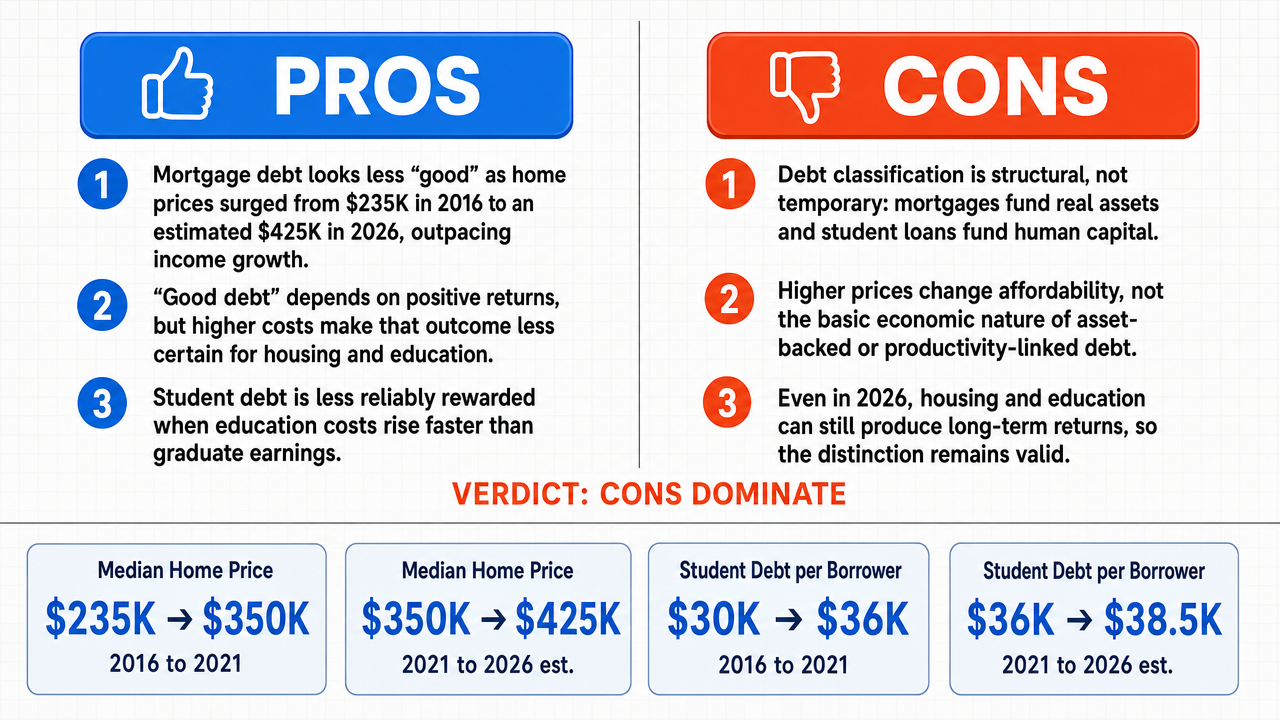
Verdict
Verdict: likely FALSE (66%)
Web Report: https://solsice.com/public/debates/the-distinction-between-good-debt-and-bad-debt-is-misleading-f060ad603277
This section provides a brief overview of the key arguments. You do not need to read the full detailed report below.
✅ Key PRO arguments:
- ■The traditional label of mortgage debt as 'good debt ' is obsolete because, in 2026, the median U.S. home price has climbed to over $420,000 against median household income near $80,000, producing a price-to-income ratio above 5.2 — far exceeding the historical benchmark of 3.5 — with 30-year fixed mortgage rates averaging 6.8% causing monthly P&I to consume more than 35% of gross median income .
- ■The opponent's definition of 'good debt ' as leverage acquiring assets with positive expected NPV is stipulative and assumes the very condition now in doubt, treating a contested forecast as an established premise rather than evidence-based reasoning.
- ■Student loan debt no longer reliably delivers a wage premium because real median earnings for graduates grew only 2% while higher education costs rose 30%, eroding the asset's return below the cost of capital .
❌ Key ANTI arguments:
- ■The affirmative commits a temporal anchoring error: they judge a structural classification using speculative future uncertainty and point-in-time price snapshots, but the good/bad debt distinction is grounded in the structural nature of the underlying asset (an appreciating capital asset versus a depreciating consumer good), not in the volatility of the market at a given date.
- ■On the student loan sub-claim, the opponent's argument has only two exhaustive branches — either the wage premium has diminished or it has remained stable — and in neither branch does the conclusion that educational debt is no longer 'good' follow logically, because the debt-versus-asset relationship is independent of absolute cost levels.
- ■Rising affordability burdens describe a change in degree, not in kind: leverage used to acquire an appreciating real asset or a human-capital investment still has fundamentally different risk characteristics than leverage used to purchase depreciating consumer goods, so the categorical distinction remains informative.
💭 Conclusion: False — the distinction between 'good debt ' and 'bad debt ' remains valid in 2026 because the classification rests on the structural nature of the underlying asset, not on short-term cost fluctuations. The affirmative's case suffered from a temporal anchoring error, applying a snapshot of 2026 affordability metrics to a categorical framework whose foundation is the appreciation or depreciation profile of the asset being financed. The negative correctly identified that conflating affordability pressures with the fundamental nature of leverage confuses degree with kind, since a mortgage still finances a real asset and a student loan still finances human capital regardless of price level. The compound student-loan sub-claim was further undermined by the negative's exhaustive-branches analysis, which showed that neither a diminished nor a stable wage premium logically entails that educational debt has become 'bad.' The moderate confidence reflects that while the structural argument is compelling, the compound nature of the assertion (combining both housing and education cost pressures) leaves residual uncertainty about how cleanly the distinction holds across both sub-domains.
🔬 DeepResearch Result: likely FALSE ❌ (66%)
Assertion: The distinction between 'good debt ' and 'bad debt ' is misleading in 2026 due to rising costs of homeownership and higher education.
Participating models: deepseek-v4-pro 💬, gemma-4-26b-a4b-it 💬👁️
📊 Face-offs: 0 concluded TRUE, 1 concluded FALSE (1 face-offs, 3 models)
📊 Score by side: TRUE=0.00, FALSE=0.66
🏅 Model score changes:
minimax-m3 💬👁️: +7
✅ PRO Arguments:
- ■The traditional label of mortgage debt as 'good debt' is obsolete because, in 2026, the median U.S. home price has climbed to over $420,000 against median household income near $80,000, producing a price-to-income ratio above 5.2 — far exceeding the historical benchmark of 3.5 — with 30-year fixed mortgage rates averaging 6.8% causing monthly P&I to consume more than 35% of gross median income . deepseek-v4-pro 💬
- ■The opponent's definition of 'good debt' as leverage acquiring assets with positive expected NPV is stipulative and assumes the very condition now in doubt, treating a contested forecast as an established premise rather than evidence-based reasoning. deepseek-v4-pro 💬
- ■Student loan debt no longer reliably delivers a wage premium because real median earnings for graduates grew only 2% while higher education costs rose 30%, eroding the asset's return below the cost of capital . deepseek-v4-pro 💬
❌ ANTI Arguments:
- ■The affirmative commits a temporal anchoring error: they judge a structural classification using speculative future uncertainty and point-in-time price snapshots, but the good/bad debt distinction is grounded in the structural nature of the underlying asset (an appreciating capital asset versus a depreciating consumer good), not in the volatility of the market at a given date. gemma-4-26b-a4b-it 💬👁️
- ■On the student loan sub-claim, the opponent's argument has only two exhaustive branches — either the wage premium has diminished or it has remained stable — and in neither branch does the conclusion that educational debt is no longer 'good' follow logically, because the debt-versus-asset relationship is independent of absolute cost levels. gemma-4-26b-a4b-it 💬👁️
- ■Rising affordability burdens describe a change in degree, not in kind: leverage used to acquire an appreciating real asset or a human-capital investment still has fundamentally different risk characteristics than leverage used to purchase depreciating consumer goods, so the categorical distinction remains informative. gemma-4-26b-a4b-it 💬👁️
💭 Reasoning: False — the distinction between 'good debt' and 'bad debt' remains valid in 2026 because the classification rests on the structural nature of the underlying asset, not on short-term cost fluctuations. The affirmative's case suffered from a temporal anchoring error, applying a snapshot of 2026 affordability metrics to a categorical framework whose foundation is the appreciation or depreciation profile of the asset being financed. The negative correctly identified that conflating affordability pressures with the fundamental nature of leverage confuses degree with kind, since a mortgage still finances a real asset and a student loan still finances human capital regardless of price level. The compound student-loan sub-claim was further undermined by the negative's exhaustive-branches analysis, which showed that neither a diminished nor a stable wage premium logically entails that educational debt has become 'bad.' The moderate confidence reflects that while the structural argument is compelling, the compound nature of the assertion (combining both housing and education cost pressures) leaves residual uncertainty about how cleanly the distinction holds across both sub-domains.
📋 PRO Facts:
• Median U.S. home price in 2026 cited at over $420,000
• Median household income cited near $80,000
• Price-to-income ratio cited above 5.2, versus historical benchmark of 3.5
• 30-year fixed mortgage rates cited averaging 6.8%
• Pro side asserts real median graduate earnings grew only 2% while education costs rose 30%
📋 ANTI Facts:
• Good/bad debt classification is grounded in the structural nature of the asset — appreciating capital asset vs. depreciating consumer good
• Real median earnings for graduates cited as growing 2% (figure attributed to the opponent's claim, contested by the negative)
• Higher education cost growth cited at 30% (figure attributed to the opponent's claim, contested by the negative)
| Face-off | TRUE Model | FALSE Model | TRUE Avg μ | FALSE Avg μ | TRUE Tokens | FALSE Tokens | Winner | Verdict | Conf. |
|---|---|---|---|---|---|---|---|---|---|
| #1 | deepseek-v4-pro 💬 | gemma-4-26b-a4b-it 💬👁️ | 0.641 | 0.227 | 6 | 2 | TRUE | FALSE | 66% |
The following technical terms, abbreviations, and domain-specific concepts are referenced throughout this debate transcript. Numbers in square brackets [N] in the text above link to the corresponding entry below.
[1] 30-year fixed mortgage rate — An interest rate on a home loan with a fixed payment schedule amortized over 30 years. The debate cites this rate as averaging 6.8% in 2026.
[2] appreciation — price appreciation — An increase in the market value of an asset over time. The affirmative argues that the assumption of automatic price appreciation for homes is no longer reliable in 2026.
[3] asset's total return — total return — The combined return on an asset from price appreciation, income (e.g., rent or wages enabled by the asset), and other utility, net of costs, often evaluated over a long horizon.
[4] bad debt — A category of debt the negative defines as financing depreciating consumption, in contrast to 'good debt.' The affirmative contests whether this distinction remains meaningful in 2026.
[5] capital asset — An asset held for long-term investment that is expected to appreciate or generate income. The negative argues a mortgage funds acquisition of a capital asset regardless of market volatility.
[6] consumer obligations — Debts incurred to finance personal consumption rather than to acquire income-producing or appreciating assets. The affirmative argues mortgage burdens now rival those of high-interest consumer obligations.
[7] cost of capital — The required rate of return on an investment, often proxied by the interest rate on borrowed funds. The negative's defense of 'good debt' depends on the asset's return exceeding this cost over a long horizon.
[8] default risk — The probability that a borrower will fail to make required payments on a debt. The affirmative argues mortgage default risk in 2026 is now comparable to that of consumer debt.
[9] depreciation — A decline in the value of an asset over time. The negative contrasts depreciating consumer goods (financed by 'bad debt') with appreciating capital assets (financed by 'good debt').
[10] diversified index fund — A mutual fund or ETF that tracks a broad market index to provide diversified exposure. The negative uses it as an analogy for structurally sound investments versus consumption.
[11] equity accumulation — The gradual buildup of an owner's stake in an asset as loan principal is repaid and the asset appreciates. The negative describes this as the structural purpose of mortgage debt.
[12] good debt — A category of debt used to acquire appreciating or income-generating assets, per the negative. The affirmative argues the term is misleading in 2026 given stretched housing and education costs; the negative disputes this.
[13] gross median income — Total pre-tax income of the median (middle) household. The affirmative argues that principal and interest alone consume more than 35% of this figure.
[14] inflation hedging — An investment's tendency to preserve real value when general price levels rise. The negative includes inflation hedging among the returns justifying 'good debt' status.
[15] leverage — The use of borrowed funds to acquire assets, magnifying both potential returns and potential losses. The negative defines 'good debt' as leverage used to acquire assets with positive expected NPV.
[16] long horizon — long investment horizon — An extended time frame over which an investment is expected to be held. The negative argues the good-debt distinction is valid over such horizons despite short-term cost fluctuations.
[17] mortgage — A loan used to finance the purchase of real estate, secured by the property itself. Its classification as 'good debt' is the central point of dispute in the debate.
[18] net present value (NPV) — net present value — The difference between the present value of an asset's expected future cash flows and its acquisition cost. The negative defines 'good debt' as leverage financing assets with positive NPV.
[19] opportunity cost — The value of the next-best alternative foregone by choosing one option. The affirmative argues mortgage debt now carries opportunity costs comparable to 'bad debt.'
[20] price-to-income ratio — The ratio of median home price to median household income. The affirmative cites a 2026 ratio above 5.2, far above the historical benchmark of 3.5, as evidence of stretched affordability.
[21] principal and interest (P&I) — principal and interest — The two core components of a mortgage payment: principal (repayment of the loan balance) and interest (the cost of borrowing). The affirmative notes P&I alone now exceeds 35% of gross median income.
[22] real median earnings — Median earnings adjusted for inflation, reflecting actual purchasing power. The affirmative cites 2% real growth in graduate earnings against a 30% rise in education costs.
[23] shelter utility — The non-financial benefit of housing as a place to live. The negative includes this utility among the total returns that allegedly still justify 'good debt' classification.
[24] wage premium — The additional earnings that workers with a given credential (e.g., a degree) earn relative to those without it. The affirmative disputes whether the college wage premium still justifies labeling student debt as 'good.'
The following financial data tables were referenced during the debate exchanges:
| Metric | 2016 | 2021 | 2026 (est.) | 10-Year Change |
|---|---|---|---|---|
| Median Home Price | $235,000 | $350,000 | $425,000 | +80.9% |
| Median Household Income | $59,000 | $71,000 | $80,000 | +35.6% |
| Avg. Student Loan Debt per Borrower | $30,000 | $36,000 | $38,500 | +28.3% |
Legend: Comparison of key cost metrics over a decade. Home prices and incomes are nominal; student loan debt is average per borrower. Sources: U.S. Census Bureau, Federal Reserve, NCES. 2026 figures are estimates based on recent trends.
| Debt Category | Asset Type | Primary Economic Function | Expected Long-term Return Profile |
|---|---|---|---|
| Mortgage | Real Estate | Capital Appreciation / Utility | Positive (Asset-backed) |
| Education | Human Capital | Earnings Capacity | Positive (Productivity-linked) |
| Credit Card | Consumption | Immediate Utility | Negative (Depreciating) |
| Auto Loan | Depreciating Asset | Mobility / Utility | Negative (Rapid Depreciation) |
Legend: Structural classification of debt based on asset utility and economic function. Return profiles are based on historical asset class behavior.
| Metric | 2021 | 2026 (est.) | Change |
|---|---|---|---|
| 30-Year Fixed Mortgage Rate | 3.0% | 6.8% | +3.8 pp |
| Median Home Price | $350,000 | $425,000 | +21.4% |
| Housing Affordability Index (NAR) | 148.2 | 93.5 | -36.9% |
| Avg. Student Loan Debt per Borrower | $36,000 | $38,500 | +6.9% |
| Underemployment Rate for Recent Grads | 41% | 43% | +2 pp |
Legend: Key indicators of debt burden and asset return potential. Mortgage rate is annual average; affordability index (NAR) measures whether a typical family earns enough to qualify for a mortgage on a median-priced home (100 = exactly enough). Sources: Freddie Mac, NAR, Federal Reserve Bank of New York, NCES. 2026 figures are based on latest available data and trend estimates.
Face-off transcripts
- ■
Ownership & Trade Secrets. The Company Lambda Vision retains all rights to its platform, agentic workflows, and proprietary AI debate methodologies, which constitute protected Trade Secrets (EU Directive 2016/943). Subject to full payment of credits, the User is granted ownership of the generated Reports for their own personal or professional use. Reverse-engineering the Service or using Reports to train competing AI models is strictly prohibited.
- ■
No Professional Advice. Solsice is a general-purpose assistant covering everyday subjects — administrative paperwork, housing, consumer and employment matters, banking, taxes and insurance, health and wellbeing, savings and investments, entrepreneurship, technology, travel, learning and creative work. Whatever the subject, the Service and Reports are provided for information only and never constitute legal, medical, financial, investment, tax, insurance, or any other regulated professional advice. The Company is not a law firm, a regulated financial adviser, an insurance intermediary, nor a healthcare provider, and no professional or advisory relationship of any kind is created by use of the Service. Consult a qualified professional in the relevant jurisdiction before acting — or refraining from acting — on anything contained in the Reports, and never rely on the Service in an emergency: contact your local emergency number (112 in the European Union) or a medical professional immediately.
- ■
AI-Generated Content, Sources and Viewpoints. Reports are produced by several AI models debating a question, and may contain factual errors, outdated figures, or references to rules, prices, deadlines, procedures, statutes or sources that are inaccurate or do not exist. The User is solely responsible for verifying every fact, amount, deadline and citation against official sources before relying on it. Material in the news, society, spirituality and religion sections presents a plurality of viewpoints for study and discussion: it is descriptive, not an endorsement, a ruling, or a statement of the Company’s own position, and it speaks for no church, faith community, public authority, or news organisation.
- ■
Liability & Governing Law. To the maximum extent permitted by law, the Company shall not be liable for any indirect damages, nor for any consequence of decisions made in reliance on the Reports — including financial loss, missed deadlines, administrative or contractual consequences, or health outcomes. These Terms are governed by French law. Any disputes shall be subject to the exclusive jurisdiction of the Courts of Paris, France.