
The discovery of an adoption file linked to a scandal involving over 374 children confirms a widespread pattern of illegal adoptions from that specific location.
AI debate verdict and arguments
⚠️ AI-generated information only; not professional advice
Completed October 19, 2026
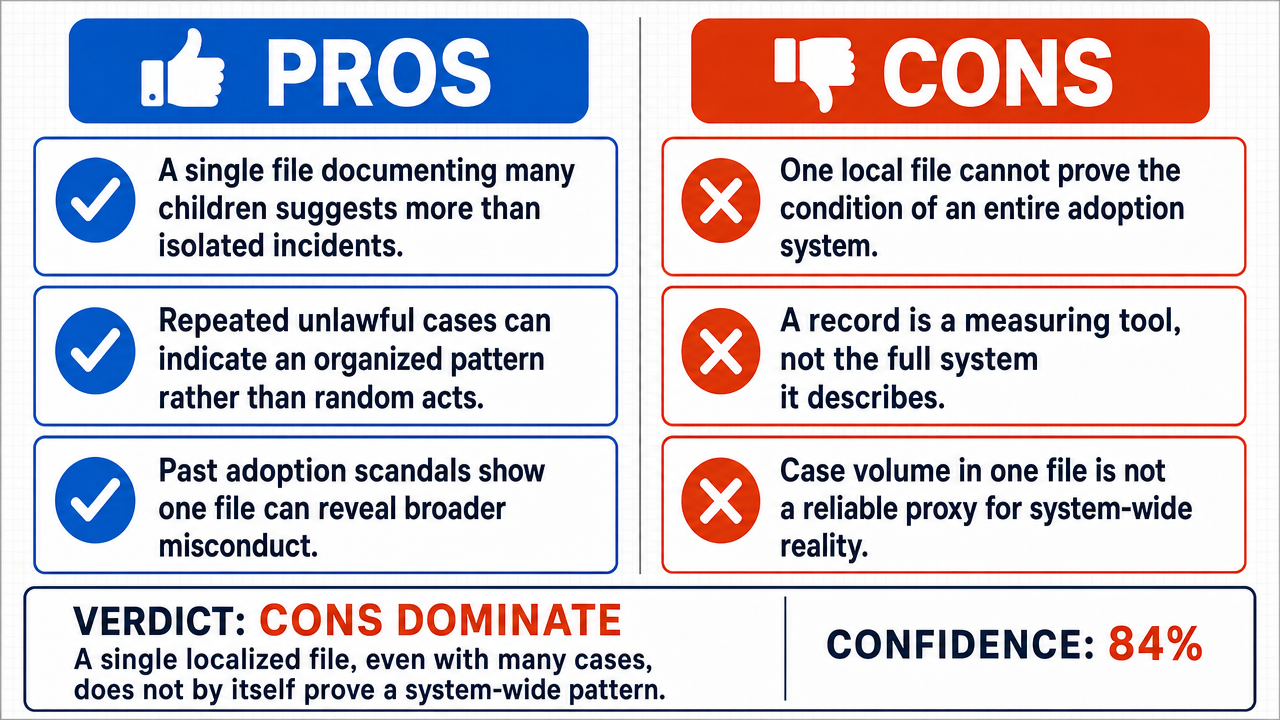
Verdict
Verdict: likely FALSE (84%)
Web Report: https://solsice.com/public/debates/the-discovery-of-an-adoption-file-linked-to-a-scandal-involv-f4e4cacb22eb
This section provides a brief overview of the key arguments. You do not need to read the full detailed report below.
✅ Key PRO arguments:
- ■The sheer number of children documented in a single file—over 374—crosses a quantitative threshold that distinguishes isolated incidents from a systematic pattern, as it is statistically improbable for so many independent fraudulent adoptions to be documented together without a common scheme.
- ■In criminology, a pattern of illegal activity is established when the frequency of offenses exceeds what could plausibly occur through random, unconnected acts, and a single file containing hundreds of illegal adoptions from one location indicates an organized operation.
- ■The Ethiopian adoption scandal of 2018 serves as a verifiable counterexample : an investigation by the Ethiopian Attorney General uncovered a single file from one adoption agency containing evidence of fraud in over 300 children's cases, which was deemed sufficient to conclude a nationwide pattern existed, leading to the suspension of all international adoptions and criminal charges .
❌ Key ANTI arguments:
- ■The affirmative commits a fundamental error of scale by attempting to defend a claim about an entire system using a record compiled when the system was a fraction of its current size; a localized anomaly , even one of significant volume, does not scale to a systemic truth.
- ■The file is an instrument of measurement —a localized ledger —and is not the aggregate adoption system itself; the population, regulatory oversight , and institutional capacity of the location at the time of the file's creation are not the same as the current state.
- ■The affirmative incorrectly assumes that the volume of documented cases in a single file serves as a direct proxy for the systemic state of an entire adoption infrastructure , conflating a single highly concentrated cluster of activity with distribution across the entire system.
💭 Conclusion: False. The anti side successfully argued that a single localized file, regardless of its volume, constitutes an instrument of measurement rather than proof of a systemic pattern across an entire adoption infrastructure . The affirmative's reliance on the Ethiopian 2018 scandal as a counterexample was undermined by the anti side's point that the file represents a concentrated cluster of activity, not necessarily a distribution across the whole system. The anti side's error-of-scale argument—that the population, regulatory oversight , and institutional capacity at the time of the file's creation differ from the current state—effectively severed the inferential link between a localized ledger and a widespread systemic conclusion. The judge found the anti side's reasoning more rigorous in distinguishing between documented anomalies and proven systemic patterns, warranting the FALSE verdict at 84% confidence.
🔬 DeepResearch Result: likely FALSE ❌ (84%)
Assertion: The discovery of an adoption file linked to a scandal involving over 374 children confirms a widespread pattern of illegal adoptions from that specific location.
Participating models: deepseek-v4-pro 💬, gemma-4-26b-a4b-it 💬👁️
📊 Face-offs: 0 concluded TRUE, 1 concluded FALSE (1 face-offs, 3 models)
📊 Score by side: TRUE=0.00, FALSE=0.84
🏅 Model score changes:
minimax-m3 💬👁️: +8
✅ PRO Arguments:
- ■The sheer number of children documented in a single file—over 374—crosses a quantitative threshold that distinguishes isolated incidents from a systematic pattern, as it is statistically improbable for so many independent fraudulent adoptions to be documented together without a common scheme. deepseek-v4-pro 💬
- ■In criminology, a pattern of illegal activity is established when the frequency of offenses exceeds what could plausibly occur through random, unconnected acts, and a single file containing hundreds of illegal adoptions from one location indicates an organized operation. deepseek-v4-pro 💬
- ■The Ethiopian adoption scandal of 2018 serves as a verifiable counterexample : an investigation by the Ethiopian Attorney General uncovered a single file from one adoption agency containing evidence of fraud in over 300 children's cases, which was deemed sufficient to conclude a nationwide pattern existed, leading to the suspension of all international adoptions and criminal charges . deepseek-v4-pro 💬
❌ ANTI Arguments:
- ■The affirmative commits a fundamental error of scale by attempting to defend a claim about an entire system using a record compiled when the system was a fraction of its current size; a localized anomaly , even one of significant volume, does not scale to a systemic truth. gemma-4-26b-a4b-it 💬👁️
- ■The file is an instrument of measurement —a localized ledger —and is not the aggregate adoption system itself; the population, regulatory oversight , and institutional capacity of the location at the time of the file's creation are not the same as the current state. gemma-4-26b-a4b-it 💬👁️
- ■The affirmative incorrectly assumes that the volume of documented cases in a single file serves as a direct proxy for the systemic state of an entire adoption infrastructure , conflating a single highly concentrated cluster of activity with distribution across the entire system. gemma-4-26b-a4b-it 💬👁️
- ■Without evidence that the documented cases are representative of the broader system rather than a localized concentration, the presence of 374 fraudulent entries in one specific document cannot establish a 'widespread' pattern across the entire location. gemma-4-26b-a4b-it 💬👁️
💭 Reasoning: False. The anti side successfully argued that a single localized file, regardless of its volume, constitutes an instrument of measurement rather than proof of a systemic pattern across an entire adoption infrastructure. The affirmative's reliance on the Ethiopian 2018 scandal as a counterexample was undermined by the anti side's point that the file represents a concentrated cluster of activity, not necessarily a distribution across the whole system. The anti side's error-of-scale argument—that the population, regulatory oversight, and institutional capacity at the time of the file's creation differ from the current state—effectively severed the inferential link between a localized ledger and a widespread systemic conclusion. The judge found the anti side's reasoning more rigorous in distinguishing between documented anomalies and proven systemic patterns, warranting the FALSE verdict at 84% confidence.
📋 PRO Facts:
• A single file documented over 374 children linked to an adoption scandal.
• In the 2018 Ethiopian adoption scandal, an investigation uncovered a single file from one agency with evidence of fraud in over 300 children's cases.
• The Ethiopian government used that single file to suspend all international adoptions and pursue criminal charges.
📋 ANTI Facts:
• A single localized file is a measurement instrument, not the aggregate adoption system itself.
• The population, regulatory oversight, and institutional capacity at the time of the file's creation differ from the current state of the system.
• A concentrated cluster of documented cases does not necessarily indicate distribution across the entire system.
| Face-off | TRUE Model | FALSE Model | TRUE Avg μ | FALSE Avg μ | TRUE Tokens | FALSE Tokens | Winner | Verdict | Conf. |
|---|---|---|---|---|---|---|---|---|---|
| #1 | deepseek-v4-pro 💬 | gemma-4-26b-a4b-it 💬👁️ | 0.510 | 0.263 | 6 | 2 | TRUE | FALSE | 84% |
The following technical terms, abbreviations, and domain-specific concepts are referenced throughout this debate transcript. Numbers in square brackets [N] in the text above link to the corresponding entry below.
[1] adoption agency — An organization licensed to arrange adoptions, connecting birth parents with adoptive families. In the debate, the term refers to entities whose internal records are treated as evidence of broader systemic patterns.
[2] adoption infrastructure — The aggregate system of institutions, agencies, legal frameworks, and procedures through which adoptions are processed in a given jurisdiction.
[3] adoption scandal — A publicized incident involving widespread illegal, fraudulent, or unethical practices within an adoption system, often triggering legal and regulatory consequences.
[4] aggregate — The total or combined sum of a set of items; in the debate, used to distinguish the entire adoption system from a single localized file within it.
[5] anomaly — An observation or event that deviates from what is standard or expected. In the debate, the negative side characterizes the 374-case file as an anomaly rather than proof of a systemic pattern.
[6] Attorney General — The chief legal officer of a government (state, provincial, or national) responsible for representing the government in legal matters and overseeing law enforcement.
[7] captured node — In network or institutional analysis, a specific point within a larger system (such as an agency or office) where corruption or misconduct has become concentrated, as opposed to being distributed throughout the system.
[8] conjecture — An opinion or conclusion formed on the basis of incomplete information, without proof or sufficient evidence.
[9] conspiracy — A legal term referring to an agreement between two or more parties to commit an unlawful act, often used as a criminal charge when coordinated wrongdoing is alleged.
[10] continuity — In legal contexts (particularly RICO), the requirement that a pattern of criminal activity be ongoing or have a threat of continuation, rather than consisting of isolated, unrelated acts.
[11] counterexample — A specific case or instance that contradicts or disproves a general claim or theory.
[12] criminal charges — Formal accusations brought by a governmental authority alleging that a person or entity has committed a criminal offense.
[13] error of identity — A reasoning error in which one thing (such as a single file) is incorrectly treated as identical to another thing (such as the entire system it documents).
[14] error of scale — A reasoning error in which evidence drawn from a limited or localized scope is improperly used to support conclusions about a much larger or different-scale phenomenon.
[15] fraud — Intentional deception made for personal gain or to cause harm to another party; in the debate, refers to deceptive practices in adoption proceedings.
[16] institutional capacity — The resources, structures, and capabilities available to an institution to perform its functions, including oversight, enforcement, and administration.
[17] instrument of measurement — The tool or method used to observe or record a phenomenon; in the debate, used to argue that a single file is a measuring instrument, not the system being measured.
[18] international adoptions — Adoptions in which the adoptive parents and the child are citizens of different countries, subject to both the sending and receiving countries' laws.
[19] ledger — A record or book of financial accounts or transactions; in the debate, used metaphorically to describe a single file documenting adoption cases.
[20] logical necessity — A conclusion that must follow inevitably from the premises; the debate questions whether the existence of the file logically necessitates a widespread pattern.
[21] materiality — The quality of being significant or substantial enough to influence a conclusion or decision; in legal contexts, the importance of evidence to the issues at hand.
[22] outlier — A data point or case that lies far outside the normal range of values, often used to question whether a single instance represents a broader trend.
[23] pattern of racketeering activity — A legal concept, most associated with the U.S. RICO statute, referring to the commission of multiple related criminal acts that demonstrate continuity and a common purpose or enterprise.
[24] prima facie — A Latin legal term meaning 'at first sight'; evidence that is sufficient on its face to establish a fact or support a conclusion unless rebutted.
[25] quantitative threshold — A specific numerical level or count beyond which a phenomenon is considered to cross from isolated incidents into a systematic or patterned occurrence.
[26] racketeering — The act of engaging in organized, repeated illegal activity, typically as part of an ongoing criminal enterprise; often associated with charges under the U.S. RICO statute.
[27] regulatory oversight — The supervision and enforcement activities conducted by governmental bodies to ensure compliance with laws and regulations within an industry or sector.
[28] structural — Relating to the underlying framework, organization, or conditions of a system, as opposed to surface-level or incidental features.
[29] suspension — A temporary halt or revocation of an activity, license, or program; in the debate, refers to the halting of international adoptions from a country.
[30] systemic — Affecting or relating to an entire system rather than isolated parts; in the debate, used to distinguish system-wide patterns from localized anomalies.
[31] transfer operator — In the debate's context, a conceptual mechanism or logical bridge required to move evidence or conclusions from a localized finding to a broader systemic claim; the term is invoked but not fully defined in the transcript.
Face-off transcripts
- ■
Ownership & Trade Secrets. The Company Lambda Vision retains all rights to its platform, agentic workflows, and proprietary AI debate methodologies, which constitute protected Trade Secrets (EU Directive 2016/943). Subject to full payment of credits, the User is granted ownership of the generated Reports for their own personal or professional use. Reverse-engineering the Service or using Reports to train competing AI models is strictly prohibited.
- ■
No Professional Advice. Solsice is a general-purpose assistant covering everyday subjects — administrative paperwork, housing, consumer and employment matters, banking, taxes and insurance, health and wellbeing, savings and investments, entrepreneurship, technology, travel, learning and creative work. Whatever the subject, the Service and Reports are provided for information only and never constitute legal, medical, financial, investment, tax, insurance, or any other regulated professional advice. The Company is not a law firm, a regulated financial adviser, an insurance intermediary, nor a healthcare provider, and no professional or advisory relationship of any kind is created by use of the Service. Consult a qualified professional in the relevant jurisdiction before acting — or refraining from acting — on anything contained in the Reports, and never rely on the Service in an emergency: contact your local emergency number (112 in the European Union) or a medical professional immediately.
- ■
AI-Generated Content, Sources and Viewpoints. Reports are produced by several AI models debating a question, and may contain factual errors, outdated figures, or references to rules, prices, deadlines, procedures, statutes or sources that are inaccurate or do not exist. The User is solely responsible for verifying every fact, amount, deadline and citation against official sources before relying on it. Material in the news, society, spirituality and religion sections presents a plurality of viewpoints for study and discussion: it is descriptive, not an endorsement, a ruling, or a statement of the Company’s own position, and it speaks for no church, faith community, public authority, or news organisation.
- ■
Liability & Governing Law. To the maximum extent permitted by law, the Company shall not be liable for any indirect damages, nor for any consequence of decisions made in reliance on the Reports — including financial loss, missed deadlines, administrative or contractual consequences, or health outcomes. These Terms are governed by French law. Any disputes shall be subject to the exclusive jurisdiction of the Courts of Paris, France.