
The 'Dirty Rag Challenge' is an effective and motivating method for cleaning homes, particularly for individuals with ADHD or for engaging children in cleaning tasks.
AI debate verdict and arguments
⚠️ AI-generated information only; not professional advice
Completed October 8, 2026
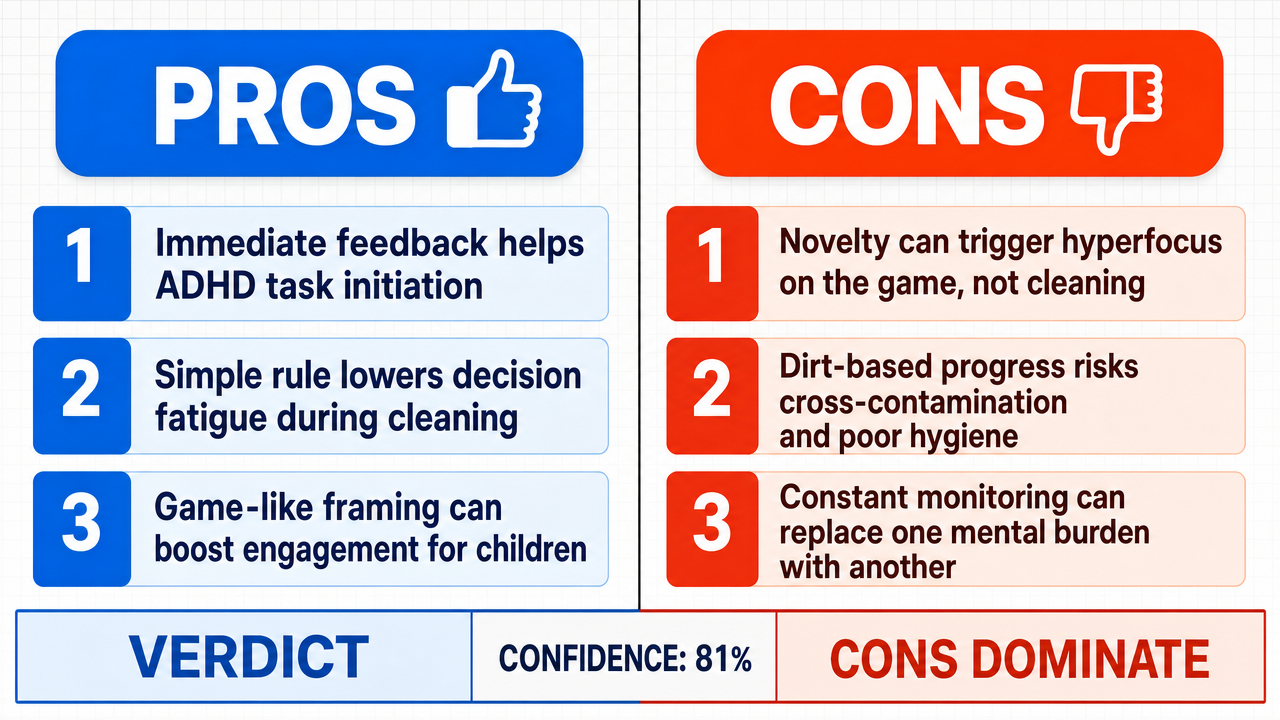
Verdict
Verdict: likely FALSE (81%)
This section provides a brief overview of the key arguments. You do not need to read the full detailed report below.
✅ Key PRO arguments:
- ■The Dirty Rag Challenge directly addresses core executive function deficits in ADHD by providing immediate, tangible feedback and breaking tasks into manageable, game-like segments, leveraging the ADHD brain's preference for novelty and immediate gratification.
- ■For children, the challenge transforms a monotonous cleaning task into an engaging scavenger hunt, significantly boosting compliance and turning a chore into a stimulating activity.
- ■The method reduces cognitive load by externalizing the 'what next' decision into a simple, actionable rule, countering the planning paralysis that often prevents cleaning altogether.
❌ Key ANTI arguments:
- ■For individuals with ADHD , the challenge's reliance on novelty-seeking behavior risks inducing maladaptive hyperfocus on the game's mechanics rather than the actual cleaning task, leading to task-switching failures.
- ■The methodology is hygienically unsound because a metric based on 'rag dirtiness' prioritizes the collection of visible grime over systematic sanitation, increasing the risk of cross-contamination .
- ■The challenge does not reduce cognitive load but merely shifts the burden from 'planning' to 'monitoring and constant re-evaluation,' introducing a new high-frequency stimulus that can trigger rapid distraction.
💭 Conclusion: False. The Dirty Rag Challenge is not an effective or motivating cleaning method because its core mechanic—prioritizing the collection of visible grime on a rag—introduces hygienic risks through potential cross-contamination rather than systematic sanitation. For individuals with ADHD , the novelty-driven framework risks inducing maladaptive hyperfocus on the game's mechanics rather than the cleaning objective, and shifts cognitive load from planning to constant monitoring, which can worsen executive dysfunction . The method also fails to provide the structured routine that ADHD populations typically require for sustained task completion. While the pro side argued that the challenge gamifies cleaning and boosts engagement, the anti side convincingly demonstrated that these motivational benefits are outweighed by the unsound hygiene premise and the risk of distraction. The judge assigned 81% confidence to the FALSE verdict, reflecting strong agreement that the challenge's design flaws undermine its claimed effectiveness across all three sub-claims (general cleaning, ADHD populations, and children).
🔬 DeepResearch Result: likely FALSE ❌ (81%)
Assertion: The 'Dirty Rag Challenge' is an effective and motivating method for cleaning homes, particularly for individuals with ADHD or for engaging children in cleaning tasks.
Participating models: deepseek-v3.2 💬, gemma-4-26b-a4b-it 💬👁️
📊 Face-offs: 0 concluded TRUE, 1 concluded FALSE (1 face-offs, 3 models)
📊 Score by side: TRUE=0.00, FALSE=0.81
🏅 Model score changes:
minimax-m3 💬👁️: +8
✅ PRO Arguments:
- ■The Dirty Rag Challenge directly addresses core executive function deficits in ADHD by providing immediate, tangible feedback and breaking tasks into manageable, game-like segments, leveraging the ADHD brain's preference for novelty and immediate gratification. deepseek-v3.2 💬
- ■For children, the challenge transforms a monotonous cleaning task into an engaging scavenger hunt, significantly boosting compliance and turning a chore into a stimulating activity. deepseek-v3.2 💬
- ■The method reduces cognitive load by externalizing the 'what next' decision into a simple, actionable rule, countering the planning paralysis that often prevents cleaning altogether. deepseek-v3.2 💬
- ■The challenge is a motivational framework for task initiation and engagement, not a replacement for basic cleaning technique; users still wipe surfaces with cleaning solution while the 'dirtiest rag' metric provides focus. deepseek-v3.2 💬
- ■By transforming cleaning into a challenge with a clear, visual goal (finding the dirtiest rag), the method creates a dopamine -releasing reward loop that sustains engagement. deepseek-v3.2 💬
❌ ANTI Arguments:
- ■For individuals with ADHD, the challenge's reliance on novelty-seeking behavior risks inducing maladaptive hyperfocus on the game's mechanics rather than the actual cleaning task, leading to task-switching failures. gemma-4-26b-a4b-it 💬👁️
- ■The methodology is hygienically unsound because a metric based on 'rag dirtiness' prioritizes the collection of visible grime over systematic sanitation, increasing the risk of cross-contamination . gemma-4-26b-a4b-it 💬👁️
- ■The challenge does not reduce cognitive load but merely shifts the burden from 'planning' to 'monitoring and constant re-evaluation,' introducing a new high-frequency stimulus that can trigger rapid distraction. gemma-4-26b-a4b-it 💬👁️
- ■The single heuristic of rag dirtiness replaces structured routine with instability, potentially worsening executive dysfunction rather than mitigating it. gemma-4-26b-a4b-it 💬👁️
- ■The challenge's goal of optimizing for visible grime is fundamentally counterproductive to hygiene, as it encourages redistribution of concentrated filth rather than removal. gemma-4-26b-a4b-it 💬👁️
💭 Reasoning: False. The Dirty Rag Challenge is not an effective or motivating cleaning method because its core mechanic—prioritizing the collection of visible grime on a rag—introduces hygienic risks through potential cross-contamination rather than systematic sanitation. For individuals with ADHD, the novelty-driven framework risks inducing maladaptive hyperfocus on the game's mechanics rather than the cleaning objective, and shifts cognitive load from planning to constant monitoring, which can worsen executive dysfunction. The method also fails to provide the structured routine that ADHD populations typically require for sustained task completion. While the pro side argued that the challenge gamifies cleaning and boosts engagement, the anti side convincingly demonstrated that these motivational benefits are outweighed by the unsound hygiene premise and the risk of distraction. The judge assigned 81% confidence to the FALSE verdict, reflecting strong agreement that the challenge's design flaws undermine its claimed effectiveness across all three sub-claims (general cleaning, ADHD populations, and children).
📋 PRO Facts:
• Individuals with ADHD often struggle with task initiation, sustained attention , and working memory , making traditional cleaning routines daunting.
• The ADHD brain shows a documented preference for novelty and immediate gratification, which game-like challenges can leverage.
• Breaking tasks into manageable, game-like segments is a recognized strategy for addressing executive function deficits.
📋 ANTI Facts:
• In ADHD populations, novelty-seeking behavior can trigger maladaptive hyperfocus on the wrong stimuli rather than the task objective.
• A cleaning metric based on rag dirtiness prioritizes visible grime collection over systematic sanitation, increasing cross-contamination risk.
• Replacing complex planning with a single heuristic shifts cognitive burden from planning to high-frequency monitoring and re-evaluation.
| Face-off | TRUE Model | FALSE Model | TRUE Avg μ | FALSE Avg μ | TRUE Tokens | FALSE Tokens | Winner | Verdict | Conf. |
|---|---|---|---|---|---|---|---|---|---|
| #1 | deepseek-v3.2 💬 | gemma-4-26b-a4b-it 💬👁️ | 0.347 | 0.311 | 12 | 3 | TRUE | FALSE | 81% |
The following technical terms, abbreviations, and domain-specific concepts are referenced throughout this debate transcript. Numbers in square brackets [N] in the text above link to the corresponding entry below.
[1] ADHD — Attention Deficit Hyperactivity Disorder — A neurodevelopmental condition referenced throughout the debate as the primary population for whom the cleaning method is proposed; characterized in the transcript by deficits in task initiation, sustained attention, and working memory.
[2] Behavioral interventions — Structured approaches used to modify behavior, cited in the affirmative argument as research-supported methods that improve task engagement for individuals with ADHD.
[3] Cognitive load — The amount of mental effort required to process information and complete tasks; the debate disputes whether the challenge reduces or merely shifts this burden.
[4] Cognitive scaffolding — Temporary support structures that help build skills or sustain task performance; the negative side argues the challenge fails to develop this for non-novel tasks.
[5] Cross-contamination — The transfer of contaminants from one surface or item to another; cited by the negative side as a hygienic risk of using a single rag across multiple surfaces.
[6] Dopamine — A neurotransmitter associated with reward and motivation; referenced in the debate as the chemical driver behind the proposed reward loop for ADHD individuals.
[7] Dopamine-releasing reward loop — A cyclical pattern in which dopamine release reinforces engagement with an activity; the affirmative argues the challenge creates this, while the negative disputes its stability.
[8] Executive dysfunction — Impairment in executive functions such as planning, task initiation, and working memory; central to the debate over whether the challenge helps or harms ADHD users.
[9] Executive function — Cognitive processes including task initiation, sustained attention, and working memory; described in the affirmative as deficits the challenge aims to address.
[10] Gamification — The application of game-like elements such as challenges, scores, or rewards to non-game activities; cited as a mechanism to improve task engagement.
[11] Goal displacement — A phenomenon in which the means or metric of a task becomes prioritized over the actual objective; raised by the negative as a risk of focusing on rag dirtiness rather than cleanliness.
[12] Heuristic — A simplified rule or mental shortcut used for decision-making; the negative side characterizes the 'rag dirtiness' metric as a single heuristic replacing complex planning.
[13] Hyperfocus — Intense, sustained concentration on a specific stimulus; the negative side argues the challenge can trigger maladaptive hyperfocus on the game rather than the cleaning task.
[14] Maladaptive — Describing a behavior or response that is counterproductive or poorly suited to the situation; used to characterize hyperfocus on game mechanics.
[15] Motivational scaffold — A support structure that helps initiate and maintain engagement with a task; the affirmative argues the challenge serves this function for users who would otherwise not clean.
[16] Neurodivergent — Describing individuals whose neurological development differs from typical patterns, including those with ADHD; used to describe the target population.
[17] Novelty-seeking behavior — The tendency to pursue new or unfamiliar stimuli; described as a characteristic of ADHD brains that the challenge leverages, but which the negative argues is unstable.
[18] Pediatric — Relating to the care or development of children; used to describe the second target population for the cleaning method.
[19] Planning paralysis — The inability to initiate planning or action due to overwhelm; cited as a barrier the challenge aims to counter by externalizing decisions.
[20] Reward loop — A cyclical pattern in which a reward reinforces a behavior, encouraging its repetition; discussed as the motivational mechanism of the challenge.
[21] Sustained attention — The ability to maintain focus on a task over time; identified as an executive function deficit in ADHD.
[22] Task initiation — The ability to begin a task; identified as an executive function deficit in ADHD that the challenge aims to address.
[23] Task switching — Shifting attention between different tasks; discussed as a failure mode in ADHD, with the negative arguing the challenge increases it.
[24] Working memory — The cognitive system for temporarily holding and manipulating information; identified as an executive function deficit in ADHD.
Face-off transcripts
- ■
Ownership & Trade Secrets. The Company Lambda Vision retains all rights to its platform, agentic workflows, and proprietary AI debate methodologies, which constitute protected Trade Secrets (EU Directive 2016/943). Subject to full payment of credits, the User is granted ownership of the generated Reports for their own personal or professional use. Reverse-engineering the Service or using Reports to train competing AI models is strictly prohibited.
- ■
No Professional Advice. Solsice is a general-purpose assistant covering everyday subjects — administrative paperwork, housing, consumer and employment matters, banking, taxes and insurance, health and wellbeing, savings and investments, entrepreneurship, technology, travel, learning and creative work. Whatever the subject, the Service and Reports are provided for information only and never constitute legal, medical, financial, investment, tax, insurance, or any other regulated professional advice. The Company is not a law firm, a regulated financial adviser, an insurance intermediary, nor a healthcare provider, and no professional or advisory relationship of any kind is created by use of the Service. Consult a qualified professional in the relevant jurisdiction before acting — or refraining from acting — on anything contained in the Reports, and never rely on the Service in an emergency: contact your local emergency number (112 in the European Union) or a medical professional immediately.
- ■
AI-Generated Content, Sources and Viewpoints. Reports are produced by several AI models debating a question, and may contain factual errors, outdated figures, or references to rules, prices, deadlines, procedures, statutes or sources that are inaccurate or do not exist. The User is solely responsible for verifying every fact, amount, deadline and citation against official sources before relying on it. Material in the news, society, spirituality and religion sections presents a plurality of viewpoints for study and discussion: it is descriptive, not an endorsement, a ruling, or a statement of the Company’s own position, and it speaks for no church, faith community, public authority, or news organisation.
- ■
Liability & Governing Law. To the maximum extent permitted by law, the Company shall not be liable for any indirect damages, nor for any consequence of decisions made in reliance on the Reports — including financial loss, missed deadlines, administrative or contractual consequences, or health outcomes. These Terms are governed by French law. Any disputes shall be subject to the exclusive jurisdiction of the Courts of Paris, France.