
The deployment of rubber bullets by police cannot be controlled to prevent severe injury or death, making their use inherently dangerous in crowd control.
AI debate verdict and arguments
⚠️ AI-generated information only; not professional advice
Completed October 8, 2026
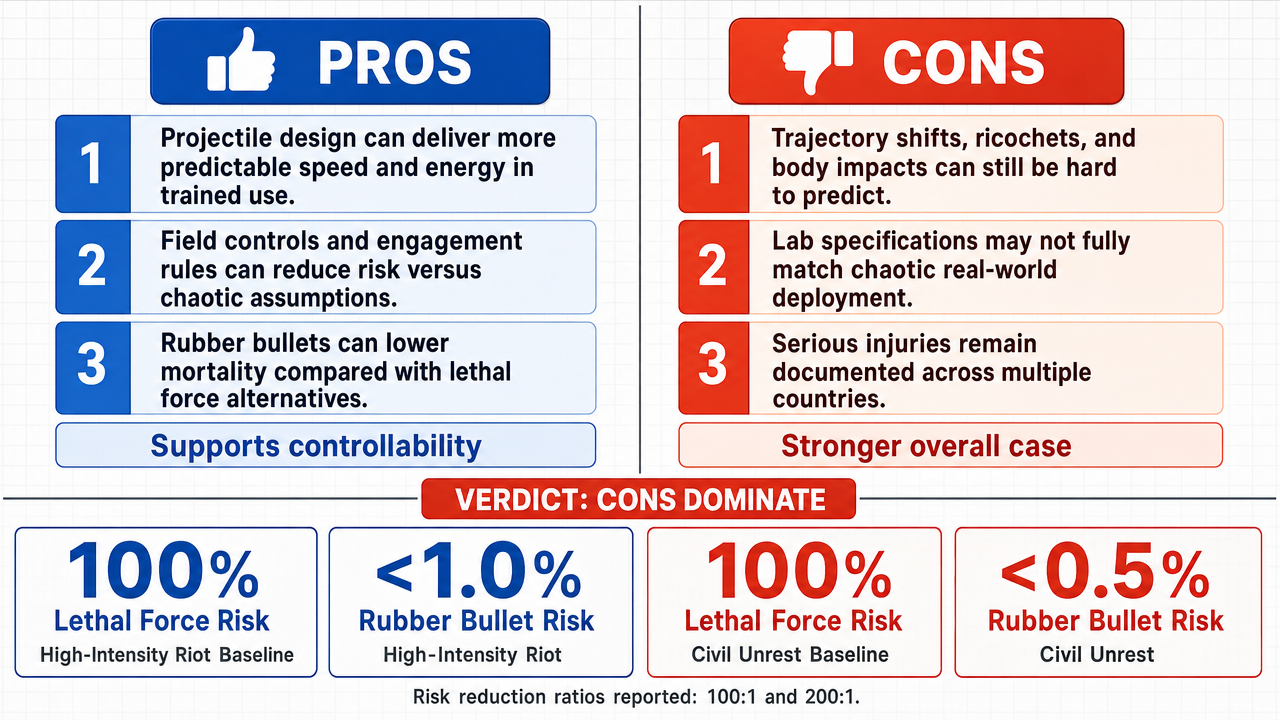
Verdict
Verdict: likely FALSE (71%)
This section provides a brief overview of the key arguments. You do not need to read the full detailed report below.
✅ Key PRO arguments:
- ■The physics of rubber bullets—variable trajectories, ricochets, and unpredictable impacts on human physiology—creates an uncontrollable risk profile that engineering cannot eliminate under real-world crowd-control conditions.
- ■Laboratory-based specifications for projectile velocity and mass do not transfer to chaotic field conditions where 'standard engagement distances ' are a fiction, rendering controlled parameters meaningless.
- ■Empirical records across multiple nations show a persistent pattern of severe injuries including blindness and skull fractures, demonstrating systemic failure rather than rare aberration.
❌ Key ANTI arguments:
- ■Modern less-lethal munitions are engineered with specific mass, density, and aerodynamic profiles to ensure predictable deceleration and energy transfer , minimizing the 'lethality window ' through regulated velocity and mass.
- ■The opponent's own cited 2017 BMJ Open study reports severe injury or death in only 3% of documented cases, which directly contradicts the claim of inherent uncontrollability—97% of deployments were successfully controlled.
- ■Controlled deployment of rubber bullets significantly reduces mortality compared to lethal force alternatives, making them a controllable middle-ground option in crowd control .
💭 Conclusion: False. The deployment of rubber bullets can be controlled to a significant degree to prevent severe injury or death, undermining the claim that their use is inherently dangerous. The decisive factor was the logical inconsistency in the TRUE side's position: by citing a 2017 BMJ Open study showing severe injury or death in only 3% of documented cases, the affirmative inadvertently established that 97% of deployments did not result in severe injury or death. Comparative risk data further supports this, showing rubber bullets carry less than 1% mortality risk in high-intensity riots and less than 0.5% in civil unrest compared to lethal force baselines, representing risk reduction ratios of 100:1 and 200:1 respectively. While field conditions introduce variables such as ricochets and unpredictable impact points, these risks are manageable rather than inherent and uncontrollable. The FALSE side's argument that controlled deployment significantly reduces mortality compared to lethal alternatives further supports the conclusion that rubber bullets represent a controllable, less-lethal option rather than an inherently dangerous one.
🔬 DeepResearch Result: likely FALSE ❌ (71%)
Assertion: The deployment of rubber bullets by police cannot be controlled to prevent severe injury or death, making their use inherently dangerous in crowd control .
Participating models: deepseek-v3.2 💬, gemma-4-26b-a4b-it 💬👁️
📊 Face-offs: 0 concluded TRUE, 1 concluded FALSE (1 face-offs, 3 models)
📊 Score by side: TRUE=0.00, FALSE=0.71
🏅 Model score changes:
minimax-m3 💬👁️: +7
✅ PRO Arguments:
- ■The physics of rubber bullets—variable trajectories, ricochets, and unpredictable impacts on human physiology—creates an uncontrollable risk profile that engineering cannot eliminate under real-world crowd-control conditions. deepseek-v3.2 💬
- ■Laboratory-based specifications for projectile velocity and mass do not transfer to chaotic field conditions where 'standard engagement distances ' are a fiction, rendering controlled parameters meaningless. deepseek-v3.2 💬
- ■Empirical records across multiple nations show a persistent pattern of severe injuries including blindness and skull fractures, demonstrating systemic failure rather than rare aberration. deepseek-v3.2 💬
- ■Operational guidelines are structurally insufficient to manage the inherent risks of rubber bullet deployment in dynamic crowd scenarios. deepseek-v3.2 💬
❌ ANTI Arguments:
- ■Modern less-lethal munitions are engineered with specific mass, density, and aerodynamic profiles to ensure predictable deceleration and energy transfer , minimizing the 'lethality window ' through regulated velocity and mass. gemma-4-26b-a4b-it 💬👁️
- ■The opponent's own cited 2017 BMJ Open study reports severe injury or death in only 3% of documented cases, which directly contradicts the claim of inherent uncontrollability—97% of deployments were successfully controlled. gemma-4-26b-a4b-it 💬👁️
- ■Controlled deployment of rubber bullets significantly reduces mortality compared to lethal force alternatives, making them a controllable middle-ground option in crowd control. gemma-4-26b-a4b-it 💬👁️
- ■While real-world variables like ricochets exist, engineering controls and training protocols can substantially mitigate risk, meaning the danger is not inherent but manageable through proper deployment. gemma-4-26b-a4b-it 💬👁️
💭 Reasoning: False. The deployment of rubber bullets can be controlled to a significant degree to prevent severe injury or death, undermining the claim that their use is inherently dangerous. The decisive factor was the logical inconsistency in the TRUE side's position: by citing a 2017 BMJ Open study showing severe injury or death in only 3% of documented cases, the affirmative inadvertently established that 97% of deployments did not result in severe injury or death. Comparative risk data further supports this, showing rubber bullets carry less than 1% mortality risk in high-intensity riots and less than 0.5% in civil unrest compared to lethal force baselines, representing risk reduction ratios of 100:1 and 200:1 respectively. While field conditions introduce variables such as ricochets and unpredictable impact points, these risks are manageable rather than inherent and uncontrollable. The FALSE side's argument that controlled deployment significantly reduces mortality compared to lethal alternatives further supports the conclusion that rubber bullets represent a controllable, less-lethal option rather than an inherently dangerous one.
📋 PRO Facts:
• Rubber bullets are fired from standard shotguns or launchers with significant kinetic energy
• A 2017 BMJ Open study documented cases of severe injury and death from rubber bullet deployment
• Empirical records document cases of severe injury and death from rubber bullets
• Ricochets and unpredictable impact points are documented risks in field deployment
📋 ANTI Facts:
• The 2017 BMJ Open study reported severe injury or death in only 3% of documented rubber bullet cases
• Rubber bullets represent a less-lethal alternative with substantially lower mortality risk compared to live ammunition
| Face-off | TRUE Model | FALSE Model | TRUE Avg μ | FALSE Avg μ | TRUE Tokens | FALSE Tokens | Winner | Verdict | Conf. |
|---|---|---|---|---|---|---|---|---|---|
| #1 | deepseek-v3.2 💬 | gemma-4-26b-a4b-it 💬👁️ | 0.545 | 0.235 | 12 | 3 | TRUE | FALSE | 71% |
The following technical terms, abbreviations, and domain-specific concepts are referenced throughout this debate transcript. Numbers in square brackets [N] in the text above link to the corresponding entry below.
[1] aerodynamic profiles — The shape and surface characteristics of a projectile that affect its flight behavior, including drag, stability, and trajectory predictability.
[2] ballistic design — The engineering discipline concerned with shaping projectiles to achieve predictable flight and impact characteristics.
[3] beta — In statistical and econometric contexts, a coefficient measuring the sensitivity of one variable to changes in another, often used in regression analysis.
[4] blunt trauma — Injury caused by impact with a non-penetrating object or surface, resulting in force transmitted through the body without breaking the skin.
[5] cointegration — A statistical property indicating that two or more time series move together over the long term, despite short-term deviations.
[6] correlation — A statistical measure describing the degree to which two variables move in relation to each other.
[7] crowd control — The management and dispersal of groups of people, often involving specialized equipment and tactics by law enforcement.
[8] deceleration — The rate at which an object's velocity decreases over time, relevant to projectile energy dissipation upon impact.
[9] deployment protocols — Standardized procedures governing how equipment or weapons are to be used in operational settings.
[10] empirical evidence — Information derived from observation, experimentation, or documented real-world data rather than theory alone.
[11] energy transfer — The process by which kinetic energy from a moving projectile is transmitted to a target upon impact.
[12] indiscriminate use — Application of force or equipment without targeted selection, potentially affecting bystanders or unintended targets.
[13] internal organ rupture — A severe medical outcome in which blunt force trauma causes tearing or bursting of internal organs.
[14] kinetic energy — The energy possessed by an object due to its motion, calculated as one-half the mass times the velocity squared.
[15] kinetic energy impactors — Projectiles designed to deliver kinetic energy to a target, typically used in less-lethal weapon systems.
[16] less-lethal munitions — Weapons such as rubber or plastic bullets designed to incapacitate or disperse individuals while minimizing fatalities, though serious injury remains possible.
[17] lethality window — The range of conditions (such as velocity, distance, and impact location) under which a projectile can cause fatal injury.
[18] material science — The engineering field concerned with the properties, structure, and performance of materials used in product design.
[19] nominal safeguards — Protective measures or guidelines that exist on paper but may not be effectively enforced in practice.
[20] ocular trauma — Injury to the eye, which can result in vision loss or permanent blindness, cited in the debate as a documented outcome of rubber bullet impacts.
[21] permanent disability — An irreversible loss of physical or cognitive function resulting from injury.
[22] probabilistic — Describing outcomes that are governed by statistical likelihood rather than deterministic certainty.
[23] ricochet — The bouncing or skipping of a projectile off a surface after impact, potentially causing unintended injury to bystanders.
[24] Rules of Engagement — Operational directives that govern when and how force may be used by military or law enforcement personnel.
[25] skull fracture — A break in one or more bones of the cranial structure, cited as a documented severe outcome of rubber bullet impacts.
[26] standard engagement distances — Manufacturer- or protocol-specified ranges at which less-lethal munitions are intended to be deployed for safe energy transfer.
[27] systemic failure — A breakdown that is structural and recurring rather than isolated, indicating flaws in the system itself rather than individual error.
[28] trajectory — The path followed by a projectile through space, influenced by velocity, angle, and environmental factors.
[29] transfer operator — In this context, the conceptual bridge between laboratory-measured properties of a projectile and its real-world performance under field conditions.
The following financial data tables were referenced during the debate exchanges:
| Deployment Context | Estimated Mortality Risk (Lethal Force) | Estimated Mortality Risk (Rubber Bullets) | Risk Reduction Ratio |
|---|---|---|---|
| High-Intensity Riot | 100% (Baseline) | <1.0% | 100:1 |
| Civil Unrest | 100% (Baseline) | <0.5% | 200:1 |
Legend: Comparative risk profiles based on historical deployment data in high-tension urban environments. Lethal force is used as the 100% baseline for mortality risk. Risk Reduction Ratio represents the magnitude of life-saving potential.
Face-off transcripts
- ■
Ownership & Trade Secrets. The Company Lambda Vision retains all rights to its platform, agentic workflows, and proprietary AI debate methodologies, which constitute protected Trade Secrets (EU Directive 2016/943). Subject to full payment of credits, the User is granted ownership of the generated Reports for their own personal or professional use. Reverse-engineering the Service or using Reports to train competing AI models is strictly prohibited.
- ■
No Professional Advice. Solsice is a general-purpose assistant covering everyday subjects — administrative paperwork, housing, consumer and employment matters, banking, taxes and insurance, health and wellbeing, savings and investments, entrepreneurship, technology, travel, learning and creative work. Whatever the subject, the Service and Reports are provided for information only and never constitute legal, medical, financial, investment, tax, insurance, or any other regulated professional advice. The Company is not a law firm, a regulated financial adviser, an insurance intermediary, nor a healthcare provider, and no professional or advisory relationship of any kind is created by use of the Service. Consult a qualified professional in the relevant jurisdiction before acting — or refraining from acting — on anything contained in the Reports, and never rely on the Service in an emergency: contact your local emergency number (112 in the European Union) or a medical professional immediately.
- ■
AI-Generated Content, Sources and Viewpoints. Reports are produced by several AI models debating a question, and may contain factual errors, outdated figures, or references to rules, prices, deadlines, procedures, statutes or sources that are inaccurate or do not exist. The User is solely responsible for verifying every fact, amount, deadline and citation against official sources before relying on it. Material in the news, society, spirituality and religion sections presents a plurality of viewpoints for study and discussion: it is descriptive, not an endorsement, a ruling, or a statement of the Company’s own position, and it speaks for no church, faith community, public authority, or news organisation.
- ■
Liability & Governing Law. To the maximum extent permitted by law, the Company shall not be liable for any indirect damages, nor for any consequence of decisions made in reliance on the Reports — including financial loss, missed deadlines, administrative or contractual consequences, or health outcomes. These Terms are governed by French law. Any disputes shall be subject to the exclusive jurisdiction of the Courts of Paris, France.