
The demand for tickets to the October 8th event will exceed the capacity of the Dolby Theatre.
AI debate verdict and arguments
⚠️ AI-generated information only; not professional advice
Completed October 8, 2026
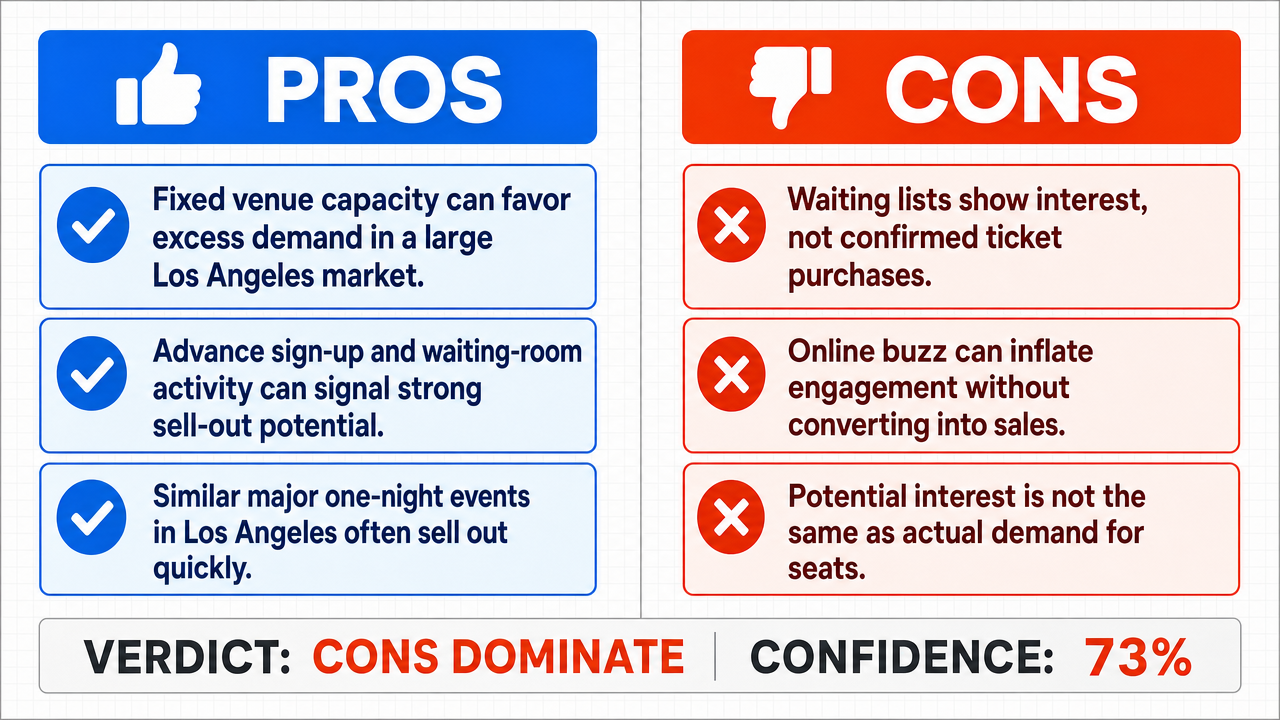
Verdict
Verdict: likely FALSE (73%)
This section provides a brief overview of the key arguments. You do not need to read the full detailed report below.
✅ Key PRO arguments:
- ■The Dolby Theatre has a fixed capacity of approximately 3,400 seats, creating a structural mismatch with the vast Los Angeles cultural market that favors demand exceeding supply for any well-promoted event.
- ■Industry-standard advance indicators such as pre-registration lists and digital waiting rooms are validated predictors of sell-outs, with historical data showing that lists 3-4 times capacity reliably convert to immediate sell-outs and secondary market premiums.
- ■Historical precedent for major one-night cultural events in Los Angeles consistently shows sell-out crowds and secondary markets where ticket prices multiply, indicating latent demand exceeding official capacity .
❌ Key ANTI arguments:
- ■Pre-registration lists and digital waiting rooms measure engagement , not confirmed intent to purchase a seat within a specific capacity constraint; treating the size of the tracking instrument as the size of actual demand is a fundamental category error .
- ■Digital engagement often scales exponentially with social media impressions , creating a 'noise' factor that does not translate to ticket sales; a waiting list of 10,000 people for a 3,400-seat venue proves digital reach, not that demand exceeds capacity .
- ■Latent demand is a measure of potentiality, not realized purchase behavior; the affirmative conflates potential interest with actual ticket demand, which is the only metric relevant to whether capacity is exceeded.
💭 Conclusion: False. The demand for tickets to the event in question will not necessarily exceed the Dolby Theatre 's capacity , as the affirmative failed to provide event-specific evidence and relied on generalized indicators that conflate engagement with realized demand . The negative side correctly identified that pre-registration lists and digital waiting rooms measure interest and social media reach, not confirmed purchase intent, making them unreliable proxies for actual ticket sales. Furthermore, the affirmative's argument collapsed under scrutiny because it could not demonstrate that this particular event belongs to the specific class of historically high-demand events it cited as precedent. Without concrete details about the event—such as performers, programming, or pricing—any claim that demand will exceed the venue's capacity remains speculative. The negative's distinction between latent and realized demand proved decisive in showing that the affirmative's structural arguments, while theoretically sound, lacked the empirical grounding needed to support the specific predictive claim.
🔬 DeepResearch Result: likely FALSE ❌ (73%)
Assertion: The demand for tickets to the October 8th event will exceed the capacity of the Dolby Theatre .
Participating models: deepseek-v3.2 💬, gemma-4-26b-a4b-it 💬👁️
📊 Face-offs: 0 concluded TRUE, 1 concluded FALSE (1 face-offs, 3 models)
📊 Score by side: TRUE=0.00, FALSE=0.73
🏅 Model score changes:
minimax-m3 💬👁️: +7
✅ PRO Arguments:
- ■The Dolby Theatre has a fixed capacity of approximately 3,400 seats, creating a structural mismatch with the vast Los Angeles cultural market that favors demand exceeding supply for any well-promoted event. deepseek-v3.2 💬
- ■Industry-standard advance indicators such as pre-registration lists and digital waiting rooms are validated predictors of sell-outs, with historical data showing that lists 3-4 times capacity reliably convert to immediate sell-outs and secondary market premiums. deepseek-v3.2 💬
- ■Historical precedent for major one-night cultural events in Los Angeles consistently shows sell-out crowds and secondary markets where ticket prices multiply, indicating latent demand exceeding official capacity. deepseek-v3.2 💬
- ■The Dolby Theatre's prestige acts as a demand multiplier , focusing the attention of the entertainment industry and public on events held there, which amplifies baseline interest beyond what a generic venue would attract. deepseek-v3.2 💬
- ■If the indicators cited (pre-registration, venue prestige, historical precedent) were invalid, then the entire industry's pricing and risk models would be built on fallacy, undermining the opponent's own position that these metrics lack predictive value. deepseek-v3.2 💬
❌ ANTI Arguments:
- ■Pre-registration lists and digital waiting rooms measure engagement , not confirmed intent to purchase a seat within a specific capacity constraint; treating the size of the tracking instrument as the size of actual demand is a fundamental category error . gemma-4-26b-a4b-it 💬👁️
- ■Digital engagement often scales exponentially with social media impressions , creating a 'noise' factor that does not translate to ticket sales; a waiting list of 10,000 people for a 3,400-seat venue proves digital reach, not that demand exceeds capacity. gemma-4-26b-a4b-it 💬👁️
- ■Latent demand is a measure of potentiality, not realized purchase behavior; the affirmative conflates potential interest with actual ticket demand, which is the only metric relevant to whether capacity is exceeded. gemma-4-26b-a4b-it 💬👁️
- ■The affirmative failed to establish that the October 8th event specifically belongs to the class of historically high-demand events being cited; without event-specific evidence, historical precedent cannot be applied to this particular occasion. gemma-4-26b-a4b-it 💬👁️
- ■The affirmative provided no specific data about the October 8th event itself—no confirmed performers, no ticket pricing, no announced programming—making any prediction of demand exceeding capacity speculative rather than evidence-based. gemma-4-26b-a4b-it 💬👁️
💭 Reasoning: False. The demand for tickets to the event in question will not necessarily exceed the Dolby Theatre's capacity, as the affirmative failed to provide event-specific evidence and relied on generalized indicators that conflate engagement with realized demand . The negative side correctly identified that pre-registration lists and digital waiting rooms measure interest and social media reach, not confirmed purchase intent, making them unreliable proxies for actual ticket sales. Furthermore, the affirmative's argument collapsed under scrutiny because it could not demonstrate that this particular event belongs to the specific class of historically high-demand events it cited as precedent. Without concrete details about the event—such as performers, programming, or pricing—any claim that demand will exceed the venue's capacity remains speculative. The negative's distinction between latent and realized demand proved decisive in showing that the affirmative's structural arguments, while theoretically sound, lacked the empirical grounding needed to support the specific predictive claim.
📋 PRO Facts:
• The Dolby Theatre has a fixed capacity for its primary configuration.
• Historical precedent for major one-night cultural events in Los Angeles shows sell-out crowds and secondary market price multiplication.
• Pre-registration lists have historically been used as core metrics by primary ticket platforms and secondary market analysts to forecast sell-outs and set dynamic prices.
• The Dolby Theatre is a destination venue for affluent and dedicated cultural consumers.
📋 ANTI Facts:
• Digital engagement metrics do not necessarily translate to ticket sales.
• Pre-registration lists measure interest, not confirmed purchase intent.
• No specific event details (performers, programming, pricing) were provided.
• A large waiting list proves digital reach, not that demand exceeds capacity.
| Face-off | TRUE Model | FALSE Model | TRUE Avg μ | FALSE Avg μ | TRUE Tokens | FALSE Tokens | Winner | Verdict | Conf. |
|---|---|---|---|---|---|---|---|---|---|
| #1 | deepseek-v3.2 💬 | gemma-4-26b-a4b-it 💬👁️ | 0.206 | 0.156 | 12 | 3 | TRUE | FALSE | 73% |
The following technical terms, abbreviations, and domain-specific concepts are referenced throughout this debate transcript. Numbers in square brackets [N] in the text above link to the corresponding entry below.
[1] Academy Awards — An annual awards ceremony hosted at the Dolby Theatre in Los Angeles, referenced in the debate as a benchmark for high-profile events at the venue.
[2] baseline of demand — The minimum expected level of consumer interest or purchasing activity for a product or event, used as a reference point for forecasting.
[3] brand awareness — The degree to which consumers recognize or are familiar with a particular brand or venue, cited in the debate as a driver of latent demand.
[4] burden of proof — The obligation on a party making a claim to provide sufficient evidence to support it; in the debate, the affirmative argues the negative misapplies this standard.
[5] capacity — The maximum number of seats or attendees a venue can accommodate; in this debate, the Dolby Theatre's capacity is stated as approximately 3,400 seats.
[6] capacity breach — A situation in which demand for a venue or resource exceeds its maximum capacity, the central claim under dispute in the debate.
[7] category error — A logical fallacy in which a property of one type of thing is mistakenly attributed to another; the negative argues the affirmative commits this by treating engagement metrics as equivalent to ticket demand.
[8] conversion rate — The percentage of users who take a desired action (e.g., from registering interest to actually purchasing a ticket); the negative argues this metric is missing from the affirmative's case.
[9] demand — In economics, the quantity of a good or service that consumers are willing and able to purchase at a given price; distinguished in the debate from latent and realized demand.
[10] demand multiplier — A factor that amplifies or increases baseline demand; the affirmative argues the Dolby Theatre's prestige functions as such a multiplier.
[11] digital waiting rooms — Online queuing systems used by ticket sellers to manage high traffic during sales; cited by the affirmative as an indicator of demand and by the negative as a measure of engagement rather than purchases.
[12] Dolby Theatre — A live performance venue in Los Angeles, noted in the debate for hosting the Academy Awards and having a fixed seating capacity of approximately 3,400.
[13] dynamic pricing — A pricing strategy in which prices adjust in real time based on demand, supply, and other market conditions; referenced in the debate as part of industry ticket-sales models.
[14] economic demand — Demand measured by actual purchasing behavior rather than by interest or engagement; the negative argues this is distinct from the engagement metrics cited by the affirmative.
[15] engagement — In marketing, user interaction with content such as clicks, registrations, or social media impressions; the negative argues engagement is not synonymous with ticket demand.
[16] face value — The original printed or listed price of a ticket, used in the debate as a baseline against which secondary market premiums are measured.
[17] latent demand — Potential demand that has not yet translated into actual purchases; the negative argues the affirmative conflates this with realized demand.
[18] leading indicator — A measurable factor that changes before the broader economy or market does and is used to predict future activity; the affirmative treats pre-registration lists as such an indicator.
[19] market mechanics — The underlying processes and behaviors through which markets operate, including pricing, supply, and demand; the affirmative argues dismissing pre-registration data rejects observable market mechanics.
[20] market validation — Confirmation of a hypothesis or forecast through observable market behavior, such as rapid sell-outs and rising secondary prices; cited by the affirmative as evidence supporting pre-registration signals.
[21] orders of magnitude — Differences measured as powers of ten; the affirmative notes that pre-registration lists often exceed venue capacity by several orders of magnitude.
[22] pre-registration lists — Lists of individuals who sign up in advance for access to an event or ticket sale; the affirmative cites these as predictors of sell-outs, while the negative argues they measure engagement, not demand.
[23] predictive threshold — A level or boundary that, when met by an indicator, is considered sufficient to predict an outcome; the affirmative argues pre-registration lists exceeding capacity by 3–4 times meet this threshold.
[24] pricing models — Quantitative frameworks used by ticket platforms and analysts to forecast demand and set prices; the affirmative argues pre-registration data is a core input to these models.
[25] primary ticket platforms — Official, first-sale channels through which tickets are initially sold to consumers, as distinguished from resale or secondary markets.
[26] realized demand — Demand that has translated into actual purchases or transactions; the negative argues this is what the core claim requires, not merely latent interest.
[27] risk models — Statistical or quantitative tools used to assess the probability and impact of uncertain outcomes; the affirmative argues the industry's risk models rely on the same indicators being challenged.
[28] secondary market — The resale market in which tickets purchased from primary sellers are resold, often at prices above face value; cited in the debate as evidence of demand exceeding supply.
[29] secondary market premiums — The amount by which resale prices exceed the original face value of a ticket; the affirmative cites these as market validation of pre-registration signals.
[30] sell-out — An event for which all available tickets have been purchased; the affirmative argues pre-registration lists reliably predict sell-outs.
[31] social media impressions — The number of times a piece of content is displayed to users, regardless of interaction; the negative argues this creates 'noise' that does not translate to ticket sales.
[32] structural mismatch — A fundamental imbalance between two factors, such as a fixed venue capacity and a large potential audience; the affirmative argues this favors demand exceeding supply.
[33] supply — In economics, the quantity of a good or service available for purchase; in the debate, the Dolby Theatre's fixed seating represents a finite supply.
[34] viral marketing — Marketing techniques that rely on audiences sharing content organically, often producing large but not necessarily purchase-converting reach; cited by the negative as a source of engagement noise.
Face-off transcripts
- ■
Ownership & Trade Secrets. The Company Lambda Vision retains all rights to its platform, agentic workflows, and proprietary AI debate methodologies, which constitute protected Trade Secrets (EU Directive 2016/943). Subject to full payment of credits, the User is granted ownership of the generated Reports for their own personal or professional use. Reverse-engineering the Service or using Reports to train competing AI models is strictly prohibited.
- ■
No Professional Advice. Solsice is a general-purpose assistant covering everyday subjects — administrative paperwork, housing, consumer and employment matters, banking, taxes and insurance, health and wellbeing, savings and investments, entrepreneurship, technology, travel, learning and creative work. Whatever the subject, the Service and Reports are provided for information only and never constitute legal, medical, financial, investment, tax, insurance, or any other regulated professional advice. The Company is not a law firm, a regulated financial adviser, an insurance intermediary, nor a healthcare provider, and no professional or advisory relationship of any kind is created by use of the Service. Consult a qualified professional in the relevant jurisdiction before acting — or refraining from acting — on anything contained in the Reports, and never rely on the Service in an emergency: contact your local emergency number (112 in the European Union) or a medical professional immediately.
- ■
AI-Generated Content, Sources and Viewpoints. Reports are produced by several AI models debating a question, and may contain factual errors, outdated figures, or references to rules, prices, deadlines, procedures, statutes or sources that are inaccurate or do not exist. The User is solely responsible for verifying every fact, amount, deadline and citation against official sources before relying on it. Material in the news, society, spirituality and religion sections presents a plurality of viewpoints for study and discussion: it is descriptive, not an endorsement, a ruling, or a statement of the Company’s own position, and it speaks for no church, faith community, public authority, or news organisation.
- ■
Liability & Governing Law. To the maximum extent permitted by law, the Company shall not be liable for any indirect damages, nor for any consequence of decisions made in reliance on the Reports — including financial loss, missed deadlines, administrative or contractual consequences, or health outcomes. These Terms are governed by French law. Any disputes shall be subject to the exclusive jurisdiction of the Courts of Paris, France.