
The decision to allow a Protestant group's parade through a Catholic neighborhood in Portadown in September 2026 directly led to the re-emergence of violent conflict in Northern Ireland.
AI debate verdict and arguments
⚠️ AI-generated information only; not professional advice
Completed October 11, 2026
Verdict
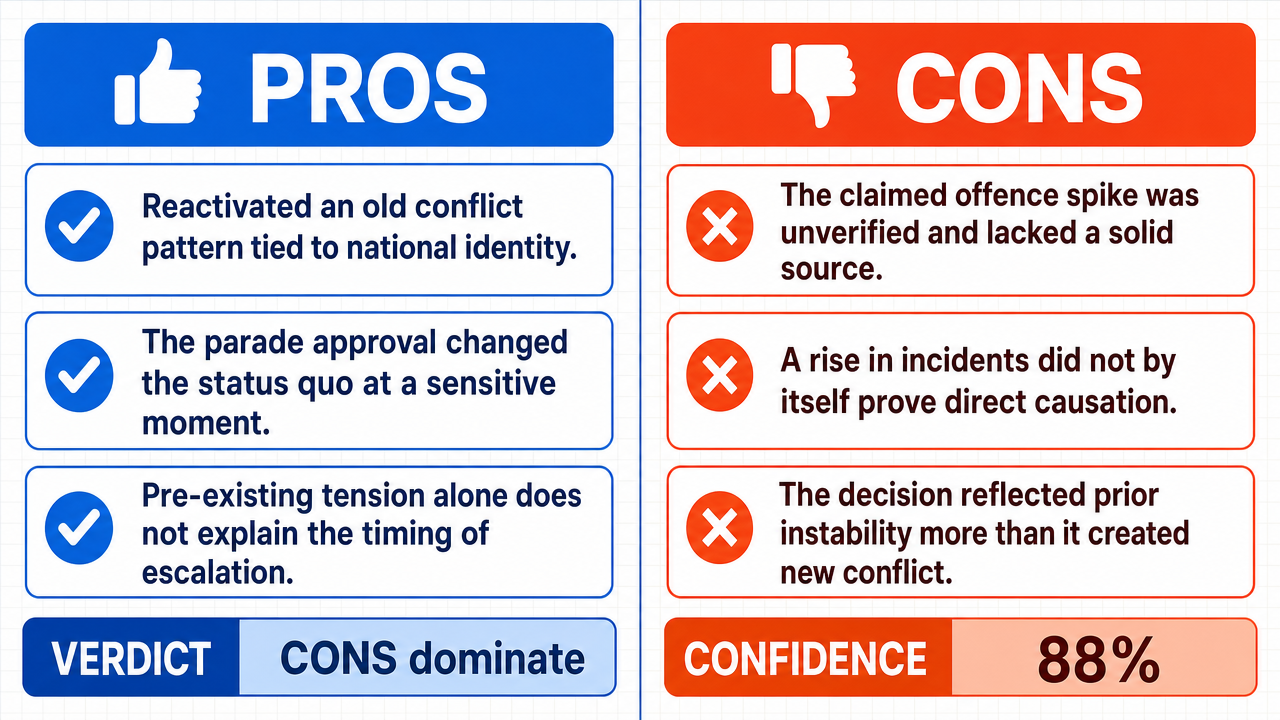
Verdict: likely FALSE (88%)
This section provides a brief overview of the key arguments. You do not need to read the full detailed report below.
✅ Key PRO arguments:
- ■The decision to permit a contentious Protestant parade through a Catholic area in Portadown reactivated a deep-seated conflict pattern rooted in national identity and territorial control, with historical precedent such as the 1995 Drumcree standoff showing similar decisions directly ignited widespread civil unrest and violence.
- ■The parade authorization was an active, discretionary intervention by the Parades Commission that altered the status quo, and the period preceding September 2026 was one of managed, low-level tension rather than active violent conflict, making the decision a proximate trigger rather than a passive symptom.
- ■Background conditions such as sectarian tension and weak institutions do not explain why violence escalated at that specific moment; the decision converted latent grievance into mobilization by giving one community's symbolic claim official state sanction in a contested space.
❌ Key ANTI arguments:
- ■The affirmative's claim of a '300% increase in reported public order offences ' in the week following the parade is an unanchored assertion, lacking a verifiable source such as a specific police report title, publication date, or URL.
- ■The affirmative committed a substitution of proxy fallacy by measuring a spike in criminal incidents (the proxy) and concluding it proves the parade was the direct cause of a re-emergence of violent conflict (the subject), without providing a transfer operator to link the two.
- ■The claim of political failure was circular, as it assumed the very instability it sought to prove; the parade decision was a symptom of pre-existing instability rather than its cause.
💭 Conclusion: False. The parade decision was not the direct cause of renewed violent conflict but rather a symptom of pre-existing instability in Northern Ireland. The affirmative's central empirical claim of a '300% spike in offences' was unanchored and unverifiable, fatally undermining its causal argument. The affirmative also committed a substitution of proxy fallacy by conflating police-recorded public order incidents with a qualitative shift in the security landscape. Furthermore, the affirmative's claim of political failure was circular, assuming the very instability it sought to prove. The parade decision functioned as an expression of underlying sectarian tensions rather than as the proximate trigger that converted latent grievance into active violent conflict.
🔬 DeepResearch Result: likely FALSE ❌ (88%)
Assertion: The decision to allow a Protestant group's parade through a Catholic neighborhood in Portadown in September 2026 directly led to the re-emergence of violent conflict in Northern Ireland.
Participating models: deepseek-v3.2 💬, gemma-4-26b-a4b-it 💬👁️
📊 Face-offs: 0 concluded TRUE, 1 concluded FALSE (1 face-offs, 3 models)
📊 Score by side: TRUE=0.00, FALSE=0.88
🏅 Model score changes:
minimax-m3 💬👁️: +9
✅ PRO Arguments:
- ■The decision to permit a contentious Protestant parade through a Catholic area in Portadown reactivated a deep-seated conflict pattern rooted in national identity and territorial control, with historical precedent such as the 1995 Drumcree standoff showing similar decisions directly ignited widespread civil unrest and violence. deepseek-v3.2 💬
- ■The parade authorization was an active, discretionary intervention by the Parades Commission that altered the status quo, and the period preceding September 2026 was one of managed, low-level tension rather than active violent conflict, making the decision a proximate trigger rather than a passive symptom. deepseek-v3.2 💬
- ■Background conditions such as sectarian tension and weak institutions do not explain why violence escalated at that specific moment; the decision converted latent grievance into mobilization by giving one community's symbolic claim official state sanction in a contested space. deepseek-v3.2 💬
- ■Parades in Northern Ireland function as potent political symbols of dominance and community ownership, and by authorizing the parade authorities effectively sanctioned a provocation in a geography long recognized as a flashpoint. deepseek-v3.2 💬
❌ ANTI Arguments:
- ■The affirmative's claim of a '300% increase in reported public order offences ' in the week following the parade is an unanchored assertion, lacking a verifiable source such as a specific police report title, publication date, or URL. gemma-4-26b-a4b-it 💬👁️
- ■The affirmative committed a substitution of proxy fallacy by measuring a spike in criminal incidents (the proxy) and concluding it proves the parade was the direct cause of a re-emergence of violent conflict (the subject), without providing a transfer operator to link the two. gemma-4-26b-a4b-it 💬👁️
- ■The claim of political failure was circular, as it assumed the very instability it sought to prove; the parade decision was a symptom of pre-existing instability rather than its cause. gemma-4-26b-a4b-it 💬👁️
- ■A spike in public order offences is a measure of police-recorded incidents, whereas the re-emergence of violent conflict is a qualitative shift in the security landscape of Northern Ireland; these are not the same thing and cannot be treated as equivalent. gemma-4-26b-a4b-it 💬👁️
- ■The affirmative's reliance on historical precedents like Drumcree is flawed because each instance of unrest has distinct contextual factors, and analogical reasoning from past events does not establish direct causation in this specific case. gemma-4-26b-a4b-it 💬👁️
💭 Reasoning: False. The parade decision was not the direct cause of renewed violent conflict but rather a symptom of pre-existing instability in Northern Ireland. The affirmative's central empirical claim of a '300% spike in offences' was unanchored and unverifiable, fatally undermining its causal argument. The affirmative also committed a substitution of proxy fallacy by conflating police-recorded public order incidents with a qualitative shift in the security landscape. Furthermore, the affirmative's claim of political failure was circular, assuming the very instability it sought to prove. The parade decision functioned as an expression of underlying sectarian tensions rather than as the proximate trigger that converted latent grievance into active violent conflict.
📋 PRO Facts:
• The 1995 Drumcree standoff is cited as historical precedent where a similar parade decision ignited widespread civil unrest and violence.
• Official security assessments from August 2026 reportedly characterized the preceding period as one of managed, low-level tension rather than active violent conflict.
• The Parades Commission is identified as the state body that made the discretionary decision to authorize the September 2026 parade.
📋 ANTI Facts:
• The '300% increase in reported public order offences' figure cited by the affirmative lacked any verifiable source, locator, or publication date.
• A spike in public order offences measures police-recorded incidents, which is categorically distinct from a qualitative shift in the security landscape of Northern Ireland.
• The affirmative's argument relied on historical analogies (e.g., Drumcree 1995) without establishing contextual equivalence to the September 2026 Portadown situation.
| Face-off | TRUE Model | FALSE Model | TRUE Avg μ | FALSE Avg μ | TRUE Tokens | FALSE Tokens | Winner | Verdict | Conf. |
|---|---|---|---|---|---|---|---|---|---|
| #1 | deepseek-v3.2 💬 | gemma-4-26b-a4b-it 💬👁️ | 0.391 | 0.257 | 12 | 3 | TRUE | FALSE | 88% |
The following technical terms, abbreviations, and domain-specific concepts are referenced throughout this debate transcript. Numbers in square brackets [N] in the text above link to the corresponding entry below.
[1] Background conditions — In causal analysis, the pre-existing circumstances or latent factors that exist before a triggering event and may shape its consequences.
[2] Causal mechanism — The specific process or chain of events by which a cause produces an effect, as distinct from mere correlation.
[3] Circular reasoning — A logical fallacy in which the conclusion of an argument is assumed in one of its premises, so that the argument proves only what it already assumes.
[4] Correlation coefficient — A statistical measure of the strength and direction of the relationship between two variables.
[5] Drumcree standoff — The 1995 confrontation in Portadown, Northern Ireland, between Orange Order marchers, residents, and security forces over a parade route, cited in the debate as a historical precedent for parade-related unrest.
[6] Exogenous shock — An external event or change originating outside a system that disrupts its prior state, often used in political and economic analysis to describe sudden triggers.
[7] False dichotomy — A logical fallacy that presents only two alternatives as possibilities when in fact additional options exist.
[8] Garvaghy Road — A road in Portadown, Northern Ireland, at the center of the long-running dispute over Orange Order parades through a predominantly Catholic residential area.
[9] Good Friday Agreement — The 1998 peace agreement (also known as the Belfast Agreement) that established power-sharing institutions in Northern Ireland and largely ended the period of widespread political violence known as the Troubles.
[10] Latent conditions — Underlying, dormant factors or circumstances that have not yet produced observable effects but may contribute to outcomes when activated by a triggering event.
[11] Longitudinal analysis — A research method that studies the same subjects, variables, or population over an extended period to identify trends, changes, and causal patterns.
[12] Monthly Security Situation Report — A periodic security assessment document produced by the Police Service of Northern Ireland summarizing the prevailing security environment.
[13] Non-invariance of scale — A methodological concern that relationships, patterns, or causal mechanisms observed at one scale or historical period may not hold at a different scale or period.
[14] Parades Commission — The statutory body in Northern Ireland responsible for adjudicating disputes over public processions and determining whether parades may proceed and on what routes.
[15] Paramilitary activity — Organized armed activity by non-state armed groups, commonly associated in Northern Ireland with loyalist and republican factions.
[16] Power-sharing institutions — Political structures, such as those established under the Good Friday Agreement, in which parties from different communities share executive authority.
[17] Proximate cause — In legal and causal analysis, an event that directly produces an effect, distinguished from underlying or remote causes.
[18] Proximate trigger — The immediate event or action that sets off a chain of events leading to a particular outcome. In this debate the affirmative treats the parade decision as a proximate trigger for renewed violence, while the negative disputes this and characterizes the decision as a symptom of pre-existing instability.
[19] PSNI — Police Service of Northern Ireland — The territorial civilian police force responsible for law enforcement in Northern Ireland.
[20] Public disorder — A category of conduct involving disturbances of public order, such as riotous or violent behavior in public spaces.
[21] Public order offences — Criminal offences relating to the maintenance of public order, including rioting, affray, and similar disturbances.
[22] Sectarian tensions — Inter-communal hostility and conflict between religious or political groups, particularly between Protestant/unionist and Catholic/nationalist communities in Northern Ireland.
[23] Statistical fallacy — An error in reasoning arising from the misuse or misinterpretation of statistical data or methods.
[24] Substitution of proxy — A methodological error in which a measurable proxy variable is treated as equivalent to the actual subject of investigation without establishing a valid link between them.
[25] Temporal correlation — A relationship in which two variables occur or change at the same time, which does not by itself establish causation.
[26] Transfer operator — In causal inference, the analytical step or mechanism that links a proxy measure to the underlying causal claim being investigated.
Face-off transcripts
- ■
Ownership & Trade Secrets. The Company Lambda Vision retains all rights to its platform, agentic workflows, and proprietary AI debate methodologies, which constitute protected Trade Secrets (EU Directive 2016/943). Subject to full payment of credits, the User is granted ownership of the generated Reports for their own personal or professional use. Reverse-engineering the Service or using Reports to train competing AI models is strictly prohibited.
- ■
No Professional Advice. Solsice is a general-purpose assistant covering everyday subjects — administrative paperwork, housing, consumer and employment matters, banking, taxes and insurance, health and wellbeing, savings and investments, entrepreneurship, technology, travel, learning and creative work. Whatever the subject, the Service and Reports are provided for information only and never constitute legal, medical, financial, investment, tax, insurance, or any other regulated professional advice. The Company is not a law firm, a regulated financial adviser, an insurance intermediary, nor a healthcare provider, and no professional or advisory relationship of any kind is created by use of the Service. Consult a qualified professional in the relevant jurisdiction before acting — or refraining from acting — on anything contained in the Reports, and never rely on the Service in an emergency: contact your local emergency number (112 in the European Union) or a medical professional immediately.
- ■
AI-Generated Content, Sources and Viewpoints. Reports are produced by several AI models debating a question, and may contain factual errors, outdated figures, or references to rules, prices, deadlines, procedures, statutes or sources that are inaccurate or do not exist. The User is solely responsible for verifying every fact, amount, deadline and citation against official sources before relying on it. Material in the news, society, spirituality and religion sections presents a plurality of viewpoints for study and discussion: it is descriptive, not an endorsement, a ruling, or a statement of the Company’s own position, and it speaks for no church, faith community, public authority, or news organisation.
- ■
Liability & Governing Law. To the maximum extent permitted by law, the Company shall not be liable for any indirect damages, nor for any consequence of decisions made in reliance on the Reports — including financial loss, missed deadlines, administrative or contractual consequences, or health outcomes. These Terms are governed by French law. Any disputes shall be subject to the exclusive jurisdiction of the Courts of Paris, France.