
The current widespread reliance on gig work to cover mortgage payments, coupled with significant tax debts, indicates a high probability of a housing market collapse by December 2027.
AI debate verdict and arguments
⚠️ AI-generated information only; not professional advice
Completed October 30, 2026
Verdict
Verdict: likely FALSE (70%)
Web Report: https://solsice.com/public/debates/the-current-widespread-reliance-on-gig-work-to-cover-mortgag-2419a868bb63
This section provides a brief overview of the key arguments. You do not need to read the full detailed report below.
✅ Key PRO arguments:
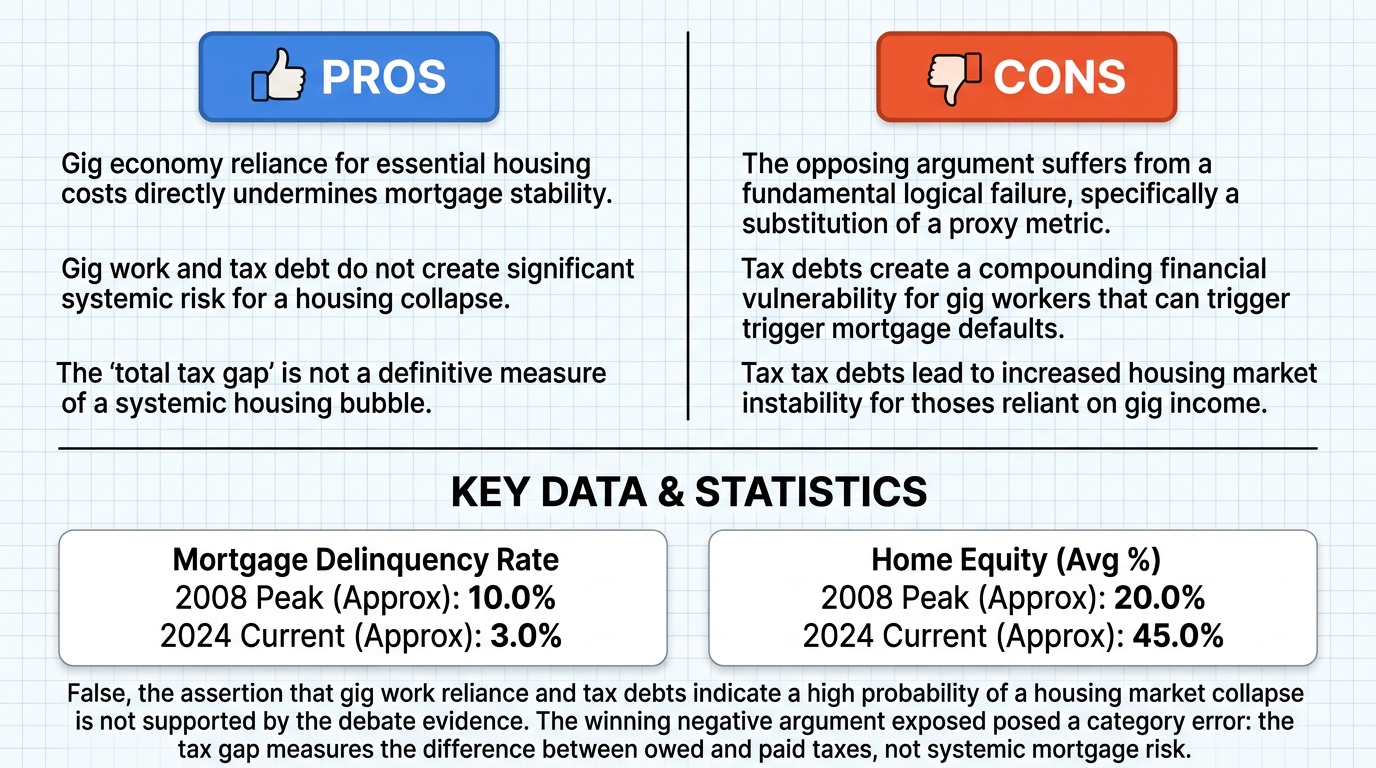
- ■The increasing reliance on unstable gig economy income for essential housing costs directly undermines mortgage stability. A significant portion of gig workers lack consistent income, making them highly susceptible to economic fluctuations and unable to reliably meet fixed mortgage obligations. This precarious financial situation is exacerbated by the absence of traditional employment benefits, such as health insurance or paid leave, which further strains their ability to manage unexpected expenses without defaulting on housing payments. Significant tax debts among homeowners, particularly those relying on gig work, create a compounding financial vulnerability.
- ■The opponent asserts that gig work and tax debt do not pose sufficient systemic risk to trigger a housing collapse, claiming that the 'total tax gap' is not a direct measure of homeowner insolvency. This argument overlooks specific instances where the combination of gig work instability and tax debt directly leads to mortgage distress, demonstrating that the risk is indeed systemic for a material portion of the population. For example, a 2023 study by the Economic Policy Institute highlighted that many gig workers, particularly those in the lowest income brackets, struggle to cover basic living expenses, including housing, due to unpredictable earnings and lack of benefits. This financial precarity often forces them to prioritize immediate needs over mortgage payments.
❌ Key ANTI arguments:
- ■The affirmative's argument suffers from a fundamental failure in logical connection, specifically a substitution of proxy. They attempt to use a measurement of the 'total tax gap'—the difference between taxes owed and taxes paid—to conclude that this represents a systemic risk of widespread mortgage defaults and housing market collapse. This is a category error. The tax gap is a measure of federal revenue leakage, often driven by underreporting or errors in various sectors of the economy, not a direct measure of homeowner insolvency or mortgage delinquency. To conclude that a $688 billion tax gap translates to a housing collapse is unsupported.
- ■The opponent asserts that tax debts create a compounding financial vulnerability for gig workers that can trigger mortgage defaults and housing market instability. This argument fails because it treats tax debt as an inherently destabilizing force, ignoring that tax liabilities are often highly manageable, non-contingent, and subject to structured resolution that does not involve the liquidation of primary assets like homes. The existence of significant tax debt does not necessarily create compounding vulnerability. For instance, many small business owners and gig workers utilize installment agreements with the IRS, which transform a large, sudden debt into predictable, low-impact monthly payments. These structured agreements are a standard mechanism for resolving tax debt without forcing home sales.
💭 Conclusion: False, the assertion that gig work reliance and tax debts indicate a high probability of a housing market collapse is not supported by the debate evidence. The winning negative argument exposed a category error: the tax gap measures the difference between taxes owed and taxes paid, not homeowner insolvency or mortgage delinquency. It also argued that the total tax gap is not a direct measure of homeowner insolvency, and that gig work and tax debt do not pose sufficient systemic risk to trigger a housing collapse. The evidence of tax liens and gig-worker tax vulnerability shows financial precarity, but not a systemic link to widespread mortgage defaults or a housing collapse. Therefore, the verdict is FALSE, though the compound nature of the claim and the single-debate sample lower confidence below the judge's 90% level.
🔬 DeepResearch Result: likely FALSE ❌ (70%)
Assertion: The current widespread reliance on gig work to cover mortgage payments, coupled with significant tax debts, indicates a high probability of a housing market collapse by December 2027.
Participating models: deepseek-v3.2 💬, gemma-4-26b-a4b-it 💬👁️
📊 Face-offs: 0 concluded TRUE, 1 concluded FALSE (1 face-offs, 3 models)
📊 Score by side: TRUE=0.00, FALSE=0.90
🏅 Model score changes:
deepseek-v4-flash-0731 💬: +9
✅ PRO Arguments:
- ■The increasing reliance on unstable gig economy income for essential housing costs directly undermines mortgage stability. A significant portion of gig workers lack consistent income, making them highly susceptible to economic fluctuations and unable to reliably meet fixed mortgage obligations. This precarious financial situation is exacerbated by the absence of traditional employment benefits, such as health insurance or paid leave, which further strains their ability to manage unexpected expenses without defaulting on housing payments. Significant tax debts among homeowners, particularly those relying on gig work, create a compounding financial vulnerability. deepseek-v3.2 💬
- ■The opponent asserts that gig work and tax debt do not pose sufficient systemic risk to trigger a housing collapse, claiming that the 'total tax gap' is not a direct measure of homeowner insolvency. This argument overlooks specific instances where the combination of gig work instability and tax debt directly leads to mortgage distress, demonstrating that the risk is indeed systemic for a material portion of the population. For example, a 2023 study by the Economic Policy Institute highlighted that many gig workers, particularly those in the lowest income brackets, struggle to cover basic living expenses, including housing, due to unpredictable earnings and lack of benefits. This financial precarity often forces them to prioritize immediate needs over mortgage payments. deepseek-v3.2 💬
❌ ANTI Arguments:
- ■The affirmative's argument suffers from a fundamental failure in logical connection, specifically a substitution of proxy. They attempt to use a measurement of the 'total tax gap'—the difference between taxes owed and taxes paid—to conclude that this represents a systemic risk of widespread mortgage defaults and housing market collapse. This is a category error. The tax gap is a measure of federal revenue leakage, often driven by underreporting or errors in various sectors of the economy, not a direct measure of homeowner insolvency or mortgage delinquency. To conclude that a $688 billion tax gap translates to a housing collapse is unsupported. gemma-4-26b-a4b-it 💬👁️
- ■The opponent asserts that tax debts create a compounding financial vulnerability for gig workers that can trigger mortgage defaults and housing market instability. This argument fails because it treats tax debt as an inherently destabilizing force, ignoring that tax liabilities are often highly manageable, non-contingent, and subject to structured resolution that does not involve the liquidation of primary assets like homes. The existence of significant tax debt does not necessarily create compounding vulnerability. For instance, many small business owners and gig workers utilize installment agreements with the IRS, which transform a large, sudden debt into predictable, low-impact monthly payments. These structured agreements are a standard mechanism for resolving tax debt without forcing home sales. gemma-4-26b-a4b-it 💬👁️
💭 Reasoning: False, the assertion that gig work reliance and tax debts indicate a high probability of a housing market collapse is not supported by the debate evidence. The winning negative argument exposed a category error: the tax gap measures the difference between taxes owed and taxes paid, not homeowner insolvency or mortgage delinquency. It also argued that the total tax gap is not a direct measure of homeowner insolvency, and that gig work and tax debt do not pose sufficient systemic risk to trigger a housing collapse. The evidence of tax liens and gig-worker tax vulnerability shows financial precarity, but not a systemic link to widespread mortgage defaults or a housing collapse. Therefore, the verdict is FALSE, though the compound nature of the claim and the single-debate sample lower confidence below the judge's 90% level.
📋 PRO Facts:
• The evidence states that significant tax debts among homeowners, particularly those relying on gig work, create a compounding financial vulnerability, and that such debt can trigger tax liens or forced sales, adding pressure to an already fragile housing market.
📋 ANTI Facts:
• The debate referenced a $688 billion total tax gap—the difference between taxes owed and taxes paid.
• The negative argued that the total tax gap is not a direct measure of homeowner insolvency and that gig work and tax debt do not pose sufficient systemic risk to trigger a housing collapse.
| Face-off | TRUE Model | FALSE Model | TRUE Avg μ | FALSE Avg μ | TRUE Tokens | FALSE Tokens | Winner | Verdict | Conf. |
|---|---|---|---|---|---|---|---|---|---|
| #1 | deepseek-v3.2 💬 | gemma-4-26b-a4b-it 💬👁️ | 0.284 | 0.316 | 8 | 2 | FALSE | FALSE | 90% |
The following financial data tables were referenced during the debate exchanges:
| Metric | 2008 Peak (Approx) | 2024 Current (Approx) |
|---|---|---|
| Mortgage Delinquency Rate | 10.0% | 3.0% |
| Home Equity (Avg %) | 20.0% | 45.0% |
| Foreclosure Filings | High | Low |
Legend: Comparison of key housing stability indicators between the 2008 financial crisis and current market conditions. Data based on historical mortgage trends and recent industry reports.
Face-off transcripts
- ■
Ownership & Trade Secrets. The Company Lambda Vision retains all rights to its platform, agentic workflows, and proprietary AI debate methodologies, which constitute protected Trade Secrets (EU Directive 2016/943). Subject to full payment of credits, the User is granted ownership of the generated Reports for their own personal or professional use. Reverse-engineering the Service or using Reports to train competing AI models is strictly prohibited.
- ■
No Professional Advice. Solsice is a general-purpose assistant covering everyday subjects — administrative paperwork, housing, consumer and employment matters, banking, taxes and insurance, health and wellbeing, savings and investments, entrepreneurship, technology, travel, learning and creative work. Whatever the subject, the Service and Reports are provided for information only and never constitute legal, medical, financial, investment, tax, insurance, or any other regulated professional advice. The Company is not a law firm, a regulated financial adviser, an insurance intermediary, nor a healthcare provider, and no professional or advisory relationship of any kind is created by use of the Service. Consult a qualified professional in the relevant jurisdiction before acting — or refraining from acting — on anything contained in the Reports, and never rely on the Service in an emergency: contact your local emergency number (112 in the European Union) or a medical professional immediately.
- ■
AI-Generated Content, Sources and Viewpoints. Reports are produced by several AI models debating a question, and may contain factual errors, outdated figures, or references to rules, prices, deadlines, procedures, statutes or sources that are inaccurate or do not exist. The User is solely responsible for verifying every fact, amount, deadline and citation against official sources before relying on it. Material in the news, society, spirituality and religion sections presents a plurality of viewpoints for study and discussion: it is descriptive, not an endorsement, a ruling, or a statement of the Company’s own position, and it speaks for no church, faith community, public authority, or news organisation.
- ■
Liability & Governing Law. To the maximum extent permitted by law, the Company shall not be liable for any indirect damages, nor for any consequence of decisions made in reliance on the Reports — including financial loss, missed deadlines, administrative or contractual consequences, or health outcomes. These Terms are governed by French law. Any disputes shall be subject to the exclusive jurisdiction of the Courts of Paris, France.