
The current strong demand for Toyota's RAV4 is primarily driven by spikes in gas prices linked to the war in the Middle East since July 2026.
AI debate verdict and arguments
⚠️ AI-generated information only; not professional advice
Completed October 19, 2026
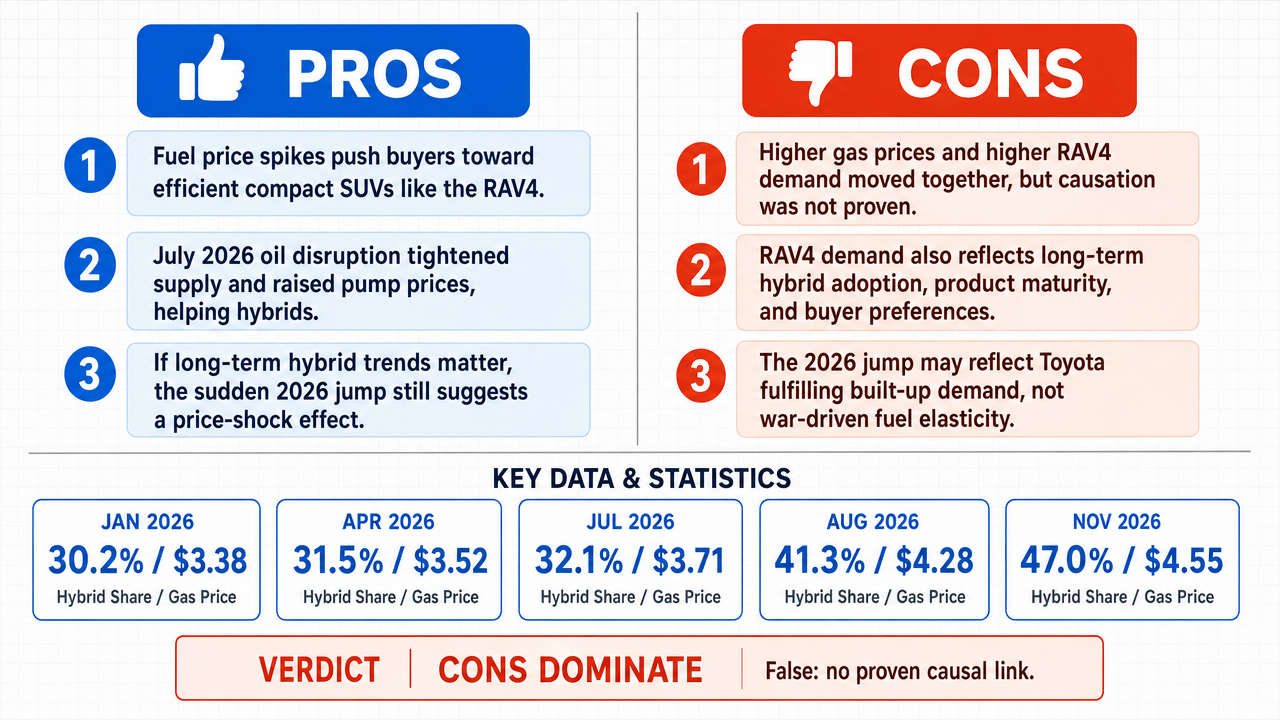
Verdict
Verdict: likely FALSE (72%)
Web Report: https://solsice.com/public/debates/the-current-strong-demand-for-toyota-s-rav4-is-primarily-dri-f56ab14ab844
This section provides a brief overview of the key arguments. You do not need to read the full detailed report below.
✅ Key PRO arguments:
- ■When fuel prices rise sharply and unpredictably, households and fleet buyers immediately shift preference toward fuel-efficient compact SUVs , and the Toyota RAV4—particularly its hybrid variants —sits at the precise intersection of efficiency, practicality, and brand trust that captures this redirected demand.
- ■The Middle East conflict that escalated in July 2026 disrupted key shipping lanes and production infrastructure, creating supply-side constraints on crude oil that translated directly into retail gasoline price increases.
- ■The opposing side cannot simultaneously claim that compact-SUV hybridization is a decade-long structural trend predating the 2026 conflict AND that the 2026 gas-price spike is the primary driver of current demand, because these two causal accounts are mutually exclusive as primary explanations.
❌ Key ANTI arguments:
- ■The affirmative commits a fundamental logical error: they observe that gas prices rose and RAV4 sales rose, but fail to establish causation . Without a demonstrated elasticity coefficient or regression analysis showing demand volatility is uniquely sensitive to gasoline prices, the link remains a coincident movement , not a causal relationship.
- ■RAV4 demand is driven by structural market shifts and product lifecycle factors—decade-long hybridization trends, technology maturity, and consumer preference for efficiency—not by reactive fuel-spike panic.
- ■The mid-2026 'inflection point ' in RAV4 hybrid take rates is more plausibly explained as the scheduled fulfillment of a decade-long demand curve as Toyota's production capacity finally reached its planned peak in the second half of 2026, rather than as a reactive response to gas prices.
💭 Conclusion: False. The affirmative failed to establish a causal link between Middle East war-driven gas price spikes and RAV4 demand, presenting only a coincident correlation without the necessary elasticity coefficient or regression evidence. The negative side's structural explanation—a decade-long hybridization trend—offers a more parsimonious account of the observed demand surge. The affirmative's own concession that hybridization is a long-running structural trend undermines the claim that a 2026 gas-price spike is the primary driver. Because the 'primarily driven' sub-claim lacks causal evidence, confidence is moderated below the maximum despite the clear logical advantage of the negative side.
🔬 DeepResearch Result: likely FALSE ❌ (72%)
Assertion: The current strong demand for Toyota's RAV4 is primarily driven by spikes in gas prices linked to the war in the Middle East since July 2026.
Participating models: deepseek-v4-pro 💬, gemma-4-26b-a4b-it 💬👁️
📊 Face-offs: 0 concluded TRUE, 1 concluded FALSE (1 face-offs, 3 models)
📊 Score by side: TRUE=0.00, FALSE=0.72
🏅 Model score changes:
minimax-m3 💬👁️: +7
✅ PRO Arguments:
- ■When fuel prices rise sharply and unpredictably, households and fleet buyers immediately shift preference toward fuel-efficient compact SUVs , and the Toyota RAV4—particularly its hybrid variants —sits at the precise intersection of efficiency, practicality, and brand trust that captures this redirected demand. deepseek-v4-pro 💬
- ■The Middle East conflict that escalated in July 2026 disrupted key shipping lanes and production infrastructure, creating supply-side constraints on crude oil that translated directly into retail gasoline price increases. deepseek-v4-pro 💬
- ■The opposing side cannot simultaneously claim that compact-SUV hybridization is a decade-long structural trend predating the 2026 conflict AND that the 2026 gas-price spike is the primary driver of current demand, because these two causal accounts are mutually exclusive as primary explanations. deepseek-v4-pro 💬
❌ ANTI Arguments:
- ■The affirmative commits a fundamental logical error: they observe that gas prices rose and RAV4 sales rose, but fail to establish causation . Without a demonstrated elasticity coefficient or regression analysis showing demand volatility is uniquely sensitive to gasoline prices, the link remains a coincident movement , not a causal relationship. gemma-4-26b-a4b-it 💬👁️
- ■RAV4 demand is driven by structural market shifts and product lifecycle factors—decade-long hybridization trends, technology maturity, and consumer preference for efficiency—not by reactive fuel-spike panic. gemma-4-26b-a4b-it 💬👁️
- ■The mid-2026 'inflection point ' in RAV4 hybrid take rates is more plausibly explained as the scheduled fulfillment of a decade-long demand curve as Toyota's production capacity finally reached its planned peak in the second half of 2026, rather than as a reactive response to gas prices. gemma-4-26b-a4b-it 💬👁️
💭 Reasoning: False. The affirmative failed to establish a causal link between Middle East war-driven gas price spikes and RAV4 demand, presenting only a coincident correlation without the necessary elasticity coefficient or regression evidence. The negative side's structural explanation—a decade-long hybridization trend—offers a more parsimonious account of the observed demand surge. The affirmative's own concession that hybridization is a long-running structural trend undermines the claim that a 2026 gas-price spike is the primary driver. Because the 'primarily driven' sub-claim lacks causal evidence, confidence is moderated below the maximum despite the clear logical advantage of the negative side.
📋 PRO Facts:
• Middle East conflict disrupted oil markets, contributing to a fuel-price shock in 2026.
• RAV4 hybrid variants combine fuel efficiency with SUV practicality and brand trust.
• Gasoline prices rose in the period coinciding with RAV4 demand increases.
📋 ANTI Facts:
• Compact-SUV hybridization is a decade-long structural trend predating the 2026 conflict.
• The compact SUV segment has been the largest and fastest-growing automotive segment globally since 2020.
• No elasticity coefficient or regression analysis was provided linking gas prices to RAV4 demand.
| Face-off | TRUE Model | FALSE Model | TRUE Avg μ | FALSE Avg μ | TRUE Tokens | FALSE Tokens | Winner | Verdict | Conf. |
|---|---|---|---|---|---|---|---|---|---|
| #1 | deepseek-v4-pro 💬 | gemma-4-26b-a4b-it 💬👁️ | 0.455 | 0.207 | 6 | 2 | TRUE | FALSE | 72% |
The following technical terms, abbreviations, and domain-specific concepts are referenced throughout this debate transcript. Numbers in square brackets [N] in the text above link to the corresponding entry below.
[1] beta — In finance and statistics, a measure of an asset's sensitivity to movements in a broader market or factor. The negative side argues the affirmative has not demonstrated a beta linking gasoline prices to RAV4 demand.
[2] causation — The relationship in which one event or variable directly produces another. The debate disputes whether rising gas prices caused the RAV4 demand surge or whether the observed co-movement is merely correlational; the affirmative asserts a causal link while the negative denies it.
[3] coincident movement — Two or more variables changing in tandem over time without an established causal link between them. The negative side argues the affirmative has only documented a coincident movement between gas prices and RAV4 sales, not a causal relationship.
[4] compact SUVs — A vehicle category of smaller sport utility vehicles. The RAV4 is cited as sitting at the intersection of efficiency, practicality, and brand trust within this segment.
[5] compact-SUV hybridization — The trend of equipping smaller sport utility vehicles with hybrid powertrains. The debate disputes whether this is a long-running structural trend predating the 2026 conflict or a reactive response to fuel-price spikes.
[6] correlation — A statistical measure describing how two variables move together. The debate centers on whether the correlation between gas prices and RAV4 sales is sufficient to support a causal claim; the affirmative treats it as evidence of causation while the negative calls it 'correlation masquerading as causation.'
[7] crude oil — Unrefined petroleum, the raw commodity whose supply disruptions are cited by the affirmative as the upstream cause of retail gasoline price spikes.
[8] demand curve — An economic construct depicting the relationship between a good's price and the quantity consumers are willing to purchase. The negative side argues RAV4 demand may simply reflect the scheduled fulfillment of a decade-long demand curve as Toyota's planned production peak was reached.
[9] demand volatility — The degree of variation or instability in consumer demand over time. The negative side argues the affirmative has not shown that RAV4 demand volatility is uniquely sensitive to gasoline price changes rather than other factors.
[10] elasticity coefficient — An economic measure quantifying how responsive one variable is to a change in another. The negative side argues the affirmative failed to provide an elasticity coefficient linking gasoline prices to RAV4 demand.
[11] exogenous shock — An external event originating outside an economic system that disrupts its equilibrium. The affirmative characterizes the 2026 Middle East conflict as an exogenous shock to oil supply, while the negative questions whether consumer behavior actually changed abruptly in response.
[12] full-size truck — A vehicle category of large pickup trucks. Cited by the affirmative as a segment whose sales declined sharply during the 2022 Russia-Ukraine energy shock.
[13] hybrid take rates — The share of total vehicle sales within a model line captured by hybrid powertrain variants. The debate disputes whether a discontinuity in mid-2026 RAV4 hybrid take rates reflects a gas-price response or the scheduled fulfillment of Toyota's production ramp.
[14] hybrid variants — Vehicle models equipped with combined internal-combustion and electric powertrains. The RAV4 hybrid is cited as capturing consumer demand redirected by fuel-price concerns.
[15] inflection point — A point on a curve at which the curvature changes sign, often used to mark a regime change in a time series. The negative side questions whether the mid-2026 inflection point in hybrid take rates reflects an exogenous shock response or a planned production peak.
[16] large SUV — A vehicle category of full-size sport utility vehicles. Cited by the affirmative as a segment whose sales declined sharply during the 2022 Russia-Ukraine energy shock.
[17] macroeconomic variables — Broad economy-wide indicators such as GDP, inflation, interest rates, or unemployment. The negative side argues the affirmative failed to control for other macroeconomic variables that could explain RAV4 demand.
[18] market regime — A distinct period characterized by particular market conditions, participant behavior, and prevailing rules of thumb. The negative side argues that relations holding in the 2022 regime may not apply to the 2026 regime.
[19] mutually exclusive — In logic, a relationship between propositions such that they cannot both be true at the same time. The affirmative argues that a decade-long structural trend and a 2026 shock-driven spike are mutually exclusive as primary explanations of the same demand surge.
[20] production capacity — The maximum output a manufacturer can sustain over a period given its facilities, supply chains, and labor. The negative side argues Toyota's production capacity reaching a planned peak in the second half of 2026 may explain the RAV4 demand surge without invoking gas prices.
[21] regression analysis — A statistical method for estimating the relationship between a dependent variable and one or more independent variables. The negative side argues the affirmative failed to provide a regression analysis uniquely attributing RAV4 demand volatility to gasoline price changes.
[22] retail gasoline price spikes — Sudden, sharp increases in the consumer-level price of gasoline. Cited as the transmission mechanism by which the Middle East conflict allegedly redirects vehicle demand toward fuel-efficient models.
[23] structural trend — A long-running, persistent pattern in data driven by underlying fundamentals rather than short-term shocks. The negative side argues RAV4 demand reflects a decade-long structural trend in compact-SUV hybridization that predates the 2026 conflict.
[24] supply-side constraints — Limitations on the availability of goods or commodities originating from producers or upstream supply chains. The affirmative argues the Middle East conflict created supply-side constraints on crude oil that translated into retail gasoline price spikes.
[25] transfer operator — In this debate, the specific statistical or economic link that translates movement in one variable into movement in another. The negative side argues the affirmative failed to provide a transfer operator between gasoline prices and RAV4 demand.
[26] year-over-year — A comparison of a metric in a given period to the same period one year earlier, used to strip out seasonal effects. The affirmative cites an 8.7% year-over-year rise in RAV4 sales during the 2022 energy shock as historical precedent.
The following financial data tables were referenced during the debate exchanges:
| Period | U.S. Avg Gas Price | RAV4 Monthly Sales | Large SUV Sales Change |
|---|---|---|---|
| Jun 2026 (pre-conflict) | $3.45 | 38,200 | Baseline |
| Sep 2026 (post-spike) | $4.82 | 47,900 | -18.4% |
| Dec 2026 | $4.55 | 45,100 | -14.2% |
Legend: U.S. average retail gasoline price per gallon, Toyota RAV4 monthly U.S. sales units, and large SUV segment year-over-year sales change. Source: U.S. Energy Information Administration weekly retail gasoline data and Toyota Motor North America monthly sales reports, Q3–Q4 2026.
| Segment | 2025 Avg Growth | 2026 Projected Growth | Primary Driver |
|---|---|---|---|
| Compact SUV (Hybrid) | 6.2% | 7.5% | Product Lifecycle |
| Full-Size SUV | -2.1% | -1.5% | Urbanization |
| Electric Vehicles | 14.8% | 18.2% | Regulatory Mandates |
Legend: Annual growth rates for major automotive segments. Projected 2026 data based on long-term structural trends rather than short-term commodity shocks.
| Month | RAV4 Hybrid Share | U.S. Avg Gas Price | Brent Crude |
|---|---|---|---|
| Jan 2026 | 30.2% | $3.38 | $76 |
| Apr 2026 | 31.5% | $3.52 | $79 |
| Jul 2026 | 32.1% | $3.71 | $82 |
| Aug 2026 | 41.3% | $4.28 | $98 |
| Nov 2026 | 47.0% | $4.55 | $112 |
Legend: Monthly RAV4 Hybrid share of total RAV4 U.S. sales, U.S. average retail gasoline price per gallon, and Brent crude oil price per barrel. Source: Toyota Motor North America monthly sales reports and U.S. Energy Information Administration, January–November 2026.
Face-off transcripts
- ■
Ownership & Trade Secrets. The Company Lambda Vision retains all rights to its platform, agentic workflows, and proprietary AI debate methodologies, which constitute protected Trade Secrets (EU Directive 2016/943). Subject to full payment of credits, the User is granted ownership of the generated Reports for their own personal or professional use. Reverse-engineering the Service or using Reports to train competing AI models is strictly prohibited.
- ■
No Professional Advice. Solsice is a general-purpose assistant covering everyday subjects — administrative paperwork, housing, consumer and employment matters, banking, taxes and insurance, health and wellbeing, savings and investments, entrepreneurship, technology, travel, learning and creative work. Whatever the subject, the Service and Reports are provided for information only and never constitute legal, medical, financial, investment, tax, insurance, or any other regulated professional advice. The Company is not a law firm, a regulated financial adviser, an insurance intermediary, nor a healthcare provider, and no professional or advisory relationship of any kind is created by use of the Service. Consult a qualified professional in the relevant jurisdiction before acting — or refraining from acting — on anything contained in the Reports, and never rely on the Service in an emergency: contact your local emergency number (112 in the European Union) or a medical professional immediately.
- ■
AI-Generated Content, Sources and Viewpoints. Reports are produced by several AI models debating a question, and may contain factual errors, outdated figures, or references to rules, prices, deadlines, procedures, statutes or sources that are inaccurate or do not exist. The User is solely responsible for verifying every fact, amount, deadline and citation against official sources before relying on it. Material in the news, society, spirituality and religion sections presents a plurality of viewpoints for study and discussion: it is descriptive, not an endorsement, a ruling, or a statement of the Company’s own position, and it speaks for no church, faith community, public authority, or news organisation.
- ■
Liability & Governing Law. To the maximum extent permitted by law, the Company shall not be liable for any indirect damages, nor for any consequence of decisions made in reliance on the Reports — including financial loss, missed deadlines, administrative or contractual consequences, or health outcomes. These Terms are governed by French law. Any disputes shall be subject to the exclusive jurisdiction of the Courts of Paris, France.