
The current Russian political system and regime, driven by an imperialistic ideology, makes a sustainable resolution to the conflict in Ukraine impossible.
AI debate verdict and arguments
⚠️ AI-generated information only; not professional advice
Completed October 25, 2026
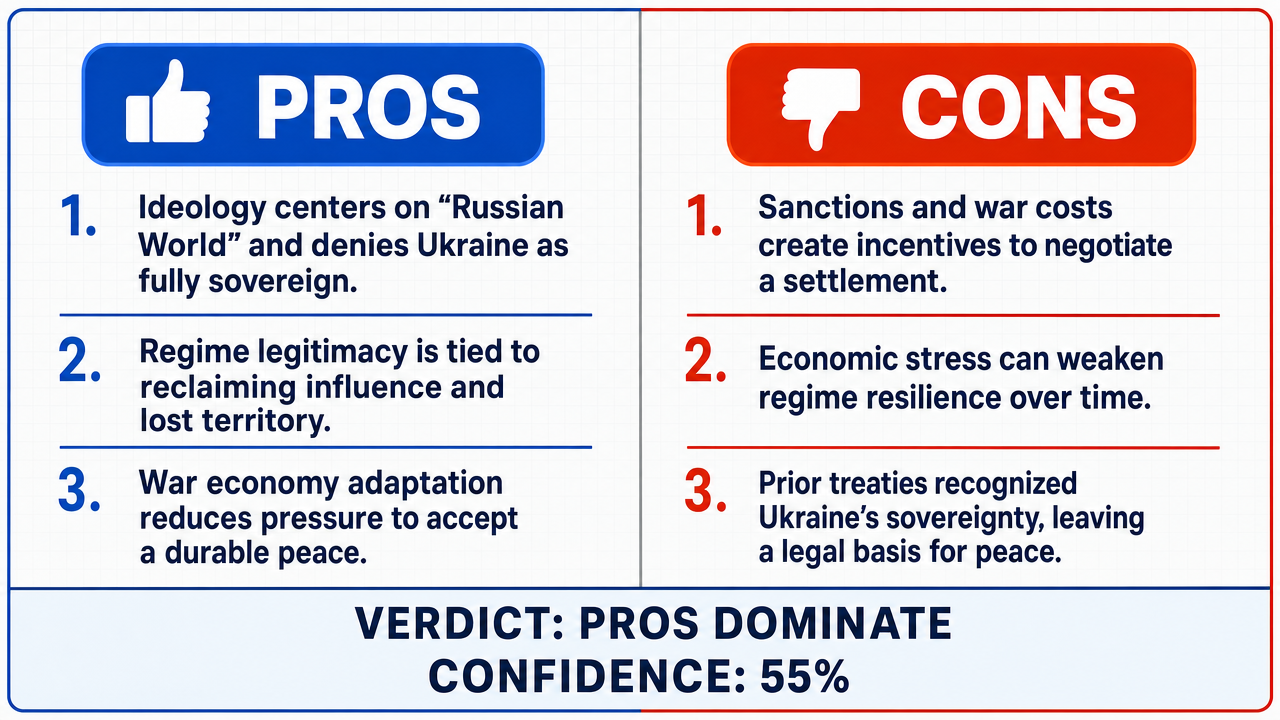
Verdict
Verdict: likely TRUE (55%)
Web Report: https://solsice.com/public/debates/the-current-russian-political-system-and-regime-driven-by-an-0cbe83a8482b
This section provides a brief overview of the key arguments. You do not need to read the full detailed report below.
✅ Key PRO arguments:
- ■The Russian political regime is structurally predicated on 'Russkiy Mir ' (Russian World), an expansionist ideology that views Ukraine not as a sovereign neighbor but as an integral part of a singular civilization under Moscow's spiritual and political hegemony , codified in official state doctrines that explicitly reject Ukrainian sovereignty and territorial integrity .
- ■The regime defines its own domestic legitimacy through the reclamation of 'lost' territories and the assertion of dominance over former Soviet spaces, meaning any compromise recognizing Ukrainian independence would undermine the regime's foundational narrative.
- ■Economic pressure has not constrained the Kremlin because the current political system has successfully restructured its economy into a 'war economy ' specifically designed to sustain prolonged conflict despite sanctions , co-opting economic strain to justify increased state control and fuel the nationalist narrative of 'fortress Russia ' under siege.
❌ Key ANTI arguments:
- ■The economic strain of sanctions and war expenditures creates a tangible incentive for the Kremlin to seek a negotiated settlement rather than continue an endless war, as the Russian economy faces significant headwinds from isolation and military spending that threaten long-term stability.
- ■Financial indicators signal regime vulnerability: Real GDP Growth shifted from -2.1% in 2023 to 3.6% in 2024 (a +5.7 percentage point change), while the Budget Deficit widened from 2.4% to 7.5% (a +5.1 percentage point change), indicating that the regime's survival depends on stabilizing the conflict.
- ■The Russian Federation has formally recognized Ukrainian sovereignty through binding international instruments , including the 1997 Russian-Ukrainian Friendship and Cooperation Treaty and the 2003 treaty recognizing the existing borders, contradicting the claim that the ideology explicitly denies sovereignty.
💭 Conclusion: True, the assertion is supported, though with moderate confidence reflecting the compound nature of the claim. The pro side's strongest argument is that the Russian regime 's ideological foundation in 'Russkiy Mir ' structurally precludes sustainable peace because the regime's domestic legitimacy depends on asserting dominance over former Soviet spaces, making any genuine compromise that recognizes Ukrainian sovereignty incompatible with the regime's self-conception. The anti side's strongest counter—that Russia has historically recognized Ukrainian sovereignty through binding treaties like the 1997 Friendship Treaty—undermines the absolute claim that ideology forecloses all recognition, which is why the judge's confidence was moderate rather than higher. The financial data presented (GDP growth recovering from -2.1% to 3.6% and budget deficit widening from 2.4% to 7.5%) is ambiguous and does not clearly demonstrate either regime collapse or war-economy resilience. Because the anti side successfully contested the absoluteness of the ideological foreclosure through historical precedents of formal recognition, the compound claim's second sub-claim—that resolution is 'impossible'—is the weakest link, warranting the moderate confidence level.
🔬 DeepResearch Result: likely TRUE ✅ (55%)
Assertion: The current Russian political system and regime , driven by an imperialistic ideology, makes a sustainable resolution to the conflict in Ukraine impossible.
Participating models: gemma-4-26b-a4b-it 💬👁️, glm-4.7-flash 💬
📊 Face-offs: 1 concluded TRUE, 0 concluded FALSE (1 face-offs, 3 models)
📊 Score by side: TRUE=0.55, FALSE=0.00
🏅 Model score changes:
minimax-m3 💬👁️: +6
✅ PRO Arguments:
- ■The Russian political regime is structurally predicated on 'Russkiy Mir ' (Russian World), an expansionist ideology that views Ukraine not as a sovereign neighbor but as an integral part of a singular civilization under Moscow's spiritual and political hegemony , codified in official state doctrines that explicitly reject Ukrainian sovereignty and territorial integrity . gemma-4-26b-a4b-it 💬👁️
- ■The regime defines its own domestic legitimacy through the reclamation of 'lost' territories and the assertion of dominance over former Soviet spaces, meaning any compromise recognizing Ukrainian independence would undermine the regime's foundational narrative. gemma-4-26b-a4b-it 💬👁️
- ■Economic pressure has not constrained the Kremlin because the current political system has successfully restructured its economy into a 'war economy ' specifically designed to sustain prolonged conflict despite sanctions , co-opting economic strain to justify increased state control and fuel the nationalist narrative of 'fortress Russia ' under siege. gemma-4-26b-a4b-it 💬👁️
- ■The argument that economic strain creates pragmatic incentive for settlement relies on the unproven assumption that the Russian regime is a rational-actor state prioritizing macroeconomic stability over its core ideological identity, which fails to account for the regime's demonstrated willingness to absorb economic costs in pursuit of imperial objectives. gemma-4-26b-a4b-it 💬👁️
❌ ANTI Arguments:
- ■The economic strain of sanctions and war expenditures creates a tangible incentive for the Kremlin to seek a negotiated settlement rather than continue an endless war, as the Russian economy faces significant headwinds from isolation and military spending that threaten long-term stability. glm-4.7-flash 💬
- ■Financial indicators signal regime vulnerability: Real GDP Growth shifted from -2.1% in 2023 to 3.6% in 2024 (a +5.7 percentage point change), while the Budget Deficit widened from 2.4% to 7.5% (a +5.1 percentage point change), indicating that the regime's survival depends on stabilizing the conflict. glm-4.7-flash 💬
- ■The Russian Federation has formally recognized Ukrainian sovereignty through binding international instruments , including the 1997 Russian-Ukrainian Friendship and Cooperation Treaty and the 2003 treaty recognizing the existing borders, contradicting the claim that the ideology explicitly denies sovereignty. glm-4.7-flash 💬
- ■The 2014 Minsk agreements , signed by Russia, acknowledged the special status of Donbas within Ukraine's sovereignty, demonstrating that the regime has engaged in formal recognition of Ukrainian statehood and has historically accepted negotiated frameworks. glm-4.7-flash 💬
💭 Reasoning: True, the assertion is supported, though with moderate confidence reflecting the compound nature of the claim. The pro side's strongest argument is that the Russian regime's ideological foundation in 'Russkiy Mir' structurally precludes sustainable peace because the regime's domestic legitimacy depends on asserting dominance over former Soviet spaces, making any genuine compromise that recognizes Ukrainian sovereignty incompatible with the regime's self-conception. The anti side's strongest counter—that Russia has historically recognized Ukrainian sovereignty through binding treaties like the 1997 Friendship Treaty—undermines the absolute claim that ideology forecloses all recognition, which is why the judge's confidence was moderate rather than higher. The financial data presented (GDP growth recovering from -2.1% to 3.6% and budget deficit widening from 2.4% to 7.5%) is ambiguous and does not clearly demonstrate either regime collapse or war-economy resilience. Because the anti side successfully contested the absoluteness of the ideological foreclosure through historical precedents of formal recognition, the compound claim's second sub-claim—that resolution is 'impossible'—is the weakest link, warranting the moderate confidence level.
📋 PRO Facts:
• The Russian regime has codified 'Russkiy Mir' ideology in official state doctrines that reject Ukrainian sovereignty and territorial integrity.
• The Russian economy has been restructured into a 'war economy' designed to sustain prolonged conflict despite sanctions.
• Economic pressure has been co-opted to justify increased state control and fuel the nationalist narrative of 'fortress Russia' under siege.
📋 ANTI Facts:
• Real GDP Growth changed from -2.1% in 2023 to 3.6% in 2024, a +5.7 percentage point shift.
• Budget Deficit widened from 2.4% in 2023 to 7.5% in 2024, a +5.1 percentage point increase.
• The 1997 Russian-Ukrainian Friendship and Cooperation Treaty formally recognized Ukrainian sovereignty.
• The 2003 treaty recognized the existing borders between Russia and Ukraine.
| Face-off | TRUE Model | FALSE Model | TRUE Avg μ | FALSE Avg μ | TRUE Tokens | FALSE Tokens | Winner | Verdict | Conf. |
|---|---|---|---|---|---|---|---|---|---|
| #1 | gemma-4-26b-a4b-it 💬👁️ | glm-4.7-flash 💬 | 0.262 | 0.464 | 4 | 4 | FALSE | TRUE | 55% |
The following technical terms, abbreviations, and domain-specific concepts are referenced throughout this debate transcript. Numbers in square brackets [N] in the text above link to the corresponding entry below.
[1] annual percentage change — An economic metric expressing the year-over-year rate of change in a variable, such as GDP growth, expressed as a percentage.
[2] autocracy — A political system in which a single ruler or a small group holds absolute power, with limited or no meaningful political pluralism or institutional checks.
[3] binding international instruments — Formal international agreements, such as treaties, that create legally enforceable obligations between the signatory states under international law.
[4] budget deficit — A financial condition in which a government's expenditures exceed its revenues during a given period, often expressed as a percentage of GDP.
[5] domestic legitimacy — The acceptance and justification of a regime's authority by its own population, often derived from ideology, performance, or nationalist appeals.
[6] Donbas — A region in eastern Ukraine referenced in the debate in connection with the 2014 Minsk agreements and questions of special status within Ukrainian sovereignty.
[7] expansionist ideology — A political doctrine that justifies or promotes the territorial or political extension of a state's power beyond its existing borders.
[8] fortress Russia — A nationalist narrative framing Russia as a besieged civilization under external threat, used in the debate to describe a domestic legitimation strategy.
[9] GDP — Gross Domestic Product — The total monetary value of all goods and services produced within a country's borders over a specified period, used as a primary measure of economic output.
[10] hegemony — The dominance of one state or group over others, particularly in political, cultural, or ideological terms.
[11] imperialist ideology — A political doctrine asserting the right or mission of a state to extend its authority over other peoples or territories, often framed in civilizational terms.
[12] International Monetary Fund — IMF — An international financial institution cited in the debate as the source of macroeconomic data on Russia's GDP growth and budget deficit.
[13] Kremlin — A shorthand reference to the Russian federal government and its decision-making apparatus, particularly the executive leadership in Moscow.
[14] macroeconomic stability — A condition in which key aggregate economic indicators, such as growth, inflation, and fiscal balance, remain within sustainable ranges.
[15] Minsk agreements — A set of 2014 agreements referenced in the debate as having been signed by Russia and as acknowledging a special status for Donbas within Ukrainian sovereignty.
[16] nationalist narrative — A politically constructed storyline emphasizing national identity, grievance, or external threat to mobilize domestic support.
[17] negotiated settlement — A diplomatic resolution to a conflict reached through formal bargaining between the parties, rather than through military victory or unilateral imposition.
[18] rational-actor state — A theoretical model in international relations assuming that states make foreign policy decisions by calculating costs and benefits to maximize defined interests, such as economic stability.
[19] regime — The set of formal and informal institutions, rules, and leadership structures through which political authority is exercised in a state.
[20] Russkiy Mir — Russian World — An expansionist ideology referenced in the debate as viewing Ukraine as part of a singular civilization under Moscow's spiritual and political hegemony.
[21] sanctions — Coercive economic measures, such as trade restrictions or asset freezes, imposed by one or more states against another to alter its behavior.
[22] sovereignty — The principle that a state has supreme authority within its territory and independence in its external relations, free from external interference.
[23] state doctrines — Officially codified political principles or ideologies that guide a state's foreign and domestic policy.
[24] territorial integrity — A principle of international law holding that a state's borders are inviolable and may not be altered by force or external intervention.
[25] vertical autocracy — A political structure in which power is concentrated in a single hierarchy with no independent lateral or horizontal institutional checks, limiting policy flexibility.
[26] war economy — An economic system restructured to prioritize sustained military production and conflict financing, often at the expense of civilian economic activity.
[27] World Economic Outlook — A periodic economic publication cited in the debate as the source of comparative GDP and fiscal data for Russia.
The following financial data tables were referenced during the debate exchanges:
| Indicator | 2023 Value | 2024 Value | Change |
|---|---|---|---|
| Real GDP Growth | -2.1% | 3.6% | +5.7% |
| Budget Deficit | 2.4% | 7.5% | +5.1% |
Legend: Russia's economic indicators (2023-2024). Source: International Monetary Fund World Economic Outlook. Growth is annual percentage change; deficit is % of GDP.
Face-off transcripts
- ■
Ownership & Trade Secrets. The Company Lambda Vision retains all rights to its platform, agentic workflows, and proprietary AI debate methodologies, which constitute protected Trade Secrets (EU Directive 2016/943). Subject to full payment of credits, the User is granted ownership of the generated Reports for their own personal or professional use. Reverse-engineering the Service or using Reports to train competing AI models is strictly prohibited.
- ■
No Professional Advice. Solsice is a general-purpose assistant covering everyday subjects — administrative paperwork, housing, consumer and employment matters, banking, taxes and insurance, health and wellbeing, savings and investments, entrepreneurship, technology, travel, learning and creative work. Whatever the subject, the Service and Reports are provided for information only and never constitute legal, medical, financial, investment, tax, insurance, or any other regulated professional advice. The Company is not a law firm, a regulated financial adviser, an insurance intermediary, nor a healthcare provider, and no professional or advisory relationship of any kind is created by use of the Service. Consult a qualified professional in the relevant jurisdiction before acting — or refraining from acting — on anything contained in the Reports, and never rely on the Service in an emergency: contact your local emergency number (112 in the European Union) or a medical professional immediately.
- ■
AI-Generated Content, Sources and Viewpoints. Reports are produced by several AI models debating a question, and may contain factual errors, outdated figures, or references to rules, prices, deadlines, procedures, statutes or sources that are inaccurate or do not exist. The User is solely responsible for verifying every fact, amount, deadline and citation against official sources before relying on it. Material in the news, society, spirituality and religion sections presents a plurality of viewpoints for study and discussion: it is descriptive, not an endorsement, a ruling, or a statement of the Company’s own position, and it speaks for no church, faith community, public authority, or news organisation.
- ■
Liability & Governing Law. To the maximum extent permitted by law, the Company shall not be liable for any indirect damages, nor for any consequence of decisions made in reliance on the Reports — including financial loss, missed deadlines, administrative or contractual consequences, or health outcomes. These Terms are governed by French law. Any disputes shall be subject to the exclusive jurisdiction of the Courts of Paris, France.