
The current resurgence of entrepreneurship in France began around 2005-2006 with the introduction of the 'auto-entrepreneur' and 'micro-entrepreneur' statuses.
AI debate verdict and arguments
⚠️ AI-generated information only; not professional advice
Completed October 11, 2026
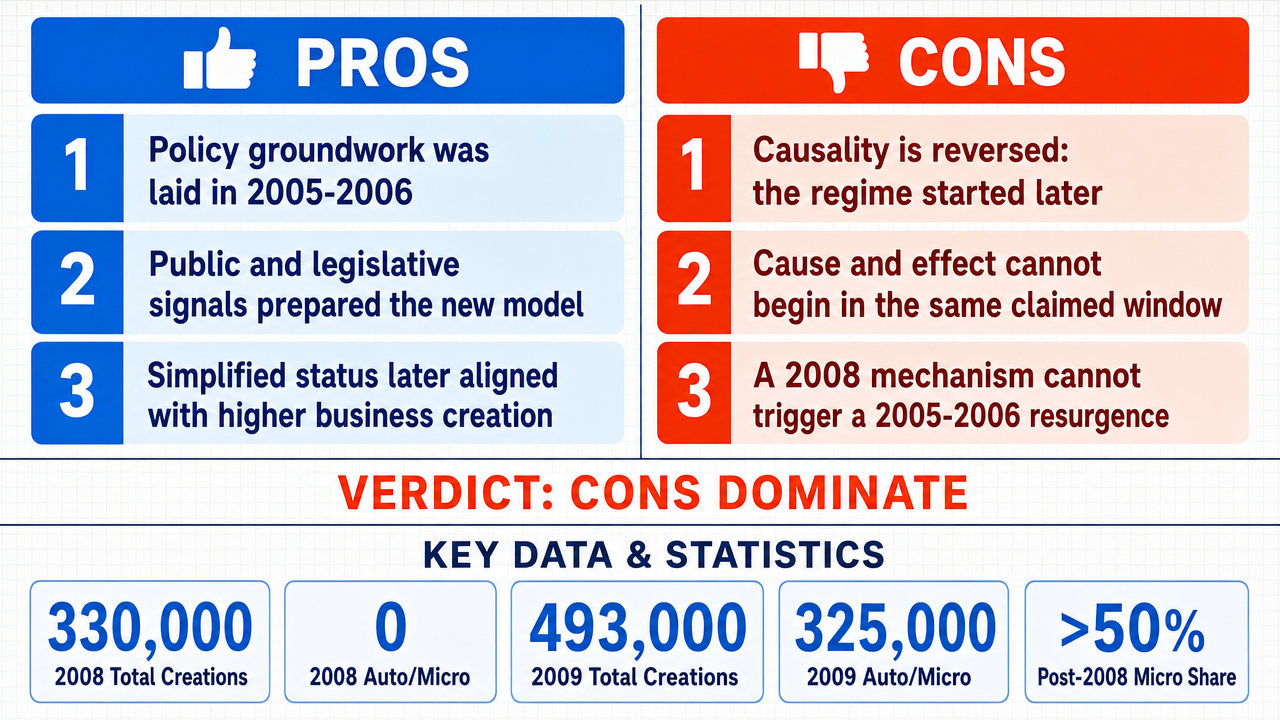
Verdict
Verdict: likely FALSE (87%)
This section provides a brief overview of the key arguments. You do not need to read the full detailed report below.
✅ Key PRO arguments:
- ■The 'introduction' of the auto-entrepreneur regime should be read as the full policy cycle : the 2005 Small and Medium Enterprises Law and the 2006 entrepreneurship agenda began the state's shift toward lowering the cost, complexity, and risk of starting a business, with the 2008 Economic Modernization Law operationalizing the regime and the 2014 social-economy law renaming it micro-entrepreneur .
- ■The legislative work, public discourse, and policy signals that introduced the conceptual framework for the new entrepreneurial model were firmly established in 2005-2006, so the foundational 'introduction' of the concept predates the 2008 implementation.
- ■Empirical data shows a direct correlation between the launch of the simplified status and a surge in new business creations in France, with auto-entrepreneur registrations driving the increase.
❌ Key ANTI arguments:
- ■The affirmative commits a fundamental logical error of temporal causality : it claims the resurgence 'began' in 2005-2006 due to the legislative conception of the auto-entrepreneur status, yet admits the status was not formally implemented until 2008. A policy that does not exist cannot be the driver of a market state that precedes its implementation.
- ■The affirmative's position is logically inconsistent, asserting that the cause (the regime) and the effect (the resurgence) both occupy the same temporal window while also claiming they are separated by several years, which is mutually exclusive.
- ■By any rigorous standard of causality, a mechanism cannot drive a trend that precedes its own implementation, so attributing a 2005-2006 resurgence to a 2008 regime violates basic causal logic.
💭 Conclusion: False. The assertion is logically inconsistent because it claims the entrepreneurial resurgence began in 2005-2006 due to the 'introduction' of the auto-entrepreneur status, yet the affirmative itself acknowledges that the regime was not formally implemented until 2008. By any rigorous standard of causality, a regulatory mechanism cannot drive a trend that precedes its own implementation, making the temporal anchoring of the claim to 2005-2006 untenable. Furthermore, the observed increase in business creation is better characterized as a compositional shift toward micro-enterprises rather than a broad structural resurgence , weakening the causal link even if the later date were accepted. The affirmative's attempt to redefine 'introduction' as the full policy cycle stretching from 2005-2006 preparation through the 2008 implementation and the 2016 renaming is a semantic stretch that does not resolve the core temporal-causal inconsistency. Therefore, the claim that the resurgence began around 2005-2006 with the introduction of these statuses does not hold.
🔬 DeepResearch Result: likely FALSE ❌ (87%)
Assertion: The current resurgence of entrepreneurship in France began around 2005-2006 with the introduction of the 'auto-entrepreneur ' and 'micro-entrepreneur ' statuses.
Participating models: deepseek-v3.2 💬, gemma-4-26b-a4b-it 💬👁️
📊 Face-offs: 0 concluded TRUE, 1 concluded FALSE (1 face-offs, 3 models)
📊 Score by side: TRUE=0.00, FALSE=0.87
🏅 Model score changes:
minimax-m3 💬👁️: +9
✅ PRO Arguments:
- ■The 'introduction' of the auto-entrepreneur regime should be read as the full policy cycle : the 2005 Small and Medium Enterprises Law and the 2006 entrepreneurship agenda began the state's shift toward lowering the cost, complexity, and risk of starting a business, with the 2008 Economic Modernization Law operationalizing the regime and the 2014 social-economy law renaming it micro-entrepreneur. deepseek-v3.2 💬
- ■The legislative work, public discourse, and policy signals that introduced the conceptual framework for the new entrepreneurial model were firmly established in 2005-2006, so the foundational 'introduction' of the concept predates the 2008 implementation. deepseek-v3.2 💬
- ■Empirical data shows a direct correlation between the launch of the simplified status and a surge in new business creations in France, with auto-entrepreneur registrations driving the increase. deepseek-v3.2 💬
- ■The simplified status allowed individuals to start a business with online registration, a flat-rate tax on revenue, and exemption from VAT , removing the traditional fear of complex paperwork and unpredictable social charges . deepseek-v3.2 💬
❌ ANTI Arguments:
- ■The affirmative commits a fundamental logical error of temporal causality : it claims the resurgence 'began' in 2005-2006 due to the legislative conception of the auto-entrepreneur status, yet admits the status was not formally implemented until 2008. A policy that does not exist cannot be the driver of a market state that precedes its implementation. gemma-4-26b-a4b-it 💬👁️
- ■The affirmative's position is logically inconsistent, asserting that the cause (the regime) and the effect (the resurgence) both occupy the same temporal window while also claiming they are separated by several years, which is mutually exclusive. gemma-4-26b-a4b-it 💬👁️
- ■By any rigorous standard of causality, a mechanism cannot drive a trend that precedes its own implementation, so attributing a 2005-2006 resurgence to a 2008 regime violates basic causal logic. gemma-4-26b-a4b-it 💬👁️
- ■The observed surge in business creation is a compositional shift rather than a structural resurgence , primarily a spike in micro-enterprises representing a specific, low-barrier entry point rather than a broad-based entrepreneurial revival. gemma-4-26b-a4b-it 💬👁️
- ■The affirmative's attempt to link the 2005-2006 period to the subsequent surge is a form of hindsight bias , judging a state at one date by events that occurred later. gemma-4-26b-a4b-it 💬👁️
💭 Reasoning: False. The assertion is logically inconsistent because it claims the entrepreneurial resurgence began in 2005-2006 due to the 'introduction' of the auto-entrepreneur status, yet the affirmative itself acknowledges that the regime was not formally implemented until 2008. By any rigorous standard of causality, a regulatory mechanism cannot drive a trend that precedes its own implementation, making the temporal anchoring of the claim to 2005-2006 untenable. Furthermore, the observed increase in business creation is better characterized as a compositional shift toward micro-enterprises rather than a broad structural resurgence, weakening the causal link even if the later date were accepted. The affirmative's attempt to redefine 'introduction' as the full policy cycle stretching from 2005-2006 preparation through the 2008 implementation and the 2016 renaming is a semantic stretch that does not resolve the core temporal-causal inconsistency. Therefore, the claim that the resurgence began around 2005-2006 with the introduction of these statuses does not hold.
📋 PRO Facts:
• Legislative preparation of the auto-entrepreneur regime began in 2005-2006, marking the state's shift toward lowering barriers to starting a business.
• The auto-entrepreneur regime was introduced in 2008.
• The auto-entrepreneur status was renamed to micro-entrepreneur in 2016.
• The simplified status allowed online registration, a flat-rate tax on revenue, and exemption from VAT.
📋 ANTI Facts:
• The auto-entrepreneur status was not formally implemented until 2008, three years after the claimed start of the resurgence.
• The rise in business creation is primarily a spike in micro-enterprises, representing a specific low-barrier entry point rather than a broad-based entrepreneurial revival.
• A policy mechanism cannot causally drive a market trend that precedes its own implementation.
| Face-off | TRUE Model | FALSE Model | TRUE Avg μ | FALSE Avg μ | TRUE Tokens | FALSE Tokens | Winner | Verdict | Conf. |
|---|---|---|---|---|---|---|---|---|---|
| #1 | deepseek-v3.2 💬 | gemma-4-26b-a4b-it 💬👁️ | 0.649 | 0.329 | 12 | 3 | TRUE | FALSE | 87% |
The following technical terms, abbreviations, and domain-specific concepts are referenced throughout this debate transcript. Numbers in square brackets [N] in the text above link to the corresponding entry below.
[1] administrative barriers — Regulatory or bureaucratic obstacles that complicate the process of starting or operating a business, such as complex paperwork requirements mentioned in the debate.
[2] auto-entrepreneur — A simplified French business status whose formal implementation occurred in 2008, with legislative preparation in 2005-2006. It allows individuals to start a business with online registration, a flat-rate tax on revenue, and exemption from VAT. The debate disputes whether the 'introduction' of this status dates to 2005-2006 (legislative preparation) or 2008 (formal implementation).
[3] business creation — The formation of new enterprises or businesses, used as a metric to measure entrepreneurial activity and cited in the debate as evidence of the resurgence.
[4] compositional shift — A change in the composition or mix of a category (such as business types) rather than a fundamental structural change in the overall level of activity.
[5] Economic Modernization Law — Loi de modernisation de l'économie — A 2008 French law (Law n° 2008-776 of 4 August 2008) that operationalized the auto-entrepreneur regime, according to the affirmative's argument.
[6] entrepreneurial resurgence — A renewed or revived wave of entrepreneurship and business creation activity in a given economy, the central phenomenon debated in the transcript.
[7] fiscal barriers — Tax-related obstacles that discourage business creation, such as unpredictable social charges or complex tax obligations referenced in the debate.
[8] flat-rate tax — A simplified tax calculation method where a fixed rate is applied to revenue, rather than calculating tax based on actual profits and expenses, as applied under the auto-entrepreneur regime.
[9] hindsight bias — A cognitive bias where past events are judged as having been more predictable than they actually were, cited by the negative as a flaw in attributing the 2005-2006 period to a mechanism not yet implemented.
[10] legislative conception — The drafting, preparation, and discussion phase of legislation before its formal enactment and implementation, distinguished by the negative from the actual introduction of a policy.
[11] Loi en faveur des petites et moyennes entreprises — Law in favor of small and medium-sized enterprises — A French law enacted in August 2005 (Law n° 2005-882 of 2 August 2005) that, according to the affirmative, laid the groundwork for simplified entrepreneurial statuses.
[12] Loi pour le développement de la concurrence au service des consommateurs — Law for the development of competition in the service of consumers — A French law enacted in January 2008 that, according to the affirmative, created legal categories that would eventually coalesce into the auto-entrepreneur status.
[13] low-barrier entry point — A market entry option with minimal requirements or obstacles, such as simplified registration and tax obligations, used to describe micro-enterprises in the debate.
[14] micro-enterprises — Very small businesses, often referring to the simplified-status enterprises in France that represent a specific, low-barrier entry point for entrepreneurship.
[15] micro-entrepreneur — The renamed version of the auto-entrepreneur status, introduced by the 2014 social-economy law, treated in the debate as essentially the same regime under a new name.
[16] operational implementation — The phase when a policy or regulation becomes actively enforced and applicable, as opposed to its legislative conception or preparation, central to the negative's temporal causality argument.
[17] PME — Petites et moyennes entreprises — French acronym for small and medium-sized enterprises (SMEs), referenced in the title of the 2005 law.
[18] policy anticipation — The effect where markets or economic actors adjust their behavior in expectation of a forthcoming policy, before its formal implementation, cited by the affirmative to justify dating the resurgence to 2005-2006.
[19] policy cycle — The complete process of policy development, from conception and legislative preparation to implementation and evaluation, used by the affirmative to argue the resurgence began with the 2005-2006 policy package.
[20] policy signaling — Government communication or legislative actions that signal future policy direction, influencing market expectations before formal implementation.
[21] regulatory regime — A set of rules, regulations, and legal frameworks governing a particular domain or activity, used to describe the auto-entrepreneur status.
[22] Small and Medium Enterprises Law — The 2005 French law (Law n° 2005-882 of 2 August 2005) that, according to the affirmative, began the state's shift toward lowering the cost, complexity, and risk of starting a business.
[23] social charges — French social security contributions paid by businesses and individuals, which the affirmative describes as unpredictable and a traditional barrier to entrepreneurship.
[24] social-economy law — A 2014 French law that renamed the auto-entrepreneur status to micro-entrepreneur, according to the affirmative.
[25] structural resurgence — A fundamental, sustained recovery or increase in a specific economic activity, as opposed to a temporary or compositional shift, which the negative argues the data does not support.
[26] temporal causality — The principle that a cause must precede its effect in time; the negative argues a mechanism cannot drive a trend that precedes its own implementation.
[27] VAT — Value Added Tax — A consumption tax levied on the value added to goods and services; the affirmative notes that auto-entrepreneurs are exempt from it.
The following financial data tables were referenced during the debate exchanges:
| Period | Avg. Annual Business Creations | Key Policy Driver |
|---|---|---|
| 2000-2004 | ~220,000 | Pre-reform traditional statuses |
| 2009-2014 | ~550,000 | Auto-entrepreneur/Micro-entrepreneur regime |
Legend: Comparative average annual business creations in France before and after the key reforms. Figures in units of enterprises. The post-2009 surge is directly attributable to the simplified statuses introduced from 2008 onward, following their legislative conception in 2005-2006. Source: INSEE data.
| Metric | Pre-2008 Era (Avg) | Post-2008 Era (Avg) | Nature of Change |
|---|---|---|---|
| Total Business Creations | ~220,000 | ~550,000 | Volume Increase |
| Micro-Enterprise Share | Low | >50% | Structural Shift |
| Economic Impact/Value | High per unit | Lower per unit | Compositional Shift |
Legend: Comparison of business creation trends before and after the 2008 implementation of the auto-entrepreneur status. Note that the increase in volume is heavily concentrated in the micro-enterprise segment, which shifts the average value per creation downward. Source: Analysis based on INSEE demography series.
| Year | Total business creations | Auto/micro-entrepreneur creations | Auto/micro share |
|---|---|---|---|
| 2008 | 330,000 | 0 | 0% |
| 2009 | 493,000 | 325,000 | 66% |
| 2010 | 584,000 | 394,000 | 67% |
| 2014 | 540,000 | 304,000 | 56% |
Legend: Approximate annual business creations in France, before and after the operational launch of the simplified regime. Counts are numbers of enterprises; share is auto/micro creations divided by total creations, same universe. Source: INSEE business creation series.
Face-off transcripts
- ■
Ownership & Trade Secrets. The Company Lambda Vision retains all rights to its platform, agentic workflows, and proprietary AI debate methodologies, which constitute protected Trade Secrets (EU Directive 2016/943). Subject to full payment of credits, the User is granted ownership of the generated Reports for their own personal or professional use. Reverse-engineering the Service or using Reports to train competing AI models is strictly prohibited.
- ■
No Professional Advice. Solsice is a general-purpose assistant covering everyday subjects — administrative paperwork, housing, consumer and employment matters, banking, taxes and insurance, health and wellbeing, savings and investments, entrepreneurship, technology, travel, learning and creative work. Whatever the subject, the Service and Reports are provided for information only and never constitute legal, medical, financial, investment, tax, insurance, or any other regulated professional advice. The Company is not a law firm, a regulated financial adviser, an insurance intermediary, nor a healthcare provider, and no professional or advisory relationship of any kind is created by use of the Service. Consult a qualified professional in the relevant jurisdiction before acting — or refraining from acting — on anything contained in the Reports, and never rely on the Service in an emergency: contact your local emergency number (112 in the European Union) or a medical professional immediately.
- ■
AI-Generated Content, Sources and Viewpoints. Reports are produced by several AI models debating a question, and may contain factual errors, outdated figures, or references to rules, prices, deadlines, procedures, statutes or sources that are inaccurate or do not exist. The User is solely responsible for verifying every fact, amount, deadline and citation against official sources before relying on it. Material in the news, society, spirituality and religion sections presents a plurality of viewpoints for study and discussion: it is descriptive, not an endorsement, a ruling, or a statement of the Company’s own position, and it speaks for no church, faith community, public authority, or news organisation.
- ■
Liability & Governing Law. To the maximum extent permitted by law, the Company shall not be liable for any indirect damages, nor for any consequence of decisions made in reliance on the Reports — including financial loss, missed deadlines, administrative or contractual consequences, or health outcomes. These Terms are governed by French law. Any disputes shall be subject to the exclusive jurisdiction of the Courts of Paris, France.