
The current regulatory framework for US utility monopolies, including Public Utility Commissions, is ineffective at preventing price gouging and ensuring fair consumer rates.
AI debate verdict and arguments
⚠️ AI-generated information only; not professional advice
Completed October 8, 2026
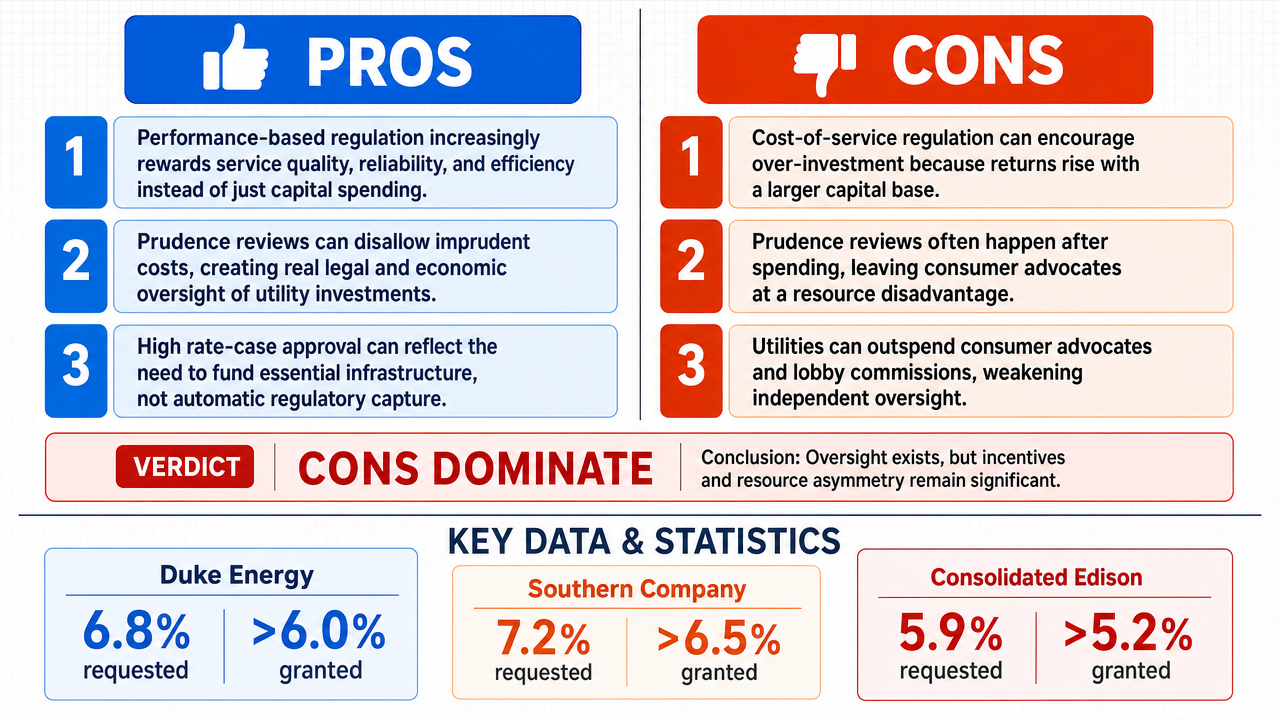
Verdict
Verdict: likely FALSE (55%)
This section provides a brief overview of the key arguments. You do not need to read the full detailed report below.
✅ Key PRO arguments:
- ■The cost-of-service model with a guaranteed return on equity creates a perverse incentive for over-investment in capital projects ('gold-plating '), as higher rate bases directly increase profits, and PUC prudence reviews are weak and rarely disallow significant spending.
- ■Prudence reviews are backward-looking audits that occur years after capital is spent, placing the burden of proof on under-resourced consumer advocates ; in a 2023 Northeastern utility rate case, the commission disallowed only $12 million of a $1.2 billion capital request—a 1% reduction—after the utility had already collected interim rates .
- ■Political and resource asymmetry allows utilities to vastly outspend consumer advocates in rate cases and influence commissions through lobbying , undermining the independence and effectiveness of regulatory oversight.
❌ Key ANTI arguments:
- ■Modern regulatory frameworks have increasingly moved toward Performance-Based Regulation (PBR), which shifts focus from capital expenditure to service outcomes such as reliability and efficiency, tying utility compensation to meeting specific metrics rather than guaranteeing returns on every dollar spent.
- ■Prudence reviews are rigorous legal and economic audits where commissions can and do disallow imprudent expenditures, providing meaningful oversight rather than rubber-stamping utility requests.
- ■High approval rates for rate increases do not imply a lack of scrutiny; rather, they reflect the commission's role in ensuring essential, revenue-requiring infrastructure investment is adequately funded, and rising prices reflect external cost factors rather than regulatory failure.
💭 Conclusion: False. The regulatory framework for US utility monopolies, while imperfect, incorporates meaningful oversight mechanisms such as prudence reviews, rate decoupling , and an evolving shift toward Performance-Based Regulation that ties utility compensation to service outcomes rather than capital expenditure . The PRO side's reliance on token disallowances in rate cases as evidence of systemic failure is undermined by the recognition that high approval rates reflect necessary infrastructure investment rather than rubber-stamping, and that rising consumer prices are driven by external factors such as fuel costs and grid modernization rather than gouging. The ANTI side more accurately characterized the structural role of commissions and the logical distinction between capital expenditure volume and regulatory efficacy. However, legitimate concerns about political capture and resource asymmetry remain unresolved.
🔬 DeepResearch Result: likely FALSE ❌ (55%)
Assertion: The current regulatory framework for US utility monopolies, including Public Utility Commissions , is ineffective at preventing price gouging and ensuring fair consumer rates.
Participating models: deepseek-v3.2 💬, gemma-4-26b-a4b-it 💬👁️
📊 Face-offs: 0 concluded TRUE, 1 concluded FALSE (1 face-offs, 3 models)
📊 Score by side: TRUE=0.00, FALSE=0.55
🏅 Model score changes:
minimax-m3 💬👁️: +6
✅ PRO Arguments:
- ■The cost-of-service model with a guaranteed return on equity creates a perverse incentive for over-investment in capital projects ('gold-plating '), as higher rate bases directly increase profits, and PUC prudence reviews are weak and rarely disallow significant spending. deepseek-v3.2 💬
- ■Prudence reviews are backward-looking audits that occur years after capital is spent, placing the burden of proof on under-resourced consumer advocates ; in a 2023 Northeastern utility rate case, the commission disallowed only $12 million of a $1.2 billion capital request—a 1% reduction—after the utility had already collected interim rates . deepseek-v3.2 💬
- ■Political and resource asymmetry allows utilities to vastly outspend consumer advocates in rate cases and influence commissions through lobbying , undermining the independence and effectiveness of regulatory oversight. deepseek-v3.2 💬
- ■The regulatory framework structurally allows utilities to pass excessive costs to consumers with minimal risk because rate cases approve investments after the fact with weak disallowance mechanisms. deepseek-v3.2 💬
❌ ANTI Arguments:
- ■Modern regulatory frameworks have increasingly moved toward Performance-Based Regulation (PBR), which shifts focus from capital expenditure to service outcomes such as reliability and efficiency, tying utility compensation to meeting specific metrics rather than guaranteeing returns on every dollar spent. gemma-4-26b-a4b-it 💬👁️
- ■Prudence reviews are rigorous legal and economic audits where commissions can and do disallow imprudent expenditures, providing meaningful oversight rather than rubber-stamping utility requests. gemma-4-26b-a4b-it 💬👁️
- ■High approval rates for rate increases do not imply a lack of scrutiny; rather, they reflect the commission's role in ensuring essential, revenue-requiring infrastructure investment is adequately funded, and rising prices reflect external cost factors rather than regulatory failure. gemma-4-26b-a4b-it 💬👁️
- ■The volume of rate requests is a measure of utility capital expenditure requirements, not a measure of regulatory efficacy; using aggregate approval rates as a proxy for 'regulatory failure' is a logical error that conflates necessary infrastructure funding with gouging. gemma-4-26b-a4b-it 💬👁️
💭 Reasoning: False. The regulatory framework for US utility monopolies, while imperfect, incorporates meaningful oversight mechanisms such as prudence reviews, rate decoupling , and an evolving shift toward Performance-Based Regulation that ties utility compensation to service outcomes rather than capital expenditure. The PRO side's reliance on token disallowances in rate cases as evidence of systemic failure is undermined by the recognition that high approval rates reflect necessary infrastructure investment rather than rubber-stamping, and that rising consumer prices are driven by external factors such as fuel costs and grid modernization rather than gouging. The ANTI side more accurately characterized the structural role of commissions and the logical distinction between capital expenditure volume and regulatory efficacy. However, legitimate concerns about political capture and resource asymmetry remain unresolved.
📋 PRO Facts:
• Token disallowances in rate cases represent only a small fraction of requested capital, demonstrating that prudence reviews fail to deter over-investment.
• The cost-of-service model grants utilities a guaranteed return on equity for capital investments, creating incentives for over-investment.
• Prudence reviews occur years after capital is spent, placing the burden of proof on under-resourced consumer advocates.
📋 ANTI Facts:
• Performance-Based Regulation (PBR) ties utility compensation to service outcomes rather than guaranteeing returns on capital expenditure.
• Rate decoupling is incorporated as a meaningful oversight mechanism in the regulatory framework.
• High approval rates for rate increases reflect essential infrastructure funding requirements rather than lack of regulatory scrutiny.
| Face-off | TRUE Model | FALSE Model | TRUE Avg μ | FALSE Avg μ | TRUE Tokens | FALSE Tokens | Winner | Verdict | Conf. |
|---|---|---|---|---|---|---|---|---|---|
| #1 | deepseek-v3.2 💬 | gemma-4-26b-a4b-it 💬👁️ | 0.288 | 0.189 | 12 | 3 | TRUE | FALSE | 55% |
The following technical terms, abbreviations, and domain-specific concepts are referenced throughout this debate transcript. Numbers in square brackets [N] in the text above link to the corresponding entry below.
[1] base return — base return on equity — A guaranteed minimum return on equity that utilities receive under cost-of-service regulation, serving as the foundation upon which performance incentives may be added.
[2] capital expenditure — CapEx — Funds spent by a utility on physical assets and infrastructure, which are added to the rate base and earn a return under cost-of-service regulation.
[3] capital over-investment — capital over-investment / gold-plating — The tendency of utilities under cost-of-service regulation to invest excessively in capital projects because larger rate bases yield higher guaranteed profits.
[4] consumer advocates — Representatives who argue on behalf of ratepayers in utility rate cases, typically possessing far fewer resources than the utilities they oppose.
[5] cost-of-service model — cost-of-service regulation — A regulatory framework in which utilities are allowed to recover their prudently incurred operating costs plus a guaranteed return on capital invested in the rate base.
[6] disallowance — cost disallowance — A regulatory decision by a Public Utility Commission to exclude specific utility costs from the rate base, preventing the utility from recovering those expenses from customers.
[7] double-digit rate increases — Rate hikes of 10% or more, cited in the debate as an outcome of utilities securing approval for large capital investments.
[8] electricity prices — The retail rates charged to consumers for electrical service, which the affirmative side argues have risen faster than inflation and wage growth in regulated states.
[9] empirical trends — Data-based patterns cited as evidence, such as sustained increases in electricity prices relative to inflation and wage growth.
[10] gold-plating — The practice of utilities over-investing in capital projects beyond what is necessary, driven by the incentive that larger rate bases produce higher guaranteed returns.
[11] grid stability — The reliable operation of the electrical power grid, cited by the negative side as a legitimate justification for approving utility capital expenditure.
[12] inflation — The general rise in prices over time, used as a benchmark against which electricity price increases are compared in the debate.
[13] infrastructure projects — Large-scale physical improvements to utility systems, such as power plants and transmission lines, often cited as justification for rate increases.
[14] interim rates — Temporary rates collected from customers during the pendency of a rate case, which the utility typically retains even if final approved rates are lower.
[15] just and reasonable — just and reasonable rates — The legal standard applied by Public Utility Commissions when evaluating whether proposed utility rates are fair to both consumers and the utility.
[16] lobbying — Efforts by utilities to influence regulatory commissions and legislators, cited as a factor contributing to political capture of oversight bodies.
[17] monopoly utilities — Utility companies that operate as the exclusive provider of a service in a given geographic area, justifying regulatory oversight in lieu of competition.
[18] natural gas plant — A type of fossil-fuel power generation facility cited in the debate as an example of utility capital investment that may exceed the cost of renewable alternatives.
[19] natural monopolies — Industries in which competition is inefficient due to high fixed costs, justifying regulatory oversight as a substitute for market competition.
[20] performance incentives — Bonus payments or rate adjustments tied to utilities meeting specified service metrics under Performance-Based Regulation.
[21] Performance-Based Regulation — PBR — An alternative regulatory framework that ties utility compensation to meeting specific performance metrics such as reliability and efficiency, rather than solely to capital investment.
[22] price gouging — The practice of charging consumers excessive prices, which the affirmative side argues the current regulatory framework fails to prevent.
[23] prudence review — A backward-looking audit conducted by a Public Utility Commission to determine whether utility expenditures were reasonable and necessary, with the power to disallow imprudent costs.
[24] Public Utility Commissions — PUCs — State-level regulatory bodies that oversee monopoly utilities, set rates, and conduct prudence reviews of utility expenditures.
[25] rate base — The total value of a utility's capital investments on which it is permitted to earn a guaranteed return under cost-of-service regulation.
[26] rate cases — Formal proceedings before a Public Utility Commission in which a utility seeks approval to change the rates it charges customers.
[27] rate decoupling — A regulatory mechanism that separates a utility's revenue recovery from its volumetric sales, removing the disincentive for energy efficiency programs.
[28] rate increases — Approved hikes in the prices utilities charge customers, which the affirmative side argues are routinely granted while the negative side argues reflect legitimate cost recovery.
[29] rate-setting process — The formal regulatory procedure by which Public Utility Commissions determine the prices utilities may charge consumers.
[30] regulatory capture — A condition in which a regulatory agency advances the interests of the industry it regulates rather than the public interest, cited as a risk in utility oversight.
[31] regulatory dockets — The official records of proceedings before a Public Utility Commission, used in the debate to assess the prevalence of Performance-Based Regulation.
[32] regulatory framework — The system of laws, rules, and oversight bodies governing utility operations and rate-setting, the effectiveness of which is the subject of the debate.
[33] renewable alternatives — Lower-cost clean energy options such as wind or solar, cited as alternatives to natural gas plant investments that utilities nonetheless pursued.
[34] resource asymmetry — The imbalance in financial and legal resources between utilities and consumer advocates in rate case proceedings, cited as compromising oversight.
[35] return on equity — ROE — The profit a utility is permitted to earn on the equity portion of its rate base, guaranteed under cost-of-service regulation and creating incentives for capital investment.
[36] revolving door — The movement of individuals between employment as utility regulators and as utility industry representatives, cited as a factor in regulatory capture.
[37] service reliability — The consistency and quality of utility service delivery, cited as a key performance metric under Performance-Based Regulation.
[38] wage growth — The rate of increase in worker earnings over time, used alongside inflation as a benchmark for assessing whether electricity price increases are fair to consumers.
The following financial data tables were referenced during the debate exchanges:
| Utility | Avg. Annual Rate Increase Requested (2020-2024) | Avg. Annual Increase Granted | Total Increase Granted (Period) |
|---|---|---|---|
| Southern Company | 7.2% | more than -6.5% | ~$2.1B |
| Duke Energy | 6.8% | more than -6.0% | ~$1.8B |
| Consolidated Edison | 5.9% | more than -5.2% | ~$1.3B |
Legend: Analysis of approved rate increases for selected major investor-owned utilities in the US (2020-2024). Figures are approximate based on publicly available rate case orders. The high grant rate shows regulatory deference.
| Driver of Rate Changes | Impact on Utility Cost Structure | Regulatory Role |
|---|---|---|
| Fuel/Commodity Volatility | High (Variable) | Pass-through mechanism with audit |
| Grid Modernization/Renewables | High (Fixed/Capital) | Prudence review and necessity test |
| Operational/Labor Costs | Moderate | Efficiency benchmarking |
| Interest Rates | Moderate | ROE oversight and capital cost review |
Legend: Primary drivers affecting utility rate adjustments. Regulatory frameworks manage these through different mechanisms to ensure costs are justified and efficient.
Face-off transcripts
- ■
Ownership & Trade Secrets. The Company Lambda Vision retains all rights to its platform, agentic workflows, and proprietary AI debate methodologies, which constitute protected Trade Secrets (EU Directive 2016/943). Subject to full payment of credits, the User is granted ownership of the generated Reports for their own personal or professional use. Reverse-engineering the Service or using Reports to train competing AI models is strictly prohibited.
- ■
No Professional Advice. Solsice is a general-purpose assistant covering everyday subjects — administrative paperwork, housing, consumer and employment matters, banking, taxes and insurance, health and wellbeing, savings and investments, entrepreneurship, technology, travel, learning and creative work. Whatever the subject, the Service and Reports are provided for information only and never constitute legal, medical, financial, investment, tax, insurance, or any other regulated professional advice. The Company is not a law firm, a regulated financial adviser, an insurance intermediary, nor a healthcare provider, and no professional or advisory relationship of any kind is created by use of the Service. Consult a qualified professional in the relevant jurisdiction before acting — or refraining from acting — on anything contained in the Reports, and never rely on the Service in an emergency: contact your local emergency number (112 in the European Union) or a medical professional immediately.
- ■
AI-Generated Content, Sources and Viewpoints. Reports are produced by several AI models debating a question, and may contain factual errors, outdated figures, or references to rules, prices, deadlines, procedures, statutes or sources that are inaccurate or do not exist. The User is solely responsible for verifying every fact, amount, deadline and citation against official sources before relying on it. Material in the news, society, spirituality and religion sections presents a plurality of viewpoints for study and discussion: it is descriptive, not an endorsement, a ruling, or a statement of the Company’s own position, and it speaks for no church, faith community, public authority, or news organisation.
- ■
Liability & Governing Law. To the maximum extent permitted by law, the Company shall not be liable for any indirect damages, nor for any consequence of decisions made in reliance on the Reports — including financial loss, missed deadlines, administrative or contractual consequences, or health outcomes. These Terms are governed by French law. Any disputes shall be subject to the exclusive jurisdiction of the Courts of Paris, France.