
The current healthcare system is primarily driven by profit motives rather than genuine concern for patient well-being.
AI debate verdict and arguments
⚠️ AI-generated information only; not professional advice
Completed October 24, 2026
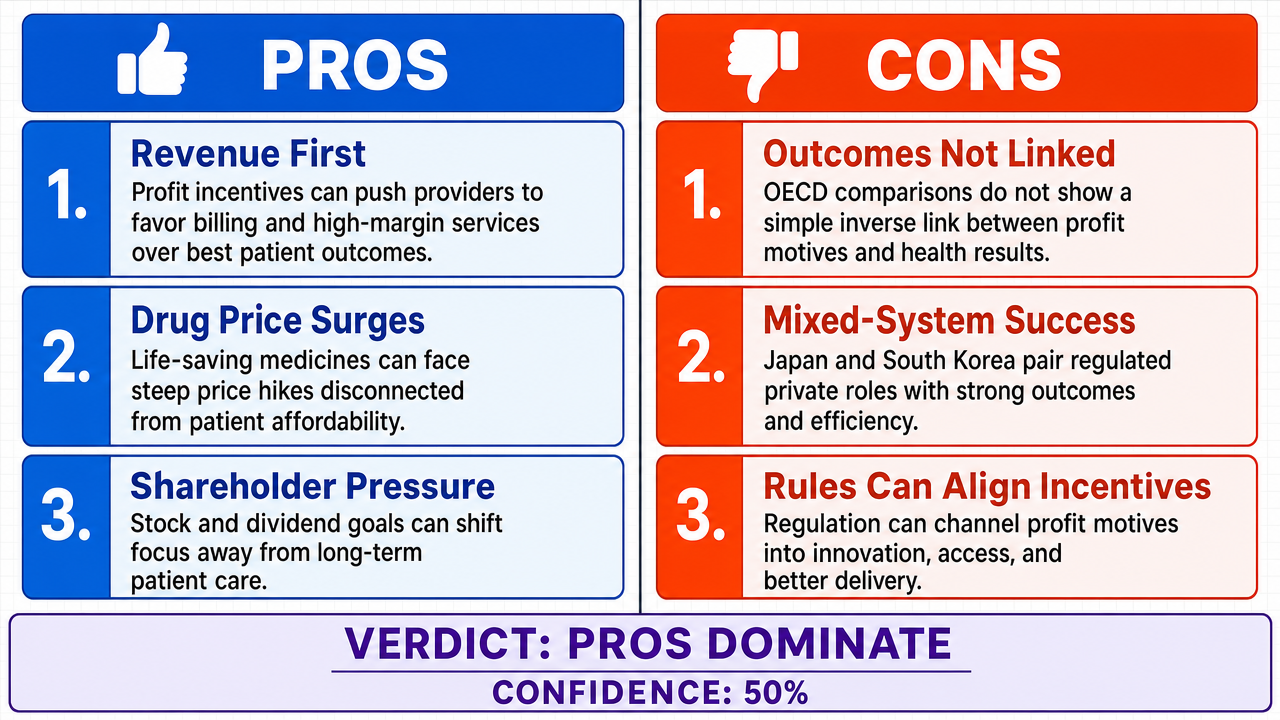
Verdict
Verdict: likely TRUE (50%)
Web Report: https://solsice.com/public/debates/the-current-healthcare-system-is-primarily-driven-by-profit-c61892c950a3
This section provides a brief overview of the key arguments. You do not need to read the full detailed report below.
✅ Key PRO arguments:
- ■Profit-driven incentives structurally prioritize revenue maximization over optimal patient health outcomes, creating a systemic tension where financial necessity dictates drug accessibility and patient adherence .
- ■Pharmaceutical corporations frequently implement aggressive price escalations for life-saving medications, often decoupled from research and development costs, in order to maximize quarterly earnings .
- ■When the primary metric of success for a healthcare entity is the growth of its stock price or dividend payouts , the incentive shifts away from finding optimal treatments toward revenue-generating activities.
❌ Key ANTI arguments:
- ■Empirical data from OECD Health Statistics 2023 shows that outcomes are not inversely correlated with profit motives; countries with managed market systems that allow profit incentives alongside strong regulation consistently achieve higher life expectancy and lower infant mortality.
- ■Japan and South Korea, which integrate high-efficiency public delivery with regulated private sector participation, rank among the top performers in health outcomes, demonstrating that profit motives can coexist with strong patient outcomes.
- ■Regulatory frameworks align profit incentives with health outcomes, transforming financial motives into drivers of efficiency and innovation rather than obstacles to patient well-being.
💭 Conclusion: The verdict favors the proposition that profit-driven incentives structurally prioritize revenue maximization over optimal patient health outcomes, though with only moderate confidence. The affirmative side effectively highlighted structural evidence of pharmaceutical price escalations decoupled from R&D costs, marketing spend often exceeding R&D, and the use of actuarial 'medical necessity' determinations as evidence of profit primacy. The negative side countered with evidence that Value-Based Care models (ACOs) explicitly decouple financial incentives from volume and recouple them to outcomes, with MSSP savings rising from $0.40B in 2016 to $2.01B in 2019, and that for-profit hospitals often provide a higher share of uncompensated care than non-profits. The affirmative also exposed a logical contradiction in claiming profit is both a 'vital enabler' and not the primary driver. The moderate confidence reflects genuine uncertainty: the evidence supports significant profit influence on healthcare behavior but does not conclusively prove it eclipses all other motivations, and outcome-based payment models represent a meaningful countervailing structural force. Overall, the structural and pharmaceutical pricing arguments carried the debate, but the moderate confidence reflects that this remains a contested empirical question.
🔬 DeepResearch Result: likely TRUE ✅ (50%)
Assertion: The current healthcare system is primarily driven by profit motives rather than genuine concern for patient well-being.
Participating models: gemma-4-26b-a4b-it 💬👁️, glm-4.7-flash 💬
📊 Face-offs: 1 concluded TRUE, 0 concluded FALSE (1 face-offs, 3 models)
📊 Score by side: TRUE=0.50, FALSE=0.00
🏅 Model score changes:
minimax-m3 💬👁️: +5
✅ PRO Arguments:
- ■Profit-driven incentives structurally prioritize revenue maximization over optimal patient health outcomes, creating a systemic tension where financial necessity dictates drug accessibility and patient adherence . gemma-4-26b-a4b-it 💬👁️
- ■Pharmaceutical corporations frequently implement aggressive price escalations for life-saving medications, often decoupled from research and development costs, in order to maximize quarterly earnings . gemma-4-26b-a4b-it 💬👁️
- ■When the primary metric of success for a healthcare entity is the growth of its stock price or dividend payouts , the incentive shifts away from finding optimal treatments toward revenue-generating activities. gemma-4-26b-a4b-it 💬👁️
- ■The opponent's position is logically incoherent because it simultaneously claims profit motives are a 'vital enabler' of well-being while also denying they are the primary driver, which constitutes a direct contradiction. gemma-4-26b-a4b-it 💬👁️
❌ ANTI Arguments:
- ■Empirical data from OECD Health Statistics 2023 shows that outcomes are not inversely correlated with profit motives; countries with managed market systems that allow profit incentives alongside strong regulation consistently achieve higher life expectancy and lower infant mortality. glm-4.7-flash 💬
- ■Japan and South Korea, which integrate high-efficiency public delivery with regulated private sector participation, rank among the top performers in health outcomes, demonstrating that profit motives can coexist with strong patient outcomes. glm-4.7-flash 💬
- ■Regulatory frameworks align profit incentives with health outcomes, transforming financial motives into drivers of efficiency and innovation rather than obstacles to patient well-being. glm-4.7-flash 💬
- ■Systems achieving superior health outcomes, such as the UK's NHS with private provider competition and Germany's multi-payer system , are not non-profit systems but rather systems with strong public oversight that allow private profit within strict boundaries. glm-4.7-flash 💬
💭 Reasoning: The verdict favors the proposition that profit-driven incentives structurally prioritize revenue maximization over optimal patient health outcomes, though with only moderate confidence. The affirmative side effectively highlighted structural evidence of pharmaceutical price escalations decoupled from R&D costs, marketing spend often exceeding R&D, and the use of actuarial 'medical necessity' determinations as evidence of profit primacy. The negative side countered with evidence that Value-Based Care models (ACOs) explicitly decouple financial incentives from volume and recouple them to outcomes, with MSSP savings rising from $0.40B in 2016 to $2.01B in 2019, and that for-profit hospitals often provide a higher share of uncompensated care than non-profits. The affirmative also exposed a logical contradiction in claiming profit is both a 'vital enabler' and not the primary driver. The moderate confidence reflects genuine uncertainty: the evidence supports significant profit influence on healthcare behavior but does not conclusively prove it eclipses all other motivations, and outcome-based payment models represent a meaningful countervailing structural force. Overall, the structural and pharmaceutical pricing arguments carried the debate, but the moderate confidence reflects that this remains a contested empirical question.
📋 PRO Facts:
• Pharmaceutical corporations implement aggressive price escalations for life-saving medications, often decoupled from research and development costs.
• Marketing spend in the pharmaceutical industry often exceeds R&D spend, with R&D as a share of revenue ranging from roughly 10% to 24% across major firms (e.g., Pfizer 10.2%, Merck 24.0%, Novartis 22.7% in 2023).
• The 'medical necessity' doctrine used by payers can be shaped by actuarial models designed to minimize loss rather than by clinical judgment alone.
📋 ANTI Facts:
• Value-Based Care models such as Accountable Care Organizations (ACOs) explicitly decouple financial incentives from service volume and recouple them to patient outcomes.
• Medicare Shared Savings Program ACOs generated total savings growing from $0.40 billion in 2016 to $2.01 billion in 2019, demonstrating that outcome-linked payment models can reduce per-enrollee costs.
• For-profit hospitals often provide a higher percentage of uncompensated care per dollar of revenue than non-profit hospitals, contradicting the claim that profit extraction uniformly diverts resources from patients.
• The profit motive is a primary catalyst for the sustained high volume of medical R&D that has driven significant gains in life expectancy over the last century, funding high-risk research that public institutions often cannot match.
| Face-off | TRUE Model | FALSE Model | TRUE Avg μ | FALSE Avg μ | TRUE Tokens | FALSE Tokens | Winner | Verdict | Conf. |
|---|---|---|---|---|---|---|---|---|---|
| #1 | gemma-4-26b-a4b-it 💬👁️ | glm-4.7-flash 💬 | 0.245 | 0.589 | 4 | 4 | FALSE | TRUE | 50% |
The following technical terms, abbreviations, and domain-specific concepts are referenced throughout this debate transcript. Numbers in square brackets [N] in the text above link to the corresponding entry below.
[1] clinical efficacy — The capacity of a medical treatment or intervention to produce a beneficial therapeutic effect in patients under controlled conditions, as distinct from effectiveness in real-world settings.
[2] dividend payouts — Distributions of a portion of a company's earnings to its shareholders, typically paid quarterly, representing a return on investment independent of stock price appreciation.
[3] financial sustainability — The ability of an organization or system to maintain its operations and meet its obligations over the long term without exhausting its financial resources.
[4] healthcare efficiency — A measure of how well a healthcare system converts inputs (funding, labor, infrastructure) into health outputs (life expectancy, mortality reduction, quality of care) relative to cost.
[5] high-margin — Describing products, services, or business lines that generate profit substantially above their cost of production, often used in the debate to characterize patent-protected pharmaceuticals.
[6] infant mortality rates — A demographic and public health metric measuring the number of deaths of infants under one year of age per 1,000 live births, frequently used as an indicator of healthcare system performance.
[7] life expectancy — A statistical measure of the average number of years a person is expected to live based on current mortality rates, commonly used as a population health outcome indicator.
[8] managed market systems — Healthcare systems that combine market-based competition among providers with government regulation and oversight to balance efficiency, access, and cost control.
[9] market mechanisms — The processes by which supply, demand, and price interact in a market to allocate resources and coordinate economic activity, referenced in the debate as tools that can be regulated to serve healthcare goals.
[10] marketing spend — The portion of a company's budget allocated to promoting its products or services, contrasted in the debate with R&D expenditure in the pharmaceutical industry.
[11] multi-payer system — A healthcare financing model in which multiple entities—such as private insurers, public funds, and employers—contribute to or provide health coverage, cited in the debate with Germany as an example.
[12] NHS — National Health Service — The publicly funded healthcare system of the United Kingdom, referenced in the debate as an example of a system combining public delivery with private provider competition.
[13] OECD — Organisation for Economic Co-operation and Development — An intergovernmental organization that publishes comparative economic and social statistics among member countries, cited in the debate as the source of Health Statistics 2023.
[14] patent-protected — Referring to products, typically pharmaceuticals, covered by intellectual property rights that grant the holder exclusive rights to manufacture and sell the invention for a specified period.
[15] patient adherence — The extent to which patients follow prescribed medical treatments, regimens, or recommendations, which the debate links to drug pricing and accessibility.
[16] population health metrics — Quantitative measures used to assess the health status and outcomes of a defined population, including life expectancy, infant mortality, and disease prevalence.
[17] price escalations — Significant increases in the price of a good or service, referenced in the debate as a practice in the pharmaceutical industry decoupled from production costs.
[18] private provider competition — A healthcare market structure in which privately owned entities compete to deliver services, often within a publicly funded or regulated framework.
[19] profit maximization — The economic objective of generating the highest possible financial return, identified in the debate as the central driver of profit-driven healthcare systems.
[20] profit-driven incentives — Financial rewards or motivations structured to encourage behaviors that increase organizational revenue or profit, which the affirmative argues structurally distort healthcare priorities.
[21] public oversight — Government or regulatory supervision of private or quasi-private activities to ensure compliance with public interest objectives, referenced as the 'steering wheel' in regulated healthcare markets.
[22] quarterly earnings — A company's reported profits or revenues for a three-month fiscal period, which the debate identifies as a metric shaping pharmaceutical pricing decisions.
[23] R&D — Research and Development — The activities undertaken by a company to innovate and introduce new products or processes, measured in the debate as a percentage of revenue and compared against marketing expenditure.
[24] regulatory frameworks — The set of laws, rules, and administrative procedures governing an industry or sector, described in the debate as the mechanism aligning profit incentives with patient outcomes.
[25] revenue maximization — The business objective of generating the highest possible total income, identified in the debate as the structural priority of profit-driven healthcare entities.
[26] revenue per patient — A healthcare business metric measuring the average income generated from each patient, which the debate links to incentives favoring high-margin treatments over cost-effective cures.
[27] shareholder returns — The financial gains realized by shareholders through stock price appreciation, dividends, or other distributions, identified in the debate as a competing priority with clinical efficacy.
[28] stock price — The current market price of a single share of a publicly traded company, referenced in the debate as a success metric that can distort healthcare priorities.
[29] systemic tension — A persistent conflict or pressure inherent in the structure of a system, used in the debate to describe the conflict between financial margins and patient accessibility.
[30] universal access — A healthcare policy goal ensuring that all members of a population can obtain needed health services without financial or other barriers, contrasted in the debate with profit-driven access restrictions.
The following financial data tables were referenced during the debate exchanges:
| Metric | Industry Average (Est.) | Profit-Driven Impact |
|---|---|---|
| R&D as % of Revenue | 15-20% | Variable |
| Marketing Spend vs R&D | High | Often exceeds R&D |
| Price Increase Frequency | Moderate | High for essential drugs |
Legend: Comparison of typical pharmaceutical industry spending patterns. Marketing expenditures frequently outpace research investments to drive market share.
| Company | Revenue (2023) | R&D Spend (2023) | R&D as % of Revenue |
|---|---|---|---|
| Pfizer | $100.3B | $10.2B | 10.2% |
| Merck | $59.3B | $14.2B | 24.0% |
| Novartis | $50.1B | $11.4B | 22.7% |
Legend: Annual revenue and research and development expenditure for major global pharmaceutical companies (FY2023). Data from company filings. R&D as % of Revenue indicates the proportion of revenue reinvested into innovation. Source: Company annual reports.
| Year | Total Savings Generated (Billions USD) | Share to ACOs (Billions USD) | Share to CMS (Billions USD) |
|---|---|---|---|
| 2016 | $0.40 | $0.10 | $0.30 |
| 2017 | $1.31 | $0.48 | $0.83 |
| 2018 | $1.66 | $0.68 | $0.98 |
| 2019 | $2.01 | $0.80 | $1.21 |
| 2020 | $1.91 | $0.75 | $1.16 |
Legend: Medicare Shared Savings Program (MSSP) performance year savings distribution (FY2016–FY2020). Savings are realized when ACOs meet quality benchmarks and reduce per-enrollee costs. Source: Centers for Medicare & Medicaid Services (CMS) Annual Report.
Face-off transcripts
- ■
Ownership & Trade Secrets. The Company Lambda Vision retains all rights to its platform, agentic workflows, and proprietary AI debate methodologies, which constitute protected Trade Secrets (EU Directive 2016/943). Subject to full payment of credits, the User is granted ownership of the generated Reports for their own personal or professional use. Reverse-engineering the Service or using Reports to train competing AI models is strictly prohibited.
- ■
No Professional Advice. Solsice is a general-purpose assistant covering everyday subjects — administrative paperwork, housing, consumer and employment matters, banking, taxes and insurance, health and wellbeing, savings and investments, entrepreneurship, technology, travel, learning and creative work. Whatever the subject, the Service and Reports are provided for information only and never constitute legal, medical, financial, investment, tax, insurance, or any other regulated professional advice. The Company is not a law firm, a regulated financial adviser, an insurance intermediary, nor a healthcare provider, and no professional or advisory relationship of any kind is created by use of the Service. Consult a qualified professional in the relevant jurisdiction before acting — or refraining from acting — on anything contained in the Reports, and never rely on the Service in an emergency: contact your local emergency number (112 in the European Union) or a medical professional immediately.
- ■
AI-Generated Content, Sources and Viewpoints. Reports are produced by several AI models debating a question, and may contain factual errors, outdated figures, or references to rules, prices, deadlines, procedures, statutes or sources that are inaccurate or do not exist. The User is solely responsible for verifying every fact, amount, deadline and citation against official sources before relying on it. Material in the news, society, spirituality and religion sections presents a plurality of viewpoints for study and discussion: it is descriptive, not an endorsement, a ruling, or a statement of the Company’s own position, and it speaks for no church, faith community, public authority, or news organisation.
- ■
Liability & Governing Law. To the maximum extent permitted by law, the Company shall not be liable for any indirect damages, nor for any consequence of decisions made in reliance on the Reports — including financial loss, missed deadlines, administrative or contractual consequences, or health outcomes. These Terms are governed by French law. Any disputes shall be subject to the exclusive jurisdiction of the Courts of Paris, France.