
The current EBT system allows individuals who are not genuinely in need to receive benefits, leading to a misuse of public funds.
AI debate verdict and arguments
⚠️ AI-generated information only; not professional advice
Completed October 18, 2026
Verdict
Verdict: likely TRUE (58%)
Web Report: https://solsice.com/public/debates/the-current-ebt-system-allows-individuals-who-are-not-genuin-63a309b6d7a5
This section provides a brief overview of the key arguments. You do not need to read the full detailed report below.
✅ Key PRO arguments:
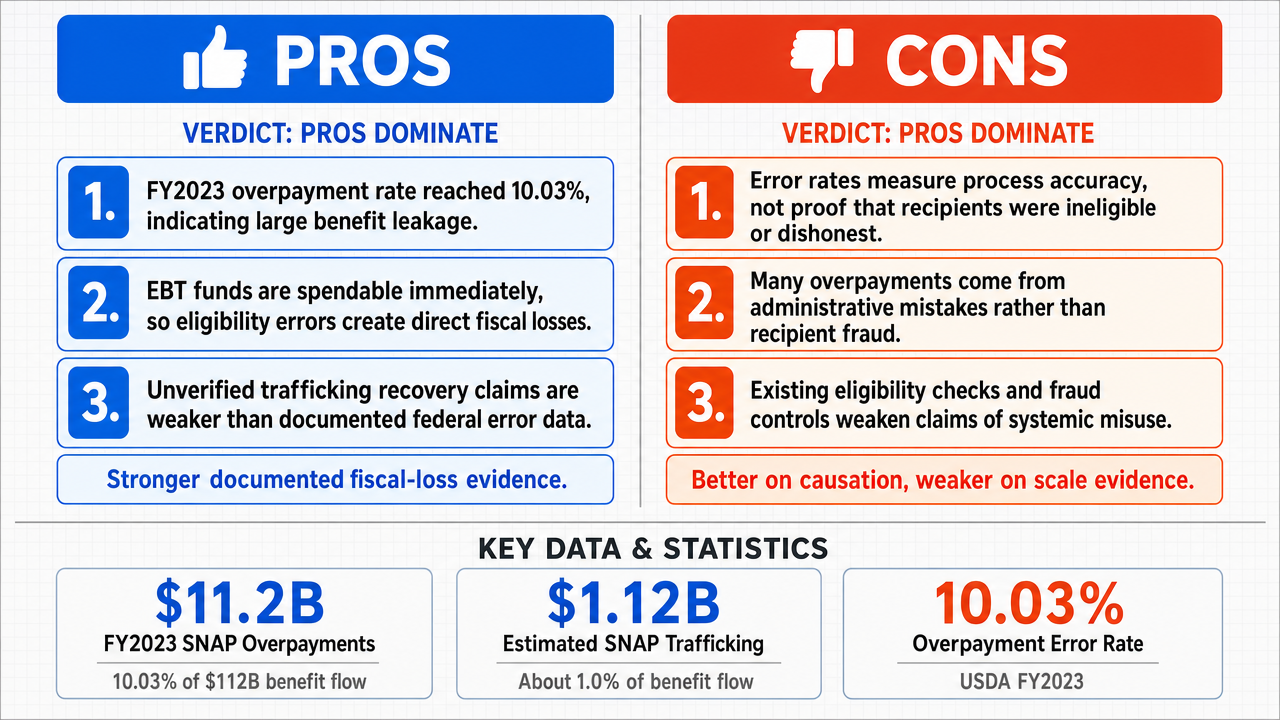
- ■Federal quality-control data shows the SNAP overpayment error rate was 10.03% of benefit dollars in FY2023, with a total payment error rate of 11.68%, implying more than $11 billion in gross overpayments against a national benefit level of roughly $112 billion.
- ■Because EBT benefits are loaded onto cards that can be spent immediately at authorized retailers , eligibility or benefit-calculation errors translate directly into actual fund disbursement rather than being caught before payout.
- ■The cited 'tens of millions of dollars' trafficking recovery figure is given without a report title, publication date, or URL, making it unverifiable, and it measures enforcement output rather than the underlying scale of misuse.
❌ Key ANTI arguments:
- ■An error rate is a measurement of administrative process accuracy, not of recipient intent or eligibility status, so conflating data entry errors and calculation lags with 'individuals who are not genuinely in need' is a logical failure.
- ■Errors fall into two mutually exclusive branches: recipient-level misinformation or fraud, versus agency-level administrative or processing mistakes, and the record does not support recipient-level causes as the primary driver of the 10.03% rate.
- ■The EBT system maintains high integrity through rigorous eligibility controls and fraud detection , so the affirmative's framing of systemic misuse by ineligible individuals is not supported by the underlying administrative data.
💭 Conclusion: The FY2023 SNAP overpayment error rate of 10.03% and total payment error rate of 11.68%, applied to a roughly $112 billion national benefit level , imply approximately $11.2 billion in gross overpayments . However, the evidence indicates that these error rates measure administrative process accuracy rather than recipient intent or eligibility status. Federal quality control data distinguishes between recipient-caused errors and agency-level administrative or processing mistakes, meaning the aggregate overpayment rate cannot be treated as a direct proxy for recipient ineligibility. The overpayment figure also substantially exceeds the estimated trafficking share of about 1% (approximately $1.12 billion), indicating that administrative error, not fraud, is the dominant source of federal loss.
🔬 DeepResearch Result: likely TRUE ✅ (58%)
Assertion: The current EBT system allows individuals who are not genuinely in need to receive benefits, leading to a misuse of public funds.
Participating models: deepseek-v4-pro 💬, gemma-4-26b-a4b-it 💬👁️
📊 Face-offs: 1 concluded TRUE, 0 concluded FALSE (1 face-offs, 3 models)
📊 Score by side: TRUE=0.58, FALSE=0.00
🏅 Model score changes:
minimax-m3 💬👁️: +6
✅ PRO Arguments:
- ■Federal quality-control data shows the SNAP overpayment error rate was 10.03% of benefit dollars in FY2023, with a total payment error rate of 11.68%, implying more than $11 billion in gross overpayments against a national benefit level of roughly $112 billion. deepseek-v4-pro 💬
- ■Because EBT benefits are loaded onto cards that can be spent immediately at authorized retailers , eligibility or benefit-calculation errors translate directly into actual fund disbursement rather than being caught before payout. deepseek-v4-pro 💬
- ■The cited 'tens of millions of dollars' trafficking recovery figure is given without a report title, publication date, or URL, making it unverifiable, and it measures enforcement output rather than the underlying scale of misuse. deepseek-v4-pro 💬
- ■Every benefit dollar is either recorded as a trafficking recovery or absent from that record, so the opponent's argument that trafficking is a small, actively prosecuted subset cannot account for the broader overpayment error rate. deepseek-v4-pro 💬
❌ ANTI Arguments:
- ■An error rate is a measurement of administrative process accuracy, not of recipient intent or eligibility status, so conflating data entry errors and calculation lags with 'individuals who are not genuinely in need' is a logical failure. gemma-4-26b-a4b-it 💬👁️
- ■Errors fall into two mutually exclusive branches: recipient-level misinformation or fraud, versus agency-level administrative or processing mistakes, and the record does not support recipient-level causes as the primary driver of the 10.03% rate. gemma-4-26b-a4b-it 💬👁️
- ■The EBT system maintains high integrity through rigorous eligibility controls and fraud detection , so the affirmative's framing of systemic misuse by ineligible individuals is not supported by the underlying administrative data. gemma-4-26b-a4b-it 💬👁️
💭 Reasoning: The FY2023 SNAP overpayment error rate of 10.03% and total payment error rate of 11.68%, applied to a roughly $112 billion national benefit level, imply approximately $11.2 billion in gross overpayments. However, the evidence indicates that these error rates measure administrative process accuracy rather than recipient intent or eligibility status. Federal quality control data distinguishes between recipient-caused errors and agency-level administrative or processing mistakes, meaning the aggregate overpayment rate cannot be treated as a direct proxy for recipient ineligibility. The overpayment figure also substantially exceeds the estimated trafficking share of about 1% (approximately $1.12 billion), indicating that administrative error, not fraud, is the dominant source of federal loss.
📋 PRO Facts:
• SNAP overpayment error rate was 10.03% of benefit dollars in FY2023
• Total SNAP payment error rate was 11.68% in FY2023
• National SNAP benefit level was roughly $112 billion
• Gross overpayments implied by the error rate exceed $11 billion
📋 ANTI Facts:
• Error rates measure administrative process accuracy, not recipient intent or eligibility status
• Errors can originate from agency-level administrative or processing mistakes rather than recipient fraud
| Face-off | TRUE Model | FALSE Model | TRUE Avg μ | FALSE Avg μ | TRUE Tokens | FALSE Tokens | Winner | Verdict | Conf. |
|---|---|---|---|---|---|---|---|---|---|
| #1 | deepseek-v4-pro 💬 | gemma-4-26b-a4b-it 💬👁️ | 0.679 | 0.319 | 6 | 2 | TRUE | TRUE | 58% |
The following technical terms, abbreviations, and domain-specific concepts are referenced throughout this debate transcript. Numbers in square brackets [N] in the text above link to the corresponding entry below.
[1] agency error — In the context of SNAP quality control, an overpayment caused by administrative or processing mistakes made by the administering agency, as distinguished from errors caused by recipients.
[2] authorized retailers — Stores and merchants approved to accept EBT cards for the purchase of eligible items under benefit programs such as SNAP.
[3] benefit dollars — The total monetary value of benefits issued through a program such as SNAP, used as the denominator when computing error rates.
[4] benefit trafficking — The illegal exchange or resale of SNAP benefits (typically loaded on EBT cards) for cash or non-eligible goods, identified in the debate as a form of misuse.
[5] benefit-calculation error — A mistake in determining the dollar amount of a benefit a household is entitled to, which can result in overpayments loaded onto EBT cards.
[6] detection net — The set of monitoring, auditing, and enforcement mechanisms used to identify and recover trafficked or improperly used benefits; the affirmative argues this net leaves most trafficking outside its reach.
[7] EBT — Electronic Benefit Transfer — An electronic system that delivers government benefit funds onto a card recipients can use at authorized retailers, as referenced throughout the debate.
[8] eligibility controls — The rules, verification procedures, and administrative checks used to determine whether an individual or household qualifies to receive benefits.
[9] enforcement output — The measurable results of fraud detection and prosecution activity, such as dollars recovered or cases closed, which the negative distinguishes from the underlying level of misuse.
[10] federal quality control — A measurement system used to assess the accuracy of benefit administration, producing error rates that distinguish recipient-caused from agency-caused errors.
[11] Food and Nutrition Service — FNS — The federal agency referenced in the debate as the source of estimates regarding SNAP benefit trafficking (roughly one cent per benefit dollar).
[12] fraud detection — The processes and tools used to identify benefit recipients who obtain payments through misrepresentation, trafficking, or other prohibited conduct.
[13] FY — Fiscal Year — A 12-month accounting period used for government budgeting and reporting; the debate cites fiscal year 2023 SNAP data.
[14] gross overpayments — The total dollar value of benefits issued in excess of what recipients were entitled to, before any recovery or offset; the affirmative estimates this at more than $11 billion for SNAP in FY2023.
[15] national benefit level — The aggregate dollar value of benefits issued under a program across all states in a given period, cited in the debate as roughly $112 billion for SNAP.
[16] overpayment error rate — The share of benefit dollars paid in excess of what recipients were entitled to, expressed as a percentage; cited in the debate as 10.03% for SNAP in FY2023. The affirmative treats this as evidence of misuse by ineligible individuals, while the negative argues it largely reflects administrative error rather than recipient fraud.
[17] payment error rate — The broader share of benefit dollars paid incorrectly, encompassing both overpayments and underpayments; cited in the debate as 11.68% for SNAP in FY2023.
[18] recipient error — In SNAP quality control, an overpayment caused by information or circumstances provided by the recipient, as distinguished from agency error.
[19] recipient fraud — Deliberate misrepresentation or concealment by a benefit recipient to obtain payments they are not entitled to, which the debate distinguishes from administrative error.
[20] SNAP — Supplemental Nutrition Assistance Program — A federal benefit program that provides funds via EBT cards for households to purchase food at authorized retailers, cited in the debate as having a roughly $112 billion national benefit level.
[21] state administrative error — A mistake in benefit administration attributable to the state agency processing the case, such as data entry or calculation errors.
[22] trafficking — In the SNAP context, the exchange of EBT benefits for cash, alcohol, tobacco, or other non-eligible items; the affirmative cites a Food and Nutrition Service estimate of roughly one cent per benefit dollar.
[23] transfer operator — The entity that processes EBT transactions between retailers and benefit recipients; the negative argues that without this operator's records showing specific dollars were diverted to ineligible persons, error statistics reflect agency process rather than recipient misuse.
The following financial data tables were referenced during the debate exchanges:
| SNAP payment accuracy measure | FY2023 rate |
|---|---|
| Overpayment error rate | 10.03% |
| Underpayment error rate | 1.65% |
| Total payment error rate | 11.68% |
Legend: SNAP national payment error rates for fiscal year 2023, expressed as percentages of benefit dollars. The overpayment rate is the dominant source of federal loss. Source: USDA Food and Nutrition Service, SNAP Payment Error Rates, https://www.fns.usda.gov/snap/qc/per.
| Error Type | Impact Category | Nature of Error |
|---|---|---|
| Overpayment | Administrative/Eligibility | Calculation or data lag |
| Underpayment | Administrative/Eligibility | Systemic under-calculation |
| Trafficking | Criminal/Fraud | Intentional diversion |
Legend: Categorization of SNAP error types based on the nature of the discrepancy. Overpayments and underpayments are primarily administrative in origin, while trafficking is a criminal subset.
| Measure | Annual amount | Share of $112 billion national benefit flow |
|---|---|---|
| Opponent's documented trafficking recoveries | tens of millions (no locator) | not verifiable |
| Federal estimated SNAP trafficking (about 1%) | about $1.12 billion | about 1.0% |
| SNAP overpayments, fiscal year 2023 | about $11.2 billion | 10.03% |
Legend: Comparison of the documented recovery figure the opponent cites against the national trafficking estimate and SNAP overpayment total. Trafficking share is approximately one cent per benefit dollar; overpayment share is the reported fiscal 2023 rate. Sources: Food and Nutrition Service retailer trafficking page, https://www.fns.usda.gov/snap/retailer-trafficking, and SNAP payment error rates, https://www.fns.usda.gov/snap/qc/per.
| Error Category | Primary Driver | Impact on Misuse Claim |
|---|---|---|
| Recipient Error | Misreporting/Fraud | Supports claim of misuse |
| Agency Error | Data Entry/Processing | Refutes claim of misuse |
| Total Overpayment | Combined | Ambiguous without breakdown |
Legend: Categorization of SNAP error drivers. The opponent's claim relies on the assumption that all overpayments fall into the "Recipient Error" category, which is not supported by the distinction between agency and recipient error in federal quality control reports.
Face-off transcripts
- ■
Ownership & Trade Secrets. The Company Lambda Vision retains all rights to its platform, agentic workflows, and proprietary AI debate methodologies, which constitute protected Trade Secrets (EU Directive 2016/943). Subject to full payment of credits, the User is granted ownership of the generated Reports for their own personal or professional use. Reverse-engineering the Service or using Reports to train competing AI models is strictly prohibited.
- ■
No Professional Advice. Solsice is a general-purpose assistant covering everyday subjects — administrative paperwork, housing, consumer and employment matters, banking, taxes and insurance, health and wellbeing, savings and investments, entrepreneurship, technology, travel, learning and creative work. Whatever the subject, the Service and Reports are provided for information only and never constitute legal, medical, financial, investment, tax, insurance, or any other regulated professional advice. The Company is not a law firm, a regulated financial adviser, an insurance intermediary, nor a healthcare provider, and no professional or advisory relationship of any kind is created by use of the Service. Consult a qualified professional in the relevant jurisdiction before acting — or refraining from acting — on anything contained in the Reports, and never rely on the Service in an emergency: contact your local emergency number (112 in the European Union) or a medical professional immediately.
- ■
AI-Generated Content, Sources and Viewpoints. Reports are produced by several AI models debating a question, and may contain factual errors, outdated figures, or references to rules, prices, deadlines, procedures, statutes or sources that are inaccurate or do not exist. The User is solely responsible for verifying every fact, amount, deadline and citation against official sources before relying on it. Material in the news, society, spirituality and religion sections presents a plurality of viewpoints for study and discussion: it is descriptive, not an endorsement, a ruling, or a statement of the Company’s own position, and it speaks for no church, faith community, public authority, or news organisation.
- ■
Liability & Governing Law. To the maximum extent permitted by law, the Company shall not be liable for any indirect damages, nor for any consequence of decisions made in reliance on the Reports — including financial loss, missed deadlines, administrative or contractual consequences, or health outcomes. These Terms are governed by French law. Any disputes shall be subject to the exclusive jurisdiction of the Courts of Paris, France.