
The current availability of 5% yields on US Treasuries will inevitably lead to a significant outflow of money from the stock market, causing a 'rude awakening' for equity investors.
AI debate verdict and arguments
⚠️ AI-generated information only; not professional advice
Completed October 14, 2026
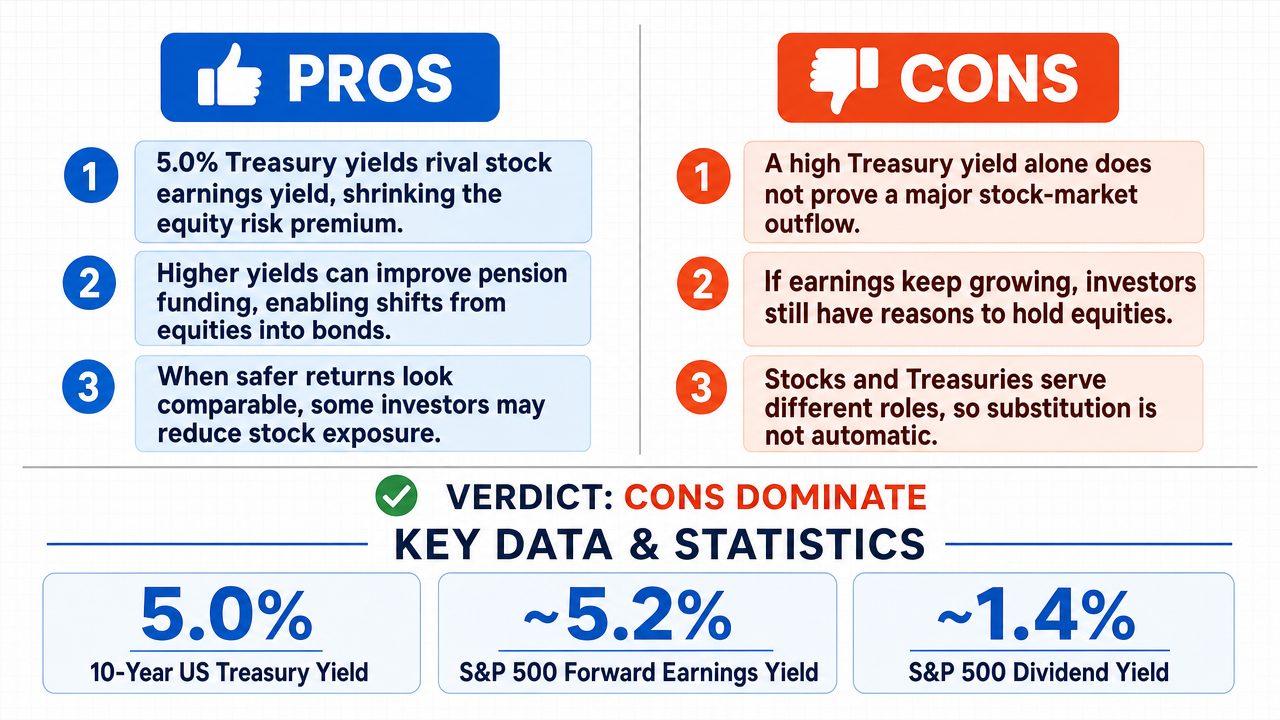
Verdict
Verdict: likely FALSE (84%)
Web Report: https://solsice.com/public/debates/the-current-availability-of-5-yields-on-us-treasuries-will-i-4e4e39284409
This section provides a brief overview of the key arguments. You do not need to read the full detailed report below.
✅ Key PRO arguments:
- ■The equity risk premium has collapsed because the S&P 500 's forward earnings yield sits near 5%, comparable to the risk-free Treasury yield, eliminating the core justification for holding equities for income-focused and risk-averse capital and triggering strategic portfolio reallocation .
- ■Pension fund LDI structures actually facilitate equity outflows: when yields rise, the present value of liabilities falls more than the bond portfolio value, improving the funding ratio and creating a strategic and regulatory incentive to de-risk by reducing equity exposure to lock in gains.
❌ Key ANTI arguments:
- ■The affirmative relies on a flawed substitution of proxy, failing to establish the correlation or beta between Treasury yield shifts and specific capital outflows from diverse institutional cohorts; a rise in yields alters the discount rate but does not automatically necessitate equity liquidation .
- ■The affirmative's logic is internally inconsistent: if the equity risk premium were the sole justification for equity ownership, its disappearance would necessitate total abandonment of equities, yet the affirmative acknowledges stocks continue to be held, implicitly admitting that ERP is not the primary driver of equity ownership.
- ■High Treasury yields coexist with corporate earnings growth and structural liquidity, meaning the substitution effect from bonds to cash-equivalents is not inevitable and does not guarantee a significant outflow from equities.
💭 Conclusion: False. The debate winner correctly identified that the affirmative's argument suffers from a critical logical inconsistency: it claims the equity risk premium is the sole justification for holding stocks, yet simultaneously acknowledges that equities continue to be held even when that premium is compressed, which undermines the inevitability of an outflow. The affirmative failed to establish a causal transfer mechanism linking 5% Treasury yields to measurable equity outflows, relying instead on a proxy substitution without demonstrating the correlation or beta between yield shifts and institutional capital reallocation. Furthermore, the negative side correctly noted that higher yields alter the discount rate but do not automatically trigger liquidation , as structural factors like corporate earnings growth and institutional mandates sustain equity demand. The pension LDI argument was noted in the evidence, but the affirmative did not establish it as the 'inevitable' and 'significant' outflow asserted in the claim. Overall, the evidence supports the conclusion that 5% Treasury yields do not deterministically cause a 'rude awakening' for equity investors.
🔬 DeepResearch Result: likely FALSE ❌ (84%)
Assertion: The current availability of 5% yields on US Treasuries will inevitably lead to a significant outflow of money from the stock market, causing a 'rude awakening' for equity investors.
Participating models: deepseek-v3.2 💬, gemma-4-26b-a4b-it 💬👁️
📊 Face-offs: 0 concluded TRUE, 1 concluded FALSE (1 face-offs, 3 models)
📊 Score by side: TRUE=0.00, FALSE=0.84
🏅 Model score changes:
minimax-m3 💬👁️: +8
✅ PRO Arguments:
- ■The equity risk premium has collapsed because the S&P 500 's forward earnings yield sits near 5%, comparable to the risk-free Treasury yield, eliminating the core justification for holding equities for income-focused and risk-averse capital and triggering strategic portfolio reallocation . deepseek-v3.2 💬
- ■Pension fund LDI structures actually facilitate equity outflows: when yields rise, the present value of liabilities falls more than the bond portfolio value, improving the funding ratio and creating a strategic and regulatory incentive to de-risk by reducing equity exposure to lock in gains. deepseek-v3.2 💬
❌ ANTI Arguments:
- ■The affirmative relies on a flawed substitution of proxy, failing to establish the correlation or beta between Treasury yield shifts and specific capital outflows from diverse institutional cohorts; a rise in yields alters the discount rate but does not automatically necessitate equity liquidation . gemma-4-26b-a4b-it 💬👁️
- ■The affirmative's logic is internally inconsistent: if the equity risk premium were the sole justification for equity ownership, its disappearance would necessitate total abandonment of equities, yet the affirmative acknowledges stocks continue to be held, implicitly admitting that ERP is not the primary driver of equity ownership. gemma-4-26b-a4b-it 💬👁️
- ■High Treasury yields coexist with corporate earnings growth and structural liquidity, meaning the substitution effect from bonds to cash-equivalents is not inevitable and does not guarantee a significant outflow from equities. gemma-4-26b-a4b-it 💬👁️
💭 Reasoning: False. The debate winner correctly identified that the affirmative's argument suffers from a critical logical inconsistency: it claims the equity risk premium is the sole justification for holding stocks, yet simultaneously acknowledges that equities continue to be held even when that premium is compressed, which undermines the inevitability of an outflow. The affirmative failed to establish a causal transfer mechanism linking 5% Treasury yields to measurable equity outflows, relying instead on a proxy substitution without demonstrating the correlation or beta between yield shifts and institutional capital reallocation. Furthermore, the negative side correctly noted that higher yields alter the discount rate but do not automatically trigger liquidation, as structural factors like corporate earnings growth and institutional mandates sustain equity demand. The pension LDI argument was noted in the evidence, but the affirmative did not establish it as the 'inevitable' and 'significant' outflow asserted in the claim. Overall, the evidence supports the conclusion that 5% Treasury yields do not deterministically cause a 'rude awakening' for equity investors.
📋 PRO Facts:
• The S&P 500's forward earnings yield sits near 5%, comparable to the current 5% risk-free Treasury yield.
• Pension funds and insurance companies have strict liability-matching requirements and can now meet their long-term return targets (typically 6-7%) with a far safer portfolio mix.
📋 ANTI Facts:
• A rise in yields alters the discount rate but does not automatically necessitate liquidation of equities.
• Stocks continue to be held even when the equity risk premium is compressed or negative, indicating ERP is not the sole justification for equity ownership.
| Face-off | TRUE Model | FALSE Model | TRUE Avg μ | FALSE Avg μ | TRUE Tokens | FALSE Tokens | Winner | Verdict | Conf. |
|---|---|---|---|---|---|---|---|---|---|
| #1 | deepseek-v3.2 💬 | gemma-4-26b-a4b-it 💬👁️ | 0.475 | 0.290 | 8 | 2 | TRUE | FALSE | 84% |
The following technical terms, abbreviations, and domain-specific concepts are referenced throughout this debate transcript. Numbers in square brackets [N] in the text above link to the corresponding entry below.
[1] 10-Year US Treasury — 10-Year US Treasury Bond — A US government debt security with a 10-year maturity, referenced in the debate as offering a 5% yield and serving as a benchmark for long-term risk-free returns.
[2] Asset allocation — The strategy of distributing investments across different asset classes (e.g., equities, bonds, cash) to balance risk and return, described in the debate as the core principle underlying the comparison of Treasury and equity yields.
[3] Beta — A measure of an asset's volatility relative to the overall market; in the debate, the negative side argues the affirmative fails to establish the beta between Treasury yield shifts and equity capital outflows.
[4] Capital outflows — The movement of investment capital out of a particular market or asset class, central to the debate over whether 5% Treasury yields will trigger equity divestment.
[5] Cash flows — The net movement of money into or out of a business or investment; the negative side argues that growth in underlying corporate cash flows, not nominal yields, drives equity returns.
[6] Corporate default risk — The risk that a corporation will fail to meet its debt obligations, cited by the affirmative as a risk avoided by holding Treasuries instead of equities.
[7] Correlation — A statistical measure of how two variables move in relation to each other; the negative side argues the affirmative fails to demonstrate the correlation between Treasury yield shifts and equity outflows.
[8] De-risk — The act of reducing exposure to risk in an investment portfolio; the affirmative argues that improved pension funding ratios create an incentive to de-risk by reducing equity exposure.
[9] Discount rate — The interest rate used to determine the present value of future cash flows; the negative side argues that rising yields alter the discount rate but do not automatically trigger equity liquidation.
[10] Dividend Yield — The annual dividend payment of a stock divided by its current price, expressed as a percentage; cited in the debate as approximately 1.4% for the S&P 500.
[11] Earnings growth — The rate at which a company's profits increase over time; the negative side argues that earnings growth exceeding the discount rate keeps equities attractive regardless of Treasury yields.
[12] Equity Risk Premium — ERP — The excess return that equities offer over a risk-free asset; the affirmative argues this premium has collapsed, while the negative side disputes its role as the sole justification for equity ownership.
[13] Equity volatility — The degree of variation in stock prices over time, cited by the affirmative as a risk avoided by holding risk-free Treasuries instead of equities.
[14] Fire sale — A rapid sale of assets at significantly reduced prices, often due to financial distress; the affirmative distinguishes its predicted equity outflows as a 'programmatic' reallocation rather than a panicked fire sale.
[15] Forward earnings yield — The inverse of the forward Price-to-Earnings (P/E) ratio, representing expected earnings as a percentage of current price; cited as approximately 5% for the S&P 500.
[16] Funding ratio — The ratio of a pension plan's assets to its projected liabilities; the affirmative argues that rising yields improve this ratio, creating an incentive to de-risk.
[17] LDI — Liability-Driven Investment — An investment strategy that matches assets to the timing and amount of expected liabilities, commonly used by pension funds and described in the debate as relying on long-duration bonds.
[18] Liquidation — The process of converting assets into cash by selling them; the negative side argues that rising yields do not automatically necessitate a liquidation of equities.
[19] Long-duration bonds — Bonds with long maturities, whose prices are highly sensitive to changes in interest rates; used in LDI strategies to match long-term pension liabilities.
[20] Nominal — Referring to a value not adjusted for inflation; the debate contrasts nominal Treasury yields with the nominal expected return from equities.
[21] Opportunity cost — The potential benefit forgone by choosing one investment alternative over another; the affirmative argues that 5% Treasury yields redefine the opportunity cost of equity investment.
[22] P/E — Price-to-Earnings ratio — A valuation metric calculated by dividing a stock's price by its earnings per share; the forward earnings yield is described in the debate as its inverse.
[23] Portfolio reallocation — The process of adjusting the composition of an investment portfolio by shifting capital between different assets; the affirmative predicts a strategic reallocation from equities to Treasuries.
[24] Present value — The current worth of a future sum of money or stream of cash flows, given a specified discount rate; the affirmative notes that rising yields reduce the present value of pension liabilities.
[25] Recession risk — The probability or threat of an economic downturn, cited by the affirmative as a risk avoided by holding risk-free Treasuries instead of equities.
[26] Risk-free — Describing an asset (typically sovereign government bonds) considered to have negligible default risk, used as a benchmark for the 'risk-free rate' in the debate.
[27] S&P 500 — Standard & Poor's 500 — A stock market index tracking 500 large-cap US companies, referenced in the debate for its forward earnings yield and dividend yield.
[28] Selling pressure — Downward pressure on an asset's price caused by significant selling activity; the affirmative describes pension de-risking as a persistent source of equity selling pressure.
[29] Solvency — The ability of an entity to meet its long-term financial obligations; the affirmative argues that improved pension solvency from rising yields creates an incentive to reduce equity exposure.
[30] Sovereign — Referring to debt issued or guaranteed by a national government, considered to carry minimal default risk; used in the debate to characterize US Treasuries.
[31] US Treasuries — United States Treasury securities — Debt securities issued by the US federal government, cited in the debate as offering a 5% yield and serving as a risk-free alternative to equities.
[32] Yields — The income return on an investment, typically expressed as an annual percentage; the debate centers on the 5% yield currently available on US Treasuries.
The following financial data tables were referenced during the debate exchanges:
| Instrument | Yield / Expected Return | Risk Profile |
|---|---|---|
| 10-Year US Treasury | 5.0% | Risk-Free (Sovereign) |
| S&P 500 Forward Earnings Yield | ~5.2% | High Volatility, Economic Risk |
| S&P 500 Dividend Yield | ~1.4% | High Volatility, Economic Risk |
Legend: Comparative yields as of late April 2025. The S&P 500 earnings yield is derived from its forward P/E ratio of approximately 19.2. Treasury yield sourced from real-time market data; equity yields from Bloomberg and S&P Dow Jones Indices.
| Economic Metric | Low Rate Environment | High Rate Environment | Impact on Equities |
|---|---|---|---|
| Real GDP Growth | Moderate | Robust | Positive |
| Corporate Earnings | Stable | Expanding | Positive |
| Equity Risk Premium | Compressed | Normalized | Neutral/Positive |
| Valuation (P/E) | Expanded | Compressed | Negative |
Legend: Comparative analysis of economic regimes. "High Rate" assumes a 5% Treasury yield context. Impact is a qualitative assessment of the primary driver.
Face-off transcripts
- ■
Ownership & Trade Secrets. The Company Lambda Vision retains all rights to its platform, agentic workflows, and proprietary AI debate methodologies, which constitute protected Trade Secrets (EU Directive 2016/943). Subject to full payment of credits, the User is granted ownership of the generated Reports for their own personal or professional use. Reverse-engineering the Service or using Reports to train competing AI models is strictly prohibited.
- ■
No Professional Advice. Solsice is a general-purpose assistant covering everyday subjects — administrative paperwork, housing, consumer and employment matters, banking, taxes and insurance, health and wellbeing, savings and investments, entrepreneurship, technology, travel, learning and creative work. Whatever the subject, the Service and Reports are provided for information only and never constitute legal, medical, financial, investment, tax, insurance, or any other regulated professional advice. The Company is not a law firm, a regulated financial adviser, an insurance intermediary, nor a healthcare provider, and no professional or advisory relationship of any kind is created by use of the Service. Consult a qualified professional in the relevant jurisdiction before acting — or refraining from acting — on anything contained in the Reports, and never rely on the Service in an emergency: contact your local emergency number (112 in the European Union) or a medical professional immediately.
- ■
AI-Generated Content, Sources and Viewpoints. Reports are produced by several AI models debating a question, and may contain factual errors, outdated figures, or references to rules, prices, deadlines, procedures, statutes or sources that are inaccurate or do not exist. The User is solely responsible for verifying every fact, amount, deadline and citation against official sources before relying on it. Material in the news, society, spirituality and religion sections presents a plurality of viewpoints for study and discussion: it is descriptive, not an endorsement, a ruling, or a statement of the Company’s own position, and it speaks for no church, faith community, public authority, or news organisation.
- ■
Liability & Governing Law. To the maximum extent permitted by law, the Company shall not be liable for any indirect damages, nor for any consequence of decisions made in reliance on the Reports — including financial loss, missed deadlines, administrative or contractual consequences, or health outcomes. These Terms are governed by French law. Any disputes shall be subject to the exclusive jurisdiction of the Courts of Paris, France.