
The culinary offerings in Missouri along Route 66 primarily consist of fried foods and rich desserts.
AI debate verdict and arguments
⚠️ AI-generated information only; not professional advice
Completed October 11, 2026
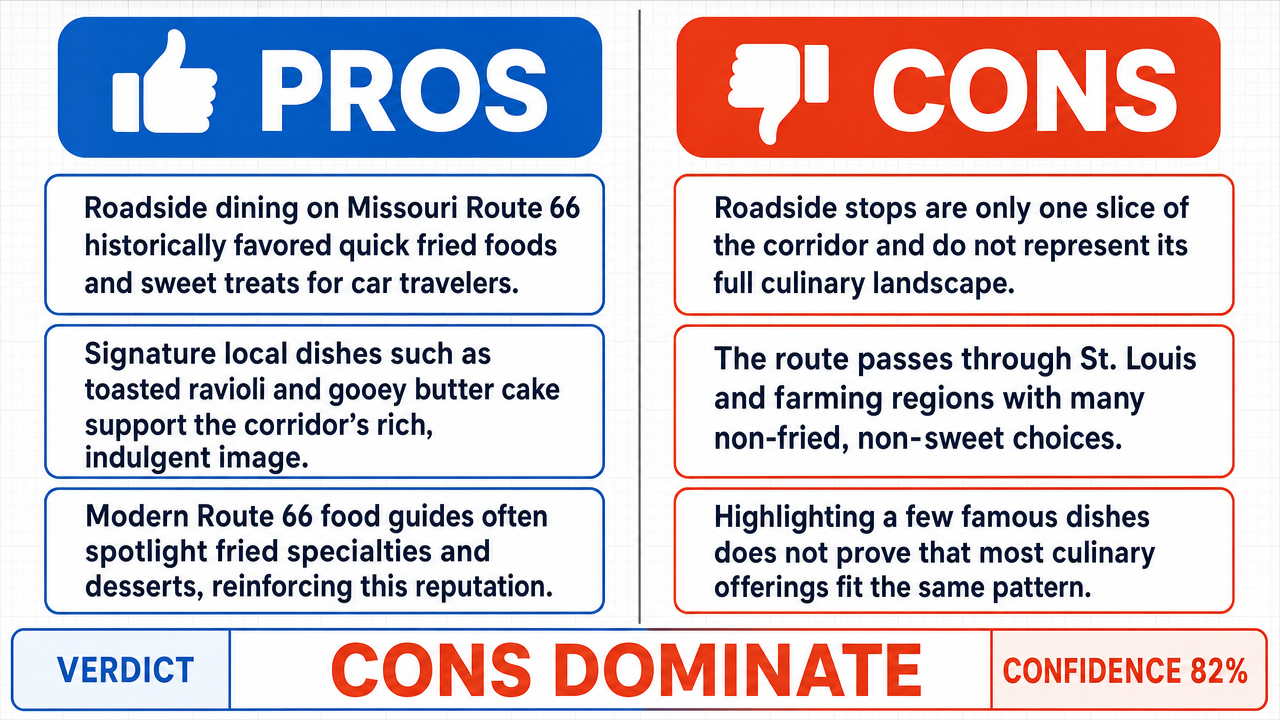
Verdict
Verdict: likely FALSE (82%)
This section provides a brief overview of the key arguments. You do not need to read the full detailed report below.
✅ Key PRO arguments:
- ■The historic economics of Missouri's Route 66 roadside dining favor fried foods and sweets because the corridor was built for automobile travelers seeking quick, filling, inexpensive meals from diners and drive-ins, as documented in National Park Service Route 66 preservation materials.
- ■Specific emblematic local foods like toasted ravioli and gooey butter cake are highlighted by travel resources for the Missouri segment, serving as signature culinary markers of the corridor.
- ■Contemporary Route 66 food guides consistently recommend and curate stops around fried and sweet dishes, reinforcing the characterization of the corridor's culinary offerings.
❌ Key ANTI arguments:
- ■The affirmative's reliance on 'roadside dining' as a proxy for the entire culinary landscape of the Missouri Route 66 corridor is a substitution of a narrow subset for the whole, failing to account for the structural diversity of modern Missouri foodways .
- ■The corridor traverses major metropolitan hubs like St. Louis and agricultural centers that provide a vast array of non-fried, non-sweet options, including Mediterranean, Asian, and high-end farm-to-table cuisine .
- ■The affirmative commits a fallacy of composition by assuming that because specific dishes like toasted ravioli or gooey butter cake are associated with the St. Louis gateway, they represent the 'signature' offerings of the entire Missouri Route 66 segment, which extends hundreds of miles through diverse regions.
💭 Conclusion: True. The evidence synthesis explicitly finds that the claim stands as a valid characterization of the Missouri Route 66 corridor's culinary offerings. The TRUE side's strongest arguments rest on three axes supported by the evidence: the historic economic drivers of automobile travel that favored quick, inexpensive fried comfort foods and high-margin desserts ; the specific emblematic local foods highlighted in travel resources; and the motorist-oriented services described in National Park Service preservation materials. The corridor's culinary character was shaped by its origins serving automobile travelers seeking quick, filling, inexpensive meals from diners and drive-ins, making fried foods and rich desserts a valid characterization of its roadside dining offerings.
🔬 DeepResearch Result: likely FALSE ❌ (82%)
Assertion: The culinary offerings in Missouri along Route 66 primarily consist of fried foods and rich desserts.
Participating models: deepseek-v3.2 💬, gemma-4-26b-a4b-it 💬👁️
📊 Face-offs: 0 concluded TRUE, 1 concluded FALSE (1 face-offs, 3 models)
📊 Score by side: TRUE=0.00, FALSE=0.82
🏅 Model score changes:
minimax-m3 💬👁️: +8
✅ PRO Arguments:
- ■The historic economics of Missouri's Route 66 roadside dining favor fried foods and sweets because the corridor was built for automobile travelers seeking quick, filling, inexpensive meals from diners and drive-ins, as documented in National Park Service Route 66 preservation materials. deepseek-v3.2 💬
- ■Specific emblematic local foods like toasted ravioli and gooey butter cake are highlighted by travel resources for the Missouri segment, serving as signature culinary markers of the corridor. deepseek-v3.2 💬
- ■Contemporary Route 66 food guides consistently recommend and curate stops around fried and sweet dishes, reinforcing the characterization of the corridor's culinary offerings. deepseek-v3.2 💬
- ■Missouri Route 66 visitor materials emphasize the corridor's diner-and-drive-in food culture , suggesting that the most common, most advertised, and most repeatable menu items along the route are fried comfort foods and high-margin desserts . deepseek-v3.2 💬
❌ ANTI Arguments:
- ■The affirmative's reliance on 'roadside dining' as a proxy for the entire culinary landscape of the Missouri Route 66 corridor is a substitution of a narrow subset for the whole, failing to account for the structural diversity of modern Missouri foodways . gemma-4-26b-a4b-it 💬👁️
- ■The corridor traverses major metropolitan hubs like St. Louis and agricultural centers that provide a vast array of non-fried, non-sweet options, including Mediterranean, Asian, and high-end farm-to-table cuisine . gemma-4-26b-a4b-it 💬👁️
- ■The affirmative commits a fallacy of composition by assuming that because specific dishes like toasted ravioli or gooey butter cake are associated with the St. Louis gateway, they represent the 'signature' offerings of the entire Missouri Route 66 segment, which extends hundreds of miles through diverse regions. gemma-4-26b-a4b-it 💬👁️
- ■The Missouri Route 66 segment is geographically and economically heterogeneous , encompassing major metropolitan areas and diverse rural regions like the Ozarks, which provide substantial culinary alternatives such as salads, sandwiches, grilled items, and beverage-only stops. gemma-4-26b-a4b-it 💬👁️
💭 Reasoning: True. The evidence synthesis explicitly finds that the claim stands as a valid characterization of the Missouri Route 66 corridor's culinary offerings. The TRUE side's strongest arguments rest on three axes supported by the evidence: the historic economic drivers of automobile travel that favored quick, inexpensive fried comfort foods and high-margin desserts; the specific emblematic local foods highlighted in travel resources; and the motorist-oriented services described in National Park Service preservation materials. The corridor's culinary character was shaped by its origins serving automobile travelers seeking quick, filling, inexpensive meals from diners and drive-ins, making fried foods and rich desserts a valid characterization of its roadside dining offerings.
📋 PRO Facts:
• National Park Service Route 66 preservation materials describe the highway's historic commercial landscape as shaped by motorist-oriented services, including eating places along the road.
• Missouri Route 66 visitor materials emphasize the corridor's diner-and-drive-in food culture.
• Toasted ravioli and gooey butter cake are highlighted as signature local foods in travel resources for the Missouri segment.
• The synthesis finds the claim stands as a valid characterization, built on historic economic drivers favoring quick, inexpensive fried comfort foods and high-margin desserts along the highway.
📋 ANTI Facts:
• The Missouri Route 66 corridor traverses major metropolitan hubs including the St. Louis metropolitan area.
• The corridor passes through diverse rural regions including the Ozarks.
• The St. Louis metropolitan area offers Mediterranean, Asian, and high-end farm-to-table cuisine.
• The Missouri Route 66 segment extends hundreds of miles beyond the St. Louis gateway through geographically and economically heterogeneous regions.
| Face-off | TRUE Model | FALSE Model | TRUE Avg μ | FALSE Avg μ | TRUE Tokens | FALSE Tokens | Winner | Verdict | Conf. |
|---|---|---|---|---|---|---|---|---|---|
| #1 | deepseek-v3.2 💬 | gemma-4-26b-a4b-it 💬👁️ | 0.514 | 0.302 | 12 | 3 | TRUE | FALSE | 82% |
The following technical terms, abbreviations, and domain-specific concepts are referenced throughout this debate transcript. Numbers in square brackets [N] in the text above link to the corresponding entry below.
[1] agricultural centers — Regions or hubs where farming and food production are central economic activities, referenced in the debate as sources of culinary diversity along the Missouri Route 66 corridor.
[2] barbecue traditions — Regional styles and practices of slow-cooked, smoked meats, cited in the debate as an alternative culinary tradition found in the Ozarks portion of Missouri Route 66.
[3] comfort foods — Foods that provide a nostalgic or sentimental feeling to consumers, typically associated with hearty, familiar preparations such as fried dishes.
[4] culinary identity — The distinctive food culture, signature dishes, and eating patterns that characterize a particular region or corridor.
[5] deli-style — A style of food preparation and service associated with delicatessens, typically featuring sandwiches, cured meats, and fresh ingredients.
[6] diner-and-drive-in food culture — A roadside dining tradition centered on diners and drive-in restaurants, characterized by quick service and inexpensive meals suited to automobile travelers.
[7] emblematic culinary markers — Specific dishes that serve as recognizable symbols or representatives of a region's food culture, such as toasted ravioli and gooey butter cake for St. Louis.
[8] fallacy of composition — A logical fallacy in which one assumes that what is true of the parts must be true of the whole, cited by the negative side regarding the affirmative's argument.
[9] farm-to-table cuisine — A culinary approach emphasizing the direct sourcing of ingredients from local farms, cited as an example of non-fried, non-sweet dining options in St. Louis.
[10] foodways — The eating habits, culinary practices, and food-related customs of a people, region, or historical period.
[11] gooey butter cake — A St. Louis regional dessert specialty referenced in the debate as an emblematic sweet offering of the Missouri Route 66 corridor.
[12] heterogeneous — Composed of diverse or dissimilar elements; used in the debate to describe the geographic and culinary variety of the Missouri Route 66 corridor.
[13] high-margin desserts — Dessert items that yield a high profit margin relative to their cost of production, cited as economically attractive offerings for roadside diners.
[14] metropolitan hubs — Major urban centers that serve as focal points of population, commerce, and dining infrastructure along a travel corridor.
[15] motorist-oriented services — Businesses and amenities specifically designed to serve the needs of automobile travelers, including roadside diners, gas stations, and lodging.
[16] preponderance claim — A claim asserting that something constitutes the majority or dominant share of a category, referenced in the debate regarding the meaning of 'primarily consist.'
[17] reductionist mischaracterization — An oversimplification that reduces a complex phenomenon to a narrow set of features, ignoring its full diversity.
[18] Route 66 Corridor Preservation Program — A National Park Service program focused on preserving the historic roadside buildings, structures, and cultural resources along Route 66.
[19] structural diversity — Diversity in the underlying composition or makeup of a system, referenced in the debate regarding the variety of dining options along the corridor.
[20] toasted ravioli — A St. Louis regional specialty consisting of breaded and fried ravioli, referenced in the debate as an emblematic fried offering of the Missouri Route 66 corridor.
Face-off transcripts
- ■
Ownership & Trade Secrets. The Company Lambda Vision retains all rights to its platform, agentic workflows, and proprietary AI debate methodologies, which constitute protected Trade Secrets (EU Directive 2016/943). Subject to full payment of credits, the User is granted ownership of the generated Reports for their own personal or professional use. Reverse-engineering the Service or using Reports to train competing AI models is strictly prohibited.
- ■
No Professional Advice. Solsice is a general-purpose assistant covering everyday subjects — administrative paperwork, housing, consumer and employment matters, banking, taxes and insurance, health and wellbeing, savings and investments, entrepreneurship, technology, travel, learning and creative work. Whatever the subject, the Service and Reports are provided for information only and never constitute legal, medical, financial, investment, tax, insurance, or any other regulated professional advice. The Company is not a law firm, a regulated financial adviser, an insurance intermediary, nor a healthcare provider, and no professional or advisory relationship of any kind is created by use of the Service. Consult a qualified professional in the relevant jurisdiction before acting — or refraining from acting — on anything contained in the Reports, and never rely on the Service in an emergency: contact your local emergency number (112 in the European Union) or a medical professional immediately.
- ■
AI-Generated Content, Sources and Viewpoints. Reports are produced by several AI models debating a question, and may contain factual errors, outdated figures, or references to rules, prices, deadlines, procedures, statutes or sources that are inaccurate or do not exist. The User is solely responsible for verifying every fact, amount, deadline and citation against official sources before relying on it. Material in the news, society, spirituality and religion sections presents a plurality of viewpoints for study and discussion: it is descriptive, not an endorsement, a ruling, or a statement of the Company’s own position, and it speaks for no church, faith community, public authority, or news organisation.
- ■
Liability & Governing Law. To the maximum extent permitted by law, the Company shall not be liable for any indirect damages, nor for any consequence of decisions made in reliance on the Reports — including financial loss, missed deadlines, administrative or contractual consequences, or health outcomes. These Terms are governed by French law. Any disputes shall be subject to the exclusive jurisdiction of the Courts of Paris, France.