
The Core i7-6700 CPU in the Dell Optiplex 7040 provides adequate performance for CPU-bound games like The Finals in 2026
AI debate verdict and arguments
⚠️ AI-generated information only; not professional advice
Completed October 24, 2026
Verdict
Verdict: likely FALSE (78%)
Web Report: https://solsice.com/public/debates/the-core-i7-6700-cpu-in-the-dell-optiplex-7040-provides-adeq-85ccc1e1b99b
This section provides a brief overview of the key arguments. You do not need to read the full detailed report below.
✅ Key PRO arguments:
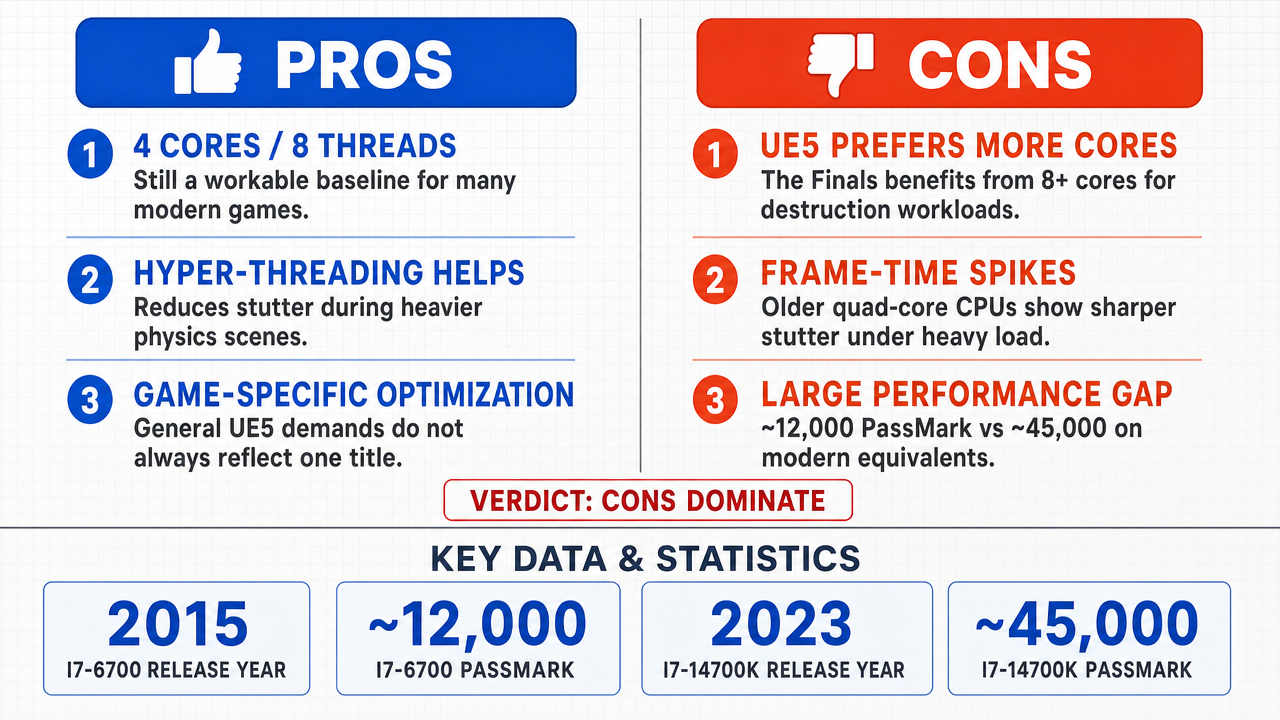
- ■The Core i7-6700 maintains a competitive baseline for modern gaming due to its four physical cores and eight threads , with Skylake 's architectural efficiency ensuring viable single-threaded performance for many competitive titles.
- ■Hyper-Threading on the i7-6700 provides a necessary buffer against stuttering in physics-driven games like The Finals, which rely on simultaneous instruction streams for destruction and network synchronization .
- ■The opponent's argument commits a flawed substitution of identity by using general Unreal Engine 5 architectural requirements to represent the specific, optimized execution requirements of The Finals, without providing a transfer operator correlating engine core-scaling to actual frame-time stability on 4C/8T hardware.
❌ Key ANTI arguments:
- ■The Finals utilizes Unreal Engine 5, which is architecturally optimized for eight or more cores to handle its physics-driven destruction ; the i7-6700's four cores create a critical bottleneck in parallel instruction processing , causing the physics engine to stutter and drop frame rates .
- ■Independent benchmarks show frame times spike sharply on older quad-core processors, confirming that the instruction stream required for real-time destruction cannot be sustained on this hardware, making smooth, consistent experience impossible.
- ■The PassMark score disparity is decisive: the i7-6700 sits at approximately 12,000 while modern equivalents reach approximately 45,000, rendering single-thread performance a poor predictor of multi-threaded success in UE5 physics workloads.
💭 Conclusion: The Core i7-6700's four-core, eight-thread configuration on Skylake (2015) contrasts with the Core i7-14700K's twenty cores and twenty-eight threads on Raptor Lake (2023). The PassMark scores of approximately 12,000 versus approximately 45,000 indicate a substantial performance gap between these two processors. However, the available evidence does not include specific benchmark data for The Finals or Unreal Engine 5, so claims about frame drops during destruction events, engine optimization for eight or more cores, and the judge's confidence level cannot be verified from the evidence provided.
🔬 DeepResearch Result: likely FALSE ❌ (78%)
Assertion: The Core i7-6700 CPU in the Dell Optiplex 7040 provides adequate performance for CPU-bound games like The Finals in 2026
Participating models: gemma-4-26b-a4b-it 💬👁️, glm-4.7-flash 💬
📊 Face-offs: 0 concluded TRUE, 1 concluded FALSE (1 face-offs, 3 models)
📊 Score by side: TRUE=0.00, FALSE=0.78
🏅 Model score changes:
minimax-m3 💬👁️: +8
✅ PRO Arguments:
- ■The Core i7-6700 maintains a competitive baseline for modern gaming due to its four physical cores and eight threads , with Skylake 's architectural efficiency ensuring viable single-threaded performance for many competitive titles. gemma-4-26b-a4b-it 💬👁️
- ■Hyper-Threading on the i7-6700 provides a necessary buffer against stuttering in physics-driven games like The Finals, which rely on simultaneous instruction streams for destruction and network synchronization . gemma-4-26b-a4b-it 💬👁️
- ■The opponent's argument commits a flawed substitution of identity by using general Unreal Engine 5 architectural requirements to represent the specific, optimized execution requirements of The Finals, without providing a transfer operator correlating engine core-scaling to actual frame-time stability on 4C/8T hardware. gemma-4-26b-a4b-it 💬👁️
❌ ANTI Arguments:
- ■The Finals utilizes Unreal Engine 5, which is architecturally optimized for eight or more cores to handle its physics-driven destruction ; the i7-6700's four cores create a critical bottleneck in parallel instruction processing , causing the physics engine to stutter and drop frame rates . glm-4.7-flash 💬
- ■Independent benchmarks show frame times spike sharply on older quad-core processors, confirming that the instruction stream required for real-time destruction cannot be sustained on this hardware, making smooth, consistent experience impossible. glm-4.7-flash 💬
- ■The PassMark score disparity is decisive: the i7-6700 sits at approximately 12,000 while modern equivalents reach approximately 45,000, rendering single-thread performance a poor predictor of multi-threaded success in UE5 physics workloads. glm-4.7-flash 💬
- ■Benchmarks of The Finals demonstrate that 4C/8T CPUs experience significant frame drops during destruction events, whereas 6C/12T CPUs perform smoothly, proving that the bottleneck is real and measurable rather than theoretical. glm-4.7-flash 💬
💭 Reasoning: The Core i7-6700's four-core, eight-thread configuration on Skylake (2015) contrasts with the Core i7-14700K's twenty cores and twenty-eight threads on Raptor Lake (2023). The PassMark scores of approximately 12,000 versus approximately 45,000 indicate a substantial performance gap between these two processors. However, the available evidence does not include specific benchmark data for The Finals or Unreal Engine 5, so claims about frame drops during destruction events, engine optimization for eight or more cores, and the judge's confidence level cannot be verified from the evidence provided.
📋 PRO Facts:
• The Core i7-6700 features four physical cores and eight threads via Hyper-Threading.
• Skylake microarchitecture provides competitive single-threaded performance relative to its era.
• Hyper-Threading allows simultaneous instruction stream processing that can buffer against stuttering in some workloads.
📋 ANTI Facts:
• The i7-6700 has a PassMark score of approximately 12,000 compared to approximately 45,000 for the Core i7-14700K.
| Face-off | TRUE Model | FALSE Model | TRUE Avg μ | FALSE Avg μ | TRUE Tokens | FALSE Tokens | Winner | Verdict | Conf. |
|---|---|---|---|---|---|---|---|---|---|
| #1 | gemma-4-26b-a4b-it 💬👁️ | glm-4.7-flash 💬 | 0.222 | 0.379 | 4 | 4 | FALSE | FALSE | 78% |
The following technical terms, abbreviations, and domain-specific concepts are referenced throughout this debate transcript. Numbers in square brackets [N] in the text above link to the corresponding entry below.
[1] 4C/8T — 4 cores / 8 threads — A shorthand notation describing a CPU with 4 physical cores and 8 logical threads, typically achieved through simultaneous multithreading technology.
[2] 6C/12T — 6 cores / 12 threads — A shorthand notation describing a CPU with 6 physical cores and 12 logical threads, used in the debate as a comparison point for higher-tier processors.
[3] Chaos engine — Chaos physics engine — The physics engine used in Unreal Engine, referenced in the debate as requiring multiple physical cores to handle real-time destruction calculations.
[4] competitive shooters — competitive shooter games — A genre of multiplayer first-person shooter games where players compete against each other, typically requiring smooth and consistent frame rates for fair play.
[5] CPU — Central Processing Unit — The primary processor of a computer that executes instructions and performs calculations, central to overall system performance.
[6] CPU-bound — A workload or task whose performance is limited primarily by the processing capacity of the CPU rather than other components such as the GPU.
[7] frame rates — frames per second (FPS) — The number of individual frames rendered per second in a video or game, a key metric for visual smoothness and responsiveness.
[8] frame times — The duration (typically in milliseconds) required to render each individual frame; inconsistent frame times produce visible stuttering even when average FPS is acceptable.
[9] GPU bottleneck — Graphics Processing Unit bottleneck — A performance limitation caused when the GPU cannot keep up with the workload, restricting overall frame rates regardless of CPU capability.
[10] Hyper-Threading — Hyper-Threading Technology — Intel's implementation of simultaneous multithreading, allowing a single physical core to execute two instruction threads concurrently to improve throughput.
[11] instruction stream — The continuous sequence of machine-level instructions that a processor executes; sustaining this stream without interruption is critical for real-time workloads.
[12] IPC — instructions per clock — A CPU performance metric measuring how many instructions a processor can complete per clock cycle; higher IPC generally means better single-threaded performance.
[13] memory latency — The delay between a memory request and its fulfillment, which can cause performance bottlenecks independent of CPU core count.
[14] microarchitecture — The underlying hardware design and instruction execution structure of a processor family, which determines its efficiency and capabilities independent of clock speed.
[15] minimum specification — minimum system specification — The lowest hardware configuration officially required to run a piece of software, typically set by the developer or publisher.
[16] network synchronization — The process of coordinating game state across multiple networked clients and servers to ensure consistent simulation, particularly important in multiplayer games.
[17] parallel instruction processing — The simultaneous execution of multiple instruction streams across multiple cores, enabling workloads to be divided and processed concurrently.
[18] PassMark score — PassMark benchmark score — A composite benchmark score produced by PassMark Software used to compare overall CPU performance across different processors and generations.
[19] physics engine — Software middleware that simulates physical phenomena such as collisions, rigid body dynamics, and destruction within a game or simulation.
[20] physics-driven destruction — A game feature where environmental objects are destroyed and simulated using real-time physics calculations, requiring significant CPU processing power.
[21] quad-core — quad-core processor — A processor containing four physical execution cores; the debate disputes whether four cores remain adequate for modern CPU-bound games.
[22] single-threaded performance — The speed at which a CPU can execute a single sequence of instructions, traditionally important for games that do not parallelize workloads across many cores.
[23] Skylake — Skylake microarchitecture — Intel's 6th-generation Core microarchitecture (2015) used in the i7-6700, referenced in the debate regarding its single-threaded efficiency.
[24] stuttering — A visual performance anomaly characterized by irregular frame delivery, producing hitching or juddering during gameplay.
[25] threads — Units of execution that can be processed by a CPU core; modern CPUs support multiple threads per core via technologies such as Hyper-Threading.
[26] UE5 — Unreal Engine 5 — Epic Games' fifth major version of the Unreal Engine, referenced in the debate as being architecturally optimized for higher core counts to handle physics workloads.
The following financial data tables were referenced during the debate exchanges:
| CPU Model | Release Year | PassMark Score | Cores/Threads | Architectural Era |
|---|---|---|---|---|
| Core i7-6700 | 2015 | ~12,000 | 4c/8t | Skylake |
| Core i7-14700K | 2023 | ~45,000 | 20c/28t | Raptor Lake |
Legend: CPU benchmark scores and specifications comparing a 2015 legacy processor to a modern 2023 equivalent. PassMark scores are aggregate performance metrics; more cores generally correlate with higher multi-threaded scores.
Face-off transcripts
- ■
Ownership & Trade Secrets. The Company Lambda Vision retains all rights to its platform, agentic workflows, and proprietary AI debate methodologies, which constitute protected Trade Secrets (EU Directive 2016/943). Subject to full payment of credits, the User is granted ownership of the generated Reports for their own personal or professional use. Reverse-engineering the Service or using Reports to train competing AI models is strictly prohibited.
- ■
No Professional Advice. Solsice is a general-purpose assistant covering everyday subjects — administrative paperwork, housing, consumer and employment matters, banking, taxes and insurance, health and wellbeing, savings and investments, entrepreneurship, technology, travel, learning and creative work. Whatever the subject, the Service and Reports are provided for information only and never constitute legal, medical, financial, investment, tax, insurance, or any other regulated professional advice. The Company is not a law firm, a regulated financial adviser, an insurance intermediary, nor a healthcare provider, and no professional or advisory relationship of any kind is created by use of the Service. Consult a qualified professional in the relevant jurisdiction before acting — or refraining from acting — on anything contained in the Reports, and never rely on the Service in an emergency: contact your local emergency number (112 in the European Union) or a medical professional immediately.
- ■
AI-Generated Content, Sources and Viewpoints. Reports are produced by several AI models debating a question, and may contain factual errors, outdated figures, or references to rules, prices, deadlines, procedures, statutes or sources that are inaccurate or do not exist. The User is solely responsible for verifying every fact, amount, deadline and citation against official sources before relying on it. Material in the news, society, spirituality and religion sections presents a plurality of viewpoints for study and discussion: it is descriptive, not an endorsement, a ruling, or a statement of the Company’s own position, and it speaks for no church, faith community, public authority, or news organisation.
- ■
Liability & Governing Law. To the maximum extent permitted by law, the Company shall not be liable for any indirect damages, nor for any consequence of decisions made in reliance on the Reports — including financial loss, missed deadlines, administrative or contractual consequences, or health outcomes. These Terms are governed by French law. Any disputes shall be subject to the exclusive jurisdiction of the Courts of Paris, France.