
The content creator's decision to operate entirely alone without assistants or a team is the primary reason their earnings are comparatively low despite a substantial following.
AI debate verdict and arguments
⚠️ AI-generated information only; not professional advice
Completed October 11, 2026
Verdict
Verdict: likely FALSE (80%)
This section provides a brief overview of the key arguments. You do not need to read the full detailed report below.
✅ Key PRO arguments:
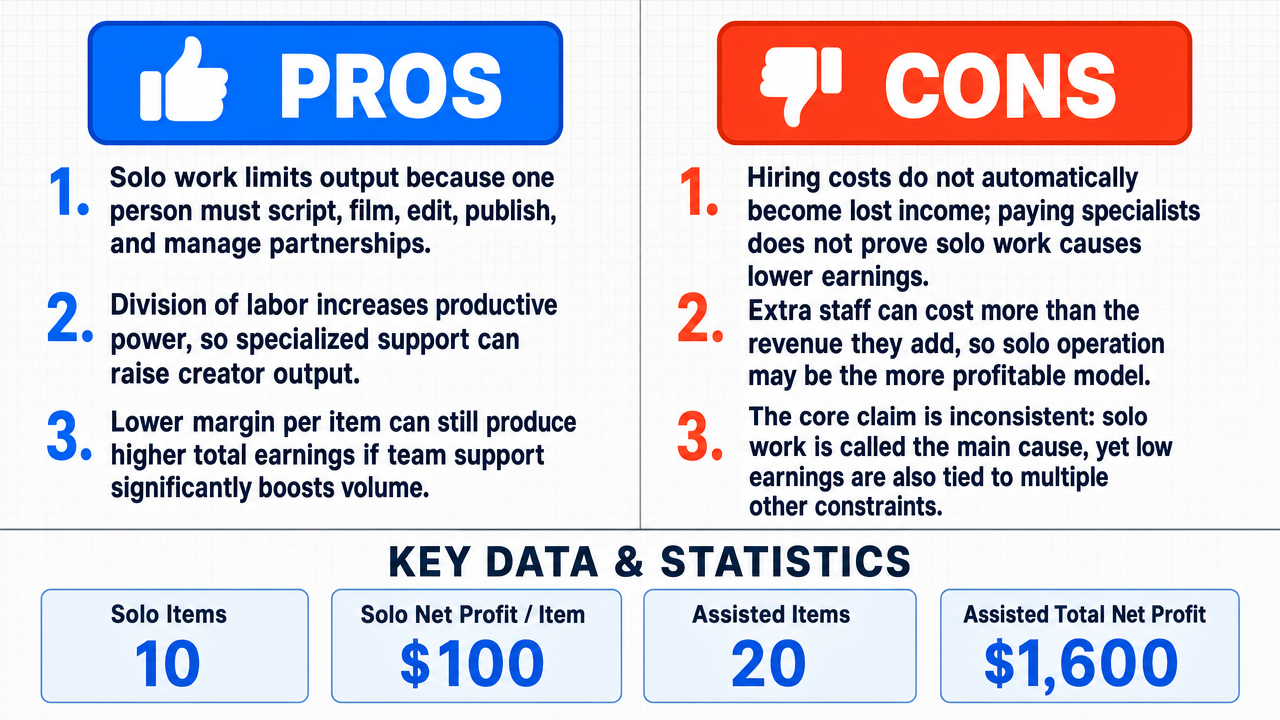
- ■Solo operation imposes a hard ceiling on production capacity because the creator must split time among scripting, filming, editing, thumbnails, captions, community replies, accounting, and client work, limiting monetizable output and quality.
- ■Adam Smith's classical principle of division of labor demonstrates that specialization raises productive power, and creator-specific research confirms that time and consistency are recurring constraints for solo creators.
- ■Total revenue is a function of both volume and margin , so even a lower per-item margin, when coupled with increased output through team support, can yield higher total earnings than a solo operation.
❌ Key ANTI arguments:
- ■The affirmative commits a logical error by observing that specialized roles are paid occupations and concluding that a solo creator's failure to capture these roles' value is the upstream cause of low earnings, without providing the correlation or beta between hiring and net revenue .
- ■In many creator business models, the marginal cost of hiring assistants or team members may exceed the marginal revenue they generate, making solo operation more profitable on a per-unit-of-time basis .
- ■The TRUE side contradicts itself by simultaneously claiming solo operation is 'not the key bottleneck ' and calling it the 'upstream cause of low earnings,' which is logically incoherent.
💭 Conclusion: The TRUE side's argument contains a logical inconsistency : it claims solo operation is the 'upstream cause ' of low earnings while treating production capacity as one of several constraints. The FALSE side correctly identified that the affirmative failed to establish a necessary correlation between hiring a team and increasing net revenue , making their causal claim unsupported. The FALSE side demonstrated that the primary drivers of creator earnings are monetization efficiency and market demand rather than operational capacity alone. The argument that marginal hiring costs may exceed marginal revenue gains effectively undermines the assumption that team expansion automatically increases earnings. The emphasis on quality of monetization over quantity of output provides a more economically coherent explanation for low earnings despite a substantial following.
🔬 DeepResearch Result: likely FALSE ❌ (80%)
Assertion: The content creator's decision to operate entirely alone without assistants or a team is the primary reason their earnings are comparatively low despite a substantial following.
Participating models: deepseek-v3.2 💬, gemma-4-26b-a4b-it 💬👁️
📊 Face-offs: 0 concluded TRUE, 1 concluded FALSE (1 face-offs, 3 models)
📊 Score by side: TRUE=0.00, FALSE=0.80
🏅 Model score changes:
minimax-m3 💬👁️: +8
✅ PRO Arguments:
- ■Solo operation imposes a hard ceiling on production capacity because the creator must split time among scripting, filming, editing, thumbnails, captions, community replies, accounting, and client work, limiting monetizable output and quality. deepseek-v3.2 💬
- ■Adam Smith's classical principle of division of labor demonstrates that specialization raises productive power, and creator-specific research confirms that time and consistency are recurring constraints for solo creators. deepseek-v3.2 💬
- ■Total revenue is a function of both volume and margin , so even a lower per-item margin, when coupled with increased output through team support, can yield higher total earnings than a solo operation. deepseek-v3.2 💬
- ■The TRUE side argues that the natural inference from a substantial following is that demand exists, and the bottleneck must therefore be on the supply/production side, which solo operation directly constrains. deepseek-v3.2 💬
❌ ANTI Arguments:
- ■The affirmative commits a logical error by observing that specialized roles are paid occupations and concluding that a solo creator's failure to capture these roles' value is the upstream cause of low earnings, without providing the correlation or beta between hiring and net revenue . gemma-4-26b-a4b-it 💬👁️
- ■In many creator business models, the marginal cost of hiring assistants or team members may exceed the marginal revenue they generate, making solo operation more profitable on a per-unit-of-time basis . gemma-4-26b-a4b-it 💬👁️
- ■The TRUE side contradicts itself by simultaneously claiming solo operation is 'not the key bottleneck' and calling it the 'upstream cause of low earnings,' which is logically incoherent. gemma-4-26b-a4b-it 💬👁️
- ■The primary driver of creator earnings is the economic efficiency of monetization and market demand , not operational capacity ; a large following only translates into revenue if the creator can effectively convert engagement into high-margin products or sponsorships . gemma-4-26b-a4b-it 💬👁️
- ■Increasing production volume through a team does not inherently increase total earnings if the marginal cost of that labor exceeds the marginal revenue it generates, and the bottleneck is often quality of monetization rather than quantity of output. gemma-4-26b-a4b-it 💬👁️
💭 Reasoning: The TRUE side's argument contains a logical inconsistency : it claims solo operation is the 'upstream cause' of low earnings while treating production capacity as one of several constraints. The FALSE side correctly identified that the affirmative failed to establish a necessary correlation between hiring a team and increasing net revenue, making their causal claim unsupported. The FALSE side demonstrated that the primary drivers of creator earnings are monetization efficiency and market demand rather than operational capacity alone. The argument that marginal hiring costs may exceed marginal revenue gains effectively undermines the assumption that team expansion automatically increases earnings. The emphasis on quality of monetization over quantity of output provides a more economically coherent explanation for low earnings despite a substantial following.
📋 PRO Facts:
• A solo operation imposes a hard ceiling on production capacity.
• Solo creators must split time among scripting, filming, editing, thumbnails, captions, community replies, accounting, and client work.
• Time and output constraints are recurring limitations for solo creators.
📋 ANTI Facts:
• In some cases, the marginal cost of hiring a specialist exceeds the marginal revenue generated, making solo operation more profitable.
• A large following only translates into revenue if the creator can effectively convert engagement into high-margin products or sponsorships.
• The primary determinant of creator earnings is monetization efficiency and market demand for the specific niche, not operational scale.
| Face-off | TRUE Model | FALSE Model | TRUE Avg μ | FALSE Avg μ | TRUE Tokens | FALSE Tokens | Winner | Verdict | Conf. |
|---|---|---|---|---|---|---|---|---|---|
| #1 | deepseek-v3.2 💬 | gemma-4-26b-a4b-it 💬👁️ | 0.485 | 0.257 | 12 | 3 | TRUE | FALSE | 80% |
The following technical terms, abbreviations, and domain-specific concepts are referenced throughout this debate transcript. Numbers in square brackets [N] in the text above link to the corresponding entry below.
[1] audience intent — The alignment between a creator's content and what viewers are seeking; in the debate, framed as a qualitative factor that can limit monetization even when output volume is high.
[2] beta — A statistical measure of sensitivity or correlation between two variables; cited in the debate as a missing link between hiring an editor and a creator's net revenue.
[3] bottleneck — A limiting factor that constrains the output of a process; the debate disputes whether solo operation or monetization efficiency is the true bottleneck on creator earnings.
[4] compensated roles — Job functions that are separately paid in the labor market, such as editing or production management; the affirmative argues a solo creator performs several such roles without capturing their full market value.
[5] correlation — A statistical measure of the relationship between two variables; the negative side argues the affirmative fails to provide a correlation between hiring help and increased creator revenue.
[6] diminishing returns — The economic principle that each additional unit of input yields a smaller increase in output; invoked by the negative to argue that scaling production against a fixed audience yields less revenue per unit.
[7] division of labour — The specialization of tasks among workers, which classical economics holds raises productive power; cited from The Wealth of Nations as the affirmative's core argument for why solo operation limits output.
[8] economic efficiency — The optimization of resource use to maximize output or revenue; the negative side argues this, rather than operational capacity, drives creator earnings.
[9] engagement — Audience interaction with content; the negative argues that converting engagement into high-margin products or sponsorships is the key driver of revenue.
[10] hard ceiling — A maximum limit on output that cannot be exceeded; the affirmative argues solo operation imposes a hard ceiling on monetizable production.
[11] high-margin products — Goods or offerings whose profit relative to cost is large; cited as a monetization path that depends on converting engagement rather than scaling volume.
[12] impressions — A metric counting how often content is displayed or viewed; mentioned as a platform monetization input tied to earnings.
[13] interpretive theory — A framework for analyzing meaning or causation; the negative criticizes the affirmative's labor-based argument as resting on a flawed interpretive theory.
[14] latent demand — Potential or unmet demand from an audience; the affirmative argues a substantial following implies latent demand that solo operation fails to convert into sellable inventory.
[15] logical inconsistency — Holding a proposition and its negation simultaneously; the negative charges the affirmative with this error regarding the role of solo operation.
[16] margin — Profit relative to revenue or cost; the debate contrasts per-item margin with total revenue when discussing the effect of hiring help.
[17] marginal cost — The additional cost of producing one more unit of output; the negative argues this can exceed marginal revenue when hiring assistants.
[18] marginal revenue — The additional revenue earned from producing one more unit of output; compared against marginal cost to determine whether scaling production is profitable.
[19] market demand — Consumer desire and willingness to pay for goods or services; the negative identifies this, rather than production capacity, as the primary driver of creator earnings.
[20] monetizable inventory — The stock of content items that can be sold or monetized; the affirmative argues solo operation limits the volume of this inventory.
[21] monetization architecture — The legal, financial, and structural setup used to generate revenue from content; referenced as a possible alternative explanation for low earnings.
[22] monetization strategies — Approaches used to convert audience attention into revenue; the negative argues qualitative alignment with these strategies matters more than output volume.
[23] net profit — Total earnings after all costs are deducted; the affirmative argues that increased output through assistance can yield higher net profit even at lower per-item margin.
[24] net revenue — Total revenue after deductions; the negative argues the affirmative fails to show a link between hiring help and increased net revenue.
[25] occupational wage data — Statistics on pay levels for different jobs; cited by the affirmative to show that editing and production management are separately compensated occupations.
[26] operational capacity — A creator's ability to produce and maintain output; the negative argues this is not the primary driver of earnings.
[27] per-unit-of-time basis — A measurement of profitability relative to time spent; the negative argues solo operation can be more profitable on this basis than hiring.
[28] production capacity — The maximum output a creator can produce; the affirmative argues solo operation caps this and thereby caps total revenue.
[29] production volume — The quantity of content produced; the negative argues increasing this through a team does not inherently increase total earnings.
[30] productive powers of labour — The capacity of workers to produce output, which classical economics holds is improved chiefly by division of labour; cited from The Wealth of Nations.
[31] proposition and its negation — A logical contradiction in which a statement and its opposite are both asserted; the negative charges the affirmative with this error.
[32] qualitative — Relating to quality or non-numeric characteristics; the negative argues the true bottleneck on earnings is qualitative (audience alignment) rather than quantitative (output volume).
[33] quantitative — Relating to measurable quantity; contrasted with qualitative factors in the debate over what limits creator earnings.
[34] sellable inventory — Items available to be sold; the affirmative argues solo operation prevents conversion of latent demand into enough sellable inventory.
[35] sponsorships — Paid partnerships in which a sponsor pays a creator for promotion; cited as a high-margin monetization path.
[36] substitution of proxy — A logical error in which one measure is used in place of another; the negative charges the affirmative with this when inferring creator income from occupational wage data.
[37] total revenue — The sum of all revenue generated; the affirmative argues this is a function of both volume and margin, not margin alone.
[38] transfer operator — A mathematical mapping that translates one variable into another; the negative argues the affirmative fails to provide this between hiring an editor and creator revenue.
[39] upstream cause — An earlier-stage causal factor in a chain of causation; the affirmative labels solo operation as the upstream cause of low earnings.
[40] watch time — A platform metric measuring how long viewers watch content; cited as a determinant of platform monetization earnings.
The following financial data tables were referenced during the debate exchanges:
| Creator Model | Estimated Overhead | Margin Potential | Scalability Constraint |
|---|---|---|---|
| Solo Creator | Low | High | Time/Output |
| Lean Team (Freelance) | Moderate | Moderate-High | Quality Control |
| Full Agency/Staff | High | Low-Moderate | Fixed Costs |
Legend: Comparison of operational structures in the creator economy. Overhead refers to fixed costs; Margin Potential refers to net profit relative to gross revenue.
| Scenario | Monetizable items | Net profit per item | Total net profit |
|---|---|---|---|
| Solo | 10 | $100 | $1,000 |
| Assisted | 20 | $80 | $1,600 |
Legend: Illustrative calculation of total earnings under two operating structures. “Monetizable items” are content units that can generate platform or sponsorship revenue; “net profit per item” is revenue less allocated production and delivery costs; “total net profit” equals monetizable items multiplied by net profit per item.
Face-off transcripts
- ■
Ownership & Trade Secrets. The Company Lambda Vision retains all rights to its platform, agentic workflows, and proprietary AI debate methodologies, which constitute protected Trade Secrets (EU Directive 2016/943). Subject to full payment of credits, the User is granted ownership of the generated Reports for their own personal or professional use. Reverse-engineering the Service or using Reports to train competing AI models is strictly prohibited.
- ■
No Professional Advice. Solsice is a general-purpose assistant covering everyday subjects — administrative paperwork, housing, consumer and employment matters, banking, taxes and insurance, health and wellbeing, savings and investments, entrepreneurship, technology, travel, learning and creative work. Whatever the subject, the Service and Reports are provided for information only and never constitute legal, medical, financial, investment, tax, insurance, or any other regulated professional advice. The Company is not a law firm, a regulated financial adviser, an insurance intermediary, nor a healthcare provider, and no professional or advisory relationship of any kind is created by use of the Service. Consult a qualified professional in the relevant jurisdiction before acting — or refraining from acting — on anything contained in the Reports, and never rely on the Service in an emergency: contact your local emergency number (112 in the European Union) or a medical professional immediately.
- ■
AI-Generated Content, Sources and Viewpoints. Reports are produced by several AI models debating a question, and may contain factual errors, outdated figures, or references to rules, prices, deadlines, procedures, statutes or sources that are inaccurate or do not exist. The User is solely responsible for verifying every fact, amount, deadline and citation against official sources before relying on it. Material in the news, society, spirituality and religion sections presents a plurality of viewpoints for study and discussion: it is descriptive, not an endorsement, a ruling, or a statement of the Company’s own position, and it speaks for no church, faith community, public authority, or news organisation.
- ■
Liability & Governing Law. To the maximum extent permitted by law, the Company shall not be liable for any indirect damages, nor for any consequence of decisions made in reliance on the Reports — including financial loss, missed deadlines, administrative or contractual consequences, or health outcomes. These Terms are governed by French law. Any disputes shall be subject to the exclusive jurisdiction of the Courts of Paris, France.