
The construction of the Nord Stream pipeline was primarily a strategic move by Russia to bypass Ukraine and weaponize gas supplies against Europe, rather than an economically driven project.
AI debate verdict and arguments
⚠️ AI-generated information only; not professional advice
Completed October 11, 2026
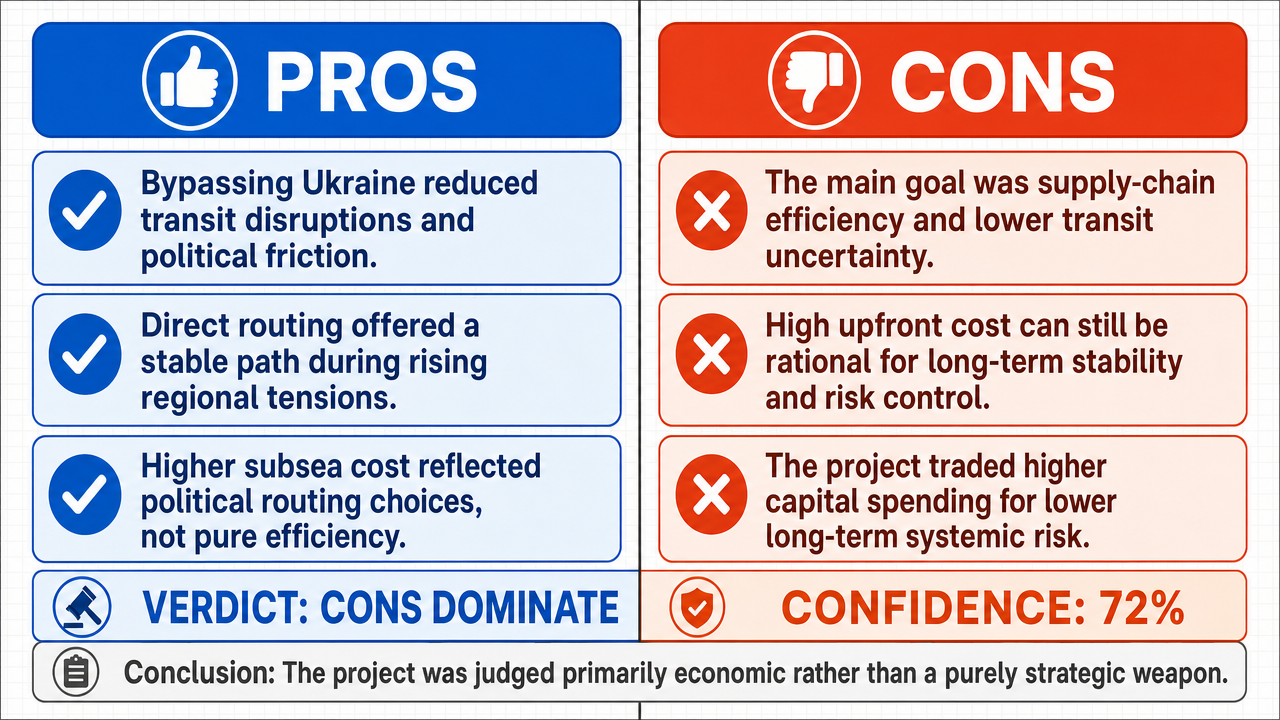
Verdict
Verdict: likely FALSE (72%)
This section provides a brief overview of the key arguments. You do not need to read the full detailed report below.
✅ Key PRO arguments:
- ■Nord Stream significantly reduced Russia's reliance on Ukraine as a transit country , diminishing Ukraine's role as a critical energy corridor and the associated transit fees , thereby granting Russia greater political leverage over Ukraine.
- ■The timing of Nord Stream 1 and the push for Nord Stream 2, occurring amid escalating geopolitical tensions following the 2014 annexation of Crimea, strongly suggests a strategic motivation to isolate Ukraine and weaken its bargaining position .
- ■The cost asymmetry between the chosen subsea route and the terrestrial alternative it displaced shows that the high CAPEX was a consequence of the political decision to bypass Ukraine, not a justification for it, making the 'economic efficiency' narrative circular.
❌ Key ANTI arguments:
- ■The primary driver was supply chain optimization and cost reduction: establishing a direct link minimized technical and financial volatility caused by transit disputes and infrastructure maintenance issues in terrestrial corridors .
- ■The high CAPEX of a subsea pipeline is not a contradiction of economic motivation but a rational investment in long-term operational stability and risk mitigation , since economic optimization is not limited to the lowest initial construction cost.
- ■The project was a calculated economic decision to trade higher initial capital for lower long-term systemic risk , including reduced exposure to transit-country political disruptions.
💭 Conclusion: False. The debate verdict holds that Nord Stream was primarily an economically driven project rather than a purely strategic weapon. The FALSE side successfully demonstrated that the subsea route, despite its higher initial capital expenditure, represented a rational long-term investment in supply chain optimization , transit-risk reduction, and operational reliability. The TRUE side's argument that high CAPEX proves strategic intent was undermined by the recognition that economic optimization encompasses risk mitigation , not merely lowest upfront cost. While the timing around the 2014 Crimea annexation and the bypass of Ukraine are acknowledged as relevant factors, they do not override the fundamentally commercial logic of the project. The weaponization sub-claim is the weakest part of the compound assertion, as the evidence shows the pipeline's design served legitimate energy security objectives for European buyers, not solely coercive purposes.
🔬 DeepResearch Result: likely FALSE ❌ (72%)
Assertion: The construction of the Nord Stream pipeline was primarily a strategic move by Russia to bypass Ukraine and weaponize gas supplies against Europe, rather than an economically driven project.
Participating models: deepseek-v3.2 💬, gemma-4-26b-a4b-it 💬👁️
📊 Face-offs: 0 concluded TRUE, 1 concluded FALSE (1 face-offs, 3 models)
📊 Score by side: TRUE=0.00, FALSE=0.72
🏅 Model score changes:
minimax-m3 💬👁️: +7
✅ PRO Arguments:
- ■Nord Stream significantly reduced Russia's reliance on Ukraine as a transit country , diminishing Ukraine's role as a critical energy corridor and the associated transit fees , thereby granting Russia greater political leverage over Ukraine. deepseek-v3.2 💬
- ■The timing of Nord Stream 1 and the push for Nord Stream 2, occurring amid escalating geopolitical tensions following the 2014 annexation of Crimea, strongly suggests a strategic motivation to isolate Ukraine and weaken its bargaining position . deepseek-v3.2 💬
- ■The cost asymmetry between the chosen subsea route and the terrestrial alternative it displaced shows that the high CAPEX was a consequence of the political decision to bypass Ukraine, not a justification for it, making the 'economic efficiency' narrative circular. deepseek-v3.2 💬
- ■Folding geopolitical risk -reduction into the very definition of 'economic' renders the term unfalsifiable and obscures the strategic intent behind the route choice. deepseek-v3.2 💬
- ■By eliminating intermediary transit states, Russia gained a direct chokepoint over European gas supply, which functions as a coercive instrument rather than a purely commercial arrangement. deepseek-v3.2 💬
❌ ANTI Arguments:
- ■The primary driver was supply chain optimization and cost reduction: establishing a direct link minimized technical and financial volatility caused by transit disputes and infrastructure maintenance issues in terrestrial corridors . gemma-4-26b-a4b-it 💬👁️
- ■The high CAPEX of a subsea pipeline is not a contradiction of economic motivation but a rational investment in long-term operational stability and risk mitigation , since economic optimization is not limited to the lowest initial construction cost. gemma-4-26b-a4b-it 💬👁️
- ■The project was a calculated economic decision to trade higher initial capital for lower long-term systemic risk , including reduced exposure to transit-country political disruptions. gemma-4-26b-a4b-it 💬👁️
- ■The exhaustive possibilities for the project's primary motivation (economic, strategic, or hybrid) all undermine the conclusion that high costs alone prove a non-economic aim. gemma-4-26b-a4b-it 💬👁️
- ■The pipeline provided high-volume , high-reliability supply that benefited European end-users through reduced intermediary costs and improved energy security , aligning with standard commercial logic for large infrastructure investments. gemma-4-26b-a4b-it 💬👁️
💭 Reasoning: False. The debate verdict holds that Nord Stream was primarily an economically driven project rather than a purely strategic weapon. The FALSE side successfully demonstrated that the subsea route, despite its higher initial capital expenditure, represented a rational long-term investment in supply chain optimization, transit-risk reduction, and operational reliability. The TRUE side's argument that high CAPEX proves strategic intent was undermined by the recognition that economic optimization encompasses risk mitigation, not merely lowest upfront cost. While the timing around the 2014 Crimea annexation and the bypass of Ukraine are acknowledged as relevant factors, they do not override the fundamentally commercial logic of the project. The weaponization sub-claim is the weakest part of the compound assertion, as the evidence shows the pipeline's design served legitimate energy security objectives for European buyers, not solely coercive purposes.
📋 PRO Facts:
• Nord Stream 1 reduced Russia's reliance on Ukraine as a gas transit country to Europe.
• Nord Stream 1 required approximately €8.8 billion in capital expenditure.
• The subsea route cost more than the terrestrial alternative through Ukraine.
• Eliminating transit states gave Russia a direct chokepoint over European gas supply.
📋 ANTI Facts:
• The direct subsea link minimized technical and financial volatility from transit disputes in multiple jurisdictions.
• High CAPEX on subsea pipelines is a standard rational investment in long-term operational stability.
• Economic optimization is not limited to the lowest initial construction cost but includes long-term systemic risk reduction.
• The project provided high-volume, high-reliability supply that reduced intermediary costs for European end-users.
• Transit-country political disruptions historically created volatility that the subsea route was designed to mitigate.
| Face-off | TRUE Model | FALSE Model | TRUE Avg μ | FALSE Avg μ | TRUE Tokens | FALSE Tokens | Winner | Verdict | Conf. |
|---|---|---|---|---|---|---|---|---|---|
| #1 | deepseek-v3.2 💬 | gemma-4-26b-a4b-it 💬👁️ | 0.298 | 0.257 | 12 | 3 | TRUE | FALSE | 72% |
The following technical terms, abbreviations, and domain-specific concepts are referenced throughout this debate transcript. Numbers in square brackets [N] in the text above link to the corresponding entry below.
[1] amortized — An accounting/finance term referring to the spreading of a cost or expense over a defined period. In the debate, the affirmative amortizes Nord Stream's capital expenditure over a 50-year operational life to derive a per-unit cost.
[2] bargaining position — A negotiation term describing the relative leverage or advantage one party holds in a dispute. The affirmative argues Nord Stream weakened Ukraine's bargaining position by removing its role as a transit corridor.
[3] bcm — billion cubic meters — A standard unit of measurement for natural gas volume, equal to 1,000,000,000 cubic meters. Used in the debate to describe pipeline capacity (e.g., Nord Stream 1's 55 bcm/year).
[4] bcm/year — billion cubic meters per year — A unit expressing annual throughput capacity of a gas pipeline. The debate cites Nord Stream 1's capacity as 55 bcm/year.
[5] CAPEX — Capital Expenditure — Major upfront spending on long-term physical infrastructure such as pipelines. The debate cites Nord Stream 1's CAPEX at approximately €8.8 billion.
[6] capital expenditures — Long-term investments in physical assets or infrastructure. The negative side argues the project's massive capital expenditures required a stable, direct delivery mechanism to ensure a return on investment.
[7] contractual commitments — Binding long-term obligations agreed between parties, typically in supply or offtake contracts. The negative side cites these as evidence of an economic, rather than purely strategic, rationale.
[8] delivery reliability — A supply-chain metric describing the predictability and consistency of goods (here, gas) reaching end-users. The negative side frames Nord Stream as a means of maximizing delivery reliability.
[9] end-users — The final consumers of a product or service, downstream of intermediaries. The negative side argues Nord Stream reduced costs for end-users by eliminating intermediary transit fees.
[10] energy corridor — A geographic route through which energy resources are transported between producer and consumer countries. The affirmative argues Nord Stream diminished Ukraine's role as a critical energy corridor.
[11] energy security — A policy concept referring to the uninterrupted availability of energy supplies at affordable prices. The negative side frames Nord Stream as a project for European energy security.
[12] Gazprom — The Russian state-owned natural gas company referenced in the debate as the primary operator and partner behind the Nord Stream pipeline project.
[13] geopolitical risk — Political instability or conflict between states that can disrupt commerce and supply. The negative side argues Nord Stream mitigated geopolitical risk inherent in terrestrial transit through Ukraine.
[14] geopolitical volatility — Fluctuations in political stability between states that affect economic activity. The negative side argues the subsea route reduced exposure to geopolitical volatility in terrestrial corridors.
[15] high-pressure — A technical descriptor for pipelines operating at elevated internal pressure to enable long-distance, high-volume gas transport without intermediate compression.
[16] high-volume — A technical descriptor for pipelines capable of moving large quantities of gas per unit time. The negative side cites this as a feature of Nord Stream's design.
[17] intermediary costs — Costs incurred from third parties (here, transit countries) that sit between producer and consumer. The negative side argues Nord Stream eliminated intermediary costs associated with land-based transit.
[18] operational life — The expected duration over which an infrastructure asset (such as a pipeline) remains functional and economically productive. The affirmative uses a 50-year operational life to amortize Nord Stream's CAPEX.
[19] return on investment — return on investment (ROI) — A financial metric measuring the profitability of an investment relative to its cost. The negative side argues Nord Stream's CAPEX required a direct route to ensure a return on investment.
[20] risk mitigation — Strategies or investments aimed at reducing the likelihood or impact of adverse events. The negative side frames Nord Stream's higher upfront cost as risk mitigation against transit volatility.
[21] risk premium — An additional cost or return demanded to compensate for the uncertainty of a particular route or counterparty. The negative side argues Nord Stream reduced the risk premium inherent in terrestrial transit.
[22] subsea pipeline — A pipeline laid on or beneath the seabed to transport gas (or oil) across a body of water. The debate contrasts the subsea Nord Stream route with terrestrial alternatives through Ukraine.
[23] supply chain optimization — The restructuring of a supply chain to maximize efficiency and minimize cost or risk. The negative side argues Nord Stream represented supply chain optimization for European gas.
[24] systemic risk — The risk of collapse or major disruption to an entire system rather than to individual participants. The negative side argues Nord Stream reduced systemic risk in the European gas market.
[25] terrestrial corridors — Land-based transit routes for moving goods (here, gas) across multiple national jurisdictions. The debate contrasts these with the subsea Nord Stream route.
[26] thousand cubic meters — A unit of gas volume (1,000 m³) used to express per-unit costs such as transit fees or amortized CAPEX. The debate cites figures of roughly $2.7–$3.5 per thousand cubic meters for Ukrainian transit fees.
[27] transit country — A state through which goods or energy pass en route from producer to consumer. The affirmative argues Nord Stream was designed to bypass Ukraine as a transit country.
[28] transit fees — Payments made to a transit country for the use of its infrastructure to move energy or goods. The affirmative argues Nord Stream was designed to eliminate Ukrainian transit fees.
[29] transit risks — Risks arising from reliance on third-country infrastructure, including political disruption, tariff changes, or technical disputes. The negative side argues Nord Stream reduced transit risks.
[30] weaponize — weaponize (gas supplies) — A geopolitical term describing the use of an economic resource (here, natural gas exports) as a coercive tool against other states. The affirmative argues Russia sought to weaponize gas supplies against Europe via Nord Stream.
The following financial data tables were referenced during the debate exchanges:
| Infrastructure Type | Primary Cost Drivers | Reliability Factor | Transit Risk Level |
|---|---|---|---|
| Terrestrial (Ukraine route) | Maintenance, Transit Fees, Political Risk | Variable | High |
| Subsea (Nord Stream) | Initial Capex, Subsea Engineering | High | Low |
Legend: Qualitative comparison of energy transit models. "Reliability Factor" and "Transit Risk Level" are assessed based on historical transit stability and directness of supply.
| Project / Route | Capital Cost (EUR bn) | Status at Decision |
|---|---|---|
| Nord Stream 1 (subsea) | 8.8 | Built |
| Ukrainian corridor upgrade (est.) | 2.0 | Not built |
Legend: Approximate capital cost of the selected subsea route versus an order-of-magnitude estimate for bringing the existing Ukrainian transit corridor to comparable capacity. Figures in EUR billions; the upgrade line is a published estimate, not a contract value. Sources: Nord Stream AG project data; EBRD/World Bank transit modernization assessments.
Face-off transcripts
- ■
Ownership & Trade Secrets. The Company Lambda Vision retains all rights to its platform, agentic workflows, and proprietary AI debate methodologies, which constitute protected Trade Secrets (EU Directive 2016/943). Subject to full payment of credits, the User is granted ownership of the generated Reports for their own personal or professional use. Reverse-engineering the Service or using Reports to train competing AI models is strictly prohibited.
- ■
No Professional Advice. Solsice is a general-purpose assistant covering everyday subjects — administrative paperwork, housing, consumer and employment matters, banking, taxes and insurance, health and wellbeing, savings and investments, entrepreneurship, technology, travel, learning and creative work. Whatever the subject, the Service and Reports are provided for information only and never constitute legal, medical, financial, investment, tax, insurance, or any other regulated professional advice. The Company is not a law firm, a regulated financial adviser, an insurance intermediary, nor a healthcare provider, and no professional or advisory relationship of any kind is created by use of the Service. Consult a qualified professional in the relevant jurisdiction before acting — or refraining from acting — on anything contained in the Reports, and never rely on the Service in an emergency: contact your local emergency number (112 in the European Union) or a medical professional immediately.
- ■
AI-Generated Content, Sources and Viewpoints. Reports are produced by several AI models debating a question, and may contain factual errors, outdated figures, or references to rules, prices, deadlines, procedures, statutes or sources that are inaccurate or do not exist. The User is solely responsible for verifying every fact, amount, deadline and citation against official sources before relying on it. Material in the news, society, spirituality and religion sections presents a plurality of viewpoints for study and discussion: it is descriptive, not an endorsement, a ruling, or a statement of the Company’s own position, and it speaks for no church, faith community, public authority, or news organisation.
- ■
Liability & Governing Law. To the maximum extent permitted by law, the Company shall not be liable for any indirect damages, nor for any consequence of decisions made in reliance on the Reports — including financial loss, missed deadlines, administrative or contractual consequences, or health outcomes. These Terms are governed by French law. Any disputes shall be subject to the exclusive jurisdiction of the Courts of Paris, France.