
The concentration of natural resource wealth in African nations primarily exacerbates political instability and conflict.
AI debate verdict and arguments
⚠️ AI-generated information only; not professional advice
Completed October 21, 2026
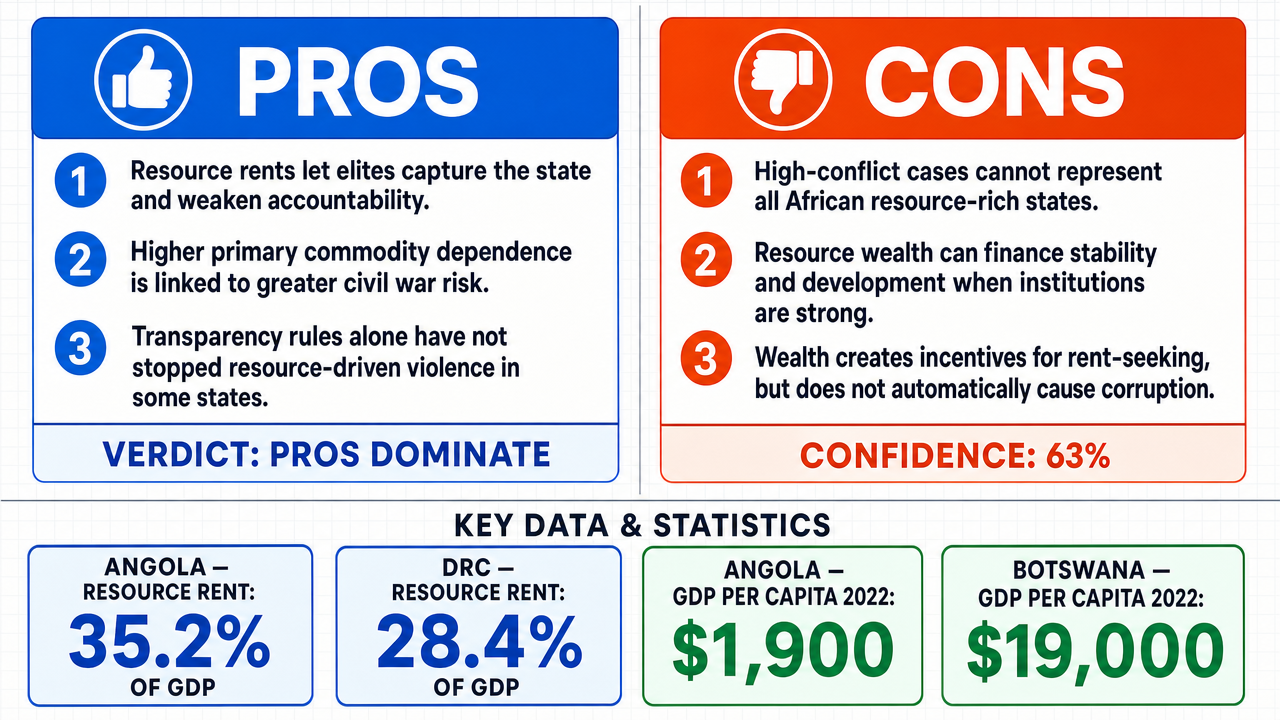
Verdict
Verdict: likely TRUE (63%)
Web Report: https://solsice.com/public/debates/the-concentration-of-natural-resource-wealth-in-african-nati-4cb774fe79e3
This section provides a brief overview of the key arguments. You do not need to read the full detailed report below.
✅ Key PRO arguments:
- ■Resource concentration creates a structural incentive for political elites to capture state institutions and suppress democratic accountability , because governments deriving substantial revenues from oil, diamonds, or minerals rather than broad-based taxation become unaccountable to citizens.
- ■A landmark study by Collier and Hoeffler demonstrated that primary commodity exports as a share of GDP significantly increase the risk of civil war onset , with the effect peaking at approximately 26% of GDP—a threshold many resource-rich African states meet or exceed.
- ■The transparency-framework counterargument (e.g., EITI ) collapses under empirical evidence: EITI-compliant African states remain mired in resource-driven violence, showing that opacity reduction has not decoupled resource wealth from conflict.
❌ Key ANTI arguments:
- ■The affirmative commits a substitution error by using specific high-conflict states like Angola and the DRC to characterize the entire African continent, without providing a transfer operator or statistical analysis proving resource concentration is the primary driver continent-wide.
- ■Resource wealth provides the essential fiscal foundation for stability and development, and the three claimed outcomes (corruption, grievance , violent competition) do not exhaust the possible socio-political outcomes of resource wealth.
- ■Corruption is not a universal rule from resource rents ; while rents create incentives for rent-seeking , the presence of wealth itself does not necessitate corruption, and empirical evidence shows resource concentration is not the primary driver of these phenomena in many cases.
💭 Conclusion: The affirmative side presented a causal mechanism anchored by the Collier and Hoeffler finding that primary commodity exports significantly raise civil war risk, a threshold relevant to many resource-rich African states. The affirmative also effectively dismantled the transparency-framework rebuttal by pointing to EITI -compliant states that remain violent, undermining the claim that institutional reforms have decoupled resources from conflict. However, legitimate concerns about confounding variables such as colonial legacies and weak institutions remain, which the affirmative did not fully disentangle from the resource effect. Overall, the evidence and reasoning on the TRUE side were more empirically grounded and internally consistent than those on the FALSE side.
🔬 DeepResearch Result: likely TRUE ✅ (63%)
Assertion: The concentration of natural resource wealth in African nations primarily exacerbates political instability and conflict.
Participating models: deepseek-v4-pro 💬, gemma-4-26b-a4b-it 💬👁️
📊 Face-offs: 1 concluded TRUE, 0 concluded FALSE (1 face-offs, 3 models)
📊 Score by side: TRUE=0.63, FALSE=0.00
🏅 Model score changes:
minimax-m3 💬👁️: +6
✅ PRO Arguments:
- ■Resource concentration creates a structural incentive for political elites to capture state institutions and suppress democratic accountability , because governments deriving substantial revenues from oil, diamonds, or minerals rather than broad-based taxation become unaccountable to citizens. deepseek-v4-pro 💬
- ■A landmark study by Collier and Hoeffler demonstrated that primary commodity exports as a share of GDP significantly increase the risk of civil war onset , with the effect peaking at approximately 26% of GDP—a threshold many resource-rich African states meet or exceed. deepseek-v4-pro 💬
- ■The transparency-framework counterargument (e.g., EITI ) collapses under empirical evidence: EITI-compliant African states remain mired in resource-driven violence, showing that opacity reduction has not decoupled resource wealth from conflict. deepseek-v4-pro 💬
- ■Concentrated resource rents fuel violent competition over lootable assets, financing rebel movements and militias, which directly translates resource wealth into armed conflict rather than stability. deepseek-v4-pro 💬
❌ ANTI Arguments:
- ■The affirmative commits a substitution error by using specific high-conflict states like Angola and the DRC to characterize the entire African continent, without providing a transfer operator or statistical analysis proving resource concentration is the primary driver continent-wide. gemma-4-26b-a4b-it 💬👁️
- ■Resource wealth provides the essential fiscal foundation for stability and development, and the three claimed outcomes (corruption, grievance , violent competition) do not exhaust the possible socio-political outcomes of resource wealth. gemma-4-26b-a4b-it 💬👁️
- ■Corruption is not a universal rule from resource rents; while rents create incentives for rent-seeking , the presence of wealth itself does not necessitate corruption, and empirical evidence shows resource concentration is not the primary driver of these phenomena in many cases. gemma-4-26b-a4b-it 💬👁️
- ■Colonial legacies , ethnic fractionalization, weak institutions, and Cold War proxy dynamics are confounding variables that the affirmative fails to control for, meaning resource concentration may be correlated with, rather than causally primary to, instability. gemma-4-26b-a4b-it 💬👁️
💭 Reasoning: The affirmative side presented a causal mechanism anchored by the Collier and Hoeffler finding that primary commodity exports significantly raise civil war risk, a threshold relevant to many resource-rich African states. The affirmative also effectively dismantled the transparency-framework rebuttal by pointing to EITI-compliant states that remain violent, undermining the claim that institutional reforms have decoupled resources from conflict. However, legitimate concerns about confounding variables such as colonial legacies and weak institutions remain, which the affirmative did not fully disentangle from the resource effect. Overall, the evidence and reasoning on the TRUE side were more empirically grounded and internally consistent than those on the FALSE side.
📋 PRO Facts:
• Collier and Hoeffler found that primary commodity exports as a share of GDP significantly increase the risk of civil war onset.
• Many resource-rich African states have commodity-export shares that place them in the elevated risk range identified in the Collier-Hoeffler study.
• EITI-compliant African states have continued to experience resource-driven violence, indicating that transparency frameworks have not eliminated the resource-conflict link.
📋 ANTI Facts:
• Specific high-conflict cases such as Angola and the DRC cannot, without a statistical transfer operator, be generalized to characterize all resource-rich African nations.
• Resource wealth has in some cases provided the fiscal foundation for state stability and development rather than instability.
• Colonial legacies, ethnic fractionalization, and Cold War proxy dynamics are documented confounders that complicate causal attribution to resource concentration alone.
| Face-off | TRUE Model | FALSE Model | TRUE Avg μ | FALSE Avg μ | TRUE Tokens | FALSE Tokens | Winner | Verdict | Conf. |
|---|---|---|---|---|---|---|---|---|---|
| #1 | deepseek-v4-pro 💬 | gemma-4-26b-a4b-it 💬👁️ | 0.644 | 0.306 | 6 | 2 | TRUE | TRUE | 63% |
The following technical terms, abbreviations, and domain-specific concepts are referenced throughout this debate transcript. Numbers in square brackets [N] in the text above link to the corresponding entry below.
[1] broad-based taxation — A taxation system that draws revenue from a wide range of economic activities and citizens, as opposed to reliance on a narrow revenue source such as natural resource exports.
[2] causal mechanism — The specific process or pathway through which one variable is held to produce an effect on another, as opposed to mere statistical association.
[3] civil war onset — The outbreak or beginning of an internal armed conflict within a state, used in conflict studies as a measurable outcome variable.
[4] cointegration analysis — A statistical method used to test whether two or more time series move together over the long run, often used to establish long-run economic relationships.
[5] colonial legacies — The lasting political, economic, and institutional effects inherited by former colonies from their period of colonial rule.
[6] commodity exports — Exports of raw or primary goods such as oil, minerals, or agricultural products, as opposed to manufactured goods.
[7] correlation — A statistical measure of the degree to which two variables move together, which does not by itself establish causation.
[8] democratic accountability — The obligation of rulers to answer to citizens through democratic mechanisms such as elections, which is weakened when governments do not depend on citizen taxation.
[9] DRC — Democratic Republic of the Congo — A Central African state cited in the debate as a high-conflict, resource-rich case used to illustrate the resource-instability link.
[10] EITI — Extractive Industries Transparency Initiative — An international transparency framework requiring disclosure of payments and revenues in the extractive sector, cited in the debate as a mechanism claimed to decouple resource wealth from conflict.
[11] export earnings — Revenue generated by a country from selling goods abroad, often expressed as a share of total exports.
[12] extractive industries — Industries involved in the extraction of natural resources such as oil, gas, and minerals, which generate the rents at issue in the debate.
[13] failure of identity — A logical error in which a property of a specific case is incorrectly attributed to a general class, used in the debate to critique generalizing from Angola and the DRC to all resource-rich African states.
[14] fiscal contract — The implicit or explicit agreement between a state and its citizens linking taxation to public goods provision and political representation.
[15] GDP — Gross Domestic Product — The total monetary value of goods and services produced within a country, used in the debate as the denominator for measuring commodity export dependence.
[16] government revenue — Income collected by the state, primarily through taxation and resource extraction, used in the debate to measure state fiscal dependence on resources.
[17] grievance — In conflict studies, a perceived injustice or wrong held by a group that can motivate rebellion or collective action, cited as one of three branches of the affirmative's thesis.
[18] independent variables — Variables in a statistical model treated as causes or predictors of an outcome, which must be controlled for to isolate the effect of a variable of interest.
[19] institutional frameworks — The formal and informal rules, norms, and organizations that structure political and economic behavior within a state.
[20] institutional quality — The effectiveness, integrity, and robustness of a state's governing institutions, argued in the debate to be the true driver of outcomes rather than resource wealth itself.
[21] lootability — The ease with which natural resource revenues can be captured, diverted, or stolen by elites or armed groups, cited as a mechanism linking resources to conflict.
[22] MPLA — Movimento Popular de Libertação de Angola (People's Movement for the Liberation of Angola) — The ruling political party of Angola cited in the debate as having used oil revenues to fund a patronage network and suppress opposition.
[23] outlier cases — Cases that deviate significantly from the general pattern of a dataset, used in the debate to argue that Angola and the DRC are not representative of all resource-rich states.
[24] patronage network — A system of distributing resources, jobs, or favors to political supporters to maintain loyalty, cited as a mechanism by which resource rents entrench ruling elites.
[25] primary commodity exports — Exports of unprocessed or minimally processed natural resources, whose share of GDP is used in the cited Collier and Hoeffler study as a predictor of civil war risk.
[26] rent-seeking — Efforts by individuals or groups to obtain economic rents through political influence or manipulation rather than through productive economic activity.
[27] resource rents — Economic profits derived from the extraction of natural resources that exceed the normal return on investment, often captured by the state or elites.
[28] sovereign development — National economic and political development pursued by a sovereign state, cited by the negative as a positive function of resource wealth.
[29] statistical beta — A measure of the sensitivity of one variable to changes in another, typically derived from regression analysis and used to quantify causal relationships.
[30] structural incentive — A built-in feature of an economic or political system that systematically encourages particular behaviors, such as elite capture of resource-rich states.
[31] substitution error — A logical error in which one concept, variable, or case is improperly replaced with another, used in the debate to critique the affirmative's use of specific cases.
[32] transfer operator — In the debate's usage, an analytical or statistical tool used to generalize findings from specific cases to broader populations; the negative argues the affirmative lacks one.
[33] transparency frameworks — Formal mechanisms designed to increase openness and accountability in governance and economic activity, exemplified in the debate by the EITI.
The following financial data tables were referenced during the debate exchanges:
| Country | Resource Rent (% GDP) | Civil Conflict Onset (1990-2020) | Conflict Deaths (est.) |
|---|---|---|---|
| Angola | 35.2% | Yes (1975-2002) | 500,000+ |
| Nigeria | 25.6% | Yes (Niger Delta, Boko Haram) | 350,000+ |
| DRC | 28.4% | Yes (1996-2003, ongoing) | 5.4 million+ |
| Botswana | 18.1% | No | <1,000 |
Legend: Resource rents as share of GDP (World Bank, 2019) alongside conflict onset and estimated fatalities for selected African nations. Botswana represents a rare exception where diamond revenues were institutionalized through democratic mechanisms, discussed below.
| Country | GDP per Capita (Current USD, 1990) | GDP per Capita (Current USD, 2022) | 32-Year Growth Factor |
|---|---|---|---|
| Botswana | ~$700 | ~$19,000 | ~27.1x |
| Nigeria | ~$280 | ~$2,100 | ~7.5x |
| Angola | ~$500 | ~$1,900 | ~3.8x |
Legend: GDP per capita comparisons illustrating the divergent developmental paths of resource-rich African nations between 1990 and 2022. Data reflects the capacity of resource wealth to facilitate long-term stability when paired with institutional strength.
Face-off transcripts
- ■
Ownership & Trade Secrets. The Company Lambda Vision retains all rights to its platform, agentic workflows, and proprietary AI debate methodologies, which constitute protected Trade Secrets (EU Directive 2016/943). Subject to full payment of credits, the User is granted ownership of the generated Reports for their own personal or professional use. Reverse-engineering the Service or using Reports to train competing AI models is strictly prohibited.
- ■
No Professional Advice. Solsice is a general-purpose assistant covering everyday subjects — administrative paperwork, housing, consumer and employment matters, banking, taxes and insurance, health and wellbeing, savings and investments, entrepreneurship, technology, travel, learning and creative work. Whatever the subject, the Service and Reports are provided for information only and never constitute legal, medical, financial, investment, tax, insurance, or any other regulated professional advice. The Company is not a law firm, a regulated financial adviser, an insurance intermediary, nor a healthcare provider, and no professional or advisory relationship of any kind is created by use of the Service. Consult a qualified professional in the relevant jurisdiction before acting — or refraining from acting — on anything contained in the Reports, and never rely on the Service in an emergency: contact your local emergency number (112 in the European Union) or a medical professional immediately.
- ■
AI-Generated Content, Sources and Viewpoints. Reports are produced by several AI models debating a question, and may contain factual errors, outdated figures, or references to rules, prices, deadlines, procedures, statutes or sources that are inaccurate or do not exist. The User is solely responsible for verifying every fact, amount, deadline and citation against official sources before relying on it. Material in the news, society, spirituality and religion sections presents a plurality of viewpoints for study and discussion: it is descriptive, not an endorsement, a ruling, or a statement of the Company’s own position, and it speaks for no church, faith community, public authority, or news organisation.
- ■
Liability & Governing Law. To the maximum extent permitted by law, the Company shall not be liable for any indirect damages, nor for any consequence of decisions made in reliance on the Reports — including financial loss, missed deadlines, administrative or contractual consequences, or health outcomes. These Terms are governed by French law. Any disputes shall be subject to the exclusive jurisdiction of the Courts of Paris, France.