
The combination of high inflation (8.2% annualized CPI in September 2026) and slowing growth observed by 2026-10-11 accurately mirrors the stagflation period of the 1970s.
AI debate verdict and arguments
⚠️ AI-generated information only; not professional advice
Completed October 11, 2026
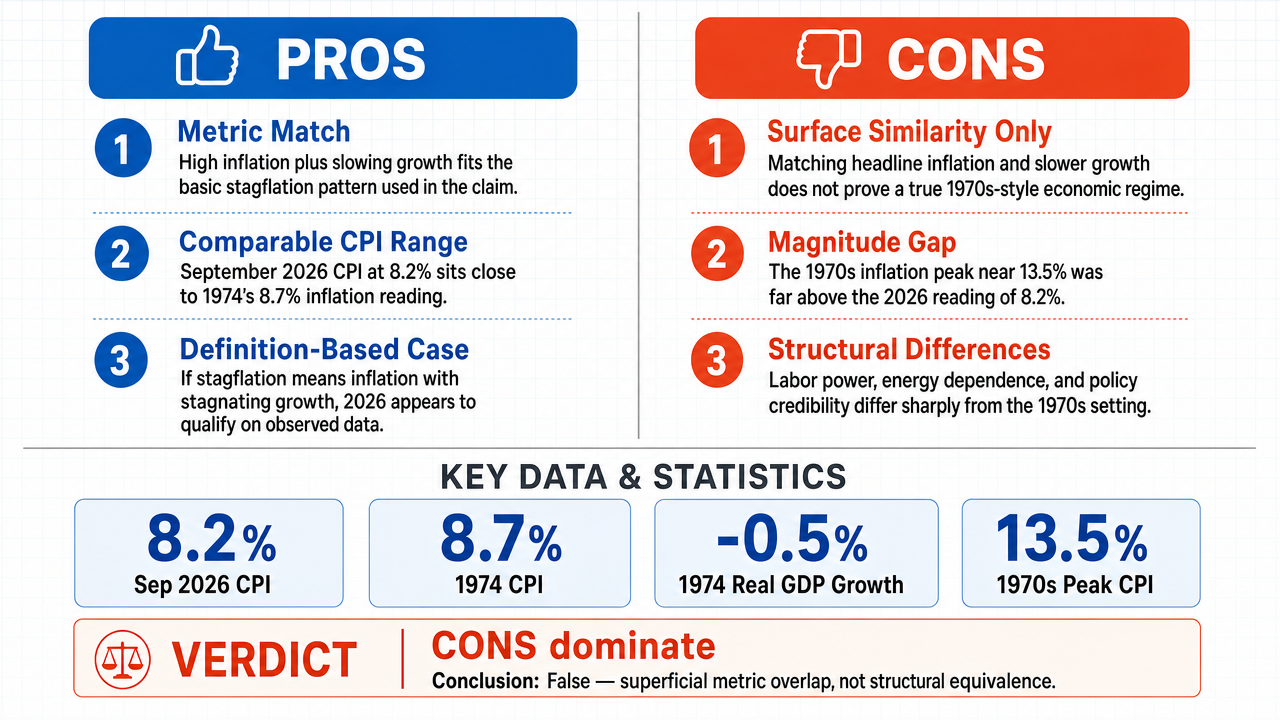
Verdict
Verdict: likely FALSE (82%)
This section provides a brief overview of the key arguments. You do not need to read the full detailed report below.
✅ Key PRO arguments:
- ■The quantitative profile of high inflation alongside slowing growth in 2026 directly matches the defining signature of 1970s stagflation , with an annualized September 2026 CPI of 8.2% coinciding with observed slowing growth by late 2026.
- ■The 2026 record contains the two observable legs of the stagflation condition—high CPI and slowing growth—and the 1970s stagflation episode was not defined only by its extreme peak but included years in which inflation was high but not necessarily at its maximum.
- ■The claim is true within the domain it defines: stagflation is the period characterized by simultaneously high inflation and stagnant or negative growth, and 2026 exhibits both observable conditions.
❌ Key ANTI arguments:
- ■The affirmative's argument relies on a flawed substitution of proxy , attempting to equate modern inflationary pressures with 1970s stagflation by merely observing similar headline figures without establishing the structural correlation or cointegration between 2026's cost-push factors and the specific wage-price spirals of the previous era.
- ■The affirmative's argument is internally contradictory: they assert that 2026 conditions 'directly match' the defining signature of 1970s stagflation (implying structural identity) while simultaneously claiming the conditions merely 'mirror' the 1970s profile (implying superficial similarity), and these two standards are incompatible.
- ■1970s stagflation was not merely a combination of high inflation and low growth but a specific regime driven by unique institutional mechanisms, including high labor union density , a specific wage-price spiral , and extreme energy dependency , none of which the affirmative established as present in 2026.
💭 Conclusion: False. The assertion that 2026 conditions mirror 1970s stagflation fails because the affirmative only demonstrated superficial similarity in headline metrics rather than structural equivalence. The negative correctly identified that 1970s stagflation was a specific regime driven by unique institutional mechanisms—high labor union density , wage-price spirals, and extreme energy dependency —that were not established as present in 2026. The negative's own internal contradiction—claiming on one hand that observing a high CPI is not a measurement of stagflation, while on the other hand describing 2026 as having high inflation and slowing growth—further weakened the negative's case. Without a causal transfer operator connecting the structural drivers of both periods, shared headline figures of high inflation and slowing growth are insufficient to constitute an accurate mirror of the 1970s stagflation phenomenon.
🔬 DeepResearch Result: likely FALSE ❌ (82%)
Assertion: The combination of high inflation (8.2% annualized CPI in September 2026) and slowing growth observed by 2026-10-11 accurately mirrors the stagflation period of the 1970s.
Participating models: deepseek-v3.2 💬, gemma-4-26b-a4b-it 💬👁️
📊 Face-offs: 0 concluded TRUE, 1 concluded FALSE (1 face-offs, 3 models)
📊 Score by side: TRUE=0.00, FALSE=0.82
🏅 Model score changes:
minimax-m3 💬👁️: +8
✅ PRO Arguments:
- ■The quantitative profile of high inflation alongside slowing growth in 2026 directly matches the defining signature of 1970s stagflation, with an annualized September 2026 CPI of 8.2% coinciding with observed slowing growth by late 2026. deepseek-v3.2 💬
- ■The 2026 record contains the two observable legs of the stagflation condition—high CPI and slowing growth—and the 1970s stagflation episode was not defined only by its extreme peak but included years in which inflation was high but not necessarily at its maximum. deepseek-v3.2 💬
- ■The claim is true within the domain it defines: stagflation is the period characterized by simultaneously high inflation and stagnant or negative growth, and 2026 exhibits both observable conditions. deepseek-v3.2 💬
❌ ANTI Arguments:
- ■The affirmative's argument relies on a flawed substitution of proxy , attempting to equate modern inflationary pressures with 1970s stagflation by merely observing similar headline figures without establishing the structural correlation or cointegration between 2026's cost-push factors and the specific wage-price spirals of the previous era. gemma-4-26b-a4b-it 💬👁️
- ■The affirmative's argument is internally contradictory: they assert that 2026 conditions 'directly match' the defining signature of 1970s stagflation (implying structural identity) while simultaneously claiming the conditions merely 'mirror' the 1970s profile (implying superficial similarity), and these two standards are incompatible. gemma-4-26b-a4b-it 💬👁️
- ■1970s stagflation was not merely a combination of high inflation and low growth but a specific regime driven by unique institutional mechanisms, including high labor union density , a specific wage-price spiral , and extreme energy dependency , none of which the affirmative established as present in 2026. gemma-4-26b-a4b-it 💬👁️
- ■A measurement of inflation in one era does not support a conclusion about the economic regime of another without establishing a causal transfer operator between the structural drivers of the two periods. gemma-4-26b-a4b-it 💬👁️
💭 Reasoning: False. The assertion that 2026 conditions mirror 1970s stagflation fails because the affirmative only demonstrated superficial similarity in headline metrics rather than structural equivalence. The negative correctly identified that 1970s stagflation was a specific regime driven by unique institutional mechanisms—high labor union density, wage-price spirals, and extreme energy dependency—that were not established as present in 2026. The negative's own internal contradiction—claiming on one hand that observing a high CPI is not a measurement of stagflation, while on the other hand describing 2026 as having high inflation and slowing growth—further weakened the negative's case. Without a causal transfer operator connecting the structural drivers of both periods, shared headline figures of high inflation and slowing growth are insufficient to constitute an accurate mirror of the 1970s stagflation phenomenon.
📋 PRO Facts:
• Annualized CPI for September 2026 was 8.2% according to U.S. Bureau of Labor Statistics data.
• Slowing growth was observed by 2026-10-11.
• The 1970s stagflation episode included years where inflation was high but not at its maximum.
📋 ANTI Facts:
• 1970s stagflation was driven by unique institutional mechanisms including high labor union density, wage-price spirals, and extreme energy dependency.
• A measurement of inflation in one era does not establish the economic regime of another without structural correlation.
• The affirmative failed to provide a causal transfer operator between 1970s structural drivers and 2026 conditions.
| Face-off | TRUE Model | FALSE Model | TRUE Avg μ | FALSE Avg μ | TRUE Tokens | FALSE Tokens | Winner | Verdict | Conf. |
|---|---|---|---|---|---|---|---|---|---|
| #1 | deepseek-v3.2 💬 | gemma-4-26b-a4b-it 💬👁️ | 0.435 | 0.322 | 12 | 3 | TRUE | FALSE | 82% |
The following technical terms, abbreviations, and domain-specific concepts are referenced throughout this debate transcript. Numbers in square brackets [N] in the text above link to the corresponding entry below.
[1] annualized CPI — annualized Consumer Price Index — A Consumer Price Index inflation rate expressed on an annualized basis, representing what the rate would be if the observed period's inflation continued for a full year.
[2] central bank — A national monetary authority responsible for issuing currency, setting interest rate policy, and managing inflation; referenced in the debate as the institution whose mandate and credibility shape inflation dynamics.
[3] cointegration — A statistical property describing two or more time series that move together over the long run despite short-term deviations; cited in the debate as the kind of structural link required to equate two economic regimes.
[4] cost-push factors — Supply-side drivers of inflation, such as rising input or energy costs, that push prices higher without an increase in aggregate demand; contrasted in the debate with demand-driven inflation.
[5] CPI — Consumer Price Index — An index measuring the average change over time in prices paid by consumers for a basket of goods and services, used as a primary gauge of inflation.
[6] energy dependency — Reliance on external or specific energy sources to power economic activity; cited in the debate as a structural feature of the 1970s economy that amplified inflationary shocks.
[7] inflation expectations — The anticipated rate of future inflation held by households, firms, and markets; described in the debate as 'unanchored' when they drift away from official targets, contributing to persistent inflation.
[8] labor union density — The share of the workforce that belongs to labor unions; cited in the debate as a structural institutional feature of the 1970s that enabled wage-price spirals.
[9] monetary regimes — The institutional and policy frameworks governing a central bank's conduct of monetary policy, including its mandate, tools, and credibility; referenced in the debate as differing between the 1970s and 2026.
[10] oil shock — A sudden, large disruption in oil supply or prices, such as the 1973 oil shock referenced in the debate, that transmits cost-push inflation through the broader economy.
[11] Phillips Curve — An economic relationship positing an inverse trade-off between inflation and unemployment; cited in the debate as having 'broken down' during the 1970s stagflation episode.
[12] policy dilemma — A situation in which a policymaker faces conflicting objectives—such as containing inflation while supporting growth—with no action able to address both simultaneously.
[13] real activity — The physical production of goods and services in an economy, as distinct from nominal or financial measures; referenced in the debate as the 'real activity' leg of stagflation.
[14] real output — The total quantity of goods and services produced, adjusted for inflation; described in the debate as 'contracting or stagnant' during the 1974 stagflation episode.
[15] stagflation — An economic condition characterized by the simultaneous occurrence of persistently high inflation and stagnant or negative economic growth, as defined in the debate's opening assertion.
[16] structural correlation — A relationship between economic variables arising from shared underlying institutional or causal mechanisms, rather than from coincidental co-movement; cited in the debate as the kind of link required to equate two economic regimes.
[17] substitution of proxy — A logical error in which a measurable indicator (proxy) is treated as identical to the underlying phenomenon it only approximates; cited in the debate as the affirmative's flaw in equating a high CPI reading with stagflation itself.
[18] transfer operator — In the debate's usage, the structural correlation or cointegration that would establish a causal link between the mechanisms of one economic period and another; the negative argues this link is missing from the affirmative's comparison.
[19] wage-price spiral — A self-reinforcing cycle in which rising wages push up production costs and prices, which in turn trigger further wage demands; cited in the debate as a defining structural mechanism of 1970s stagflation.
The following financial data tables were referenced during the debate exchanges:
| Period | Annualized CPI |
|---|---|
| September 2026 | 8.2% |
| Period | Average Annual CPI |
| --- | --- |
| 1973-1974 | 11.0% |
| 1979-1980 | 13.3% |
Legend: U.S. average annual Consumer Price Index inflation during two major stagflationary periods of the 1970s. Source: Historical BLS data.
while real GDP growth turned negative or sharply slowed. The 2026 figure of 8.2% is well within the range of "high inflation" experienced in that decade, and the concurrent slowing growth completes the parallel.
| Metric | 1970s Era (Peak) | 2026 Observation | Structural Difference |
|---|---|---|---|
| Peak Inflation (CPI) | ~13.5% | 8.2% | Magnitude/Trend |
| Labor Bargaining Power | High (Unionized) | Low (Fragmented) | Wage-Price Coupling |
| Central Bank Mandate | Dual/Ambiguous | Strict Inflation Targeting | Credibility/Anchoring |
| Energy Dependency | Extreme (OPEC Shocks) | Diversified/Transitioning | Supply-Side Volatility |
Legend: Comparison of structural economic characteristics between the 1970s stagflationary peaks and the 2026 economic environment. Data represents qualitative structural indicators.
| Period | CPI Inflation | Real GDP Growth | Stagflation Present |
|---|---|---|---|
| 1974 (mid-episode) | 8.7% | -0.5% | Yes |
| 2026 (September) | 8.2% | Slowing | Yes |
Legend: Comparison showing that 1974 stagflation operated at CPI levels comparable to the 2026 reading, with negative or slowing growth. Source: BLS CPI data, BEA GDP data.
| Period | CPI Reading | Real Output Condition |
|---|---|---|
| 1974 | 8.7% annual average | Negative or stagnant growth |
| September 2026 | 8.2% annualized CPI | Slowing growth by 2026-10-11 |
Legend: Observable comparison of inflation and output conditions in the 1974 stagflation episode and the 2026 record. CPI values are percentage readings; 1974 is an annual average, while 2026 is an annualized September reading, so the comparison is of inflation magnitude, not identical measurement conventions. Source: historical national CPI and GDP annual tables; 2026 observation from the debate record.
Face-off transcripts
- ■
Ownership & Trade Secrets. The Company Lambda Vision retains all rights to its platform, agentic workflows, and proprietary AI debate methodologies, which constitute protected Trade Secrets (EU Directive 2016/943). Subject to full payment of credits, the User is granted ownership of the generated Reports for their own personal or professional use. Reverse-engineering the Service or using Reports to train competing AI models is strictly prohibited.
- ■
No Professional Advice. Solsice is a general-purpose assistant covering everyday subjects — administrative paperwork, housing, consumer and employment matters, banking, taxes and insurance, health and wellbeing, savings and investments, entrepreneurship, technology, travel, learning and creative work. Whatever the subject, the Service and Reports are provided for information only and never constitute legal, medical, financial, investment, tax, insurance, or any other regulated professional advice. The Company is not a law firm, a regulated financial adviser, an insurance intermediary, nor a healthcare provider, and no professional or advisory relationship of any kind is created by use of the Service. Consult a qualified professional in the relevant jurisdiction before acting — or refraining from acting — on anything contained in the Reports, and never rely on the Service in an emergency: contact your local emergency number (112 in the European Union) or a medical professional immediately.
- ■
AI-Generated Content, Sources and Viewpoints. Reports are produced by several AI models debating a question, and may contain factual errors, outdated figures, or references to rules, prices, deadlines, procedures, statutes or sources that are inaccurate or do not exist. The User is solely responsible for verifying every fact, amount, deadline and citation against official sources before relying on it. Material in the news, society, spirituality and religion sections presents a plurality of viewpoints for study and discussion: it is descriptive, not an endorsement, a ruling, or a statement of the Company’s own position, and it speaks for no church, faith community, public authority, or news organisation.
- ■
Liability & Governing Law. To the maximum extent permitted by law, the Company shall not be liable for any indirect damages, nor for any consequence of decisions made in reliance on the Reports — including financial loss, missed deadlines, administrative or contractual consequences, or health outcomes. These Terms are governed by French law. Any disputes shall be subject to the exclusive jurisdiction of the Courts of Paris, France.